Liquid Staking Explained: stETH, rETH, jitoSOL and More

Unlocking illiquid staking capital maximizes capital efficiency but stacks new financial risks. We analyze LST token mechanics, arbitrage pegs, and slashing hazards.
The Capital Efficiency Paradigm: Unlocking the Staking Economy
- Traditional Proof-of-Stake (PoS) consensus mechanics require market participants to physically lock up their native digital assets to help secure a blockchain network. While this core validation layer provides a predictable source of native yield, it introduces a massive financial opportunity cost.
- Staked assets are rendered entirely illiquid, leaving them trapped inside validation node contracts during network unbonding windows that can span multiple weeks. If a severe market contraction occurs during this locking period, investors are structurally blocked from protecting their principal capital.
- Liquid Staking Tokens (LSTs) completely dismantle this liquidity constraint. By acting as a decentralized receipt system, liquid staking protocols issue tokenized financial derivatives that represent a user's underlying staked principal plus accrued validation interest.
- This architecture unlocks true capital efficiency: users can continuously secure native proof-of-stake rewards while simultaneously deploying their liquid derivative vouchers across decentralized lending markets, automated market makers, and advanced yield optimization platforms.
- This comprehensive guide breaks down the core structural styles of contemporary LST architectures, evaluates the dominant protocols shaping the multi-billion-dollar landscape, analyzes the economic forces dictating secondary market price parity, and examines the systemic risk vectors that define liquid capital curation.
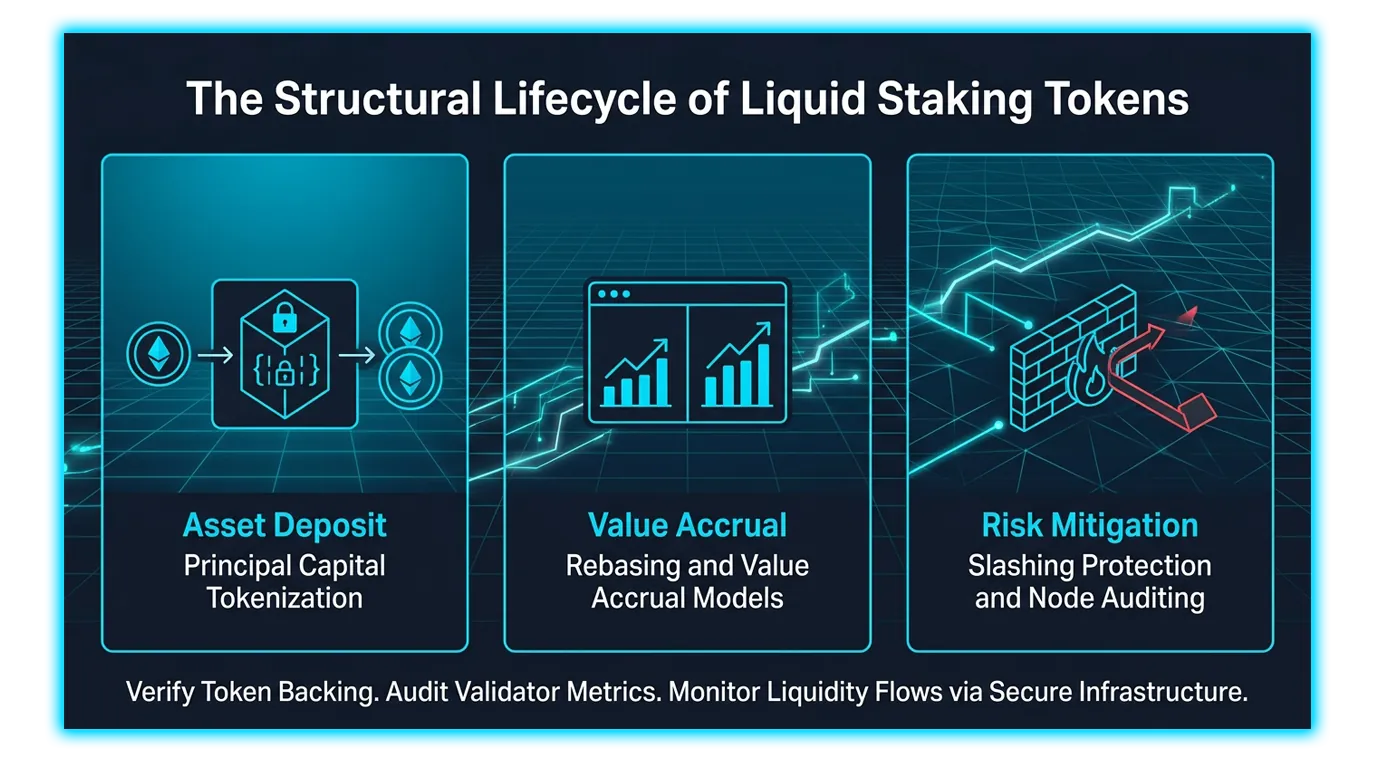
1. Core Architecture: Rebasing vs. Reward-Bearing Tokens
Liquid staking protocols do not utilize a single standardized method to distribute validation yield to token holders. Instead, the ecosystem divides token designs into two primary structural categories:
The Rebasing Token Model (e.g., Lido's stETH)
Rebasing assets maintain a tight, direct one-to-one conversion parity with the underlying native token on secondary markets.
The Distribution Flow: When the underlying validator nodes successfully mine blocks and capture transaction fees, the interest rewards are distributed to holders by programmatically expanding the token supply.
The Wallet Experience: If you hold one hundred rebasing tokens in your wallet, your balance will automatically scale upward over time (e.g., growing to one hundred and five tokens) without requiring any manual claims, transactions, or pool adjustments.
The Reward-Bearing Token Model (e.g., Rocket Pool's rETH & Jito's jitoSOL)
Reward-bearing tokens maintain a static, unchanging token quantity inside your self-custody wallet while handling interest distribution internally.
The Conversion Mechanism: Instead of creating new tokens out of thin air, the accrued validator rewards are continually added straight to the protocol’s core pool backing. This driving force means that the underlying value conversion ratio between the liquid token and the native asset expands continuously over time.
The Redemption Trajectory: If you deposit native tokens into a reward-bearing contract, you receive a smaller number of derivative vouchers in return. Over a multi-month holding horizon, the individual voucher token quantity remains entirely flat, but when you return to the primary smart contract to redeem your funds, each voucher converts back into a significantly larger amount of the native token than you originally initialized.
2. Evaluating the Top Global LST Providers
The liquid staking ecosystem has evolved into a foundational infrastructure layer across major Layer 1 networks, driven by distinct decentralized protocols and validation strategies.
Lido Finance (stETH / wstETH)
- Lido remains the undisputed giant of the liquid staking arena, controlling a commanding share of the total staked capital on Ethereum. The protocol relies on a highly curated set of enterprise-grade node operators approved via decentralized governance.
- To cater to advanced multi-chain decentralized platforms that struggle to support variable rebasing balances, Lido utilizes a wrapping contract to convert standard assets into a stable, reward-bearing equivalent, ensuring deep integration across cross-chain automated lending venues.
Rocket Pool (rETH)
- Engineered with an absolute focus on decentralization and censorship resistance, Rocket Pool lowers the technical and capital barriers required to operate a network validator. Instead of relying on a centralized, hand-picked set of enterprise corporations, the protocol permits any independent retail operator to establish a node by spinning up a "minipool."
- Node operators commit their own capital alongside pooled user deposits to back the node, providing a highly distributed network architecture that isolates users from concentrated operator failures.
Jito Network (jitoSOL)
- As the dominant liquid staking powerhouse within the high-throughput Solana ecosystem, Jito introduces an advanced layer of yield extraction by integrating Maximum Extractable Value (MEV) optimization directly into its validator infrastructure.
- The protocol runs a specialized client that tracks and sequences block space to capture validator tips and network arbitrage premiums. These optimized MEV rewards are bundled directly into the jitoSOL reward-bearing token structure, delivering an amplified return profile compared to traditional, vanilla staking methods.
3. Peg Dynamics and Secondary Market Arbitrage Loops
The utility of a liquid staking token relies entirely on its ability to maintain secondary market price parity with the native digital asset it represents. However, an LST is not mechanically locked to the native token's real-time price; it trades freely on decentralized exchange order books, creating a dynamic relationship governed by supply, demand, and capital lockups.
The Primary Arbitrage Corridor
If heavy institutional selling pressure hits secondary markets, an LST can begin to trade at a noticeable discount relative to its underlying asset backing (a "de-peg" event). This price deviation is limited by programmatic arbitrage loops:
The Discount Play: When the secondary market market price of an LST drops below its true on-chain redemption value, arbitrageurs step in to aggressively buy up the discounted tokens from decentralized exchanges.
The Primary Redemption: The trader routes those cheap tokens straight to the protocol's primary smart contract hub to initiate a formal, manual unstaking withdrawal request.
The Profit Capture: Once the network's unbonding queue clears, the arbitrageur receives full face value in the native underlying asset, pocketing the valuation spread as pure profit and driving the secondary market peg back up to equilibrium.
Liquidity Buffers and Queue Friction
- The primary limitation to perfect peg stability is the structural friction of network exit queues. Proof-of-stake blockchains enforce strict daily limits on how many validators can exit the network simultaneously to prevent mass security coordination attacks.
- If a market panics and thousands of users try to exit their positions concurrently, the primary redemption queue can grow to several weeks. If secondary market liquidity pools dry up during this waiting period, the LST's market discount can widen significantly, creating temporary localized paper losses for traders who cannot afford to wait for the official on-chain redemption window to settle.
4. Underwriting Systemic Risk Vectors
While liquid staking optimizes capital efficiency, it stacks new layers of composable financial risk on top of baseline blockchain protocols.
The Threat of Slashing Penalties
- The most critical structural risk inside any staking system is Slashing. If a validator node suffers prolonged, catastrophic network downtime, misbehaves by signing double-blocks, or drops offline due to faulty software updates, the underlying blockchain protocol executes an automated slashing penalty. The network programmatically burns a set percentage of the native tokens locked inside that specific validator's container.
- Because an LST represents a shared pool of collective assets, a severe slashing event targeting a major node operator immediately degrades the underlying asset reserves backing the liquid token, reducing the net redemption value for all token holders across the network.
Governance Concentration and Smart Contract Cracks
Beyond network validation penalties, liquid staking pools introduce high concentration and software security risks:
Smart Contract Exploits: Staking through a protocol means depositing your capital into a complex multi-contract vault architecture. A single hidden code exploit, re-entrancy bug, or faulty upgrade patch can allow an attacker to permanently drain the entire underlying pool treasury.
Network Centralization: When a single liquid staking protocol controls a massive, dominant percentage of all active validation nodes across a blockchain, it introduces systemic centralization concerns. A compromised governance vote or coordinated administrative key exploit could allow bad actors to manipulate block sequencing or halt network consensus entirely, attracting heavy scrutiny from regulatory compliance layers.
Core Architecture Comparison: Liquid Staking Modalities
| Structural Vector | Rebasing Token Infrastructure | Reward-Bearing Infrastructure |
| Primary Example Asset | Lido (stETH) | Rocket Pool (rETH) / Jito (jitoSOL) |
| Wallet Balance Behavior | Token count expands automatically | Token count remains flat |
| Token-to-Asset Ratio | Maintained at a strict 1:1 ratio | Ratio expands over time as rewards accrue |
| DeFi Composability | Requires custom wrapping for static apps | Highly compatible across all lending books |
| Yield Distribution Method | Continuous programmatic supply rebase | Added straight to the internal contract pool |
5. Universal On-Chain Forensics and Trading Telemetry via DEXTools
Evaluating liquid staking token backings, monitoring secondary market pool depths, and tracking live peg discounts requires continuous access to real-time market data. Utilizing advanced decentralized analytical networks like DEXTools gives market participants an essential universal platform to monitor live token behaviors, evaluate pool compositions, and inspect contract parameters across all public execution networks.
You can access DEXTools here and start trading today!
How to Bridge Crypto Between Chains: Complete Cross-Chain Tutorial 2026 How to Use 1inch for Swaps: Classic, Fusion and Limit Orders (2026) OKX Web3 Wallet Tutorial 2026: Multi-Chain Setup GuideDisclaimer: This article is for informational purposes only and does not constitute investment advice, financial advice, trading advice, or any other kind of advice. DEXTools does not recommend buying, selling, or holding any cryptocurrency or token. Users should conduct their own research and consult with a qualified financial advisor before making any investment decisions. Cryptocurrency investments are volatile and high-risk. DEXTools is not responsible for any losses incurred.
Related Guides
- What Is Rocket Pool (rETH): Complete Liquid Staking Guide (2026)
- Lido on Ethereum: stETH, wstETH and Dual Governance Explained (2026)
- What Is Lido Finance? Liquid Staking, stETH and LDO Explained (2026)
- How to Use Lido Finance: Stake ETH, Receive stETH and Manage Risks (2026)
- What Is Lombard Finance? LBTC Bitcoin Liquid Staking Guide 2026
Frequently Asked Questions
What is liquid staking?
Liquid staking lets you stake a token to help secure a network while receiving a tradable token that represents your staked position. This lets you keep using the value of your stake in DeFi instead of locking it up entirely.
What is a liquid staking token (LST)?
A liquid staking token is the receipt token you get when you stake through a liquid staking protocol, such as a token representing staked ETH or staked SOL. Its value is meant to track the underlying staked asset plus accrued rewards.
What are the risks of liquid staking?
Risks include smart contract vulnerabilities, the liquid staking token trading away from the value of the underlying asset, and slashing penalties affecting the staked assets. These risks stack on top of the normal risks of holding the underlying token.
What is slashing in staking?
Slashing is a penalty where a portion of staked assets is removed because a validator misbehaves or fails to follow network rules. It is designed to discourage actions that could harm the network.