Liquidation Cascade: Surviving the Market's Re-balancing
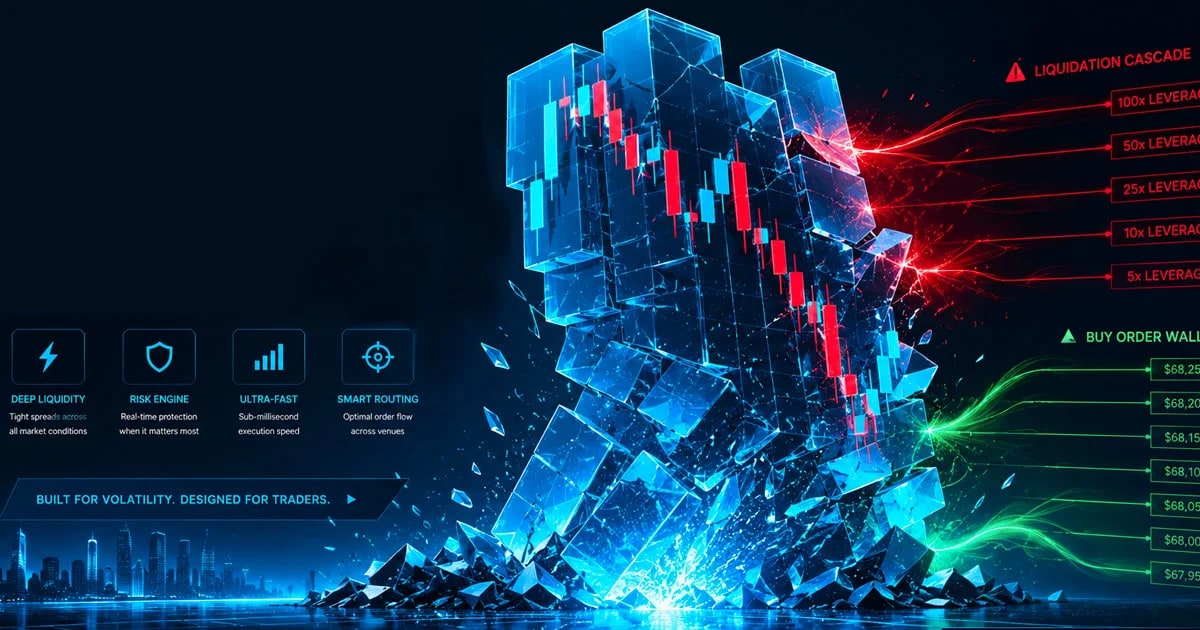
When excessive leverage meets a sudden price shift, the market can turn violent. We deconstruct how to spot a pending Liquidation Cascade and protect your capital.
The Liquidation Cascade
- In the high-octane world of digital asset derivatives, the Liquidation Cascade is the most feared phenomenon. It is a self-reinforcing cycle of forced selling (or buying) that can erase billions in market capitalization in mere minutes.
- For traders, the difference between exiting safely and "getting wicked" (having your stop-loss or liquidation point hit by a temporary, violent price fluctuation) comes down to understanding the structural mechanics of leverage and market positioning.
The Anatomy of a Cascade: Triggers and Fuel
A Liquidation Cascade does not happen in a vacuum; it requires a specific set of preconditions to turn a minor price dip into a systemic collapse.
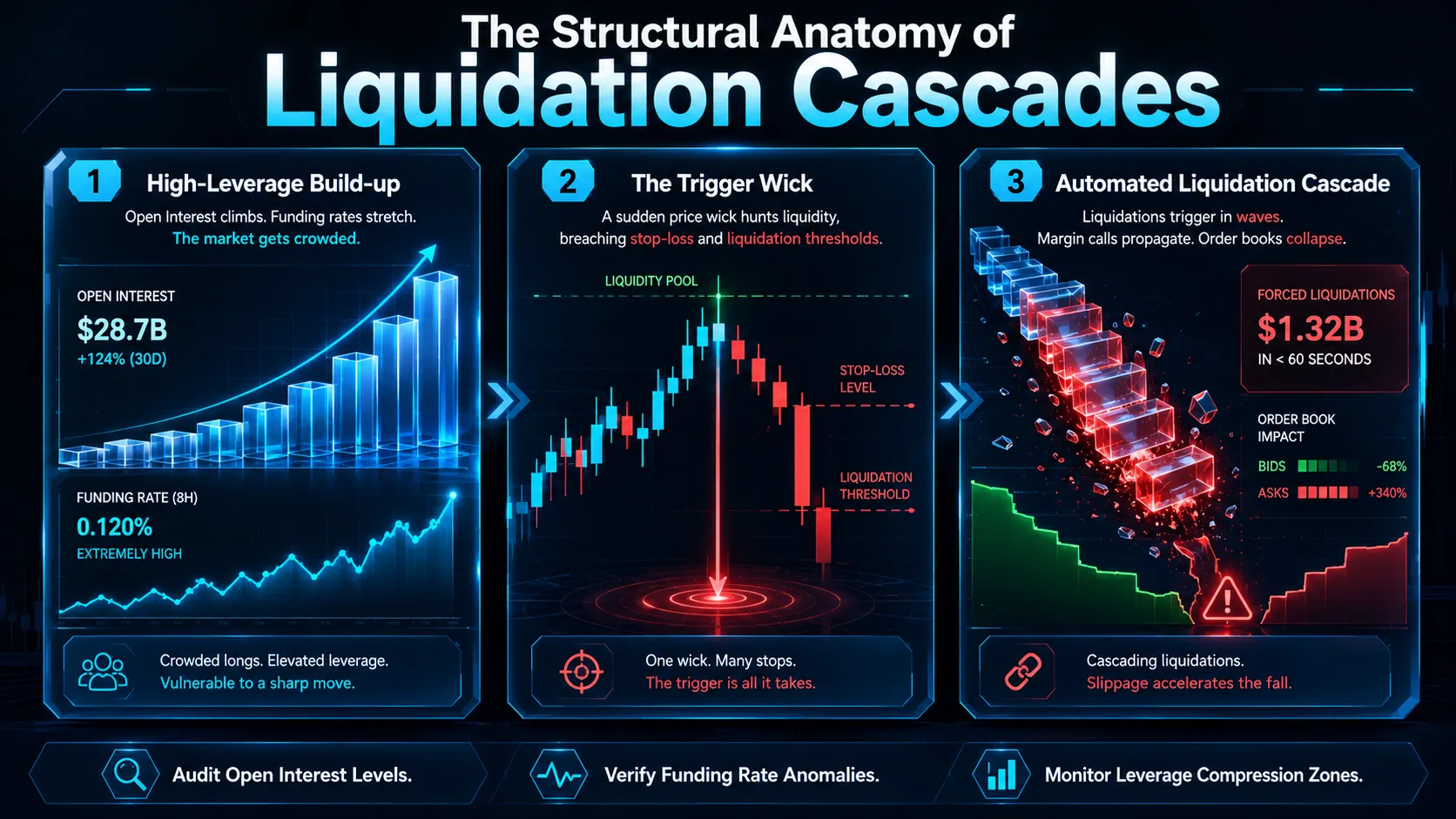
The Build-up: Open Interest and Funding
- The primary fuel for a cascade is Open Interest (OI), which represents the total number of outstanding derivative contracts that have not been settled. When OI grows rapidly alongside a rising price, it indicates that traders are piling on excessive leverage.
- To maintain these positions, traders pay "funding rates." If funding rates remain high and positive for an extended period, it shows a market heavily skewed toward long positions, all relying on the price staying above certain thresholds to avoid insolvency.
The Trigger Wick
- The trigger is often a relatively small, sudden price move: sometimes caused by a single large "market sell" order that hits a thin order book. This move forces the first wave of over-leveraged traders to be liquidated. Because liquidation involves the automated sale of the trader’s collateral at market price, it creates further selling pressure.
- This new wave of selling pushes the price even lower, hitting the liquidation points of the next, larger cluster of leveraged traders. This creates a feedback loop: liquidations cause lower prices, which cause more liquidations, eventually clearing out the entire order book.
Reading the Signals: Avoiding the Wick
To avoid getting caught in a Liquidation Cascade, you must learn to read the market's internal health metrics before the volatility hits.
Identifying Compression Zones
- Watch for "liquidation clusters." These are price levels where a massive amount of leverage is concentrated. You can often see these on heatmaps provided by derivatives exchanges.
- If the market price is approaching a zone where billions of dollars in long positions are marked for liquidation, the risk of a "wick" (a sudden downward spike meant to hunt that liquidity) is extremely high. Smart traders do not place their stop-losses directly at these round-number psychological levels or high-concentration zones.
Funding Rate Anomalies
An overheated market is often signaled by extreme, unsustainable funding rates. If everyone is leveraged long, the cost to hold those positions becomes prohibitive. A sudden, sharp dip in funding rates, or a reversal into negative territory, often signals that the market is beginning to deleverage, either voluntarily or through forced liquidations. When you see rates decoupling from the spot price, it is a primary warning to reduce your exposure.
Survival Strategies for Volatile Regimes
If you suspect that a Liquidation Cascade is imminent, your primary objective should be capital preservation, not capturing the absolute bottom.
Lower Leverage: The most effective defense against getting wicked is simply reducing your leverage. A position with 2x leverage can survive a 30% wick; a position with 20x leverage will be liquidated in seconds.
Avoid Crowded Trades: If OI is at an all-time high and funding is at record levels, consider that the market is "crowded." These conditions are precisely when the market makers are most incentivized to hunt liquidity.
Use Limit Orders: When volatility strikes, market orders often execute at prices significantly worse than anticipated due to slippage. Limit orders allow you to dictate your exit price, even during a cascading event.
Telemetry and Verification
- Verifying the market's true state is the best way to avoid being blind-sided by a cascade. DEXTools provides the critical data infrastructure needed to monitor real-time liquidity and order book health. By using the Pair Explorer and tracking large transaction volume, you can see if the underlying spot market is experiencing an exodus of liquidity before it impacts your derivative positions.
- DEXTools allows you to verify if the price drops are supported by genuine sell volume or if they are simply liquidity-hunting wicks designed to trigger retail stop-losses. Staying informed with accurate telemetry is the ultimate hedge against market volatility.
You can access DEXTools here and start trading today!
Disclaimer: This article is for informational purposes only and does not constitute investment advice, financial advice, trading advice, or any other kind of advice. DEXTools does not recommend buying, selling, or holding any cryptocurrency or token. Users should conduct their own research and consult with a qualified financial advisor before making any investment decisions. Cryptocurrency investments are volatile and high-risk. DEXTools is not responsible for any losses incurred.