Micro-Exit Planning: How to Leave a Thin Pool Without Destroying Your Own Price
— By Whatsertrade in Tutorials

Most trading content focuses on entries. Traders study charts, search for new tokens, and try to buy before momentum arrives. But in decentralized exchange trad
Most trading content focuses on entries. Traders study charts, search for new tokens, and try to buy before momentum arrives. But in decentralized exchange trading, the exit can be more important than the entry.
This is especially true in thin pools. A trader may enter a low cap token easily, watch the position rise, and then discover that selling moves the price down sharply. The larger the position relative to pool liquidity, the harder it becomes to exit without damaging the final result.
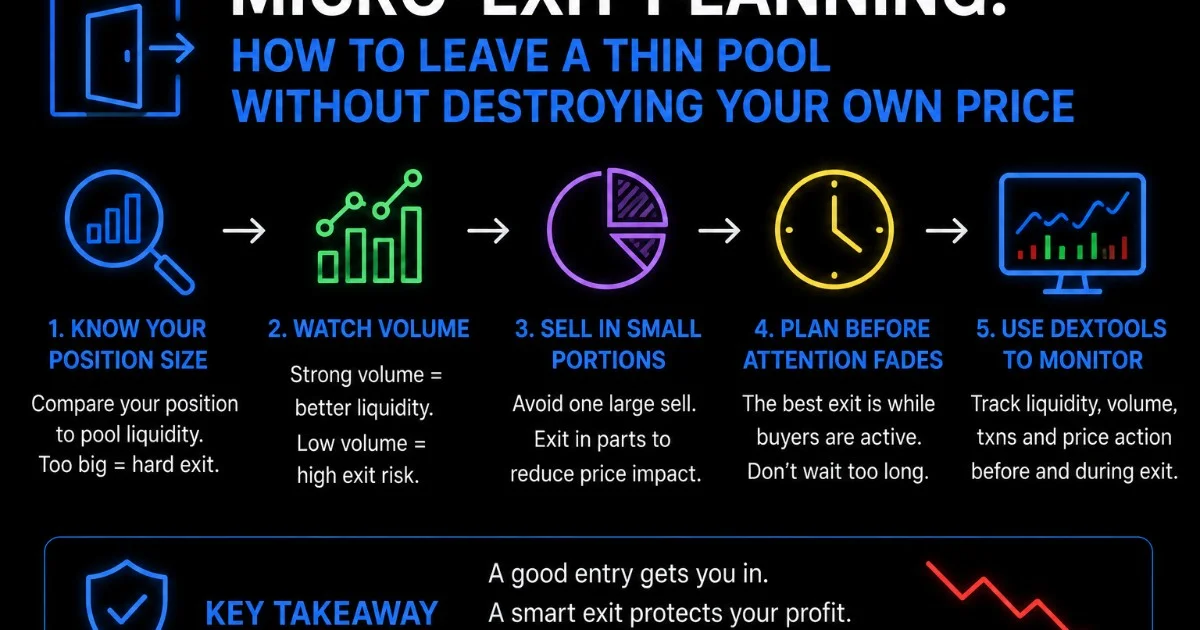
Micro-exit planning is the process of preparing an exit strategy for small or illiquid markets before the trade begins.
Why Exits Are Hard in Thin Pools
Thin pools have limited liquidity near the current price. This means trades can create strong price impact. A buy may push the price up, and a sell may push it down.
When a trader holds a position that is large compared with pool depth, selling all at once can create a bad exit. The displayed chart price may not be the price the trader receives. The act of selling can reduce the value of the remaining tokens.
This is why unrealized profit can be misleading. A position is only truly profitable if it can be exited.
What Is Micro-Exit Planning?
Micro-exit planning means breaking the exit process into smaller, more controlled decisions. Instead of waiting for one perfect sell, the trader thinks about liquidity, volume, position size, timing, and market demand.
The goal is not to exit at the absolute top. The goal is to exit without creating unnecessary damage to the trade.
In low liquidity markets, smart exits require planning. Emotional exits often create poor execution.
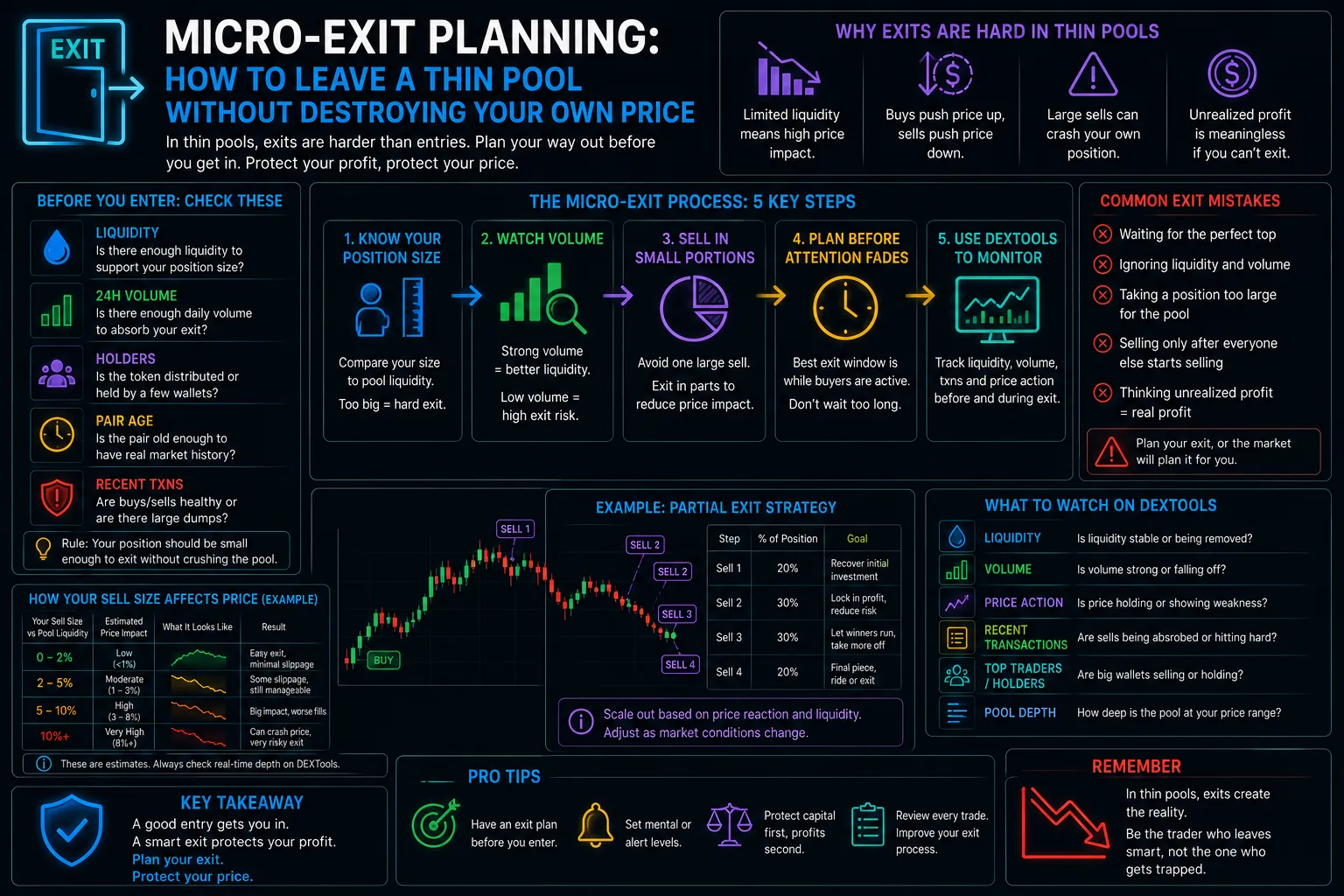
Step 1: Know Your Position Size Relative to Liquidity
Before entering, traders should compare their position size with available liquidity. If the position is too large for the pool, exiting later may be difficult.
A small trade in a deep pool may have minimal impact. The same trade in a thin pool may move the price significantly. DEXTools can help traders review liquidity, volume, price behavior, and recent transactions before entering.
If your position would be difficult to sell today, it may be even harder to sell after attention fades.
Step 2: Watch Volume Before Selling
Volume matters because it shows whether there are active buyers and sellers. A pool with strong volume can absorb exits better than a pool with almost no activity.
Selling into active demand is usually easier than selling into silence. If volume has collapsed, even a moderate sell can create a large move.
Traders should avoid assuming that the exit will be easy just because the token price is higher. The real question is whether there is enough market activity to support the sell.
Step 3: Avoid One Large Market Sell
Selling an entire position at once can create heavy price impact in a thin pool. Smaller exits may reduce the damage. This does not guarantee a better result, but it can help avoid unnecessary slippage.
Traders may choose to sell in portions based on liquidity, volume, and price reaction. After each partial exit, they can observe whether the market absorbs the sell or weakens sharply.
The goal is to work with the market instead of forcing the market to absorb too much at once.
Step 4: Plan Before Attention Fades
The best exit window often appears while attention is still present. If a token is trending and buyers are active, liquidity may feel stronger. Once attention decays, exits can become more difficult.
Waiting too long can turn a profitable position into a trapped position. Traders should have a plan before volume disappears.
This does not mean panic selling. It means understanding that attention and liquidity are connected.
Step 5: Use DEXTools to Monitor Exit Conditions
DEXTools can help traders monitor the conditions that affect exits. Watch liquidity, volume, recent transactions, and price reaction. If sells are being absorbed well, the market may remain healthy. If small sells create large drops, caution is needed.
Traders should also check whether liquidity is stable. If liquidity is being removed while price is high, exit risk may increase.
A good exit plan adapts to real market data.
Common Exit Mistakes
One mistake is waiting for a perfect top in a thin market. Another is assuming that unrealized profit equals real profit. Some traders build positions that are too large for the pool, then cannot exit without hurting their own price.
Another mistake is selling only after everyone else begins selling. In thin pools, late exits can be extremely costly.
The best exit is often planned before the crowd starts looking for the door.
Conclusion
Micro-exit planning is essential for trading thin liquidity pools. A good entry means little if the trader cannot exit efficiently. By understanding position size, liquidity depth, volume, and price impact, traders can reduce the risk of destroying their own exit.
DEXTools provides the market data needed to plan smarter exits. Liquidity, volume, transactions, and price behavior can help traders decide when and how to leave a position.
In low cap trading, profit is not only made by buying well. It is protected by exiting well.
How to Bridge Crypto Between Chains: Complete Cross-Chain Tutorial 2026 How to Use 1inch for Swaps: Classic, Fusion and Limit Orders (2026) OKX Web3 Wallet Tutorial 2026: Multi-Chain Setup GuideBeyond the Slippage: Understanding Liquidity Depth and Its Micro-Exit Impact
While slippage is a commonly understood concept when exiting a position, truly mastering micro-exit planning requires a deeper appreciation for liquidity depth. This isn't just about the total value locked in a pool, but rather the distribution of that liquidity across the price spectrum. A pool with high total liquidity might still be "thin" at your desired exit price, leading to significant price impact even for relatively small sells.
Think of it as a series of buy orders stacked at various price points. When you sell, your order consumes these available buy orders sequentially, moving up the stack until your entire sell order is filled. If there are few buy orders immediately below the current market price, your sell will have to "reach" further down the stack, impacting the price more dramatically than if there were dense layers of bids.
Practical Considerations for Thin Pools
- Utilize DEXTools' depth charts: These visual representations are invaluable for understanding where liquidity is concentrated and where it drops off significantly.
- Stagger your sells: Instead of one large market sell, consider breaking it into multiple smaller limit orders placed at slightly decreasing price points.
- Assess the volume profile: Low daily trading volume often correlates with thinner order books and greater price impact for exits.
- Consider arbitrage opportunities: In extremely thin pools, even small sells can create temporary price discrepancies that arbitrage bots will quickly exploit, often pushing the price back up. This can sometimes be leveraged for a more favorable average exit.
- Anticipate market maker behavior: In some cases, automated market makers (AMMs) will rebalance liquidity, but this is not instantaneous and large sells can still create temporary voids.
Related Guides
- Whale Buy or Exit Liquidity? How to Read Big Swaps Without Blindly Copying Whales
- Price Impact Ladder: Trade Without Moving Crypto Prices
- The Market Cap Mirage: Why Token Valuation Means Little Without Depth
- Play-to-Earn vs Play-to-Own: GameFi Evolution Since 2021
- How Much XRP Should You Own? Position Sizing and Risk Management (2026)
Frequently Asked Questions
Why is exit planning important for decentralized exchange (DEX) traders?
Exit planning is crucial because selling large amounts of a token on a DEX, especially in a thin liquidity pool, can significantly impact the token's price. Without a plan, a trader's own sell order can drive down the price, reducing their profit or increasing their loss. It ensures a more controlled and potentially profitable exit.
What is a 'thin pool' in the context of DEX trading?
A 'thin pool' refers to a liquidity pool on a decentralized exchange that has a low amount of capital available for trading a specific token pair. This means that even relatively small buy or sell orders can cause significant price slippage and volatility, making large trades difficult without impacting the market price.
How can a trader avoid destroying their own price when exiting a position in a thin pool?
Traders can avoid destroying their own price by implementing micro-exit strategies. This involves breaking down a large sell order into smaller, more manageable chunks and executing them over time or across different liquidity sources. This minimizes the immediate impact on the pool's price and allows for a more gradual, less disruptive exit.
What are some common strategies for micro-exit planning?
Common strategies include using limit orders to specify a desired minimum selling price, dollar-cost averaging out of a position by selling fixed amounts at regular intervals, or utilizing multiple DEXs or bridges if the token is available on different platforms with varying liquidity. Observing on-chain data for optimal times to sell can also be beneficial.