MVRV Z-Score Explained: How to Read On-Chain Data
— By AliceOnChain in Tutorials

Understand the mechanics of the MVRV Z-Score, a foundational on-chain metric used to identify macro crypto market tops and bottoms. Learn how to read its deviations and integrate it with DEXTools features to manage risk effectively.
MVRV Z-Score Explained: How to Read On-Chain Data for Market Cycles
Navigating cryptocurrency market cycles requires looking beyond standard price action. While traditional financial markets rely heavily on technical analysis and fundamental corporate health, public blockchains offer an entirely different layer of transparency via on-chain analytics. Among the most historically reliable macroeconomic indicators used to track these trends is the mvrv z score. Designed to identify periods where an asset is significantly overvalued or undervalued relative to its fair value, this valuation tool provides structural insights into investor behavior, liquidity flows, and market sentiment. For retail traders and DeFi users looking to enhance their risk management, understanding how to read this structural framework—and pairing it with advanced charting tools—is a vital step in moving past pure speculation.
Decoding the Mechanics: Market Value vs. Realized Value
To understand how this cyclical tracking engine functions, we must first break down the baseline relationship between market value and realized value.
Market Capitalization (Market Value): This reflects the current price of an asset multiplied by its total circulating supply. While simple, market cap can be highly volatile and often reflects short-term emotional trading, speculative volume, and sudden spikes in market sentiment.
Realized Capitalization (Realized Value): Unlike market cap, realized capitalization offers a closer look at the actual capital invested in the network. Instead of pricing every coin at the current market rate, realized capitalization aggregates the price of every individual coin when it was last moved or transferred on-chain, approximating the aggregate cost basis of all network participants.
When market capitalization rises significantly above realized capitalization, the network sits in a high state of unrealized profit. Conversely, when market cap drops below realized cap, the aggregate market is at a net loss, often indicating deep macro capitulation that impacts the broader on-chain trend.
What is the MVRV Z-Score?
The metric builds on this relationship by applying a standard deviation calculation to the data. In statistics, a Z-score measures how many standard deviations an element is from the mean.
In the context of on-chain analysis, the equation calculates the difference between market cap and realized cap, then divides that result by the standard deviation of the market cap data over time.
By introducing standard deviation, this statistical score smoothes out extreme volatility variations across different halving cycles and eras of liquidity. This allows analysts to compare market extremes across multiple years on an equal baseline, making the mathematical model a vital tool for long-term trend analysis.
How to Read the Framework
Reading the historical deviations involves monitoring momentum across specific structural thresholds, typically represented as overvalued and undervalued bands on macroeconomic charts.
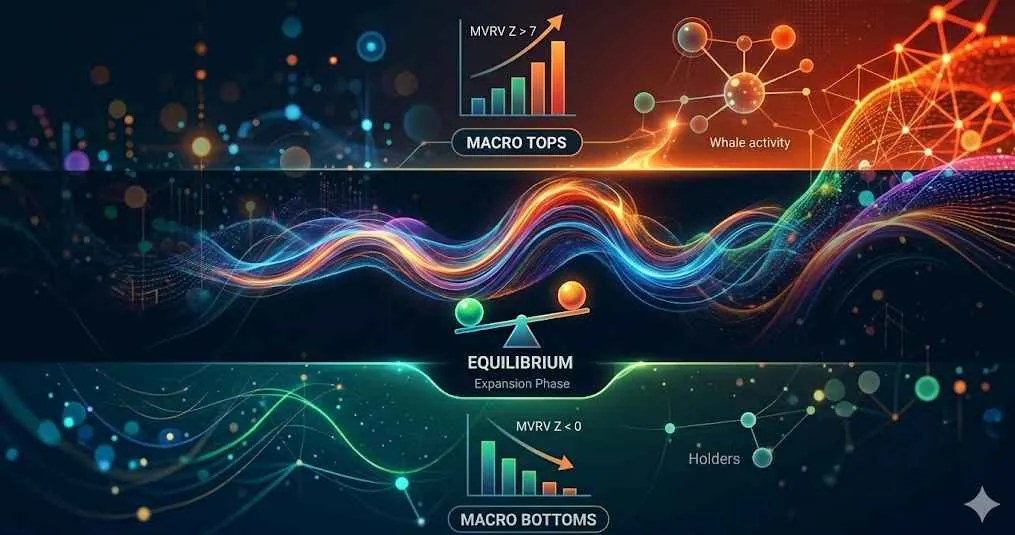
The Overvaluation Zone (Red Band)
Historically, when the raw score enters the upper threshold—typically values above seven or eight—it indicates that market value has extended dangerously far above realized value. This suggests that the vast majority of holders are sitting on massive unrealized gains. In past cycles, these high valuation levels have often coincided with extreme euphoria, heavy whale distribution activity, and macro market tops.
The Undervaluation Zone (Green Band)
Conversely, when the statistical tracking drops into the lower threshold—typically values below zero or into negative territory—it signals that market capitalization is lower than the aggregate cost basis of the network. This implies intense financial pain across holder distribution channels. Historically, these periods of low calculation values have marked structural capitulation, long-term accumulation windows, and macro market bottoms.
The Equilibrium Zone
The vast majority of a market cycle is spent moving between these two extremes. A steadily rising baseline tracks a healthy bull market backed by organic volume, while a declining variance signifies a structural cooldown or the early stages of a bear market.
Integrating On-Chain Macro with Active Trading on DEXTools
While this macroeconomic indicator is highly effective for identifying cyclical trends, it is not a short-term trading trigger. An asset can remain in an overvalued territory for weeks or even months as momentum carries it forward. To translate this macro insight into actionable execution, traders need to combine the on-chain data with granular micro metrics on platforms like DEXTools.
Mapping Support and Resistance with Live Charts
When the broad metric signals that a market is reaching historical overvaluation extremes, traders can shift their focus to DEXTools Charts and Pair Explorer. By monitoring shorter-term support and resistance levels on liquid pairs, you can watch for structural breakdowns. If the macro trend is screaming that the market is overheated while live charts show a lower-high structure or a breakdown of key daily moving averages, the probability of a structural trend reversal increases significantly.
Identifying Divergences via RSI and Volatility
Momentum indicators are also excellent companion tools for blockchain analysis. For instance, if the core variance is pressing into elevated zones, checking for a bearish Relative Strength Index divergence on DEXTools can provide crucial confirmation. If the asset price prints a new high but the RSI prints a lower high alongside declining trading volume, it indicates that the upward momentum is drying up despite the elevated macro reading.
Tracking Liquidity and Whale Distribution
Macro tops are fundamentally distribution events where large entities sell to late-stage retail buyers. By utilizing the Holder Analysis and Bubblemaps integration on DEXTools, traders can actively inspect whether top wallets are steadily distributing their tokens during periods of elevated valuation. If a token's liquidity tracking features show thin order books and whale wallets are fragmenting or selling into market strength, it reinforces the caution flagged by the network data.
A Step-by-Step Approach to Cycle Risk Management
Using this analytical tracking method alongside active DeFi analytics involves a systematic framework for risk management rather than trying to time the exact dollar top or bottom.
Phase 1: Macro Assessment: Check the overarching mvrv z score chart on a weekly baseline to evaluate the current market temperature. Identify whether the broader market is positioned in a historical accumulation zone, a neutral expansion phase, or an overheating distribution zone based on historical calculation boundaries.
Phase 2: Micro Alignment: Once the macro bias is established via the data, open DEXTools to look at the specific asset pairs driving current market volume. If the momentum is in the lower undervaluation zone, use the Pair Explorer to find pairs showing stable consolidation, high liquidity-to-market-cap ratios, and decreasing sell-side volatility.
Phase 3: Set Risk Triggers: Because markets can remain irrational longer than indicators stay solvent, rely on objective tools to complement your blockchain variance analysis. Utilize DEXTools Price Alerts around critical horizontal support and resistance lines. If the data suggests the market is overheating, setting alerts below key structural price floors ensures you are notified the moment the market begins to validate the on-chain warning signaled by the network metrics.
The Limitations of On-Chain Metrics
No single metric provides an unblemished view of crypto market reality, and this specific tracking method is no exception. When evaluating network data, analysts must account for several structural shifts in the broader ecosystem.
The introduction of spot ETFs and regulated institutional wrappers can permanently alter how realized capitalization behaves, modifying the historical baseline of crypto valuation models. Furthermore, as more transactional volume moves off the base layer to scaling networks, the frequency of on-chain base-layer updates changes, which can temporarily lag the metrics used to calculate the macro variance.
Early-era coins that are permanently lost or burned also influence realized value calculations, slightly skewing the absolute mean of the framework over time. For these reasons, the data should always be treated as a probabilistic guide rather than a deterministic clock.
Conclusion: Synthesizing the Data
On-chain analysis via the mvrv z score remains a cornerstone of market research because it cuts through the daily noise of speculative price action, anchoring valuation to the tangible cost basis of the network. However, successful trading in the decentralized financial landscape requires an unyielding commitment to multi-layered analysis.
By pairing macro blockchain indicators like this unique ratio with the real-time charting, liquidity tracking, and holder analysis available via DEXTools, traders can build a comprehensive view of the market. This structural approach bridges the gap between long-term cyclical shifts and short-term execution, allowing for calculated decisions rooted in data rather than emotion.
Is On-Chain Data Replacing Technical Analysis in Crypto?How to Read On-Chain Data: Metrics, Wallet Flows and Dashboards
Best On-Chain Analytics Tools 2026
7 On-Chain Data Signals That Help Identify High-Growth Crypto Assets
Disclaimer: This article is for informational purposes only and does not constitute investment advice, financial advice, trading advice, or any other kind of advice. DEXTools does not recommend buying, selling, or holding any cryptocurrency or token. Users should conduct their own research and consult with a qualified financial advisor before making any investment decisions. Cryptocurrency investments are volatile and high-risk. DEXTools is not responsible for any losses incurred.