Native Staking vs Liquid Staking vs Restaking: Decision Tree
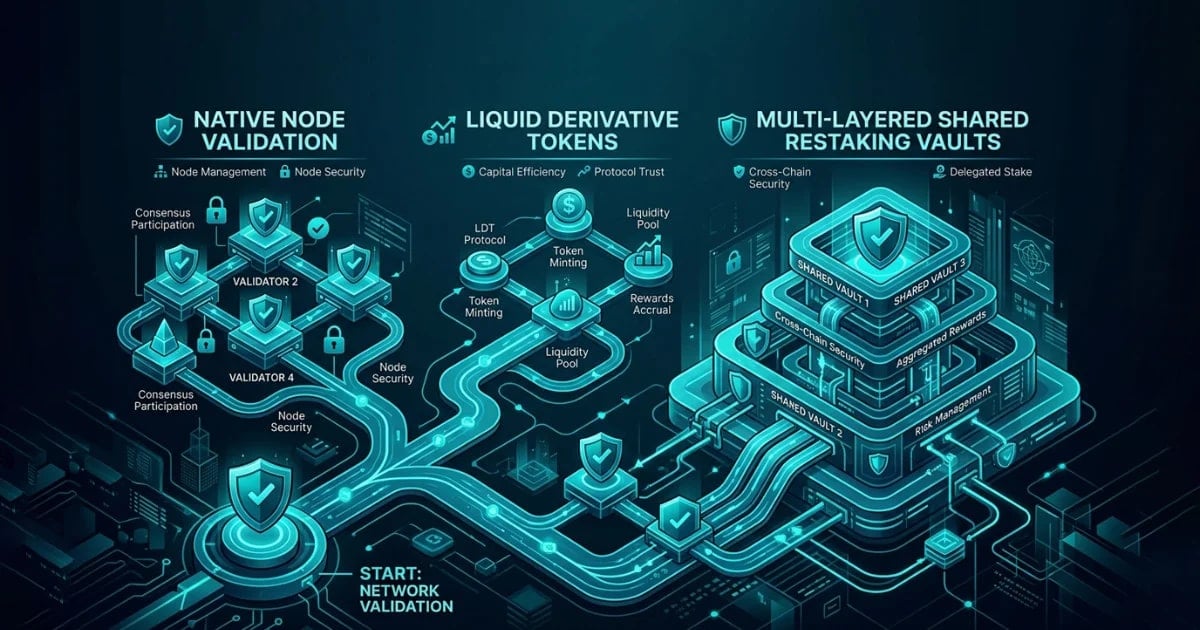
Choosing how to secure a blockchain network while deploying capital efficiently requires balancing risk and return. We analyze staking variables, smart contract risks, and structural decision tree pathways.
The Yield Paradigm: Navigating Multi-Layered Cryptoeconomic Security
- The evolution of Proof-of-Stake (PoS) consensus mechanisms has turned blockchain security into a programmable financial asset class. Historically, earning yield on digital assets required a simple, binary choice: lock up native tokens to support network validation or hold assets liquidly for active spot trading.
- In the modern 2026 Web3 architecture, this single execution layer has mutated into a complex ecosystem of composable financial derivatives.
- Today's capital allocators must manage a delicate trade-off between native protocol security, immediate market liquidity, and stacked yield generation. Choosing where to deploy your capital requires looking past raw annualized percentage yields (APY). You must evaluate the underlying structural realities of smart contract vulnerabilities, slashing exposure, network unbonding timelines, and capital efficiency.
- This guide breaks down the core structural differences between Native Staking, Liquid Staking Tokens (LSTs), and Liquid Restaking Tokens (LRTs), providing a clear, programmatic decision tree to optimize your portfolio.
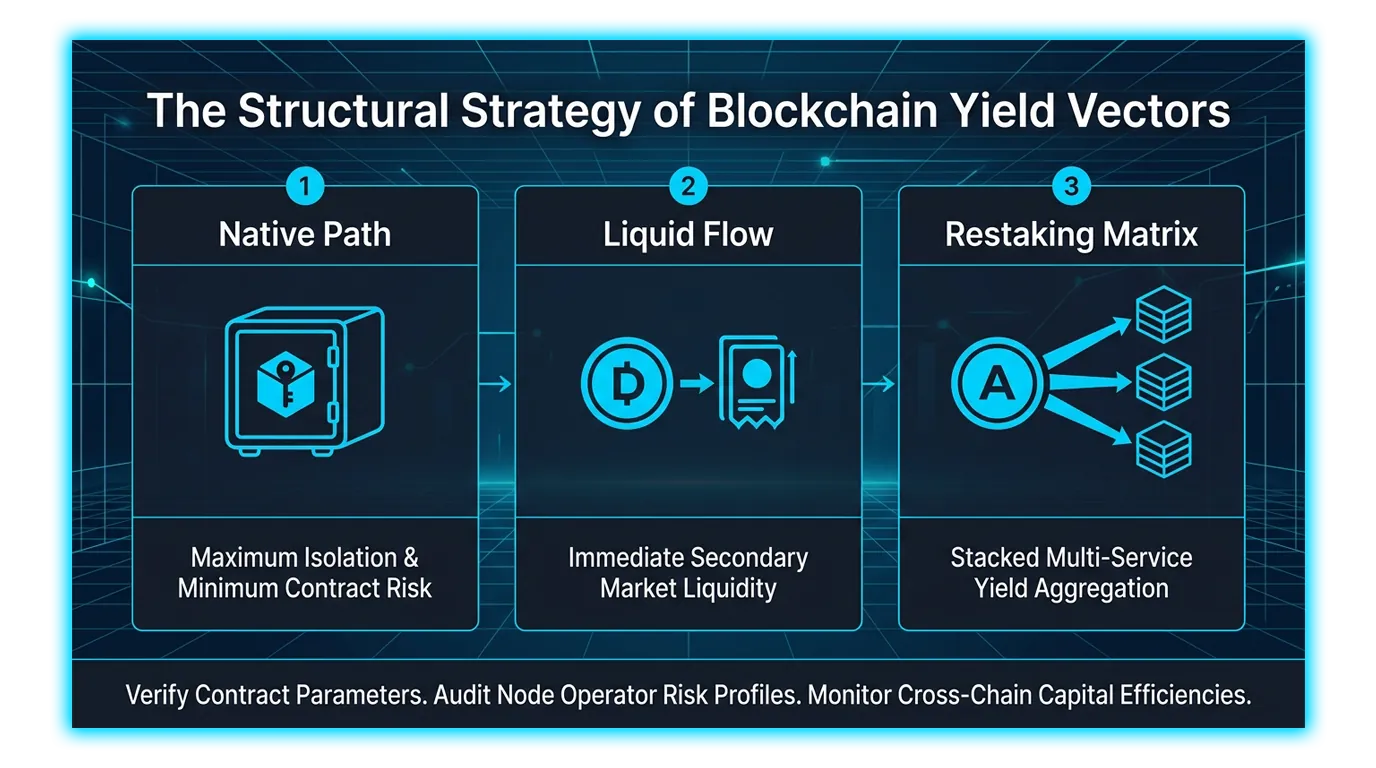
1. Deconstructing the Yield Vectors
Before navigating the logical branches of a decision tree, we must define the technical realities that govern each staking modality.
Native Staking: The baseline root-of-trust. Users lock their native assets directly into the blockchain's core consensus contract. This requires running independent physical hardware (solo staking) or utilizing non-custodial delegation interfaces to point capital toward an active validator node.
Liquid Staking (LSTs): The tokenization of trust. Users deposit native assets into a liquid staking protocol's smart contract vault. The protocol stakes those assets on behalf of the user and issues a liquid derivative voucher token (such as stETH or rETH). This receipt token represents the user's principal plus accrued rewards, and it can be traded freely across secondary decentralized markets.
Restaking / Liquid Restaking (LRTs): Shared economic security. Pioneered by infrastructure marketplaces like EigenLayer and Symbiotic, restaking allows users to take their pre-existing staked assets or LSTs and reuse them to underwrite secondary decentralized infrastructure networks, known as Actively Validated Services (AVSs) or Distributed Secure Services (DSSs).
2. Compact Staking Strategy Comparison Matrix
To ensure your layout fits cleanly on mobile and desktop screens without breaking container boundaries, this framework uses ultra-compact parameters:
| Staking Vector | Native Staking | Liquid Staking (LST) | Restaking (LRT) |
| Baseline APY | Conservative (3-5%) | Conservative (3-5%) | Aggressive (6-12%+) |
| Lockup Time | Rigid (Weeks to months) | None (Liquid on DEX) | None (Liquid via LRT) |
| Capital Efficiency | Low (Trapped funds) | High (DeFi compatible) | Maximum (Stacked yield) |
| Contract Risk | None (Protocol level) | Medium (Vault flaws) | High (Multi-layer flaws) |
| Slashing Risk | Single network rules | Shared pool rules | Layered across multi-AVS |
3. The Staking Modality Decision Tree
To determine the exact deployment path for your capital, step through the following logical program conditions:
PATH A: The Native Staking Path
IF your absolute primary goal is the long-term preservation of principal capital;
AND you possess zero tolerance for third-party smart contract vulnerabilities, protocol upgrades, or counterparty default risks;
AND you are comfortable locking up your funds completely, accepting multi-week network unbonding queues during periods of high market volatility;
THEN → Deploy Native Staking. (Ideally via an independent solo-staking hardware setup to maximize decentralization and eliminate intermediary fees).
PATH B: The Liquid Staking (LST) Path
IF you demand the steady, reliable yield of native proof-of-stake validation;
AND you refuse to let your capital sit idle, requiring immediate access to secondary market liquidity to sell your position or use it as collateral inside decentralized lending books;
AND you are willing to accept the localized risk of a smart contract exploit targeting a primary protocol vault (e.g., Lido or Rocket Pool);
THEN → Deploy Liquid Staking. (Choose between rebasing or reward-bearing token models depending on your local tax optimization preferences).
PATH C: The Liquid Restaking (LRT) Path
IF your risk profile allows for aggressive capital deployment and your main metric is maximizing net APY;
AND you want to capture multiple independent revenue streams simultaneously by underwriting cutting-edge middleware infrastructure like oracles and bridges;
AND you have an advanced understanding of composable systemic risk, layered slashing metrics, and the volatility loops of recursive DeFi leverage;
THEN → Deploy Liquid Restaking. (Utilize trusted modules like Ether.fi or Renzo while continuously tracking active node operator performance metrics).
4. Universal On-Chain Forensics and Trading Telemetry via DEXTools
- Utilizing advanced decentralized charting architectures like DEXTools provides market participants with an essential, universal platform to monitor live token behaviors, evaluate pool depths, and inspect contract parameters across all public execution networks.
- By leveraging core features such as the Pair Explorer, the Live New Pairs dashboard, and Trade Story, among other options, technical traders can audit localized volume trends and verify automated contract safety scores before initiating any on-chain interactions. This ensures that your secure hardware setup only engages with verified market venues.
You can access DEXTools here and start trading today!
How to Bridge Crypto Between Chains: Complete Cross-Chain Tutorial 2026How to Use 1inch for Swaps: Classic, Fusion and Limit Orders (2026)OKX Web3 Wallet Tutorial 2026: Multi-Chain Setup Guide
Disclaimer: This article is for informational purposes only and does not constitute investment advice, financial advice, trading advice, or any other kind of advice. DEXTools does not recommend buying, selling, or holding any cryptocurrency or token. Users should conduct their own research and consult with a qualified financial advisor before making any investment decisions. Cryptocurrency investments are volatile and high-risk. DEXTools is not responsible for any losses incurred.
Related Guides
- Ethereum Yield Evolution: Liquid Staking vs. Restaking
- What Is YieldNest (YND)? The MAX LRT Liquid Restaking Protocol Explained in 2026
- What Is Renzo (REZ)? ezETH Liquid Restaking on EigenLayer Guide 2026
- What Is Puffer Finance Pufeth Liquid Restaking Guide 2026
- What Is KelpDAO (rsETH)? Liquid Restaking on EigenLayer Guide 2026
Frequently Asked Questions
What is the difference between native staking and liquid staking?
Native staking locks your assets directly to help secure a network, with the tokens generally illiquid while staked. Liquid staking gives you a token representing your stake, so you keep liquidity while still earning rewards.
How is restaking different from staking?
Restaking reuses already-staked assets to help secure additional services beyond the base network. This can increase potential rewards but adds extra layers of risk compared with plain staking.
Which staking method has the most risk?
Generally, added layers introduce added risk, so restaking tends to carry more risk than liquid staking, which adds smart contract risk over native staking. The right choice depends on your risk tolerance and goals.
What is slashing in staking?
Slashing is a penalty that removes part of a validator's staked assets for misbehavior such as downtime or rule violations. It is a risk that can affect stakers across native, liquid, and restaking approaches.