On-Chain Analysis 101: From Mempool to Cohorts
— By AliceOnChain in Tutorials

Move beyond basic technical analysis. This advanced tutorial breaks down the core mechanics of on-chain data, from real-time mempool transactions to structural holder cohorts, helping you navigate decentralized markets with institutional-grade insights.
On-Chain Analysis 101: From Mempool to Cohorts
Traditional financial markets rely on centralized order books, clearing houses, and opaque settlement layers. In decentralized finance (DeFi), every transactional event—from a single automated market maker (AMM) swap to a multi-million dollar liquidity migration—is permanently recorded on a public ledger. This transparency shifts the paradigm for active participants, allowing them to utilize on chain analysis to audit capital flows, monitor smart contract health, and evaluate structural market sentiment in real time instead of relying solely on lagging technical indicators.
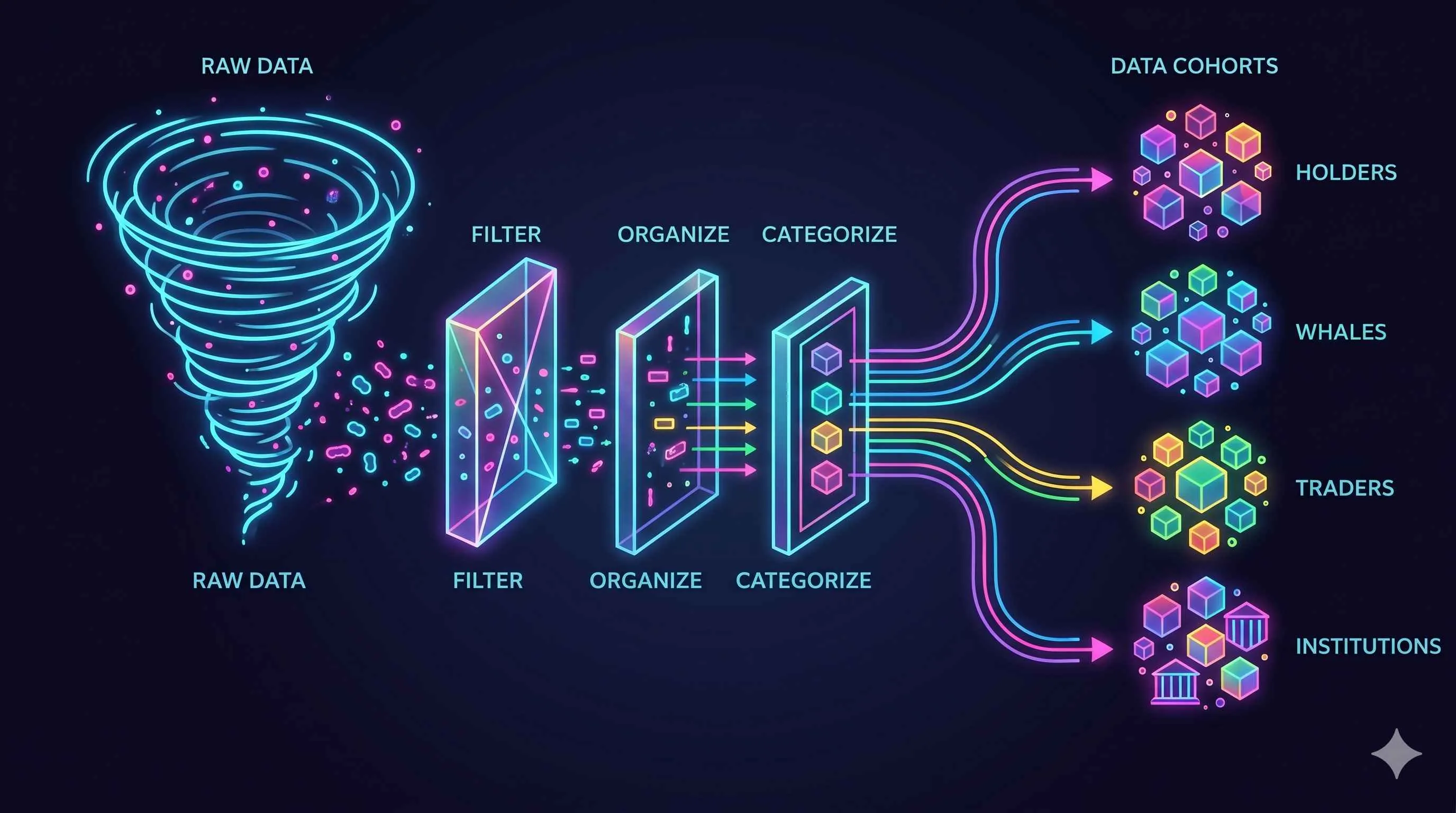
Navigating this raw data requires a structured framework. This tutorial outlines how to process on-chain data from its point of origin in the mempool to its long-term settlement across distinct wallet cohorts, enabling you to build an analytical edge in decentralized markets.
The Lifecycle of On-Chain Data: Understanding the Mempool
Every on-chain event begins before it is officially recorded on the blockchain. When a user submits a transaction to a decentralized network, it enters a temporary holding area known as the mempool (memory pool).
The mempool represents the pending state of the market. Pending transactions can offer early signals regarding shifting volatility and impending price action. For instance, a sudden influx of high-gas transactions interacting with a specific smart contract often precedes sudden spikes in volume.
Active participants track these pending events to anticipate market momentum. Within the DEXTools Pair Explorer, watching real-time transaction streams allows you to observe how order flow accumulates before it translates into a structural trend on the charts. Observing whether large orders are executing sequentially or if a sudden wave of sell orders is building can help you gauge short-term friction in the market.
Liquidity Architecture and Volume Dynamics
Once a transaction leaves the mempool and settles within a block, its primary impact is felt within liquidity pools. In DeFi, liquidity is the foundation of price stability. Understanding the relationship between volume and locked capital is a vital component of on chain analysis.
Assessing Liquidity Depth
A token might experience an aggressive price increase on low volume, but if the underlying liquidity pool is shallow, that price level is highly unstable. Evaluating liquidity tracking metrics helps determine the true depth of a market. Deep liquidity cushions a token against sharp sell-offs, whereas thin liquidity means even minor distributions can trigger severe downward price action.
The Volume-to-Liquidity Ratio
Analyzing the relationship between 24-hour trading volume and Total Value Locked (TVL) can reveal structural shifts in market sentiment.
High volume relative to low liquidity often signals intense speculation or an impending exhaustion point.
Steady volume paired with increasing liquidity generally indicates a healthier, more sustained accumulation phase.
When analyzing pairs on DEXTools Charts, matching visual volume bars with changes in overall pool liquidity helps differentiate between organic market interest and temporary speculative anomalies.
Mapping Token Mechanics: Support, Resistance, and Price Action
While on-chain data provides the underlying fundamental mechanics, combining it with technical analysis principles offers a more comprehensive view of market structure.
Support and Resistance in DeFi
In decentralized markets, support and resistance levels are frequently dictated by the specific price points where heavy accumulation occurred. When thousands of wallets acquire a asset within a tight price band, that zone becomes a psychological and structural anchor. If the price returns to that cluster, those holders may choose to defend their entry price, creating a natural support level.
Spotting RSI Divergences
Momentum indicators like the Relative Strength Index (RSI), when mapped against on-chain activity, can highlight shifting market dynamics. For example, if a token's price hits a new high but the RSI displays a lower peak (a bearish divergence), it suggests that buying momentum is fading.
[Bearish Divergence Structure]
Price Action: Low ----> Higher High (Aggressive retail buying)
RSI Indicator: High ----> Lower High (Fading structural momentum)
On-Chain Flow: Net positive inflow shifts toward silent whale distribution
If this divergence coincides with on-chain data showing net capital outflows or large wallets reducing their exposure, the probability of a market correction typically increases. Participants can utilize Price Alerts to monitor these critical technical thresholds without needing to constantly stare at a screen.
Demystifying Holder Distribution and Wallet Cohorts
Once tokens are acquired, they distribute across the network into various addresses. Segmenting these addresses into distinct wallet cohorts is essential for identifying who controls the circulating supply and how they are likely to behave under different market conditions.
Whale Activity and Concentration Risk
A primary risk metric in DeFi is supply concentration. If a tiny percentage of wallets holds a vast majority of a token’s supply, the asset carries structural concentration risk. A single market order from one of these entities can completely deplete a liquidity pool.
Using Holder Analysis tools allows you to break down the supply across different tiers. Furthermore, integrating visual mapping solutions like Bubblemaps within your research routine helps expose hidden connections between seemingly independent wallets, revealing if a single entity is masking its true allocation across multiple addresses.
Tracking Smart Money and Top Traders
Not all wallet cohorts carry the same analytical weight. Monitoring the behavior of address groups that have historically demonstrated high profitability can offer valuable perspective. By auditing the DEXTools Top Traders tab for a specific pair, you can isolate wallets that executed highly profitable entries and exits. Evaluating whether these specific profiles are currently accumulating, holding, or distributing can help clarify whether a recent price trend is being driven by experienced market participants or by late-stage retail speculation.
Volatility Management and Advanced Sentiment Risk Metrics
Decentralized markets are highly volatile. Managing this volatility requires a probabilistic approach to market sentiment and smart contract risk. On-chain metrics can serve as early warning systems before risk materializes on a price chart.
Smart Contract Exploits and Guardrails
Before analyzing holder cohorts or price action, verifying the integrity of the underlying asset contract is a necessary prerequisite. Malicious contract functions—such as hidden mint authorities, modifiable tax structures, or proxy contracts that can change logic unexpectedly—can instantly invalidate any technical or fundamental analysis. Utilizing integrated smart contract security scanners directly on the pair interface provides an initial baseline audit of an asset's programmatic safety parameters.
Interpreting Sentiment Probabilistically
On-chain analysis rarely provides absolute certainty; instead, it offers a framework for calculating probabilities.
A sudden spike in exchange or pool inflows from long-term holding wallets often coincides with an increase in selling pressure.
A steady decrease in the number of active holding addresses while the price remains flat can signal a slow loss of network utility and user interest.
Rapidly increasing wallet creation metrics during a price correction may indicate broad retail accumulation and growing decentralized support.
Conclusion: Synthesizing On-Chain Insights
Mastering on chain analysis requires looking past isolated metrics and instead synthesizing data points into a cohesive thesis. An increase in trading volume is simply data; knowing that this volume is being driven by top-performing traders clearing out historical resistance levels while liquidity depth is increasing provides a actionable framework.
As you build your analytical framework, remember that data is dynamic. A market structure that appears stable today can shift rapidly as new blocks are mined and liquidity is reallocated. Successful participants treat on-chain tools not as a guarantee of future outcomes, but as an objective lens to measure capital migration, assess structural risk, and execute trades with a clear, data-driven methodology.
Best On-Chain Analytics Tools 2026Smart Contract Audit Guide
Why Real Time Data Matters for DEX Traders
DEXTools Pair Explorer for Early Liquidity Signals
Disclaimer: This article is for informational purposes only and does not constitute investment advice, financial advice, trading advice, or any other kind of advice. DEXTools does not recommend buying, selling, or holding any cryptocurrency or token. Users should conduct their own research and consult with a qualified financial advisor before making any investment decisions. Cryptocurrency investments are volatile and high-risk. DEXTools is not responsible for any losses incurred.