Passphrase Wallets: The 25th Word Explained

A standard seed phrase leaves your cold storage vulnerable to physical coercion. Discover how passphrases unlock plausible deniability.
What Is a Passphrase Wallet? Using the 25th Word for Hidden Wallets
- The pursuit of absolute on-chain sovereignty requires a continuous escalation of personal operational security. For the vast majority of web3 participants, backing up a standard twelve or twenty-four word recovery phrase is considered the absolute pinnacle of cold storage defense. Under this standard BIP-39 framework, your recovery mnemonic acts as the master key required to derive your entire portfolio of private keys and blockchain public addresses.
- However, relying strictly on a standard seed phrase introduces an unavoidable physical vulnerability: it offers zero protection against physical coercion or discovery.
- If a malicious actor uncovers your physical seed backup card or forces you to open your hardware device under duress, your entire digital fortune can be drained in a single block execution. To neutralize this vulnerability, advanced capital allocators deploy an elite security feature known as a Passphrase Wallet, or more colloquially, the 25th Word.
- By introducing an auxiliary, user-defined string of characters to the cryptographic derivation stack, you can instantiate an entirely separate, invisible matrix of hidden accounts from the exact same recovery phrase. This comprehensive technical guide deconstructs the operational layout, defensive capabilities, and structural traps defining passphrase architectures.
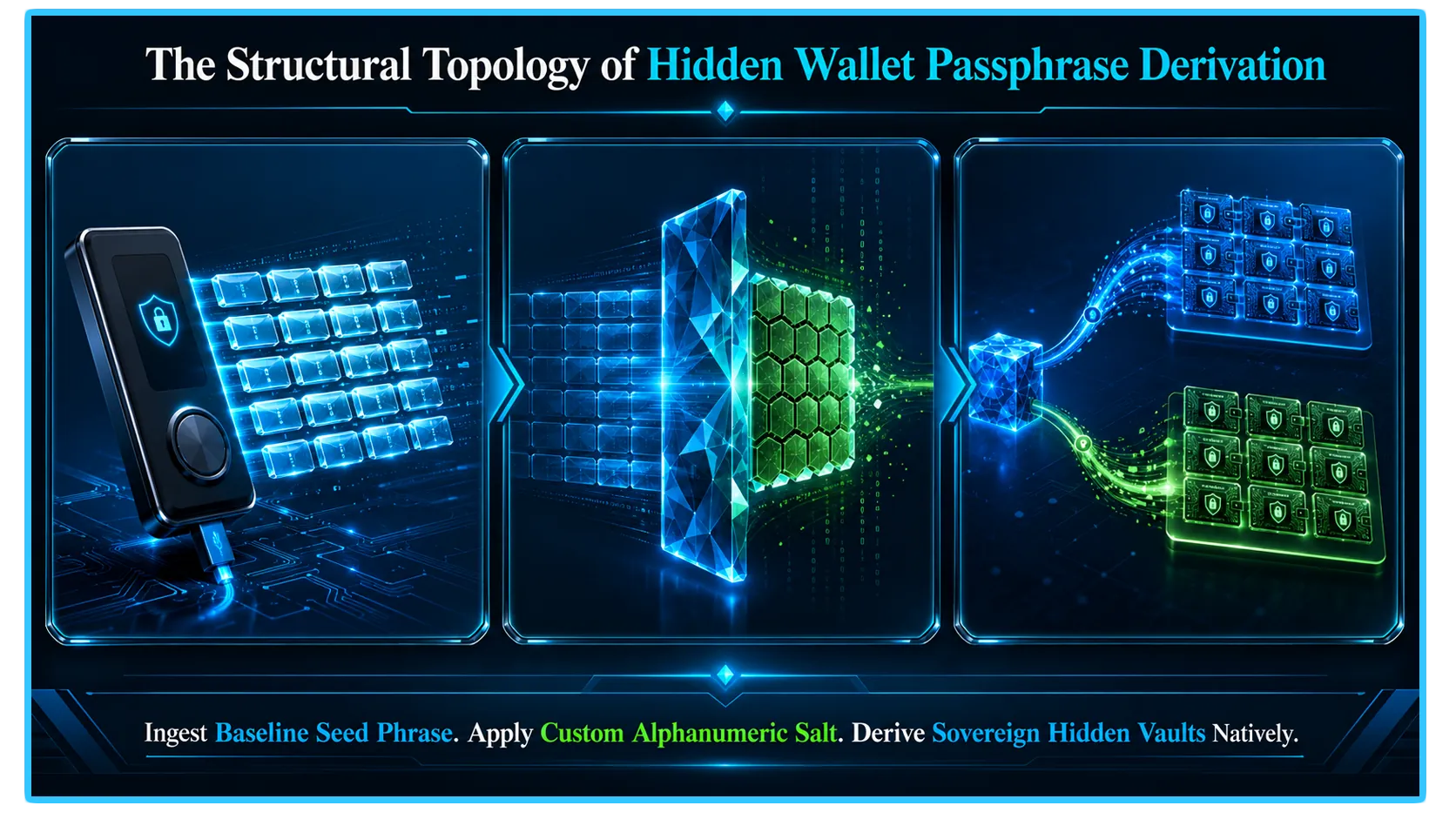
1. The Cryptographic Mechanism: How Passphrases Alter Wallet Derivation
- To deploy a passphrase wallet with professional precision, you must strip away the misleading consumer marketing label of the "25th word." A passphrase is not simply another word selected from the standard list of 2,048 approved BIP-39 vocabulary variables. It is an entirely custom, user-defined alphanumeric string that can extend up to one hundred characters in length, fully supporting case-sensitive letters, numbers, symbols, and spaces.
In the execution pipeline of a hardware wallet, the passphrase acts as a cryptographic salt.
- When your device generates your final blockchain keys, it passes your standard seed phrase through a complex hashing algorithm. If you do not configure a passphrase, the algorithm uses an empty string as the baseline salt. However, when you input a custom passphrase, the hashing engine blends the original phrase with your custom string to compute a completely unique cryptographic seed.
- This means that even a microscopic variation in your passphrase text will alter the ultimate mathematical output completely, creating an entirely unlinked set of private keys and public addresses.
[Master Seed Phrase] + [Empty Salt String] ───> Standard Wallet Addresses (Visible Accounts)
[Master Seed Phrase] + [Custom Passphrase] ───> Hidden Vault Addresses (Invisible Accounts)
2. Plausible Deniability: Decoys vs. Hidden Vaults
- The core structural advantage of utilizing a passphrase wallet is the immediate initialization of plausible deniability. Because any alphanumeric string is technically valid under the hashing protocol, there is no such thing as an "incorrect" passphrase string.
This unique structural logic allows you to construct a highly effective dual-tier security configuration designed to neutralize physical extortion threats:
The Decoy Layer (Standard Wallet): When you input your baseline seed phrase without a passphrase, the wallet populates your standard public addresses. You can deliberately store a nominal, realistic portion of your capital inside this visible account tier to satisfy an attacker or intruder during a physical crisis.
The Treasury Layer (Hidden Wallet): Your true generational wealth remains securely parked inside the address matrix derived strictly when your unique, secret passphrase is active. Because the hardware device will happily load an empty, brand-new wallet for any phrase an attacker tries to guess or input, there is absolutely no mathematical signature on the blockchain ledger indicating that a hidden passphrase account even exists.
3. The Diagnostic Grid: Storage Security Profiling
To maintain clean scannability when analyzing your multi-layered cold-storage frameworks, evaluate the primary operational profiles organized inside this optimized layout:
| Wallet Profile & Access Method | Primary Security & Operational Role |
| Standard Seed Phrase Only | Functions as a visible decoy account to satisfy physical coercion threats. |
| Seed Phrase + Custom Passphrase | Instantiates a completely hidden cryptographic vault for long-term wealth retention. |
4. The Fatal Trap: The Absence of an Error Message
While deploying a passphrase wallet grants you unparalleled security, it operates with absolute zero margin for human error. In standard web applications, typing an incorrect password triggers a helpful warning notification reading "Invalid Password, Try Again."
The Zero-Error Mandate: Passphrase wallets possess absolutely no internal feedback loops or validation checkpoints. The software engine cannot tell you if you made a typo.
If your true hidden vault is secured using the passphrase "Alpha2026", but you accidentally type "alpha2026" or introduce an accidental double space between the characters while setting up a replacement device, the wallet will not throw an error code.
- It will execute the hashing math flawlessly, generate a completely valid, brand-new, entirely empty wallet, and display it to you cleanly. If you deposit funds into a wallet generated by a typo and fail to record that exact typo meticulously, your assets are lost permanently, as bruteforcing a custom string is computationally impossible.
5. Real-Time Telemetry and Infrastructure Security via DEXTools
- Successfully engineering an unassailable hidden wallet structure insulates your generational wealth from localized physical breaches. However, securing your storage layout is only half the battle; managing your deployed capital effectively requires continuous validation of live ecosystem conditions.
- If you maintain deep liquidity allocations or execute strategic token transformations across alternative decentralized networks, checking real-time capital velocity and pool depth is the only way to protect your active positions from market anomalies.
- DEXTools provides the critical analytical data infrastructure needed to perform these diagnostic checks in real-time. By utilizing advanced multi-chain pair trackers, live transaction logs, and look-through wallet telemetry, market participants can instantly verify the structural health of any asset pool.
- Cross-referencing your secure hardware layers with live market telemetry ensures your active portfolio parameters remain completely optimized, keeping your digital wealth securely protected from hidden pool contractions or systemic liquidity issues across alternative layers.
You can access DEXTools here and start trading today!
Set Up Shamir Backup for Your Seed Phrase Shamir Secret Sharing for Seed Phrases Ultimate Crypto Security Guide Store a Seed Phrase Safely
Disclaimer: This article is for informational purposes only and does not constitute investment advice, financial advice, trading advice, or any other kind of advice. DEXTools does not recommend buying, selling, or holding any cryptocurrency or token. Users should conduct their own research and consult with a qualified financial advisor before making any investment decisions. Cryptocurrency investments are volatile and high-risk. DEXTools is not responsible for any losses incurred.