Pi Cycle Top Indicator Explained: Calling Crypto Cycle Peaks

Connecting AI models to crypto liquidity has historically required fragile, custom API glue code. The OKX Agent Trade Kit introduces a universal protocol standard.
Pi Cycle Top Indicator Explained: Calling Crypto Cycle Peaks
- In the high-stakes arena of digital asset allocation, the most psychologically punishing challenge is not identifying the bottom of a bear market: it is successfully capturing the absolute peak of a parabolic expansion. During the final, hyper-euphoric phases of a macro bull market, standard technical indicators like the Relative Strength Index (RSI) or traditional moving averages become heavily overextended, printing weeks of false overbought signals while the market continues to climb.
When retail market sentiment hits peak irrationality, institutional allocators rely on long-term historical data models to time their exits.
- The Pi Cycle Top Indicator stands as one of the most historically accurate and fascinating macro tools engineered to intercept these cycle tops. By tracking the mathematical relationship between two highly specific multi-day moving average parameters, this indicator has called the absolute peak of major market cycles within days of execution. This comprehensive analysis breaks down the moving average architecture, historical context, and tactical risk parameters defining the Pi Cycle model.
1. The Core Architecture: The Moving Average Crossover
To evaluate the Pi Cycle Top Indicator with structural accuracy, you must strip away the hype and analyze its basic mathematical substrates. The indicator does not predict the future; rather, it measures the exact rate at which short-term market momentum becomes unsustainably overextended relative to its long-term baseline.
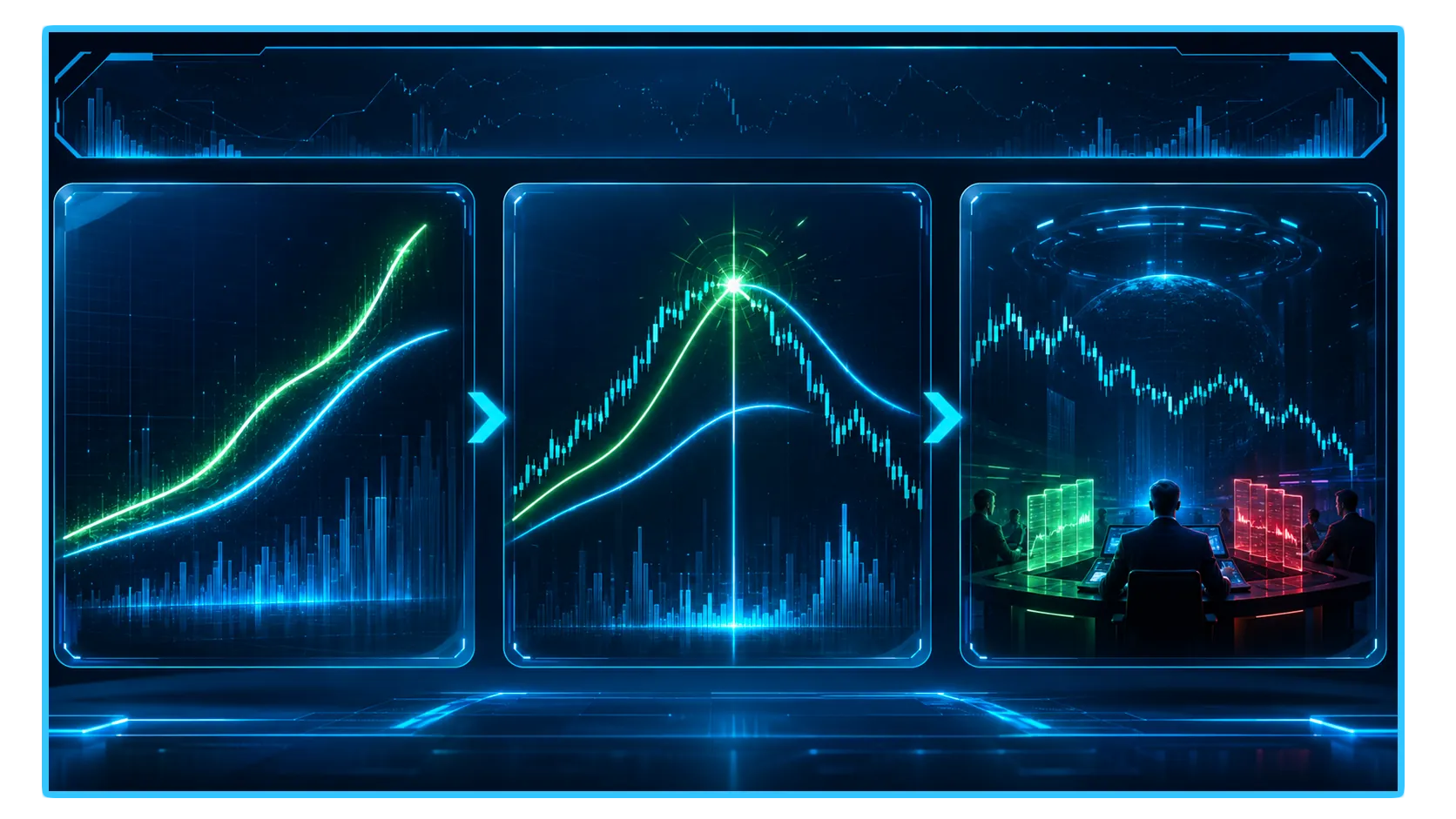
The indicator maps two distinct lines onto a macro chart:
The Fast-Moving Line: This is a simple 111-day moving average. It actively measures the short-to-medium-term price momentum of the asset, climbing rapidly during aggressive parabolic expansions.
The Slow-Moving Multiple Line: This is a simple 350-day moving average, which is subsequently multiplied by a factor of two. This multiple shifts the long-term baseline upward, creating a dynamic ceiling that sits well above normal price action.
The operational trigger is straightforward: a definitive macro market top is signaled the exact day the fast 111-day moving average crosses above the doubled 350-day moving average.
2. The Magic Behind the Metrics: Why "Pi"?
- The naming of the indicator stems from a fascinating mathematical coincidence uncovered during backtesting. When market analysts sought to understand why these two specific moving average durations worked so harmoniously across independent cycles, they examined the relationship between the two time frames.
- If you divide the slow-moving baseline parameter of 350 days by the fast-moving momentum parameter of 111 days, the resulting quotient is roughly 3.153.
- This numerical value represents an incredibly close approximation of the mathematical constant Pi, which sits at 3.142. Because this specific ratio seamlessly captured the structural rhythm of global distribution cycles, the tool was codified under the Pi moniker, serving as a testament to the hidden cyclical math driving decentralized order flow.
3. The Component Grid: Mapping the Pi Cycle Framework
To maintain a clean structural overview of how this macro indicator categorizes its underlying metric parameters, analyze the core components within this standardized data layout:
| Indicator Element | Metric Parameter |
| Fast Moving Line | 111-day moving average tracking short-term momentum |
| Slow Multiple Line | 350-day moving average doubled for macro extension |
| Trigger Condition | Golden cross signaling absolute market cycle exhaustion |
4. Tactical Execution: Trading the Intersection Safely
Utilizing the Pi Cycle Top Indicator requires deep emotional discipline and a clear understanding of its role as a macro exit filter rather than a micro entry trigger.
The Institutional Distribution Protocol
When the 111-day moving average crosses the doubled 350-day moving average on a high-timeframe chart, it indicates that the asset's current velocity has expanded too far away from its multi-year mean. This signal warns you that the pool of remaining buyers is hitting absolute exhaustion.
The Execution Blueprint: A confirmed Pi Cycle crossover should never be used to enter aggressive high-leverage short positions, as bull market tops can consolidate with high volatility. Instead, use the cross as a definitive green light to scale out of spot positions, take profits across long-term treasury vaults, and rotate capital heavily into stable liquidity buffers.
5. Real-Time Telemetry and Market Diagnostics via DEXTools
- Formulating an unassailable risk-management framework while tracking macro cycle tops requires continuous validation of localized market health across alternative layers. While long-term indicator models identify the overarching structural boundaries of historical cycles, monitoring real-time transaction velocity, liquidity pool depths, and active order flow distributions on decentralized venues is the only method to verify if a peak signal matches authentic distribution behavior.
- DEXTools provides the critical analytical data infrastructure needed to perform these multi-chain verifications in real-time. By utilizing advanced pair explorers, live buy/sell transaction logs, and comprehensive wallet tracking, market participants can independently verify if an emerging macro top signal is accompanied by massive whale wallet exfiltrations and volume deceleration.
Cross-referencing your macro indicators with live blockchain metrics ensures your exit models remain highly optimized, protecting your digital wealth from sudden market downturns.
You can access DEXTools here and start trading today!
EMA vs SMA: Which Moving Average to Use in Crypto Is On-Chain Data Replacing Technical Analysis in Crypto? What Is a Golden Cross in Crypto Trading? On-Chain Data Signals That Help Identify High-Growth Crypto AssetsDisclaimer: This article is for informational purposes only and does not constitute investment advice, financial advice, trading advice, or any other kind of advice. DEXTools does not recommend buying, selling, or holding any cryptocurrency or token. Users should conduct their own research and consult with a qualified financial advisor before making any investment decisions. Cryptocurrency investments are volatile and high-risk. DEXTools is not responsible for any losses incurred.