Points Programs Explained: From Hyperliquid to Friend.tech

Traditional retroactive airdrops frequently trigger instant token sell-offs and regulatory hurdles. We break down the off-chain gamification and conversion loops powering modern points programs.
The Financial Illusion: The Gamification of Web3 Liquidity
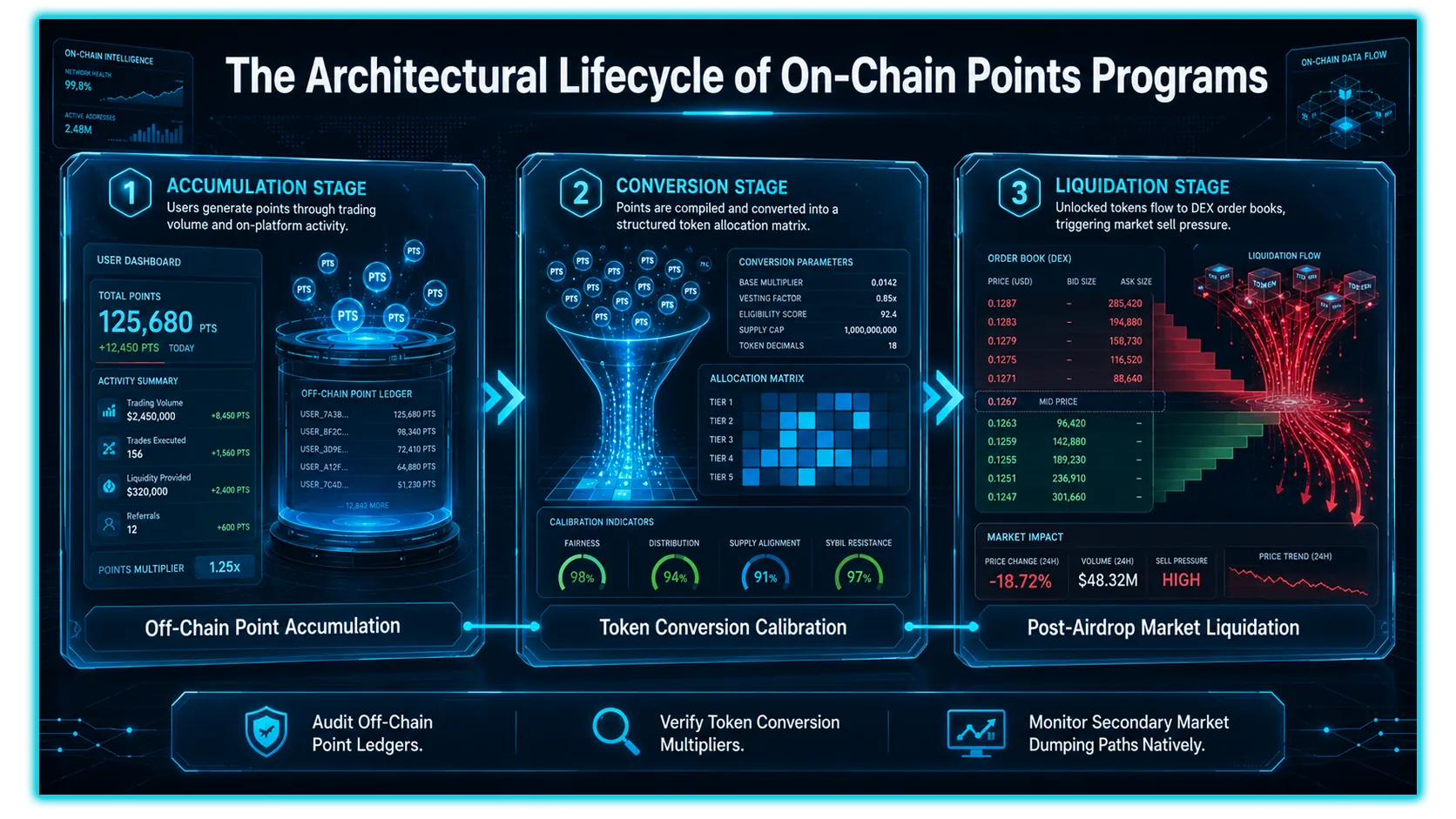
- The mechanics of decentralized user acquisition underwent a massive shift when protocols realized that direct retroactive airdrops were a dangerous, double-edged sword. Launching a token outright often invites intense regulatory scrutiny, triggers instant Sybil bot attacks, and leaves protocols vulnerable to capital flight the exact second the rewards are claimed. To fix this, founders looked to traditional corporate finance: specifically, airline loyalty miles and credit card rewards.
- Enter the Points Program era. Points function as an off-chain, centralized, and highly flexible ledger that tracks user interactions without making any explicit promises of future financial compensation. By gamifying liquidity, protocols can keep capital locked inside their ecosystems for months at a time, keeping users engaged with the promise of a future payout while avoiding immediate token liabilities.
1. Points-as-Coupons: The Ultimate Regulatory Shield
From a structural perspective, a point is not a cryptographic asset; it is a glorified database entry. This subtle distinction gives founders a powerful shield against legal and operational friction.
By keeping points off-chain, projects enjoy unmatched operational flexibility:
The Compliance Shield: Because points are distributed as loyalty rewards rather than financial instruments, they dramatically lower the risk of triggering securities violations during the pre-token phase.
Infinite Parameter Twisting: Protocol administrators retain absolute control over the ledger. If an engineering team detects an industrial bot farm gaming the system, they can manually alter the points formula, slash balances, or adjust distribution weights instantly without executing complex smart contract migrations.
2. The Conversion Rate Lottery: Hyperliquid vs. Friend.tech
The core friction of any points ecosystem centers on the highly speculative Conversion Rate: the ultimate moment where abstract database points are translated into tradeable on-chain tokens. Because projects rarely publish their conversion math ahead of time, points programs function as a psychological lottery.
Hyperliquid: The Gold Standard of Value Capture
- Hyperliquid engineered one of the most successful points-to-token migrations in Web3 history with its native token distribution. By maintaining a highly transparent, weekly points leaderboard tied directly to raw perps trading volume and organic market-making risk, Hyperliquid built immense community trust.
- When the conversion window activated, the points translated into high-value allocations, driving the platform's valuation past multi-billion-dollar milestones because users felt the distribution math respected their economic commitment.
Friend.tech: The Complexity Collapse
- Conversely, Friend.tech served as a cautionary tale regarding points mismanagement. During its V1 beta phase, the platform generated historic transaction fees by distributing off-chain points every Friday to users trading creator "keys."
- However, the launch of Friend.tech V2 and its native asset was plagued by operational confusion and structural friction. The protocol forced users into complex clubs and restricted initial claims to a tiny fraction of their total allocation, prompting a massive decline in user trust and a collapse in ecosystem retention.
3. The "Dumpers" Dilemma: Managing Post-Token Liquidation
The ultimate test of any points architecture is surviving the conversion event. The exact second points transform into liquid tokens, the protocol faces a wave of structural sell pressure from short-term farmers, known affectionately in DeFi circles as dumpers.
The Liquidation Reality: Airdrop farmers do not operate as long-term protocol stewards; they are hyper-efficient capital allocators seeking to reclaim their initial gas investments and yield parameters as fast as possible.
To insulate their ecosystems from sudden post-drop capital flight, modern points programs build structured retention mechanics directly into the conversion phase:
Vesting and Escrow Lockups: Instead of distributing 100% of the token allocation upfront, protocols lock rewards behind time-gated vesting schedules or wrap them in escrow tokens that require ongoing platform participation to fully mature.
Loyalty Multipliers: Projects reward users who choose to hold or stake their tokens with amplified yield multipliers for upcoming seasons, penalizing immediate dumpers by completely wiping out their historical point generation speeds.
Points Program Implementation Models
| Protocol | Point Sourcing | Conversion Style |
| Hyperliquid | Trading Vol & Risk | High-Trust / Direct |
| Friend.tech | Social Key Trading | Complex Gated Claims |
| Blur / Tensor | Listing & Bidding | Multi-Season Vesting |
Ecosystem Risk Profiles
| Risk Factor | Systemic Danger | Proper Mitigation |
| Dilution | Massive capital spikes | Dynamic loyalty tiers |
| Vesting Hooks | Destroys user trust | Clear, up-front rules |
| Sybil Exploits | Ruins token dispersion | Strict behavioral audits |
Universal Market Telemetry Sourcing via DEXTools
- As points programs complete their token conversions and transition into active public asset markets, tracking the resulting token capitalizations, pool depths, and secondary market trading velocities is an essential analytical requirement. Sourcing analytics through advanced decentralized charting architectures like DEXTools gives market participants an essential universal platform to monitor live token behaviors, evaluate pool depths, and inspect contract parameters across all public execution networks.
- By leveraging core features like the Pair Explorer, Live New Pairs dashboard, and the integrated Trade Story or Top Traders diagnostic tools, technical traders can seamlessly audit localized volume trends, track large whale wallet capital reallocations via the Big Swap Explorer, and check automated contract safety scores before initiating any on-chain interactions. This ensures your hardened hardware setup interacts safely with verified market venues.
Disclaimer: This article is for informational purposes only and does not constitute investment advice, financial advice, trading advice, or any other kind of advice. DEXTools does not recommend buying, selling, or holding any cryptocurrency or token. Users should conduct their own research and consult with a qualified financial advisor before making any investment decisions. Cryptocurrency investments are volatile and high-risk. DEXTools is not responsible for any losses incurred.