Claimed Rewards vs Net Deposits: When Yield Farming Becomes Value Extraction
— By Whatsertrade in Tutorials

Yield farming can help DeFi protocols attract users and liquidity. By offering rewards, a protocol can encourage deposits, trading, borrowing or staking. But no
Yield farming can help DeFi protocols attract users and liquidity. By offering rewards, a protocol can encourage deposits, trading, borrowing or staking.
But not all farming activity is healthy.
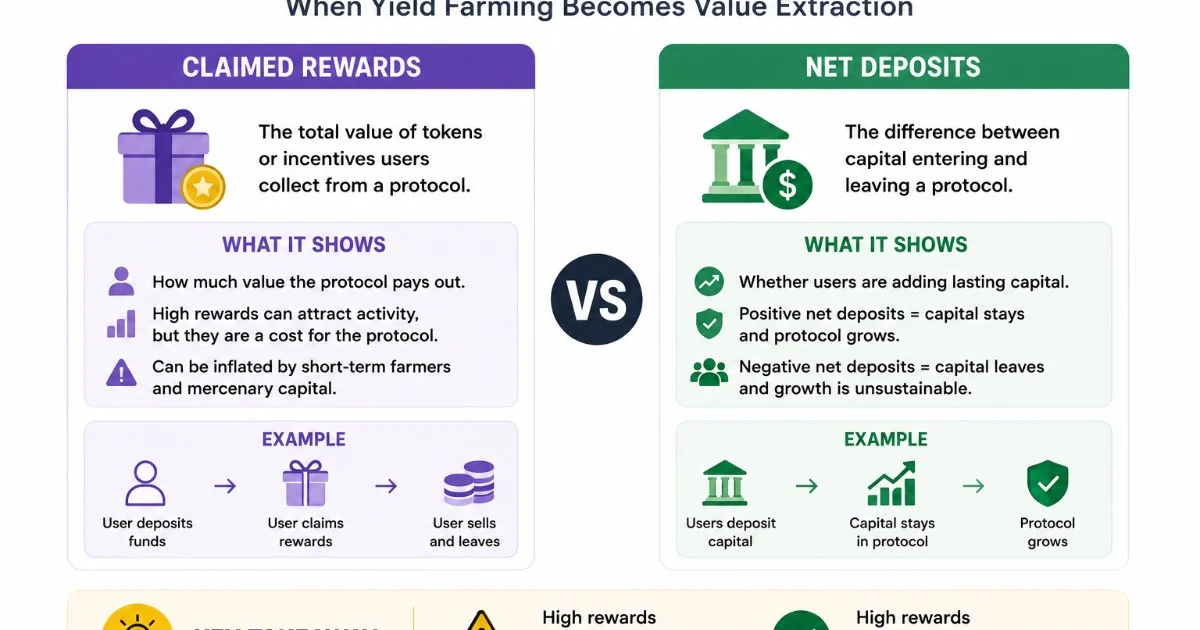
Some users deposit capital only to earn rewards, claim them and leave. If rewards are high but net deposits do not grow, the protocol may be paying users without building durable liquidity.
This is why traders should compare claimed rewards vs net deposits.
This comparison helps reveal whether yield farming supports real growth or becomes value extraction.
What Are Claimed Rewards?
Claimed rewards are tokens or incentives that users collect from a protocol.
These rewards may come from liquidity mining, staking, lending incentives, points programs, airdrops or farming campaigns.
Claimed rewards show how much value the protocol distributes to users.
Rewards can be useful for growth, but they are also a cost.
What Are Net Deposits?
Net deposits measure the difference between capital entering and leaving a protocol.
If deposits are greater than withdrawals, net deposits are positive. If withdrawals are greater than deposits, net deposits are negative.
Net deposits show whether users are adding lasting capital to the protocol.
This metric is important because it helps separate real growth from temporary reward farming.
Claimed Rewards vs Net Deposits: The Key Difference
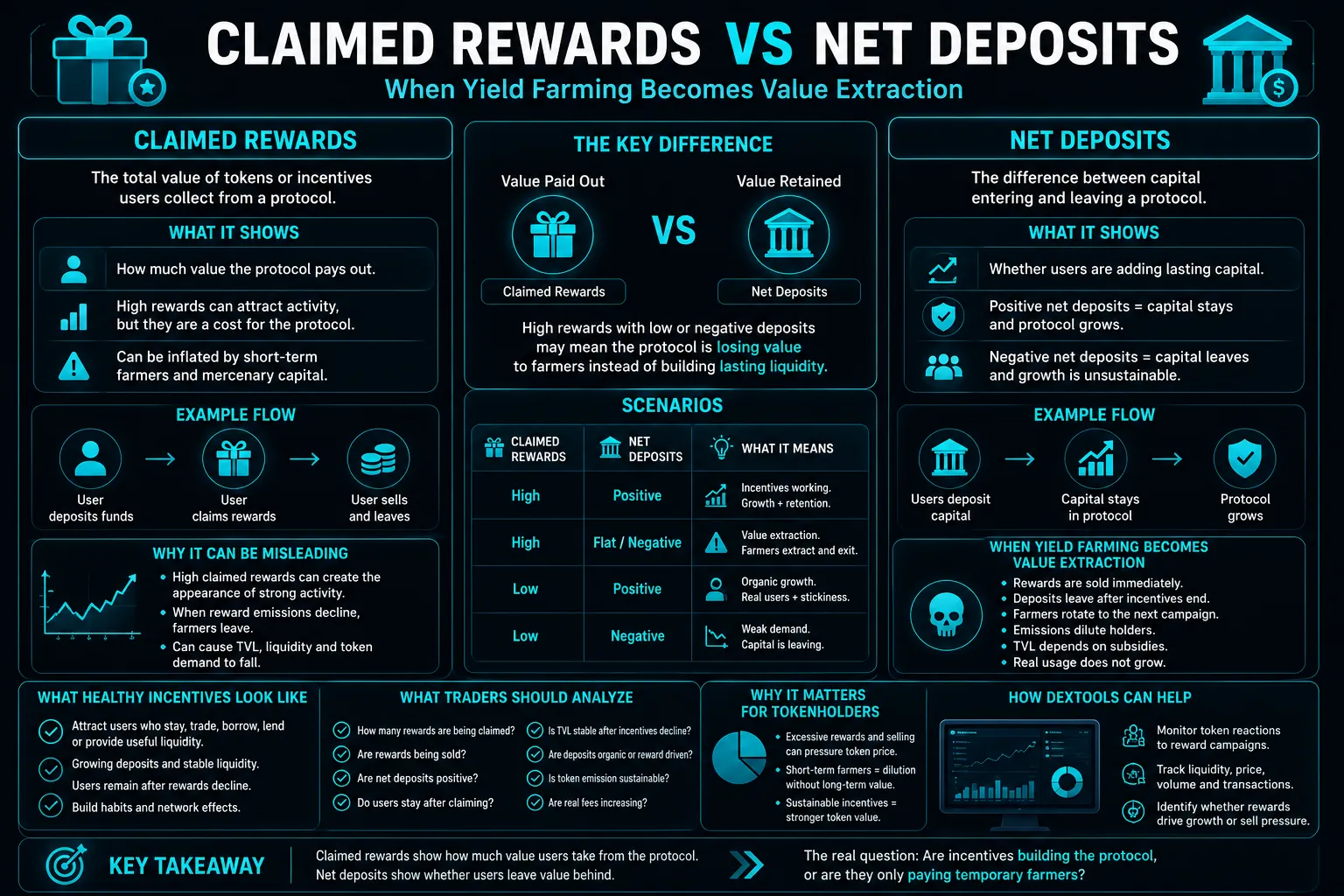
The key difference is value paid out vs value retained.
Claimed rewards show how much the protocol gives to users. Net deposits show whether users are actually leaving capital inside the system.
If claimed rewards are high and net deposits are also growing, incentives may be working.
If claimed rewards are high but net deposits are flat or negative, the protocol may be losing value to farmers.
Why Claimed Rewards Can Be Misleading
High claimed rewards can create the appearance of activity.
Users may interact frequently, deposit funds and generate transactions. But if they mainly come to extract rewards, the activity may not be sustainable.
When reward emissions decline, these users may leave.
This can cause TVL, liquidity and token demand to fall.
Why Net Deposits Matter
Net deposits show whether users are staying with capital.
If a protocol attracts deposits and keeps them after rewards are claimed, the incentive program may be building real liquidity.
If users withdraw quickly after claiming rewards, the protocol may be renting liquidity instead of earning loyalty.
Net deposits help reveal whether incentives create stickiness.
When Yield Farming Becomes Value Extraction
Yield farming becomes value extraction when users take more from the protocol than they contribute.
This can happen when:
Rewards are sold immediately.
Deposits leave after incentives end.
Farmers rotate to the next campaign.
Protocol token emissions dilute holders.
TVL depends on subsidies.
Real usage does not grow.
In this case, rewards may hurt the protocol more than they help.
What Healthy Incentives Look Like
Healthy incentives should attract users who stay, trade, borrow, lend or provide useful liquidity.
A strong campaign may show growing deposits, stable liquidity, increased user retention and continued activity after rewards decline.
The best incentives create habits and network effects.
The weakest incentives create temporary farming loops.
Why This Matters for Tokenholders
Reward programs often use protocol tokens. If too many rewards are distributed and sold, token price may face pressure.
Tokenholders should ask whether emissions are creating durable value.
If rewards attract only short term farmers, token dilution may outweigh growth.
If rewards attract long term users and capital, emissions may be more justified.
What Traders Should Analyze
Before trusting yield farming growth, traders should ask:
How many rewards are being claimed?
Are rewards being sold?
Are net deposits positive?
Do users stay after claiming?
Is TVL stable after incentives decline?
Are deposits organic or reward driven?
Is token emission sustainable?
Are real fees increasing?
These questions help identify whether a protocol is growing or being farmed.
How DEXTools Can Help
DEXTools can help traders monitor token reactions to reward campaigns. If a protocol distributes large rewards, traders can review liquidity, price action, selling pressure and transaction flow.
This can show whether rewards are supporting growth or creating sell pressure.
Live market data is especially important during high emission periods.
Final Thoughts
Claimed rewards and net deposits tell very different stories.
Claimed rewards show how much value users take from the protocol. Net deposits show whether users leave value behind.
Yield farming can be useful when it creates sticky liquidity and real usage. It becomes dangerous when rewards attract users who only extract and exit.
For traders, the key question is simple: are incentives building the protocol, or are they only paying temporary farmers?
How to Bridge Crypto Between Chains: Complete Cross-Chain Tutorial 2026 How to Use 1inch for Swaps: Classic, Fusion and Limit Orders (2026) OKX Web3 Wallet Tutorial 2026: Multi-Chain Setup GuideThe Invisible Handshake: Protocol Economics and Incentive Alignment
Beyond the surface-level APY, a deeper understanding of a protocol's underlying economic model is crucial for discerning genuine value creation from unsustainable reward cycles. Many yield farming strategies operate on the premise of a virtuous cycle: high rewards attract liquidity, increased liquidity drives utility, and utility generates revenue that can fund future rewards. However, this cycle is fragile and heavily dependent on the protocol's ability to achieve product-market fit and generate organic demand for its services or native token.
When the incentives offered outpace the protocol's fundamental economic activity, the "claimed rewards" become less about genuine yield and more about extracting value from the protocol's treasury or newly minted tokens. This often leads to a death spiral where token price declines, further reducing the real value of rewards, prompting an exodus of liquidity, and ultimately destabilizing the entire ecosystem. Smart farmers recognize the subtle cues that indicate whether a protocol's reward structure is a sustainable growth engine or a temporary liquidity siphon.
Assessing Protocol Sustainability
- Examine the protocol's revenue sources: Are they diverse and independent of token issuance?
- Analyze tokenomics: Is there a clear burn mechanism, utility, or long-term value proposition for the native token?
- Investigate team vesting schedules: Are incentives aligned for long-term project success, not just short-term pumps?
- Evaluate community engagement and development roadmap: Is there genuine interest and ongoing innovation beyond farming incentives?
- Consider the total value locked (TVL) to market cap ratio: A high TVL relative to market cap can sometimes signal over-reliance on inflationary rewards.
Related Guides
- How to Evaluate Yield Farms in Crypto: APY Quality, Risks and Red Flags (2026)
- What Is Yield Farming: Complete DeFi Earning Guide (2026)
- Yield Farming Strategies, APY Quality and Risk Management (2026)
- What is io.net? Decentralized GPU for AI Workloads Guide
- What Is io.net? The Decentralized GPU Network Powering AI on Solana in 2026
Frequently Asked Questions
What is yield farming in DeFi?
Yield farming is the practice of depositing crypto into DeFi protocols to earn rewards, often paid in a protocol's native token. It is used by protocols to attract liquidity and encourage activity like lending, trading, or staking.
What is the difference between claimed rewards and net deposits?
Claimed rewards are the incentives a farmer takes out of a protocol, while net deposits reflect how much capital actually remains committed. Comparing them can reveal whether participants are adding value or mainly extracting rewards.
When does yield farming become value extraction?
Yield farming can shift toward value extraction when participants harvest and sell rewards faster than they contribute lasting liquidity or usage. This can drain a protocol's token value without building durable activity.
Are high yield farming rewards sustainable?
Very high rewards are often funded by token emissions, which can dilute holders and prove hard to sustain over time. Sustainable yield usually comes from real protocol revenue rather than from inflationary incentives alone.