Revenue Concentration vs Revenue Diversity: Why One Income Stream Can Make Protocols Fragile
— By Whatsertrade in Tutorials
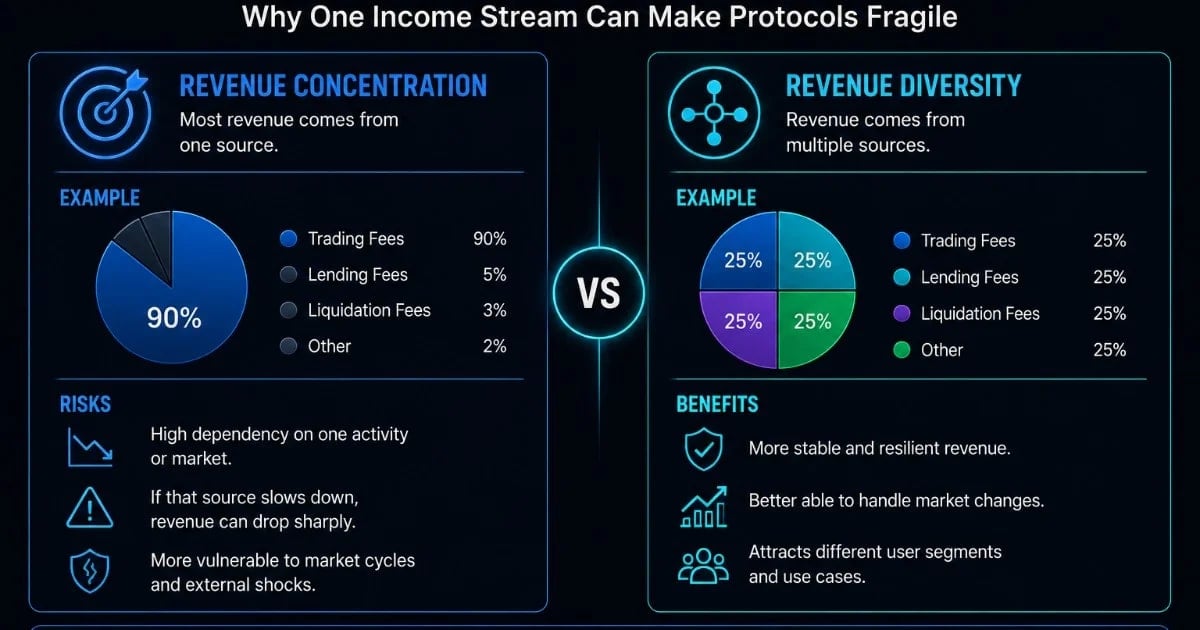
Revenue Concentration vs Revenue Diversity: Why One Income Stream Can Make Protocols Fragile Crypto traders often look at protocol revenue to judge whether a pr
Revenue Concentration vs Revenue Diversity: Why One Income Stream Can Make Protocols Fragile
Crypto traders often look at protocol revenue to judge whether a project has real demand. A protocol that generates consistent fees may appear stronger than one that depends only on hype or token emissions.
Key Takeaways
- Revenue Concentration vs Revenue Diversity: Why One Income Stream Can Make Protocols Fragile
- What Is Revenue Concentration?
- What Is Revenue Diversity?
- Revenue Concentration vs Revenue Diversity: The Key Difference
- Why Revenue Concentration Is Risky
- Examples of Revenue Concentration Risk
But revenue quality matters as much as revenue size.
A protocol can generate strong revenue from a single income stream. That may look impressive until market conditions change. If that one source weakens, the protocol can become fragile very quickly.
This is why traders should understand revenue concentration vs revenue diversity.
What Is Revenue Concentration?
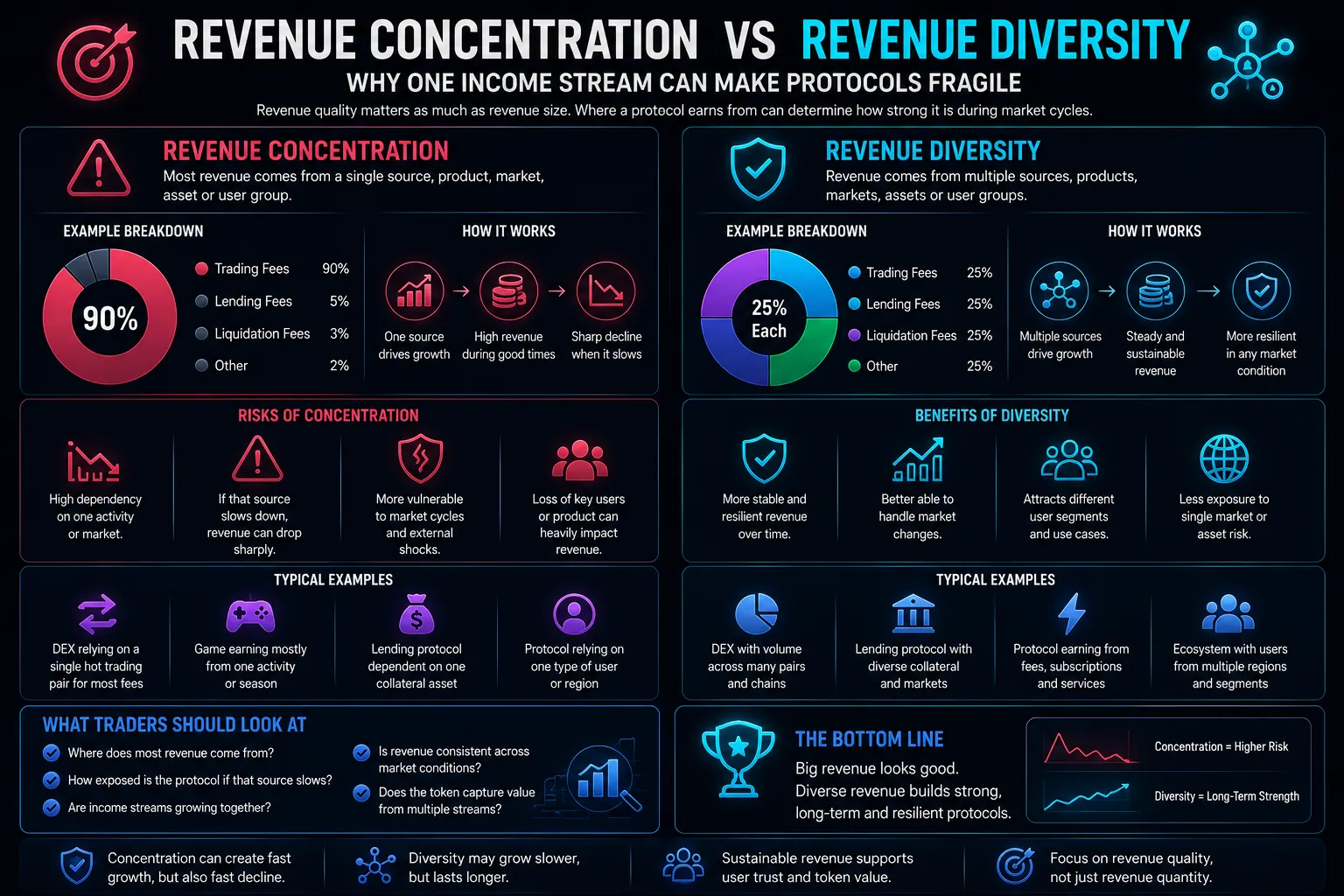
Revenue concentration happens when most of a protocol’s income comes from one product, one market, one asset or one user group.
For example, a protocol may generate most of its fees from a single trading pair, one lending market, one chain, one type of user or one volatile activity.
This can be profitable during good conditions, but it creates dependency.
If the main revenue source slows down, the entire protocol may suffer.
What Is Revenue Diversity?
Revenue diversity means that a protocol earns income from multiple sources.
This could include trading fees, lending fees, liquidation fees, staking services, bridge fees, subscription models, data services or several different product lines.
Revenue diversity can make a protocol more resilient because it does not depend entirely on one activity.
If one income stream weakens, others may continue supporting the protocol.
Revenue Concentration vs Revenue Diversity: The Key Difference
The key difference is dependency.
Revenue concentration means the protocol depends heavily on one source of income.
Revenue diversity means income is spread across different sources.
A concentrated protocol can grow quickly when its main market performs well. A diversified protocol may grow more steadily and handle market changes better.
For long term analysis, diversity often matters more than short term revenue spikes.
Why Revenue Concentration Is Risky
Revenue concentration creates fragility.
If a protocol earns most of its revenue from one asset, a decline in that asset’s activity can reduce revenue sharply. If revenue depends on one user group, the loss of that group can weaken the business model.
A protocol may look healthy during a trend but struggle when the narrative changes.
This is common in crypto, where user attention moves quickly between sectors.
Examples of Revenue Concentration Risk
A derivatives protocol may depend heavily on speculative volume during volatile markets. If volatility falls, revenue may decline.
A lending protocol may depend on one collateral asset. If demand for that asset drops, borrowing activity may weaken.
A DEX may depend on one trending token pair. If that pair loses attention, volume may fall.
In each case, the headline revenue may look strong until the main driver disappears.
Why Revenue Diversity Can Improve Stability
Revenue diversity can improve stability because different income streams may perform under different market conditions.
Trading fees may rise during volatility. Lending fees may remain steady when borrowing demand is strong. Subscription or service revenue may be less dependent on token speculation.
A protocol with multiple income sources may be better prepared for market cycles.
This can improve confidence among users, traders and tokenholders.
Revenue Diversity Is Not Always Better
Revenue diversity is useful, but it must be real.
A protocol that adds many products without traction may look diversified but still depend on one main source. Weak products do not create meaningful diversity.
True revenue diversity means multiple income streams contribute meaningful value.
Traders should look at revenue distribution, not just product count.
Why This Matters for Tokenholders
Tokenholders often want to know whether protocol revenue can support token value.
If revenue is concentrated, token value may depend on one fragile activity. If revenue is diverse and durable, the token thesis may be stronger.
However, revenue diversity only matters for tokenholders if the token captures value.
Revenue should be analyzed together with token utility, supply pressure and value capture mechanisms.
What Traders Should Check
When analyzing protocol revenue, traders should ask:
Where does most revenue come from?
Is one product responsible for most fees?
Is revenue dependent on market volatility?
Are users concentrated in one chain or asset?
Are income streams growing together?
Does the token capture any revenue?
Is revenue consistent across market conditions?
Would the protocol survive if its largest income source fell?
These questions help traders understand whether revenue is durable or fragile.
How DEXTools Can Help
DEXTools can help traders monitor the token market behind revenue narratives. If a protocol claims strong revenue, traders should still check liquidity, price action, volume and transaction flow.
A token may rise on revenue headlines, but weak market structure can make entry and exit risky.
Combining revenue analysis with live trading data gives a more complete view.
Final Thoughts
Revenue concentration and revenue diversity tell traders about protocol resilience.
Concentrated revenue can create fast growth, but it can also make protocols fragile. Diverse revenue can support stability, but only if multiple income streams are meaningful.
For traders, the key is not only how much a protocol earns. The better question is how durable that revenue is.
In crypto, revenue size matters. Revenue quality matters more.
How to Bridge Crypto Between Chains: Complete Cross-Chain Tutorial 2026 How to Use 1inch for Swaps: Classic, Fusion and Limit Orders (2026) OKX Web3 Wallet Tutorial 2026: Multi-Chain Setup GuideThe DeFi Revenue Stack: Unpacking Layers of Income Generation
While many protocols appear to have a single, dominant revenue stream, a deeper dive often reveals a multi-layered approach to income generation. Think of it as a "revenue stack," where different mechanisms contribute to the overall financial health and resilience of the project. Understanding these layers is crucial for DEXTools users seeking to identify truly robust protocols, as it highlights a nuanced approach to sustainability beyond just trading fees or lending interest.
A protocol's ability to diversify its revenue sources is a strong indicator of its strategic foresight and adaptability. This isn't just about adding more income streams, but about building a cohesive financial model where various components can support each other, especially during market downturns or shifts in user behavior. Protocols that actively build out their revenue stack are better positioned to weather volatility and continue development.
Beyond the Obvious: Hidden Revenue Levers
- Treasury Management & Yield: Protocols often deploy idle treasury assets into low-risk, diversified yield strategies on other stable DeFi protocols, generating additional income.
- Service Fees for Integrations: Charging a small fee for other protocols to integrate with or utilize a core service, such as an oracle network or a cross-chain bridge.
- Data Access & APIs: Monetizing access to valuable on-chain data or specialized APIs that power other applications or analytics platforms.
- Protocol-Owned Liquidity (POL) Returns: Earning trading fees and potentially impermanent loss mitigation from liquidity pools that the protocol itself owns and manages.
- White-Label Solutions: Offering their core technology or infrastructure as a white-label service to other projects, extending their reach and revenue base.
Related Guides
- Borrower Diversity vs Whale Borrowing: How Concentrated Loan Demand Creates DeFi Risk
- Top 5 Restaking Protocols in 2026: EigenLayer, EtherFi, Symbiotic and More
- 5 Best Liquid Staking Protocols 2026: APY, TVL & Risk Ranked
- Best Crypto Passive Income Strategies Compared in 2026
- Best Ways to Earn Yield on ETH in 2026: Guide
Frequently Asked Questions
What is revenue concentration in a crypto protocol?
Revenue concentration means a protocol earns most of its income from a single source, product, or activity. This can make it fragile if that one stream slows down or stops.
Why is revenue diversity considered healthier?
A protocol with several independent income streams is less exposed to any single one failing, which can make its earnings more resilient. Diversity can help a protocol weather changes in market conditions.
How can traders assess a protocol's revenue mix?
Traders can look at where fees come from and whether income depends heavily on one feature or set of users. Understanding the mix helps gauge how durable the revenue might be.
Does high revenue always mean a protocol is strong?
Not necessarily, because high revenue concentrated in one fragile source can be riskier than lower but more diversified income. The quality and stability of revenue matter as much as the headline number.