Fake Market Cap vs Real Exit Liquidity: Why the Number Can Mislead Traders
— By Whatsertrade in Tutorials

Explore the crucial differences between market cap and liquidity in crypto trading. Learn to make informed decisions in decentralized finance markets.
Market cap is one of the most quoted numbers in crypto. Traders use it to compare tokens, estimate upside, and decide whether a project is still early. A token with a small market cap can look attractive because it appears to have more room to grow.
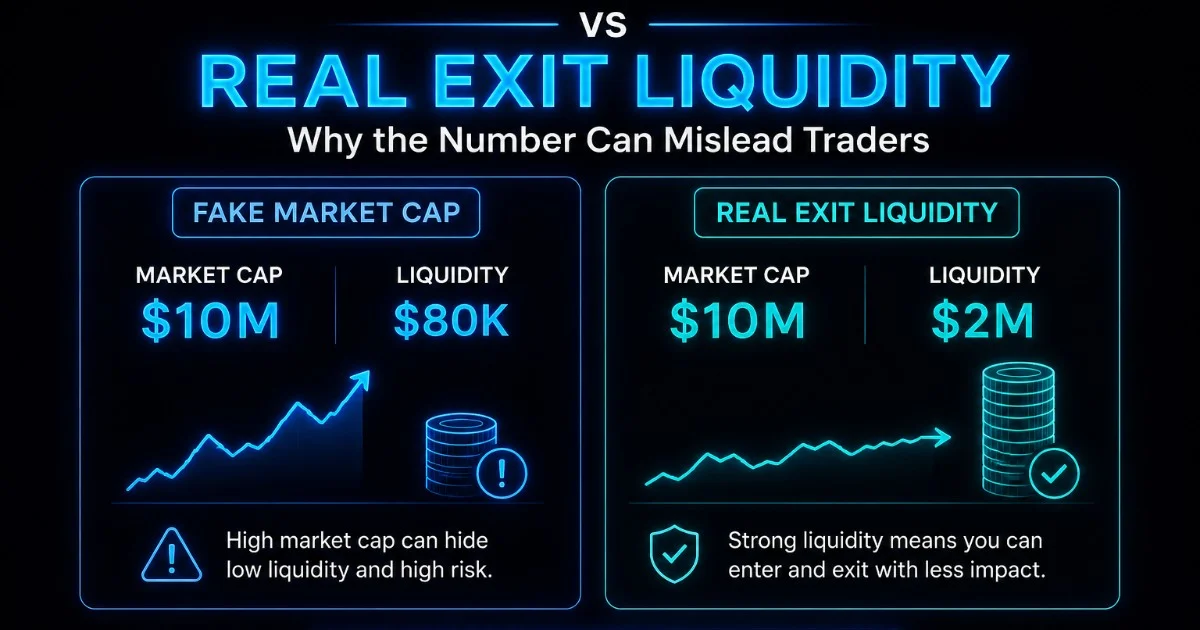
But in decentralized markets, market cap can be misleading, especially for low liquidity tokens. A token may show a market cap of several million dollars while having only a small amount of real liquidity available in the pool. In that case, the displayed valuation does not mean traders can actually buy or sell at that value.
This is where the difference between market cap and exit liquidity becomes critical.
What Market Cap Really Means
Market cap is usually calculated by multiplying the token price by the circulating supply.
For example, if a token trades at $0.01 and has 1 billion tokens in circulation, the displayed market cap is $10 million.
That number can be useful for comparison, but it does not show how much money is available for traders to exit. It also does not show how much sell pressure the liquidity pool can absorb before the price drops significantly.
In centralized markets, deep order books can sometimes support large transactions. In decentralized exchanges, the liquidity pool itself determines how much price impact a trade can create.
What Exit Liquidity Means
Exit liquidity is the amount of available buying power that allows holders to sell without crashing the price.
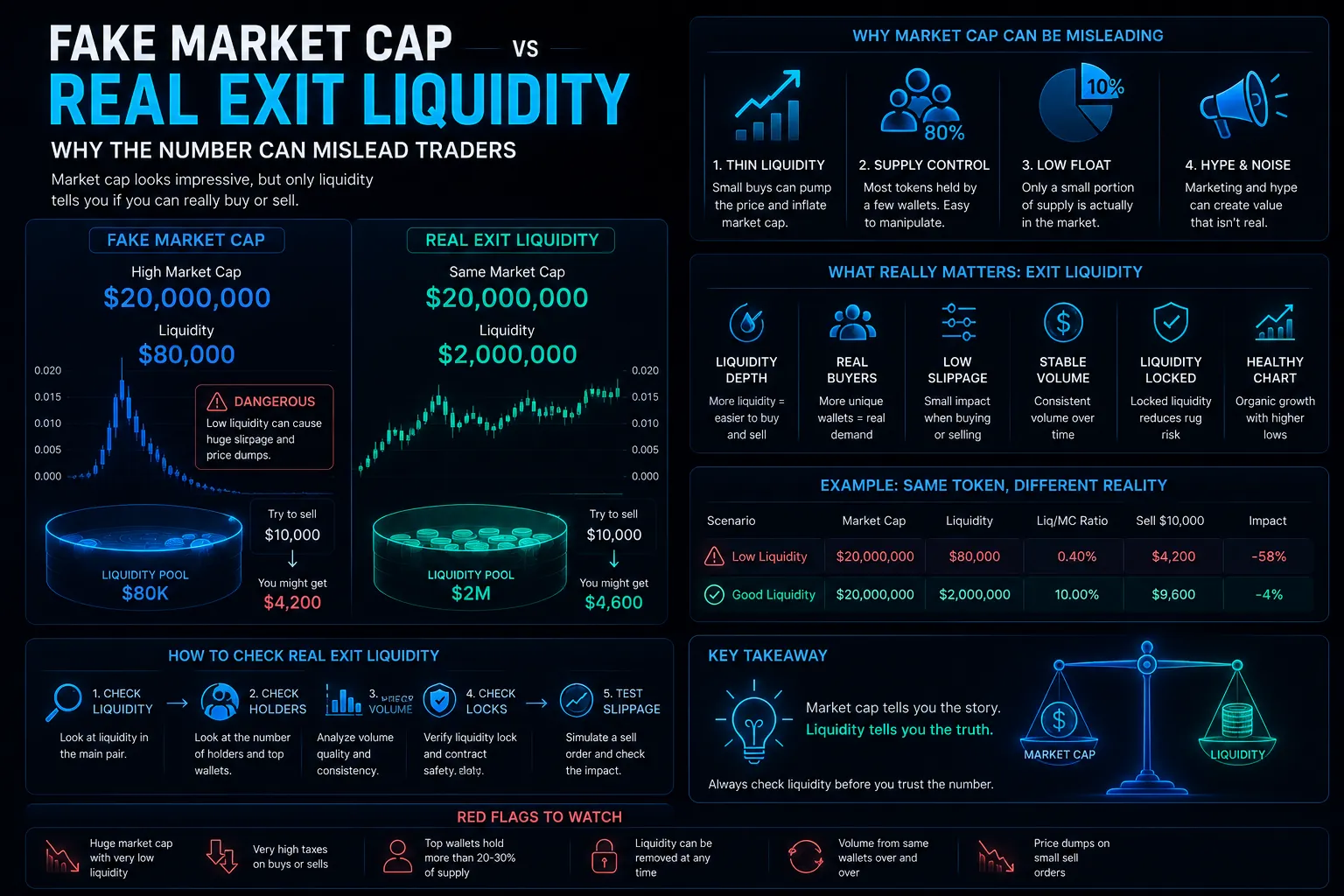
If a token has a $10 million market cap but only $80,000 in liquidity, the market cap may look impressive, but large holders may not be able to exit cleanly. A single sell order can create heavy slippage and push the chart down quickly.
This is why traders should ask a more practical question:
How much can actually be sold before the price changes dramatically?
That question is often more important than the market cap itself.
Why Fake Market Cap Happens
A misleading market cap can happen for several reasons.
First, a token price can be pushed up with relatively small buys when liquidity is thin. If the pool is shallow, a few transactions can move price aggressively. That new price is then multiplied by the full token supply, creating a large displayed market cap.
Second, a large portion of supply may be held by insiders, team wallets, or early buyers. If those wallets have not sold yet, the market cap can look stable. But if they begin selling, the available liquidity may not be enough to support the price.
Third, tokens with very low float can appear more valuable than they really are. The market may only be pricing a tiny portion of supply, while the full valuation assumes all tokens could trade at the current price.
The Liquidity to Market Cap Ratio
One simple way to evaluate risk is to compare liquidity with market cap.
A token with a $1 million market cap and $300,000 in liquidity may offer a stronger structure than a token with a $20 million market cap and $100,000 in liquidity.
The second token may look larger, but it could be much more fragile.
A low liquidity to market cap ratio can indicate that the token price is easy to move and difficult to exit. This does not always mean the token is bad, but it means traders should be more careful with position size and slippage.
How Traders Can Check Real Exit Conditions
Before buying a low cap token, traders can review several practical signals:
Total liquidity in the main pair
Liquidity compared with market cap
Average transaction size
Size of the largest holders
Recent sell impact on the chart
Whether liquidity is locked or removable
Number of unique buyers and sellers
Volume quality compared with pool depth
A healthy token does not need perfect numbers, but it should show enough liquidity to support real trading activity.
The Slippage Trap
Slippage is one of the clearest signs that market cap does not equal exit liquidity.
A trader may see a large profit on paper, but when trying to sell, the expected output may be much lower than the displayed value. This is especially common in tokens with low liquidity, high taxes, or volatile pool conditions.
The larger the sell order compared with the pool, the higher the potential price impact.
This is why position sizing matters. In low liquidity markets, buying too much can make it difficult to exit without becoming your own source of sell pressure.
Red Flags to Watch
Some warning signs include:
High market cap with very low liquidity
Massive candles created by small buys
Large holders controlling a major part of supply
Liquidity that decreases as price rises
Heavy sell impact from small transactions
Volume that looks high but comes from repeated small wallet activity
A chart that collapses after one or two large sells
These signals suggest that the displayed valuation may not reflect real market strength.
A Better Way to Think About Valuation
Instead of asking only, "What is the market cap?" traders can ask:
How deep is the liquidity?
Can average holders exit without destroying price?
Is the token supported by many buyers or only a few wallets?
Does volume look organic?
Is the market cap backed by real pool depth?
This mindset helps traders avoid overvaluing tokens that look strong on the surface but are weak underneath.
Final Thoughts
Market cap is useful, but it is not enough.
In decentralized trading, real liquidity matters more than a headline valuation. A token can show a large market cap while offering very limited exit liquidity. That gap can create serious risk for traders who only look at price and market cap.
The smartest traders look deeper. They compare valuation with liquidity, check holder concentration, watch sell impact, and think carefully about whether the market can support their exit.
A big market cap can attract attention. Real liquidity is what lets traders leave.
The Market Cap Mirage: Why Token Valuation Means Little Without Depth Market Cap vs Liquidity: Which Matters More? Exit Liquidity Mapping: Who Might Sell Into You Before You Buy? Apparent Liquidity vs Executable Liquidity: Why a Large Pool Can Still Give You a Bad EntryFrequently Asked Questions
What is market capitalization?
Market capitalization represents the total value of all outstanding tokens of a cryptocurrency. It is calculated by multiplying the current price of a single token by the total circulating supply.
How is market cap different from trading volume?
Market cap indicates the total value of a cryptocurrency, while trading volume reflects the total value of tokens traded over a specific period, typically 24 hours. Volume measures activity, while market cap measures total worth.
What is circulating supply in crypto?
Circulating supply refers to the number of cryptocurrency tokens that are publicly available and actively trading in the market. It excludes tokens that are locked, burned, or otherwise not in circulation.
Can market cap be manipulated?
Market capitalization can be influenced by various factors, including wash trading and low liquidity, which can artificially inflate price and, consequently, market cap. This can create a misleading perception of value.
Why is 'real exit liquidity' important?
Real exit liquidity refers to the actual ability to sell a significant amount of cryptocurrency without drastically impacting its price. A high market cap with low liquidity can make it difficult for large holders to sell their assets.