SEC vs CFTC: Who Regulates Crypto in the US? (2026 Guide)
— By AliceOnChain in Tutorials
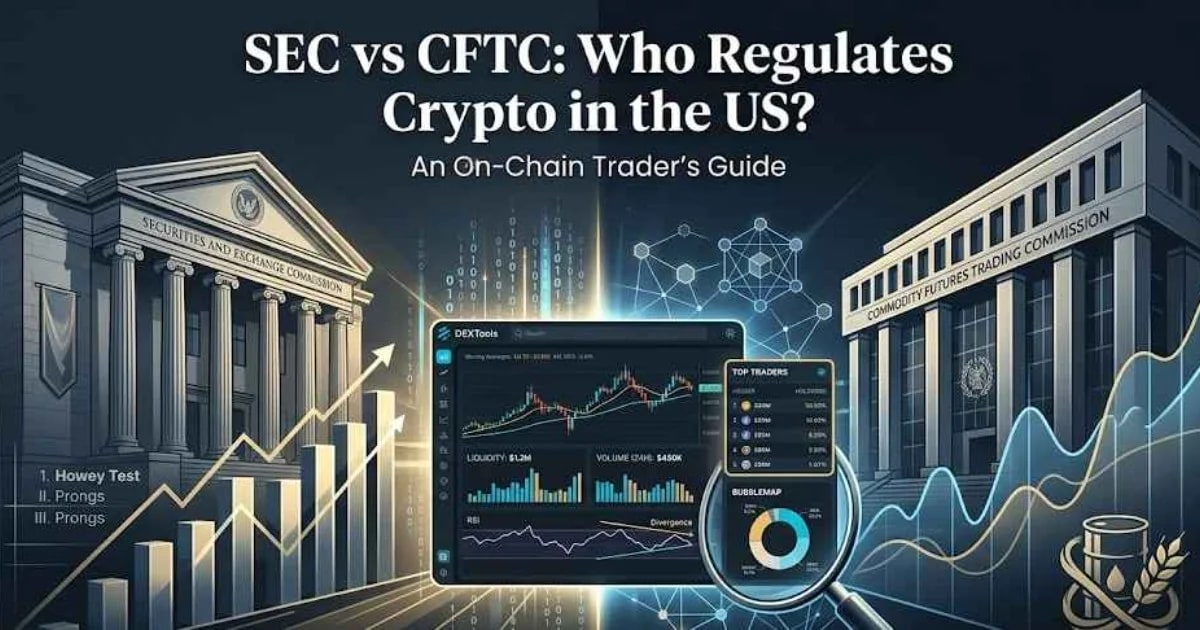
The regulatory tug-of-war between the SEC and the CFTC shapes the entire US crypto landscape. For on-chain traders, understanding whether a token is treated as a security or a digital commodity is not just about legal theory—it directly impacts market liquidity, volume stability, and whale accumulation patterns. This advanced guide breaks down the jurisdictional battleground and shows you how to use on-chain metrics to navigate shifting regulatory regimes.
SEC vs CFTC: Who Regulates Crypto in the US? An On-Chain Trader’s Guide
The regulatory architecture of the United States digital asset market resembles a dual-engine framework where two major federal agencies frequently overlap. For decentralized finance (DeFi) participants, the friction between the Securities and Exchange Commission (SEC) and the Commodity Futures Trading Commission (CFTC) represents more than an abstract legal debate. This jurisdictional boundary dictates asset classification, shapes institutional capital allocation, and directly influences token liquidity structures across smart contract networks.
When an asset is labeled a security by the SEC or a commodity by the CFTC, the broader market experiences shifts in structural volatility. Understanding how these agencies differentiate digital assets allows active on-chain traders to transition from reactive speculation to proactive risk management. By combining structural regulatory insights with real-time token metrics, market participants can spot systemic accumulation or distribution phases before they manifest as sudden price movements.
The Core Battleground: Securities vs. Commodities
To navigate the domestic market, traders must understand the legal parameters that govern the sec vs cftc framework. The division of authority relies primarily on legacy legal frameworks adapted for programmable software.
The SEC and the Howey Test
The SEC exercises jurisdiction over securities, utilizing the four-pronged Howey Test established in 1946 to evaluate digital assets. Under this framework, an investment contract exists if there is:
An investment of money
In a common enterprise
With a reasonable expectation of profits
Derived primarily from the entrepreneurial or managerial efforts of others
When the SEC applies this standard to a cryptographic asset, it focuses on centralized components, such as founding teams holding significant token allocations, active promotional strategies, or controlled upgrade mechanisms. If an asset is categorized as a security, it faces rigorous registration mandates. Consequently, sudden regulatory announcements by the SEC often trigger distribution events, recognizable on-chain via rising exchange inflows or structural shifts in token holder concentration.
The CFTC and the Commodity Exchange Act
Conversely, the CFTC oversees derivatives markets and holds anti-fraud and anti-manipulation authority over the spot markets of commodities. Under the Commodity Exchange Act (CEA), broad asset classes like gold, wheat, and oil share legal categories with decentralized digital assets like Bitcoin (BTC) and Ethereum (ETH).
The CFTC generally looks for structural decentralization. If an asset lacks a single, central group managing its ongoing development or controlling its economic framework, it is more likely to be classified as a digital commodity.
Recent Structural Shifts
The historical friction between these two regulators took a significant turn when the SEC and CFTC issued a joint interpretation establishing a synchronized five-category token taxonomy: digital commodities, digital collectibles, digital tools, stablecoins, and digital securities.
Concurrently, legislative frameworks like the Financial Innovation and Technology for the 21st Century Act (FIT21) have sought to codify these boundaries. FIT21 explicitly draws the line based on network structure: a blockchain network that is functional and decentralized falls under the CFTC’s spot market authority, whereas a functional but non-decentralized network remains a restricted digital asset under SEC purview.
A network is often deemed decentralized under these legislative guidelines if no single entity controls more than 20% of the token supply or voting power. For on-chain analysts, checking these parameters through wallet distribution data is essential for assessing regulatory risk.
Why Regulatory Labels Alter On-Chain Market Dynamics
A change in an asset's regulatory standing quickly alters its on-chain footprint. When evaluating tokens, traders can monitor specific variables to gauge how regulatory sentiment influences market structure.
Liquidity and Depth
Tokens that secure a commodity classification or navigate clear safe harbors often attract deeper liquidity. Market makers and institutional entities generally favor pairs that possess minimal regulatory risk.
Traders can monitor this stability by assessing the total value locked within automated market maker (AMM) pools. Deep liquidity pools exhibit low slippage, allowing larger trade executions without inducing significant price deviations. Conversely, assets entangled in active SEC scrutiny often show signs of liquidity fragmentation, as liquidity providers withdraw capital to mitigate smart contract or compliance exposure.
Structural Trading Volume
Persistent, organic volume usually signals sustained user adoption and healthy market participation. However, assets facing shifting legal classifications frequently experience sharp, sentiment-driven spikes in trading velocity.
Analyzing the ratio of trading volume to pool liquidity provides context on whether an asset is experiencing speculative churning or sustained accumulation. A sudden surge in volume alongside dropping liquidity pools can indicate an impending high-volatility event.
Holder Distribution and Concentration
Large capital allocators, or whales, modify their positions based on macro regulatory risks. When an asset's status skews toward a security classification, decentralized ledger data frequently reveals wallet clusters distributing tokens to retail addresses.
Conversely, when an asset clarifies its standing as a digital commodity, on-chain metrics often display gradual wallet consolidation, indicating institutional accumulation.
Step-by-Step Tutorial: Managing Regulatory Risks Using DEXTools
Evaluating an asset's regulatory exposure requires a systematic analysis of its on-chain footprints. This practical workflow shows how to use advanced metrics to cross-reference asset metrics against the market realities of the sec vs cftc landscape.
Step 1: Evaluate Token Decentralization and Supply Metrics
Because frameworks like FIT21 rely on supply distribution to determine decentralization, your first step should be evaluating token allocation. Centralized control over supply increases the probability of an SEC security classification.
Open your target pair on DEXTools and locate the Holder Analysis section. Look specifically for the percentage of supply held by deployer wallets, core teams, or localized clusters. If a single smart contract or entity controls greater than 20% of the voting or circulating supply without explicit lock-up rules, the asset carries structural centralization risks. You can use integrated visual tools like Bubblemaps within the interface to see if supposedly separate top tier wallets are transferring tokens among themselves, which may mask coordinated control.
Step 2: Track Real-Time Liquidity Changes
Liquidity acts as an early indicator of shifting market confidence. When institutional players or protocol insiders expect regulatory pressure, they often quietly withdraw liquidity from AMM pools.
Navigate to the DEXTools Pair Explorer for the selected token. Monitor the Liquidity metric listed in the pool details section. Look for structural divergence: if the underlying token price is holding steady but the absolute liquidity is decreasing, it may signal that larger capital allocators are de-risking. Ensure that the liquidity is locked or burned; unlocked liquidity pools combined with concentrated token supplies present elevated capital risks if regulatory interventions occur.
Step 3: Analyze Volume and Spot RSI Divergences
Price action alone can be misleading during regulatory updates. Comparing price momentum against underlying volume helps determine if a trend is sustainable.
Utilize the advanced Charts module to overlay trading volume with the Relative Strength Index (RSI). When an asset experiences negative regulatory headlines, watch for bearish divergences, such as when the price prints a temporary higher high while the RSI displays a distinct lower high. If this divergence coincides with elevated sell volume on the Pair Explorer ledger, it often suggests that institutional distribution is masking temporary retail momentum.
Step 4: Monitor Whale Footprints via Transaction Ledgers
Large transaction tracking allows you to see how sophisticated participants react to shifting enforcement actions or policy updates.
Examine the real-time transaction history on the Pair Explorer page. Filter transactions to isolate large-block trades, frequently referred to as whale activity. If you notice a persistent pattern of large sell orders matching an asset's approach to key technical resistance levels, it may imply that larger entities are capping the upside to exit positions under regulatory duress. You can also monitor the Top Traders tab to see if historically profitable addresses are accumulating or unwinding their holdings.
Step 5: Implement Automated Volatility Management
Regulatory developments can impact markets outside of standard trading hours. Protecting capital requires automated monitoring setups.
Set up customized triggers using the Price Alerts feature. Rather than tracking nominal price milestones alone, establish alerts near critical support zones and areas of high historical volume. If a sudden regulatory ruling drops, an automated alert gives you the notice needed to reassess pool metrics, check for systemic liquidity drains, and adjust your risk parameters before severe slippage impacts the pool.
Regulatory Profiles: Commodity vs. Security On-Chain Profiles
The table below outlines how regulatory realities tend to alter observable on-chain conditions for digital assets over time.
| Metric | Commodity-Leaning Profile (e.g., Highly Decentralized) | Security-Leaning Profile (e.g., Centralized/Promoted) |
| Holder Concentration | Highly distributed; top 10 wallets (excluding cross-chain bridges) typically control less than 15-20% of supply. | Highly concentrated; inside addresses or single entities frequently retain over 20% of total circulating tokens. |
| Liquidity Pools | Deep, persistent liquidity across multiple decentralized venues; high structural depth relative to daily volume. | Thin or un-locked liquidity pools; frequently concentrated in a single AMM pair, leaving it vulnerable to sudden capital flight. |
| Whale Activity | Gradual, long-term accumulation or steady rebalancing patterns; low correlation to single-entity announcements. | Sharp capital movements; aggressive distribution by early insider wallets often correlates with external regulatory investigations. |
| Development Activity | Open-source contributions from fragmented global developers; governance managed via active decentralized DAOs. | Code modifications driven primarily by a single corporate entity, core foundation, or centralized management group. |
Navigating a Fragmented Legal Landscape
The ongoing development of the sec vs cftc regulatory architecture ensures that digital asset markets will continue to experience localized volatility. While legislative updates like FIT21 seek to establish objective thresholds for decentralization, enforcement actions and judicial rulings remain key drivers of short-term sentiment.
For an on-chain trader, managing this environment requires moving beyond speculative headlines. By tracking supply distribution, analyzing liquidity depth, and monitoring insider wallet activity, you can identify how the market is pricing regulatory risk. Using diagnostic dashboards like DEXTools allows you to verify whether a project's structural reality matches its claims of decentralization, helping you protect your capital regardless of which agency asserts control.
Key Regulatory Signals Crypto Traders Must Monitor7 On-Chain Data Signals That Help Identify High-Growth Crypto Assets
Crypto Swing Trading: Strategy, Setups, and Risk Management
Top 5 Whale Tracking Tools in 2026: Large Wallet Monitoring Across Chains
Disclaimer: This article is for informational purposes only and does not constitute investment advice, financial advice, trading advice, or any other kind of advice. DEXTools does not recommend buying, selling, or holding any cryptocurrency or token. Users should conduct their own research and consult with a qualified financial advisor before making any investment decisions. Cryptocurrency investments are volatile and high-risk. DEXTools is not responsible for any losses incurred.