Short-Term Holder Realized Price: On-Chain Guide
— By AliceOnChain in Tutorials

Understand the mechanics behind the short-term holder realized price (STH-RP). Learn how this crucial on-chain metric acts as a psychological line in the sand during market corrections and how to pair it with DEXTools features to manage volatility.
Short-Term Holder Cost Basis: The STH Realized Price Support Level
Navigating decentralized markets requires a dual understanding of order book dynamics and on-chain behavior. While traditional technical analysis focuses on price action and volume patterns visible on a chart, blockchain analytics introduces an entirely different dimension: tracking the precise short-term holder realized price.
Among the various metrics utilized by institutional and sophisticated retail market participants, the short-term holder realized price stands out as one of the most reliable indicators of psychological support and resistance. By tracking the exact short-term holder realized price, traders can better quantify market sentiment, protect capital during volatile drawdowns, and anticipate potential inflection points across different market cycles.
Defining the Short-Term Holder Realized Price
To understand the short-term holder realized price, it is first necessary to differentiate between spot market price and realized price. While the current market price represents the value at which the last unit of an asset was traded on an exchange, the realized price calculates the value of an asset based on when each individual token last moved on-chain. In essence, the realized price reflects the aggregate cost basis of the entire network.
On-chain analytics frameworks segment the market into two primary cohorts based on the holding time of the assets:
Long-Term Holders (LTH): Entities that have held their tokens for longer than 155 days. Statistically, the likelihood of these tokens being spent decreases significantly after this threshold.
Short-Term Holders (STH): Entities that have moved their tokens within the last 155 days. This cohort represents the active, speculative, and swing-trading segment of the market.
The short-term holder realized price isolates the realized value of this latter group. It tracks the average price at which tokens moving within that 155-day window were acquired. Because this cohort represents newer market entrants, their behavior is highly sensitive to recent price shifts, making the aggregate short-term holder realized price a crucial psychological benchmark for the entire market.
Why the STH Cost Basis Acts as a Support and Resistance Level
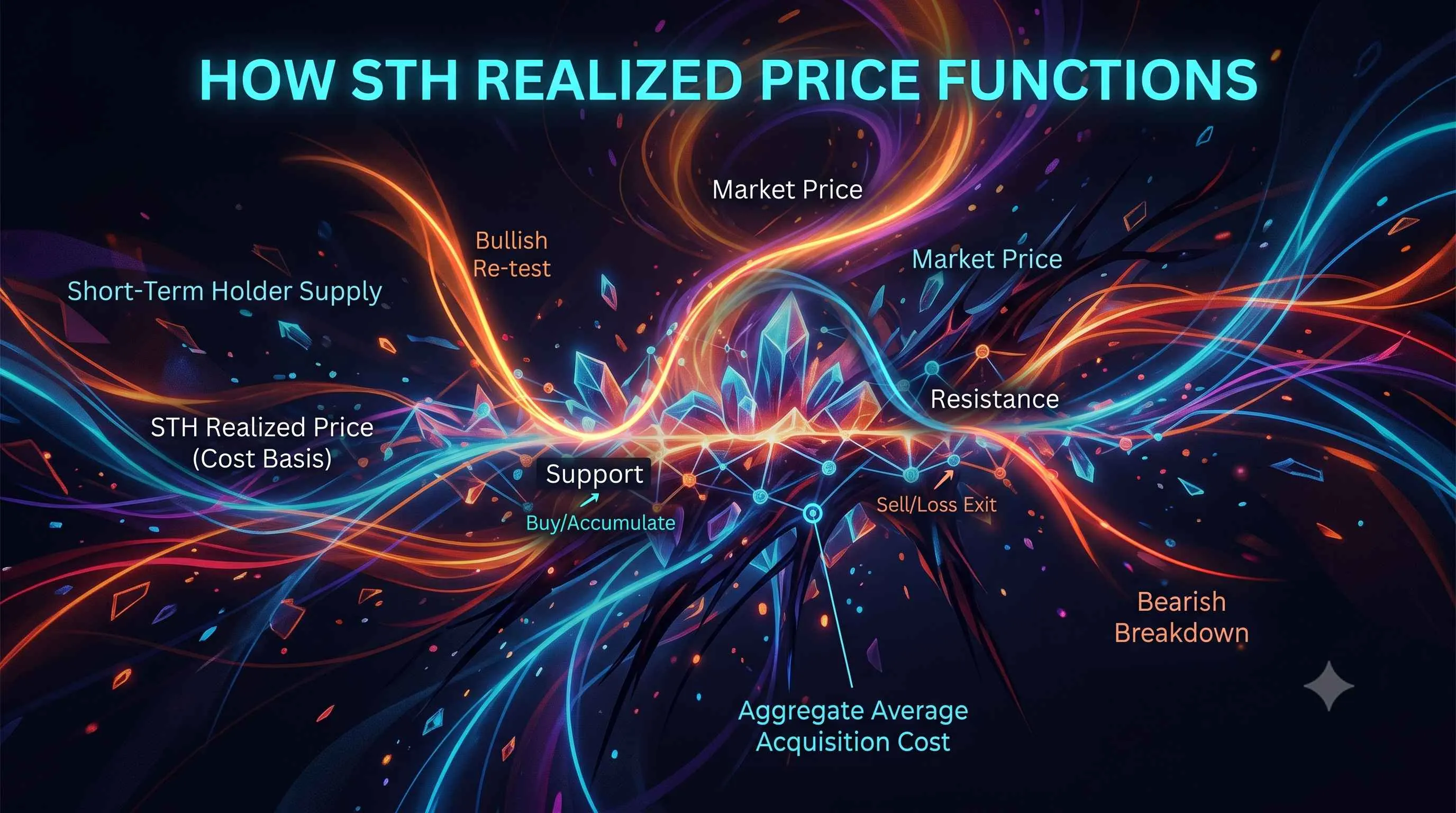
In a healthy macroeconomic uptrend, the short-term holder realized price frequently functions as a dynamic support level. The mechanics behind this phenomenon are tied directly to market psychology and participant behavior.
The Psychology of Retesting Cost Basis
When an asset experiences a correction within a broader bull market, the price often trends downward toward the average entry point of recent buyers. As the market price approaches the short-term holder realized price, two distinct behavioral shifts tend to occur:
Mitigation of Panic Selling: Short-term holders who were recently in profit see those gains diminish. As the market price touches the short-term holder realized price, the incentive to sell decreases, as many retail participants are reluctant to realize a net loss on their investment.
Accumulation by Major Players: Sophisticated market entities and whales monitoring on-chain metrics often view the short-term holder realized price as a structurally sound area to deploy capital. They recognize that absorbing supply at the short-term holder realized price can stabilize the market trend.
Conversely, in a sustained bear market, the short-term holder realized price often flips to become a formidable overhead resistance level. When the market price resides below the short-term holder realized price, recent buyers are holding unrealized losses. Any subsequent rally back toward the short-term holder realized price offers an opportunity for these distressed holders to exit at break-even, creating significant overhead supply that caps upward momentum.
Step-by-Step Framework for Analyzing On-Chain Support
Integrating the short-term holder realized price into your daily routine involves cross-referencing macroeconomic blockchain data with localized liquidity and volume indicators. Here is how to construct a comprehensive analysis framework.
Step 1: Establish the Macro On-Chain Trend
Before looking at micro-cap pairs or localized liquidity pools, determine where the broader market stands relative to the aggregate short-term holder realized price. If the major benchmark assets are trading comfortably above their respective short-term holder realized price, the broader market regime can be classified as structurally bullish. This provides a more favorable backdrop for exploring decentralized finance (DeFi) pairs.
Step 2: Utilize DEXTools Pair Explorer for Real-Time Validation
While macro on-chain data offers a bird's-eye view, decentralized markets move rapidly. To apply your knowledge of the short-term holder realized price effectively, open the DEXTools Pair Explorer for your target asset.
Look for historical confluence. When macro indicators suggest an asset is approaching its aggregate short-term holder realized price, check your localized DEXTools Pair Explorer charts to see if this corresponds with prominent historical support zones, previous consolidation blocks, or significant moving averages.
Step 3: Monitor Volume and Liquidity Tracking
An on-chain support level like the short-term holder realized price is only as strong as the liquidity backing it. In DeFi, monitoring the liquidity depth of a specific pair is paramount. Use the Liquidity Tracking features on DEXTools to observe whether liquidity providers are adding or removing capital near these critical structural levels.
A stabilization in price near the short-term holder realized price, accompanied by rising or steady pool liquidity, may indicate institutional or community confidence in that support floor. Conversely, if liquidity is thinning out as price drops toward the short-term holder realized price, it can signal that market makers are anticipating a breakdown.
Advanced Indicators: Pairing Cost Basis with Technical Analysis
Relying solely on a single on-chain metric can lead to false signals. To increase the probability of accurate market assessments, advanced traders synthesize the short-term holder realized price with established technical indicators and localized DEXTools features.
RSI Divergence at Critical Levels
When an asset retraces to its short-term holder realized price, the Relative Strength Index (RSI) can help identify if the downward momentum is exhausting. If the price touches the short-term holder realized price while the RSI prints a higher low (a bullish divergence), it suggests that selling pressure is waning despite the descending price action. This confluence near the short-term holder realized price can indicate a higher probability of a price reversal.
Analyzing Holder Distribution and Whale Activity
The composition of the asset's holder base plays an essential role in how strictly a support level is respected. Utilizing the Holder Analysis and Bubblemaps features on DEXTools allows you to dissect the distribution of token supply around key zones.
If the majority of the supply is concentrated within a few large, interconnected whale wallets, the behavior of those specific entities will often override general retail trends. If these large holders remain stable or increase their exposure as the price approaches the collective short-term holder realized price, it suggests that the core backing of the project is holding firm.
Tracking the Top Traders
To gain insight into immediate market sentiment, cross-reference the Top Traders tab on DEXTools during a retest of the short-term holder realized price. Observing whether profitable wallets are accumulation-focused or distribution-focused at the short-term holder realized price offers real-time insight into whether the smart money is treating the level as valid support.
Volatility Management and Risk Mitigation
Cryptocurrency markets are highly volatile, and on-chain metrics are probabilistic, not deterministic. A breach of the short-term holder realized price can have severe cascading effects if not anticipated correctly.
The Consequences of a Confirmed Breach
If the market price breaks below the short-term holder realized price and fails to reclaim it quickly, the market sentiment often shifts from bullish optimization to aggressive capital preservation. This shift below the short-term holder realized price can trigger systematic stop-losses and automated liquidation protocols across lending platforms, accelerating downward momentum.
Utilizing Price Alerts
Given the speed at which DeFi markets operate, manual monitoring can leave you vulnerable to sudden shifts in volatility. Setting up precise Price Alerts on DEXTools slightly above and below the calculated short-term holder realized price ensures that you are notified the moment the market structure begins to test these pivotal boundaries. This allows for proactive risk management rather than reactive decision-making when the short-term holder realized price is challenged.
Conclusion: Balancing On-Chain Data with Market Realities
The short-term holder realized price serves as a powerful barometer for market psychology, offering a window into the financial positioning of the market's most reactive participants. When combined with localized technical tools like the DEXTools Pair Explorer, volume analysis, and holder distribution metrics, the short-term holder realized price provides traders with a robust framework for identifying macro support zones.
However, no single indicator guarantees market direction. Successful navigation of decentralized markets requires a disciplined approach to risk management, continuous monitoring of liquidity depths, and an understanding that market conditions can change rapidly. Treat the short-term holder realized price as one core component of a broader, probabilistic trading strategy.
Bitcoin's Realized Price Signals a Possible Bottom After the CrashIs On-Chain Data Replacing Technical Analysis in Crypto?
Realized Cap vs Market Cap: Advanced On-Chain Guide
7 On-Chain Data Signals That Help Identify High-Growth Crypto Assets
Disclaimer: This article is for informational purposes only and does not constitute investment advice, financial advice, trading advice, or any other kind of advice. DEXTools does not recommend buying, selling, or holding any cryptocurrency or token. Users should conduct their own research and consult with a qualified financial advisor before making any investment decisions. Cryptocurrency investments are volatile and high-risk. DEXTools is not responsible for any losses incurred.