Top Airdrop Categories in 2026: L2s, Restaking and AI

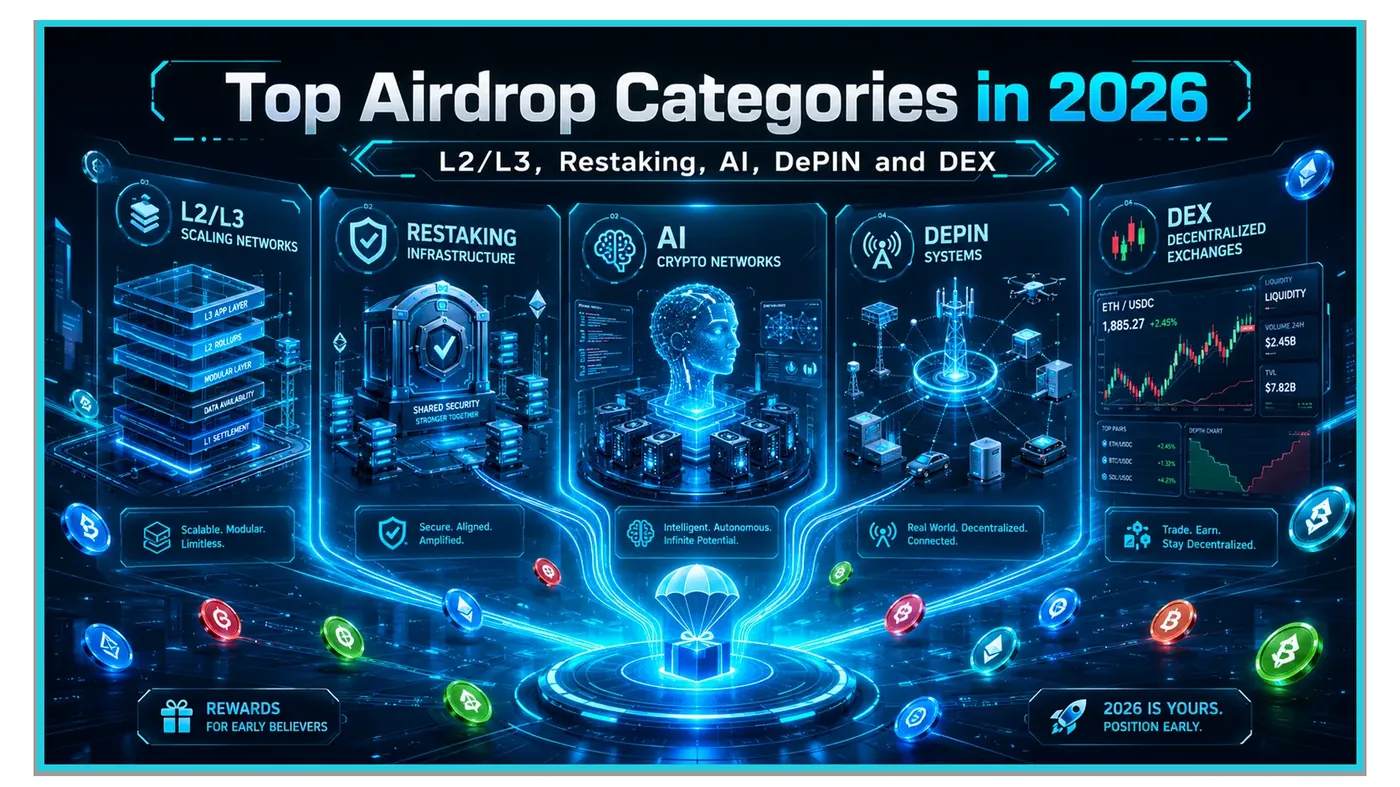
The next generation of crypto airdrops is moving beyond simple wallet activity. In 2026, the most relevant opportunities may come from L2/L3 ecosystems, restaking networks, AI protocols, DePIN infrastructure and decentralized exchanges.
The leading categories to watch
- The phrase 2026 airdrop categories reflects a major change in how crypto users think about early participation. Airdrops are no longer only surprise token distributions for people who used a protocol once. They are becoming structured growth systems designed to reward liquidity, security, user retention, technical testing, data contribution and ecosystem development.
- In earlier market cycles, users often focused on simple actions: bridging assets, making a swap, minting an NFT or completing a testnet task. Those activities may still matter, but protocols now have better tools for detecting shallow farming, sybil clusters and repetitive low-value behavior. In 2026, the strongest opportunities are likely to favor users who create measurable value across several dimensions: capital, transaction volume, infrastructure support, governance participation, social credibility and long-term ecosystem engagement.
- The leading categories to watch are Layer 2 and Layer 3 networks, restaking platforms, AI crypto infrastructure, DePIN networks and decentralized exchanges. These sectors are different, but they share the same basic need: they must attract real users before, during and after token launch. That is why airdrops remain powerful. They can transform early users into liquidity providers, validators, traders, community members and governance participants.
1. L2 and L3 Ecosystems
- Layer 2 networks remain one of the most important airdrop sectors because they sit at the center of blockchain scaling. Rollups and modular execution environments are designed to make on-chain activity faster, cheaper and more flexible. Research on Ethereum scaling has also examined how Layer 2 adoption interacts with mainnet congestion and fee pressure, showing why rollup activity is such a central part of the broader Ethereum roadmap. (arXiv)
- For airdrop hunters, L2 ecosystems are attractive because they usually include many forms of activity. A user can bridge assets, swap on native DEXs, provide liquidity, interact with lending markets, use NFT platforms, test gaming apps, vote in governance or explore ecosystem quests. Each of these actions can create a record of participation.
- Layer 3 networks may become even more interesting. L3s can be application-specific chains built for gaming, perpetual trading, social apps, AI agents, loyalty programs or consumer finance. Because many L3s need early testers and liquidity, they may design reward systems that favor consistent usage rather than one-off transactions. Users who help test apps, provide liquidity across new markets or interact with early ecosystem tools may become valuable to those networks.
- However, the key is quality. Repeating the same bridge or swap across dozens of wallets is less likely to be rewarded than meaningful engagement with the network. Stronger participation may include using multiple dApps, maintaining activity over time, joining official campaigns, holding ecosystem badges and contributing useful feedback.
2. Restaking and Shared Security
- Restaking is one of the most important infrastructure narratives in crypto because it changes how security can be reused. Instead of staking an asset for one network only, users can support additional services, middleware layers or validation systems. This creates a new incentive structure where capital, operators and protocols interact in a shared security marketplace.
- For airdrops, restaking is powerful because it can generate multiple layers of potential rewards. A user might interact with a base restaking protocol, a liquid restaking token, an operator network, a data availability service, a rollup using shared security or an actively validated service. Each layer may have its own incentive design.
- The middle of the 2026 airdrop categories landscape is where restaking becomes especially relevant. It is not only about depositing assets. It is about choosing operators, understanding protocol risk, supporting new security modules and participating in governance or ecosystem campaigns. Protocols may reward users who behave like long-term security contributors rather than short-term yield farmers.
- Still, restaking is not risk-free. Smart contract bugs, slashing events, liquidity constraints, operator failures and market volatility can all affect users. The possibility of an airdrop should never be the only reason to deposit funds. Users should understand what they are securing, how withdrawals work and what risks apply before participating.
3. AI Crypto Networks
- AI is becoming a major Web3 category because it connects automation, data, compute, agents and financial execution. In 2026, many crypto projects are experimenting with decentralized AI infrastructure, including compute marketplaces, model networks, agent platforms, data coordination systems and inference layers.
- Airdrops in this sector may reward a broader range of activity than traditional DeFi. Users might earn recognition for testing AI agents, contributing data, running nodes, providing compute, using agent-based trading tools, creating autonomous workflows or helping evaluate model outputs. This makes AI a more complex category, but also one with strong long-term potential.
- AI networks often need both supply and demand. On the supply side, they need compute providers, data contributors and developers. On the demand side, they need users who create prompts, deploy agents, test apps and generate transaction flow. Token incentives can help bootstrap both sides of the market.
- The most valuable users may be those who interact with the core product. For example, using an AI agent platform only once may not be enough. A stronger profile could involve building agents, testing different modules, connecting wallets, generating recurring activity or participating in early governance. Because AI platforms can measure product usage in detail, low-effort farming may become easier to identify.
4. DePIN Networks
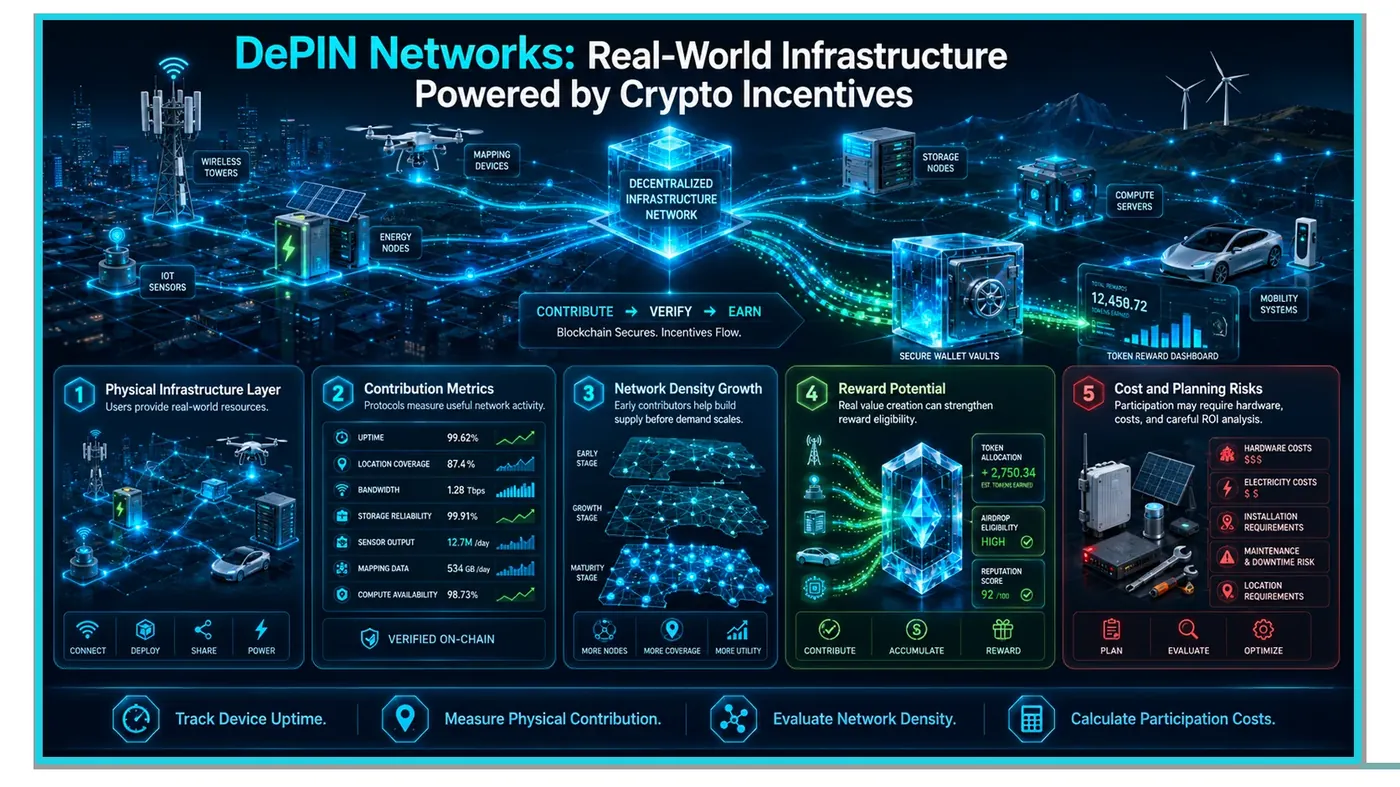
- DePIN, or decentralized physical infrastructure networks, brings crypto incentives into real-world infrastructure. This category includes wireless coverage, mapping, storage, sensors, energy networks, mobility systems, decentralized compute and data collection. Instead of rewarding only digital clicks, DePIN protocols often reward users for providing useful physical or computational resources.
- This makes DePIN a unique airdrop category. A wallet interaction may not be enough. A protocol may measure device uptime, location coverage, bandwidth, storage reliability, mapping contribution, sensor output or compute availability. Users who contribute real value to the network can become important before a token is widely distributed.
- DePIN can also reward early users because infrastructure networks depend on density. A wireless protocol becomes more useful when coverage expands. A mapping network becomes stronger when more users contribute data. A compute network becomes more valuable when more machines are available. Early contributors can help create the supply side of a marketplace before mainstream demand arrives.
- However, DePIN requires more planning than simple on-chain activity. Some projects involve hardware, installation, electricity costs, maintenance or location requirements. Users should calculate the real cost of participation and avoid assuming that every DePIN project will produce meaningful rewards.
5. DEX and On-Chain Trading Ecosystems
- Decentralized exchanges remain one of the most consistent sources of airdrop opportunities because they depend on liquidity, trading volume and active markets. A DEX needs traders, liquidity providers, market makers, governance participants and early adopters of new features. That makes user incentives central to growth.
- In 2026, DEX airdrops may become more refined. Protocols may reward sustained trading, concentrated liquidity management, referral activity, governance voting, cross-chain swaps, derivatives usage or early participation in new market structures. Perpetual DEXs, intent-based exchanges, aggregators and app-specific trading chains may all design incentive campaigns around real usage.
- DEX activity also overlaps with other categories. A user might trade AI tokens on an L2, provide liquidity for a DePIN asset, bridge through a modular ecosystem and interact with a new DEX aggregator. This overlap can create multiple reward paths from a single strategy. That is why the final layer of 2026 airdrop categories is not isolated. It is interconnected.
- Still, DEX participation carries risk. New tokens can be illiquid, volatile or malicious. Liquidity pools can expose users to impermanent loss. Thin markets can create misleading charts. Smart contract risk and fake token contracts are constant concerns. Users should analyze liquidity, holders, contract details, transaction history and trading behavior before entering new markets.
Building a Smarter Airdrop Strategy
- The strongest airdrop strategy in 2026 is not about chasing every campaign. It is about selecting categories with real product-market potential and then participating consistently. Users should ask several questions before spending time or capital: Does the protocol need users? Does it have a clear reason to launch a token? Does my activity provide value? Is the risk worth the potential reward?
- A balanced strategy may include several categories. L2s and L3s can provide broad ecosystem exposure. Restaking can connect users to shared security. AI networks can reward product testing and data contribution. DePIN can reward infrastructure support. DEXs can reward liquidity and trading behavior. Together, these sectors form a practical framework for identifying where future airdrops may emerge.
- Users should also maintain clean operational habits. This includes tracking wallets, recording campaign requirements, avoiding suspicious links, using official domains, checking contract addresses and separating experimental activity from long-term holdings. Airdrop hunting can be profitable, but it also attracts scams, phishing attempts and fake claim pages.
- The most important principle is authenticity. Protocols increasingly want users who behave like real participants, not bots. Real activity means returning to the platform, using different features, understanding the product and contributing to growth. In a more competitive environment, consistency and quality may matter more than transaction count alone.
Tracking Asset Momentum via DEXTools features
- DEXTools is a decentralized trading analytics platform that provides real-time charts, historical market data, token information and on-chain activity insights across DEX markets. Pair Explorer helps users inspect token pairs, liquidity, price action, transactions and market structure, while the Live New Pairs dashboard helps traders discover newly created pairs as they appear across decentralized exchanges.
- Trade Story and Top Traders add another layer of market context by helping users interpret trading behavior, wallet activity and the participants driving movement around specific assets. Together, these tools support faster screening, better token discovery and more informed decision-making in volatile DEX environments.
You can access DEXTools here and start trading today
Disclaimer: This article is for informational purposes only and does not constitute investment advice, financial advice, trading advice, or any other kind of advice. DEXTools does not recommend buying, selling, or holding any cryptocurrency or token. Users should conduct their own research and consult with a qualified financial advisor before making any investment decisions. Cryptocurrency investments are volatile and high-risk. DEXTools is not responsible for any losses incurred.