What Are Internet Capital Markets (ICM) in Crypto? A 2026 Guide
— By Tony Rabbit in Tutorials

Finance has outgrown the legacy banking grid. We deconstruct the institutional architecture, financial primitives, and systemic flywheels of crypto-native Internet Capital Markets.
The emergence of Internet Capital Markets
- For centuries, global financial infrastructure has been bound by the physical, legal, and operational limitations of localized geographic networks. Traditional capital markets (orchestrated by legacy institutions like the New York Stock Exchange, Euroclear, and global commercial banking cartels rely on a fragmented stack of clearing houses, transfer agents, central securities depositories, and correspondent banks.
- This multi-layered legacy architecture introduces structural friction: settlement takes days, capital is locked behind permissioned gatekeepers, markets operate only during restricted local business hours, and compliance verification requires extensive manual oversight.
- The emergence of Internet Capital Markets (often referred to as ICMs or crypto-native financial infrastructure) represents the definitive migration of global financial primitives onto public, open-source blockchain ledgers.
- Instead of treating crypto merely as a volatile alternative asset class, institutional allocators recognize that blockchains are a superior architectural substrate for financial engineering. An Internet Capital Market unifies capital formation, asset issuance, liquidity provision, risk management, and clearing into a single, programmable ledger layer that operates 24/7/365 with sub-second atomic finality. It is the reorganization of global capitalism onto the native rails of the internet.
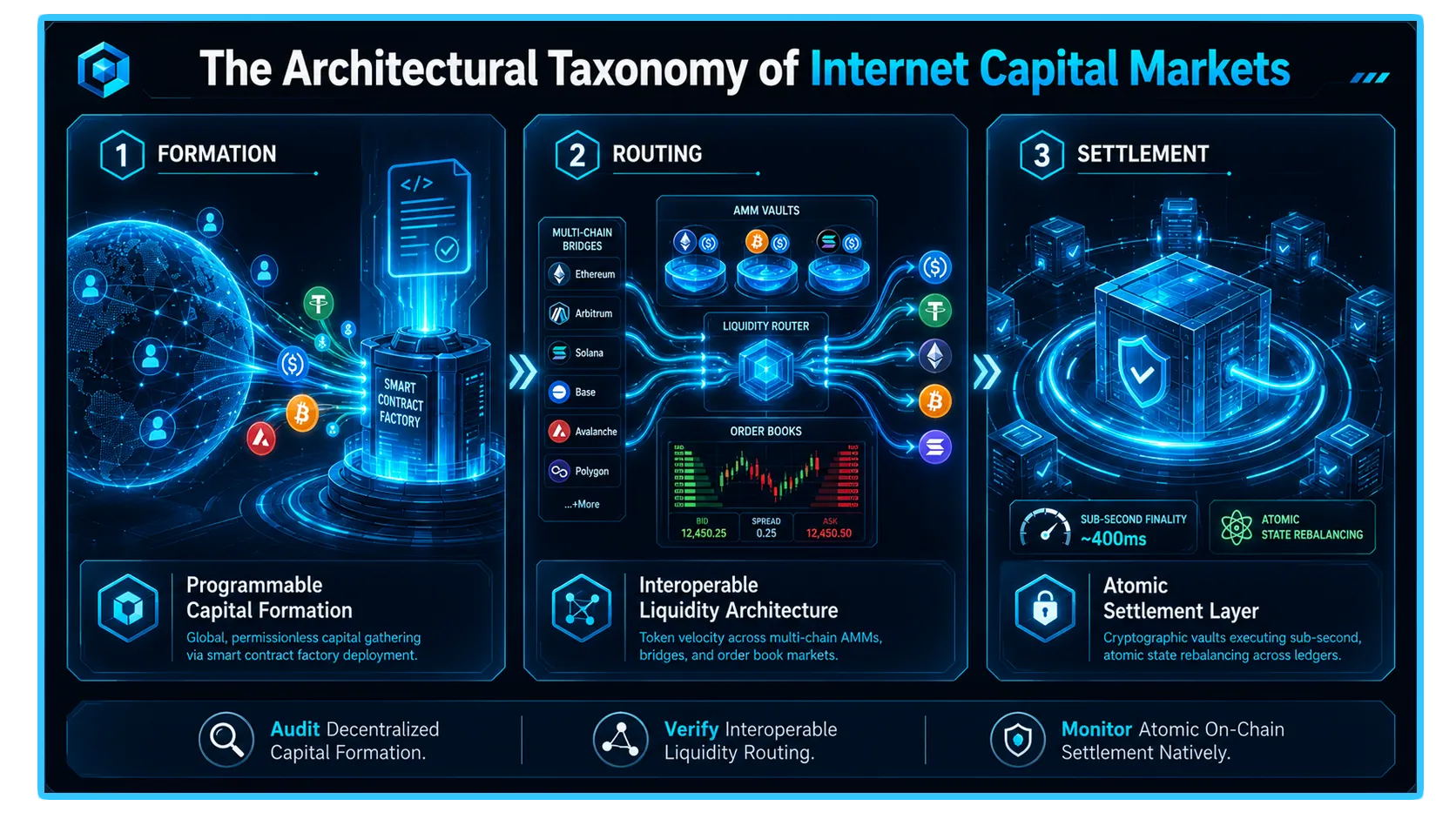
1. The Three Structural Pillars of ICM Architecture
To analyze Internet Capital Markets with professional-grade precision, you must evaluate the three foundational subsystems that replace traditional corporate investment banking pipelines.
Pillar 1: Programmable Capital Formation
- In legacy finance, raising capital requires millions of dollars in underwriting fees, legal audits, and administrative preparation to clear regulatory hurdles like IPOs or bond issuances. ICMs democratize capital formation through smart contract factories.
- Whether a project utilizes algorithmic bonding curves, Liquidity Bootstrapping Pools (LBPs), or decentralized launchpads, the process of pooling global capital and distributing equity-proxies (tokens) is completely automated. Capital can be raised from a global, permissionless pool of participants instantly, shifting the timeline of capital formation from months to seconds.
Pillar 2: The Interoperable Liquidity Matrix
- Traditional financial markets are deeply siloed; an asset listed on an exchange cannot easily or automatically interface with liquidity pools in alternative jurisdictions without expensive intermediary routing. ICM liquidity is inherently composable.
- Through Automated Market Makers (AMMs), Central Limit Order Books (CLOBs), and Discrete Liquidity Market Makers (DLMMs), assets function as open financial lego blocks. Liquid capital can be instantly auto-routed across lending markets, derivative vaults, and yield-bearing stablecoins natively, optimizing capital efficiency to its absolute mathematical maximum.
Pillar 3: Atomic Clearing and Settlement
- The traditional financial clearing system is plagued by counterparty risk due to the time lag between trade execution and asset delivery ($T+2$ settlement). ICMs achieve Atomic Settlement.
- An atomic transaction is a cryptographic operation where the delivery of an asset and the delivery of its payment occur simultaneously inside a single block validation. If one side of the transaction fails, the entire state transition is rolled back by the network. This immediate confirmation entirely eliminates settlement risk, nullifies the need for centralized clearing houses, and frees up billions of dollars in collateral that would otherwise sit idle in legacy risk-margin accounts.
2. Systemic Divergence: TradFi vs. Internet Capital Markets
The operational contrast between traditional capital structures and internet-native financial rails fundamentally alters the velocity and transparency of global capital allocation.
The Structural Infrastructure Comparison
| Financial Core Primitives | Traditional Capital Markets (TradFi) | Internet Capital Markets (ICMs) |
| Operational Availability | Restricted (9:30 AM – 4:00 PM, closed weekends) | Absolute (24/7/365 continuous streaming) |
| Asset Custody Layer | Fully custodial (held via broker-dealers and banks) | Strictly non-custodial (secured via private cryptographic keys) |
| Settlement Horizon | Latent ($T+1$ to $T+3$ banking clearing days) | Instantaneous (Atomic sub-second block validation) |
| Regulatory Enforcement | Ex-Post (Manual, retroactive legal litigation) | Ex-Ante (Hardcoded smart contract boundaries) |
| Ledger System State | Private, siloed, non-transparent databases | Public, open-source, immutable shared ledgers |
3. The Financial Engineering Matrix: Modern ICM Primitives
As the internet capital stack has institutionalized, it has developed sophisticated financial instruments that mirror and improve upon the products found on Wall Street.
Yield Tokenization: Primitives like Pendle Finance decouple an asset's principal value from its future yield stream, creating a native on-chain zero-coupon bond market (Principal Tokens) alongside a leveraged volatility market (Yield Tokens).
Synthetic Money Markets: Protocols like Ethena leverage delta-neutral basis trading (combining spot long collateral with short derivatives contracts) to engineer tokenized stable dollars that generate organic internet-native bonds independent of commercial banks.
Tokenized Real-World Assets (RWAs): Issuers like Ondo and Mountain Protocol bring institutional sovereign debt instruments, such as US Treasury bills, directly onto public ledgers. These tokenized notes function as hyper-liquid, yield-bearing collateral primitives usable across the entire decentralized financial landscape.
4. Systemic Risks and Architectural Fault Lines
Navigating the frontier of Internet Capital Markets requires an institutional appreciation of its unique failure modes. ICMs eliminate human intermediary risk but introduce systemic technological liabilities.
Code Infallibility and Smart Contract Vulnerabilities
Because ICMs operate via automated code, the security of your capital is entirely dependent on the logical perfection of the smart contracts. A minor coding syntax error, flash loan economic manipulation vector, or reentrancy vulnerability can result in an instantaneous, irreversible drain of an entire protocol's collateral vaults.
There are no corporate bailouts, insurance mechanisms, or centralized administrative overrides to reverse a cryptographic exploit.
Economic Reflexivity and De-Peg Cascades
The high composability of internet finance introduces deep systemic reflexivity. If a primary stablecoin collateral asset experiences a localized liquidity failure or an oracle pricing delay, the disruption can instantly propagate across integrated lending markets, automated option vaults, and yield protocols simultaneously. This interconnected web can trigger automated liquidation cascades, where systemic deleveraging sweeps through multiple chains at terminal velocity.
5. Real-Time Diagnostics and Telemetry via DEXTools
- Successfully navigating a global, high-velocity internet financial system requires access to look-through data telemetry. While an individual protocol's front-facing application may present an idealized version of its capital efficiency, tracking the live transaction logs, aggregate order book imbalances, and physical liquidity distribution across alternative blockchain networks is the only method to verify genuine financial stability.
- DEXTools provides the critical analytical infrastructure necessary to audit these movements in real-time. By utilizing advanced pair tracking, cross-chain volume visualization, and large-scale wallet analytics, market participants can independently verify whether the capital velocity reported across the ecosystem matches actual on-chain liquidity depth.
You can access DEXTools here and start trading today!
Disclaimer: This article is for informational purposes only and does not constitute investment advice, financial advice, trading advice, or any other kind of advice. DEXTools does not recommend buying, selling, or holding any cryptocurrency or token. Users should conduct their own research and consult with a qualified financial advisor before making any investment decisions. Cryptocurrency investments are volatile and high-risk. DEXTools is not responsible for any losses incurred.