What Are Moving Averages in Crypto? EMA vs SMA Guide 2026
— By Tony Rabbit in Tutorials
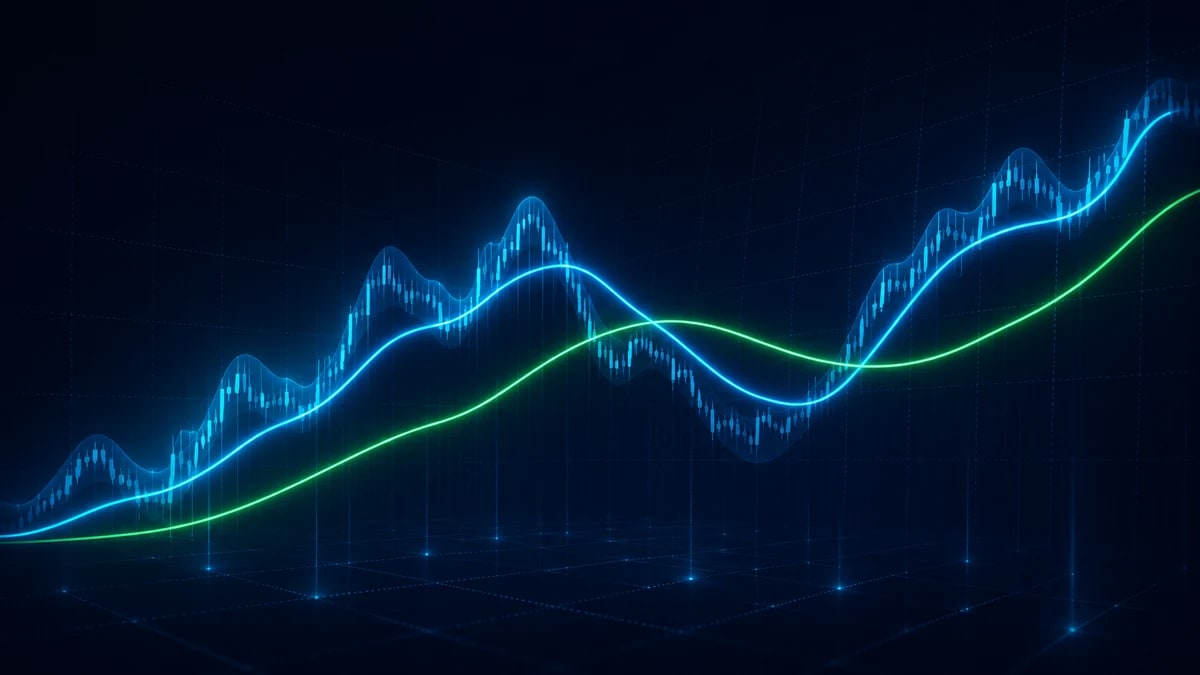
Learn how moving averages work in crypto trading, the difference between EMA and SMA, the most common periods, and how traders use them to read trend direction and find dynamic support and resistance.
Crypto charts move fast, and raw price action can look like pure noise. Candles spike up and down, wicks stab in every direction, and it becomes hard to tell whether a token is actually trending or just chopping sideways. Moving averages exist to solve exactly this problem. They take the messy price data and smooth it into a single, readable line that reveals the underlying direction.
Among all technical indicators, moving averages are some of the most widely used because they are simple to understand and flexible to apply. In this guide we break down what a moving average is, how the simple moving average (SMA) differs from the exponential moving average (EMA), which periods traders rely on, and how to use these tools on platforms like DEXTools without falling into common traps.
What Is a Moving Average?
A moving average is a line plotted on a price chart that represents the average price of an asset over a set number of periods. As each new candle closes, the oldest data point drops off and the newest one is added, so the average constantly updates, or "moves," with the market. The result is a smoothed curve that filters out short-term noise and highlights the broader trend.
The core idea is to answer one question at a glance: which way is price generally heading? When the line slopes upward, the trend is up. When it slopes downward, the trend is down. When it flattens out, the market is likely ranging. This makes moving averages a foundational building block for almost every trading strategy, from quick scalps to long-term position holding.
Moving averages are lagging indicators, which means they react to price after it has already moved. That is the trade-off for the smoothing they provide. They will not call a top or a bottom in advance, but they do a strong job of confirming and tracking a trend once it is underway.
SMA: The Simple Moving Average
The simple moving average is the most basic version. It takes the closing prices over a chosen number of periods and divides by that number. Every period in the calculation carries equal weight, so a price from 20 candles ago counts exactly as much as the most recent candle.
For example, a 20-period SMA on a daily chart adds up the last 20 daily closes and divides by 20. Tomorrow, the calculation drops the oldest close and adds the newest one. Because all data points are weighted equally, the SMA produces a very smooth line that changes direction slowly.
- Strength: the equal weighting makes it stable and resistant to single-candle spikes, so it filters noise well.
- Weakness: that same stability makes it slow to react, so it can lag noticeably behind sharp price moves.
Traders often favor the SMA when they want a clean read on the longer-term trend and are willing to accept slower signals in exchange for fewer false alarms.

EMA: The Exponential Moving Average
The exponential moving average is built to address the SMA's biggest drawback: lag. Instead of weighting every period equally, the EMA gives more weight to recent prices. The latest candles influence the line the most, while older candles fade in importance. This makes the EMA hug price more tightly and turn faster when momentum shifts.
Because it reacts quicker, the EMA is popular with active traders who want earlier signals. If a token suddenly breaks out, the EMA will start curving up sooner than the SMA, giving a more timely cue. The flip side is that this responsiveness also makes the EMA more prone to false signals when the market is choppy, since it picks up on every short burst of volatility.
- Strength: faster reaction to new price action, which is useful for catching trends early.
- Weakness: more sensitive to noise, so it can generate whipsaws in sideways or volatile conditions.
Common Moving Average Periods
The number of periods you choose defines how short-term or long-term the moving average is. Shorter periods react fast and track recent price closely; longer periods are smoother and represent the bigger picture. A handful of period settings have become standard across crypto and traditional markets alike.
- 20-period: a short-term average that many swing traders watch for near-term momentum and minor support or resistance.
- 50-period: a medium-term average often used to gauge the intermediate trend.
- 100-period: a longer-term reference that helps frame the broader market direction.
- 200-period: the major long-term benchmark. Many traders treat price above the 200 as a structurally bullish environment and price below it as bearish.
There is nothing magic about these exact numbers, but because so many participants watch them, they often act as self-fulfilling levels where price reacts. The 200-period average in particular is one of the most respected lines on any chart.
How Traders Use Moving Averages
Moving averages are versatile, and most strategies lean on one or more of the following uses. Understanding each helps you read what a chart is telling you rather than just staring at a line.
Trend Direction
The simplest use is reading where price sits relative to the moving average. Price trading above a rising MA suggests an uptrend, while price below a falling MA suggests a downtrend. The slope of the line itself also matters: a steep angle signals strong momentum, while a flat line warns that the trend is losing steam or ranging.
Dynamic Support and Resistance
Unlike horizontal levels, moving averages move with price, which lets them act as dynamic support and resistance. In an uptrend, price often pulls back to a key MA such as the 20 or 50 and bounces from it, treating the line as a floor. In a downtrend, the same averages can act as a ceiling that price struggles to break above.

Crossovers
When two moving averages of different lengths are plotted together, the points where they cross can signal a shift in momentum. A faster MA crossing above a slower MA is often read as bullish, while a faster MA crossing below a slower one is read as bearish. The most famous example is the 50 crossing the 200: a cross upward is called a golden cross and a cross downward a death cross. Those specific signals have their own dedicated guides, so here we simply note them as a special case of the broader crossover concept.
EMA vs SMA: Which Should You Use?
There is no universally correct answer; the right choice depends on your trading style and timeframe. The two tools are different lenses on the same price data, and many traders use both.
- Choose the EMA when you want faster signals for active or short-term trading and you are comfortable filtering out some false moves.
- Choose the SMA when you want a smoother, more reliable read on the longer-term trend and you prioritize stability over speed.
A common approach is to combine them: use a longer SMA to define the dominant trend and a shorter EMA to time entries within that trend. On DEXTools, you can add moving averages directly to a token's chart, adjust the period and type, and overlay several at once to build this kind of layered view across the on-chain pairs you follow.
Limitations and Best Practices
Moving averages are powerful, but they are not a complete system on their own. Keeping their limitations in mind will save you from common mistakes.
- They lag. Because they are based on past prices, they confirm trends rather than predict them. Do not expect them to catch exact tops or bottoms.
- They struggle in ranges. When a market chops sideways, price crosses back and forth over the MA, producing repeated false signals known as whipsaws. Moving averages perform best in clearly trending conditions.
- They are stronger together with other tools. Pair moving averages with volume, momentum indicators, or support and resistance to confirm signals rather than acting on a single line in isolation.
- Risk management is essential. No indicator removes the need for position sizing and stop placement. Plan your risk before you enter, regardless of what the MA shows.
Treat moving averages as a context tool that frames the trend, not as a standalone buy or sell button.
Conclusion
Moving averages turn noisy crypto price action into a clean line that reveals trend direction, marks dynamic support and resistance, and flags momentum shifts through crossovers. The SMA weights all periods equally for a smooth, stable read, while the EMA emphasizes recent prices to react faster at the cost of more false signals. Common periods like 20, 50, 100, and 200 give you short to long-term perspectives, with the 200 standing out as the key long-term benchmark.
Choosing between EMA and SMA comes down to whether you value speed or stability, and many traders blend both. Whatever you choose, combine moving averages with other tools, respect their tendency to whipsaw in ranges, and always manage risk. This article is educational and not financial advice or a price prediction.
Beyond the Basics: Applying MAs in Multi-Timeframe Analysis
While understanding individual Moving Averages (MAs) is crucial, their true power often emerges when employed in conjunction with multi-timeframe analysis. This advanced approach involves observing the same asset across different timeframes simultaneously, using MAs on each to paint a more comprehensive picture of the underlying trend and potential turning points. A short-term MA on a 1-hour chart might indicate an immediate pullback, but if the long-term MA on the daily chart is still pointing strongly upwards, the pullback is likely just a temporary retracement within a larger bullish trend.
The synergy between MAs on various timeframes helps traders filter out noise and confirm signals. For instance, a bullish crossover on a 15-minute chart gains significantly more weight if the 4-hour chart's MAs are also showing a nascent uptrend or are positioned for a potential crossover. This layered perspective provides a robust framework for trade entry and exit strategies, reducing false signals often generated by relying on a single timeframe alone.
Practical Multi-Timeframe MA Strategies
- Trend Confirmation: Use long-term MAs (e.g., 200-period daily) to confirm the primary trend direction, and shorter-term MAs (e.g., 50-period 4-hour) to identify entry points aligned with that trend.
- Support and Resistance Convergence: Look for instances where MAs from different timeframes converge at a specific price level, indicating a stronger dynamic support or resistance zone.
- Divergence Across Timeframes: Pay attention when MAs on a shorter timeframe show a strong trend in one direction, but longer-term MAs are flat or trending in the opposite direction, suggesting a potential trend reversal or significant retracement.
- Entry and Exit Filtering: Only take trades in the direction of the higher timeframe trend, using lower timeframe MA signals to fine-tune your entry and exit points for optimal risk reward.
- Volatility Assessment: Observe the spacing between MAs across timeframes; wider separation can indicate higher volatility, while tighter spacing suggests consolidation.
Related Guides
- EMA vs SMA in Crypto: Key Differences Explained (2026)
- Price Impact Ladder: Trade Without Moving Crypto Prices
- Chain Rotation: How Traders Detect Liquidity Moving Between Ecosystems
Frequently Asked Questions
What are moving averages in crypto trading?
A moving average is an indicator that averages price over a set number of periods to smooth out short-term fluctuations. Traders use it to gauge trend direction and identify dynamic support or resistance.
What is the difference between EMA and SMA?
A simple moving average gives equal weight to all prices in the period, while an exponential moving average gives more weight to recent prices. As a result, the EMA reacts faster to new price changes than the SMA.
Which is better, EMA or SMA?
Neither is universally better, since EMA reacts faster but can give more false signals, while SMA is smoother but slower. The right choice depends on the trader's strategy and time frame.
How do traders use moving averages?
Common uses include reading trend direction, spotting crossovers between different period averages, and treating the average as dynamic support or resistance. They are often combined with other indicators for confirmation.