What are Verkle Trees? Ethereum Statelessness Explained

Running an Ethereum validator node currently requires storing hundreds of gigabytes of state data on disk. We break down how Verkle Trees use vector commitments to enable stateless clients.
The Storage Bottleneck: The Ever-Expanding Footprint of Global State
- The core engineering barrier to scaling decentralized smart contract networks is not transaction execution speeds: it is database storage. For every transaction processed on Ethereum, validators must continually update and maintain a record of all accounts, balances, smart contract bytecodes, and storage slots. This collective data pool is known as the global state.
- Under the network's legacy data structure, the state is stored in a complex hierarchical architecture called a Merkle Patricia Tree (MPT). As the network ages, this state database expands relentlessly, crossing the hundreds-of-gigabytes threshold. To validate incoming blocks, full node operators are forced to buy expensive, high-performance solid-state drives (SSDs) simply to store and retrieve this data in real time. If left unchecked, this "state bloat" threatens to centralize the validator set by pricing out home stakers and consumer-tier hardware.
- Verkle Trees completely re-engineer this paradigm. Serving as a central milestone within the structural roadmap phase known as The Verge, Verkle Trees introduce the concept of Ethereum Statelessness. By shifting the underlying ledger database from primitive cryptographic hashes to advanced vector commitments, this infrastructure upgrade removes the requirement for validating nodes to store the entire state database on disk, protecting long-term decentralization.
1. The Core Objective: Achieving "Weak Statelessness"
To protect the network from hardware centralization, core developers are implementing a design known as Weak Statelessness.
In a weakly stateless network architecture, the economic burdens of block production and block validation are completely separated:
Block Builders: Commercial block builders, who are already highly specialized, professional entities, continue to maintain the full, heavy state database on disk.
Block Validators: Individual validators (including home stakers running 32 ETH setups) no longer need to keep any local copy of the global state on disk.
- Instead of executing transactions against a local database, validators receive a block accompanied by a compact packet of cryptographic data called a witness. The witness contains the precise slices of state data that the block’s transactions will read or modify, bundled alongside proof that this data is authentic.
- The validator simply executes the block against this lightweight witness payload. For this structure to work safely within Ethereum's 12-second block slots, these witness packets must be small enough to propagate across the open internet instantly without triggering network congestion.
2. The Witness Bottleneck inside Merkle Patricia Trees
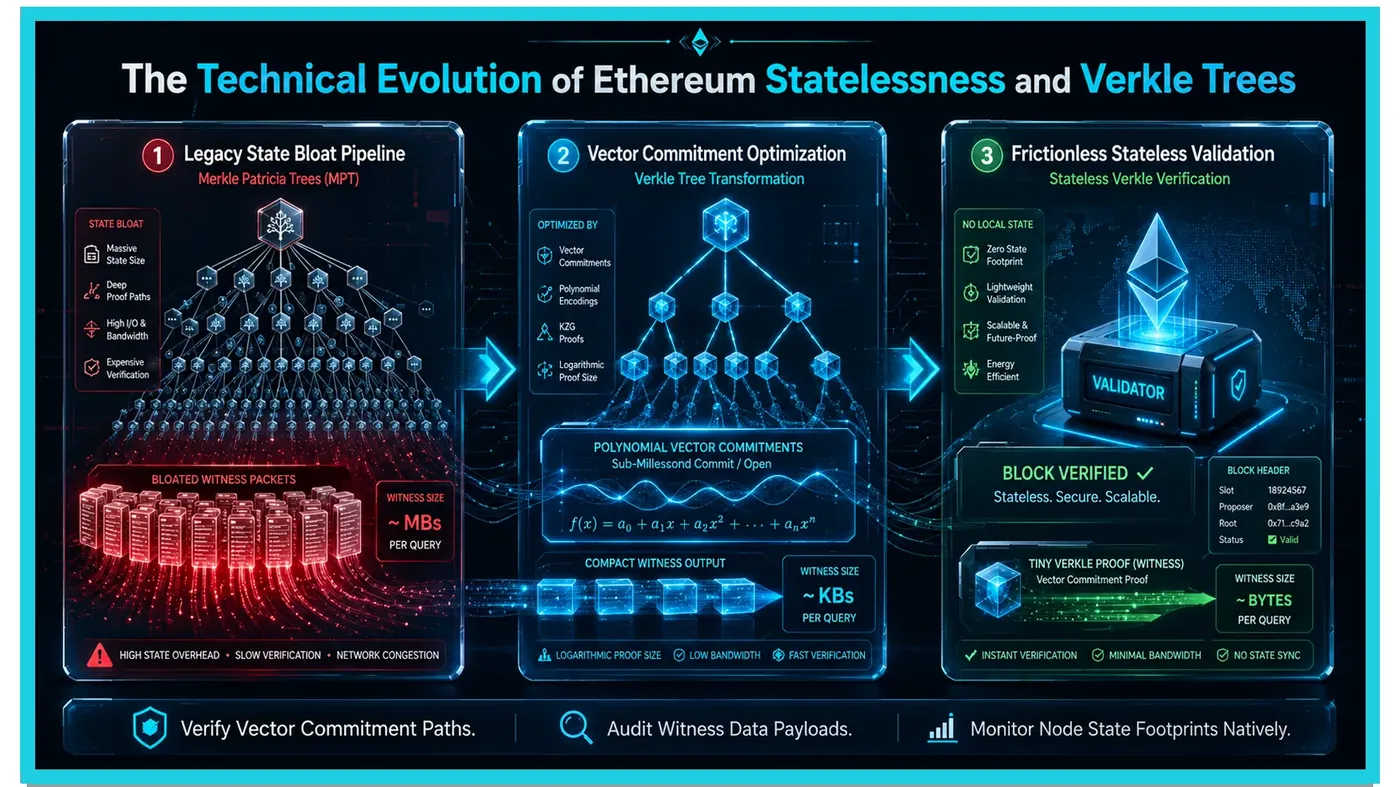
Ethereum's legacy Merkle Patricia Tree architecture is fundamentally incapable of supporting statelessness because its cryptographic proofs are too bulky.
In an MPT configuration, data items are stored as leaf nodes at the very bottom of a deep, narrow tree structure. To prove that any single piece of data is authentic, a witness must include the hashes of all sister nodes flanking that specific path all the way up to the master state root.
The Structural Failure: Because the tree is deep and narrow, proving a bundle of transactions requires attaching a massive string of intermediate hashes.
The Bandwidth Wall: A standard MPT-backed block witness regularly spans anywhere from 2 to 15 megabytes in size. Broadcasting data packets of this size across thousands of global validator nodes every 12 seconds creates severe bandwidth bottlenecks, resulting in missed attestations and unviable block propagation delays.
3. Verkle Trees: Merging Vector Commitments with Wide Branching
Verkle Trees (a portmanteau of Vector Commitment and Merkle Trees) elegantly solve the witness size dilemma by fundamentally altering the mathematical geometry of the data tree.
Extreme Wide Branching
While a standard Merkle tree features a narrow branching factor (where each parent node has only a few children), a Verkle tree is designed with extreme width. A typical Verkle tree node supports a branching factor of 256 children or more. This wide footprint drastically flattens the total height of the tree, meaning a validator needs to traverse far fewer intermediate layers to reach the data leaf from the state root.
Replacing Hashes with Polynomial Vector Commitments
If a developer attempted to build a wide tree using standard cryptographic hashes, the proof size would actually explode because you would have to provide the hashes of all 255 sibling nodes at every level.
Verkle Trees prevent this by replacing standard cryptographic hashing algorithms with Vector Commitments, specifically utilizing advanced polynomial frameworks like Inner Product Arguments (IPA) or Pedersen commitments.
The Mathematical Compression: A vector commitment allows a parent node to cryptographically bind and compress all 256 of its children simultaneously.
Constant-Size Proofs: Instead of listing every individual sibling hash along the data path, a vector commitment creates a single, unified polynomial proof that verifies the entire path context in one step.
By flattening the tree depth and compressing parent-child verifications, Verkle Trees slash the average block witness size from megabytes down to a tiny 100 to 200 kilobytes. This enables stateless nodes to receive, download, and verify incoming block proofs in milliseconds on low-power consumer hardware.
State Infrastructure Comparison Matrix
| Metric | Merkle Patricia Trees (MPT) | Verkle Trees (Polynomial Commitments) |
| Branch Factor | Narrow (Hexary / 16) | Wide (256+ Children) |
| Witness Size | Megabytes (Too Large) | Tens of Kilobytes (Compact) |
| Node State Disk | 100GB+ Required | ~0GB (Stateless Validation) |
4. Strategic Implementation: The Hegotá Hard Fork Alignment
- The transition to Verkle Trees is scheduled for deployment during the upcoming Hegotá hard fork, representing the second major upgrade phase following H1's market-focused Glamsterdam release.
- Because rewriting the data structures of a live, multi-billion-dollar operating network is exceptionally complex, the migration requires an automated protocol state-conversion cycle. During the hard fork activation, the historical MPT state root is permanently frozen as an immutable read-only leaf, while all newly generated account interactions, balances, and smart contract storage slots are mapped natively into the modernized Verkle format, enabling a progressive, zero-downtime structural migration.
5. Auditing Protocol Infrastructure via DEXTools Telemetry
- As Ethereum upgrades its Layer 1 core execution engines to support stateless operations, tracking the resulting token capital flows, liquidity rotations, and secondary market ecosystem health parameters across decentralized exchanges becomes a critical discipline for technical market participants.
- Sourcing analytics through advanced decentralized charting architectures like DEXTools gives market participants an essential universal platform to monitor live token behaviors, evaluate pool depths, and inspect contract parameters across all public execution networks. By leveraging core features like the Pair Explorer, Live New Pairs dashboard, and the integrated Trade Story or Top Traders diagnostic tools, technical traders can seamlessly audit localized volume trends, track large whale wallet capital reallocations via the Big Swap Explorer, and check automated contract safety scores before initiating any on-chain interactions, ensuring your hardened hardware setup interacts safely with verified market venues.
You can access DEXTools here and start trading today!
Disclaimer: This article is for informational purposes only and does not constitute investment advice, financial advice, trading advice, or any other kind of advice. DEXTools does not recommend buying, selling, or holding any cryptocurrency or token. Users should conduct their own research and consult with a qualified financial advisor before making any investment decisions. Cryptocurrency investments are volatile and high-risk. DEXTools is not responsible for any losses incurred.
How to Check a Liquidity Pool Before Buying a Token 2026 Smart Contract Audit Guide: How to Read an Audit Report Why Real Time Data Matters for DEX Traders Top 5 Whale Tracking Tools in 2026: Large Wallet Monitoring Across Chains