What Is a Dragonfly Doji Candlestick in Crypto Trading? (2026)
— By Tony Rabbit in Tutorials

Learn about the Dragonfly Doji candlestick pattern in crypto trading: what it is, how it forms, and how to use it for potential bullish reversals.
What Is a Dragonfly Doji Candlestick?
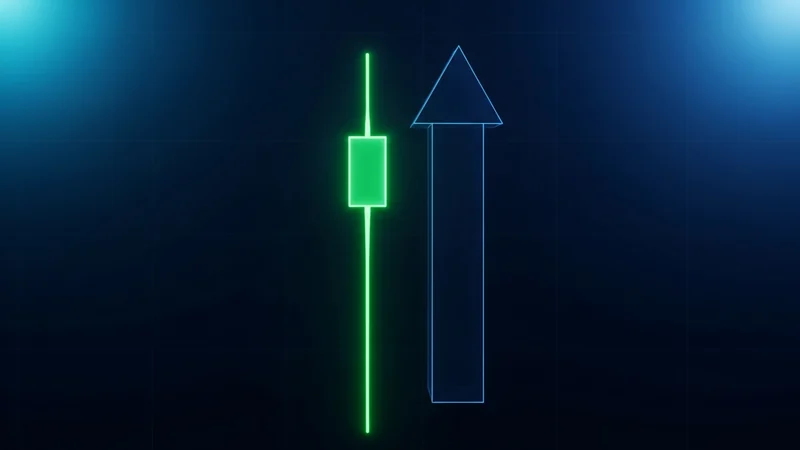
The Dragonfly Doji is a unique candlestick pattern that often catches the eye of crypto traders. It's characterized by a long lower wick and little to no upper wick, with the open, close, and high prices all converging near the top of the candle.
This distinct shape provides a visual representation of price action during a specific trading period, whether it's an hour, a day, or a week, depending on the chart's timeframe.
How Does a Dragonfly Doji Form?
This pattern forms when sellers initially push the price significantly lower during the trading session. However, by the close of the session, buyers step in with enough strength to reclaim those losses.
The price then closes near its open and high, indicating a strong rejection of lower prices. This battle between buyers and sellers is what creates its characteristic long lower shadow.
What Does a Dragonfly Doji Signal?
The Dragonfly Doji is most meaningful when it appears at the bottom of a downtrend or at a significant support level. In these contexts, it hints at a possible bullish reversal.
It suggests that selling pressure might be exhausting, and buying pressure is starting to take control, potentially leading to an upward price movement.
How to Trade with a Dragonfly Doji
Spotting a Dragonfly Doji on a DEXTools chart can be the first step in identifying a potential trading opportunity. However, it's crucial not to trade solely based on this pattern.
Traders look for additional confirmation to increase the reliability of the signal. This pattern serves as an alert, not a definitive entry point.
- Identify the Downtrend or Support. Look for a clear downtrend or a well-established support level on your chosen timeframe.
- Spot the Dragonfly Doji. Locate a candlestick with a long lower wick and a body (open, close, high) near the top.
- Look for Confirmation. Wait for the next candle to close higher than the Dragonfly Doji's close. This is a critical step.
- Observe Volume. Ideally, the confirmation candle should also show rising volume, indicating strong buying interest.
- Consider Entry. If confirmation is strong, a trader might consider an entry after the confirmation candle closes.
- Set Stop-Loss. Place a stop-loss order below the low of the Dragonfly Doji's lower wick to manage risk.
Dragonfly Doji vs. Gravestone Doji
Understanding the opposite pattern helps solidify your grasp of the Dragonfly Doji. The Gravestone Doji is its inverse, signaling potential bearish reversals.

Limitations and Confirmation
While the Dragonfly Doji can be a powerful signal, it is not reliable on its own. Confirmation from subsequent price action and other indicators is essential.
A higher close on the next candle, ideally with rising volume, provides the necessary confirmation. Without it, the pattern's predictive power is significantly reduced.
Tips for Using the Dragonfly Doji
To maximize the effectiveness of the Dragonfly Doji, consider these tips:
- Combine with Indicators: Use the Dragonfly Doji in conjunction with other technical indicators like RSI, MACD, or moving averages to strengthen your analysis.
- Multiple Timeframes: Check for the pattern across different timeframes. A Dragonfly Doji on a daily chart, confirmed by a similar pattern on a weekly chart, can be more robust.
- Volume Analysis: Always pay attention to trading volume. A strong reversal should ideally be accompanied by an increase in buying volume.
- Market Context: Consider the broader market sentiment and news. While technical analysis is key, external factors can influence price action.
Frequently Asked Questions
Q: What is a Dragonfly Doji candlestick?
A: A Dragonfly Doji is a candlestick with a long lower wick and little or no upper wick, where the open, close, and high are near the top of the candle.
Q: How does a Dragonfly Doji form?
A: It forms when sellers push the price down during a session, but buyers reclaim the losses by the close, indicating a rejection of lower prices.
Q: When is a Dragonfly Doji most significant?
A: It is most meaningful at the bottom of a downtrend or at a support level, hinting at a possible bullish reversal.
Q: What confirmation do traders look for after a Dragonfly Doji?
A: Traders look for confirmation from a higher close on the next candle and rising trading volume.
Q: Is a Dragonfly Doji reliable on its own?
A: No, a Dragonfly Doji is not reliable on its own and is the opposite of a gravestone doji.