What Is a Gamma Squeeze in Crypto? Options Mechanics (2026)
— By Whatsertrade in Tutorials

Learn what a gamma squeeze is in crypto, how options market makers drive sharp price rises through hedging, and why it differs from a short squeeze.
In the fast-paced world of cryptocurrency, understanding complex market phenomena is crucial for both seasoned traders and new entrants. One such event that can lead to dramatic price movements is a 'gamma squeeze.' While often discussed in traditional finance, its mechanics are particularly potent and relevant within the crypto landscape, where volatility and unique market structures amplify its effects.
This guide will demystify the gamma squeeze, breaking down its underlying options mechanics, how it unfolds in crypto, and what distinguishes it from other market events like a short squeeze. By 2026, as the crypto options market matures, recognizing these dynamics will be an invaluable skill for navigating volatile periods.
Understanding the Core Mechanics of a Gamma Squeeze
At its heart, a gamma squeeze is a sharp price rise driven not by an organic surge in spot market demand, but by the intricate hedging activities of options market makers. To grasp this, we first need to understand the role of market makers in options trading.
Market makers provide liquidity by continuously quoting both buy and sell prices for options contracts. When you, as a trader, buy a call option, a market maker is typically on the other side of that trade, selling it to you. This sale creates risk for the market maker, as they are now exposed to potential losses if the price of the underlying asset rises significantly.
To mitigate this risk, market makers employ a strategy called 'delta hedging.' Delta is a Greek letter that measures an option's sensitivity to a change in the underlying asset's price. For a call option they have sold, as the price of the underlying asset increases, the delta of that call option also increases. To remain delta-neutral, the market maker must buy more of the underlying asset.
The Feedback Loop: How a Squeeze Initiates
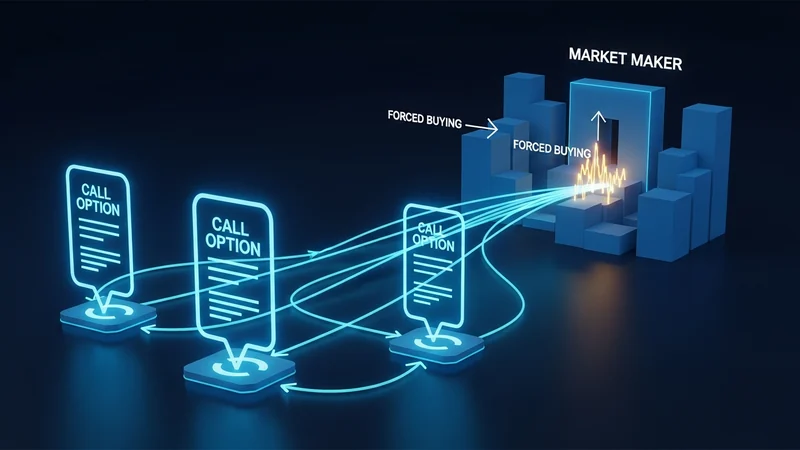
The squeeze begins when a significant volume of call options is purchased by traders. This initial buying pressure forces market makers to sell these calls and, in turn, buy the underlying asset to hedge their exposure. This initial hedging activity pushes the price of the underlying asset up slightly.
As the price rises, more of the previously sold call options move 'in the money' or closer to being in the money. This change in the options' status causes their deltas to increase further, requiring market makers to buy even more of the underlying asset to re-establish their delta neutrality. This creates a powerful, self-reinforcing feedback loop, or 'snowball' effect:
- Traders buy call options.
- Market makers sell calls and buy underlying assets to hedge.
- Underlying asset price rises.
- More calls move in the money, increasing their delta.
- Market makers must buy even more underlying assets to re-hedge.
- The price rises further, perpetuating the cycle.
Why Crypto is Particularly Prone to Gamma Squeezes
While gamma squeezes can occur in any market with active options trading, cryptocurrency markets are especially susceptible to these phenomena for several key reasons:
- Thinner Liquidity: Compared to traditional financial markets, many crypto assets, even prominent ones, have thinner liquidity. This means that even relatively smaller amounts of buying pressure from market makers can have a disproportionately larger impact on the spot price.
- High Sensitivity to Flows: Crypto assets often exhibit high sensitivity to order book flows. The concentrated buying activity from market makers during a gamma squeeze can quickly deplete available liquidity at certain price levels, leading to rapid upward movements. You can often track these rapid movements and unusual volume spikes on platforms like DEXTools, which can sometimes be an early indicator of such market dynamics.
- Retail Trader Influence: The crypto market has a significant retail trader presence, often characterized by strong community sentiment and coordinated buying efforts. While not the direct cause of the squeeze, concentrated retail buying of call options can be the initial catalyst that sets the market maker hedging cycle in motion.
- Volatility: Crypto assets are inherently more volatile than most traditional assets. This higher volatility means that price movements can be more extreme, making the delta of options change more rapidly and forcing market makers to adjust their hedges more aggressively.

Gamma Squeeze vs. Short Squeeze: Key Differences
It's common to confuse a gamma squeeze with a short squeeze, as both result in sharp price increases. However, their underlying mechanisms are fundamentally different.
A short squeeze occurs when a heavily shorted asset begins to rise in price. Short sellers, who profit when a price falls, are forced to buy back the asset to close their positions and limit losses. This forced buying creates demand, pushing the price even higher and triggering more short sellers to cover, leading to a cascade. The core difference is that a short squeeze is driven by short sellers being forced to buy back to cover, whereas a gamma squeeze is driven by market makers buying the underlying asset to hedge their options exposure.
The Transient Nature and Risks of a Gamma Squeeze
It's crucial to understand that a gamma squeeze is inherently transient. While it can lead to explosive, rapid price appreciation, it is typically not sustainable in the long term. The price surge is not usually backed by fundamental changes in the asset's value or sustained organic spot demand. Instead, it's a byproduct of options market mechanics.
Once the initial buying of call options slows down, or if the underlying asset price stabilizes, the need for market makers to buy more of the asset diminishes. The feedback loop can then quickly reverse. Market makers might even become net sellers if prices start to fall, exacerbating the decline.
For traders, recognizing a gamma squeeze can present opportunities, but it also carries significant risks. Entering a trade near the peak of a squeeze can expose you to rapid price reversals. Understanding when the conditions for a squeeze are forming and when they are dissipating is key to navigating these volatile periods safely.
Conclusion
As the crypto market continues to evolve and its derivatives landscape matures, phenomena like the gamma squeeze will become increasingly relevant. By understanding that these sharp price rises are driven by market maker hedging in the options market, rather than solely by pure spot demand, you gain a deeper insight into crypto's complex price action.
While powerful, a gamma squeeze is a transient event, prone to quick reversals once the underlying options buying pressure subsides. For any crypto enthusiast or trader, having a clear grasp of these mechanics is vital for making informed decisions and navigating the often-turbulent waters of the digital asset space.
Frequently Asked Questions
What is the primary driver of a gamma squeeze?
The primary driver of a gamma squeeze is the hedging activity of options market makers. When traders buy large volumes of call options, market makers who sold those calls must buy the underlying asset to hedge their risk, leading to a self-reinforcing price rise.
How does a gamma squeeze differ from a short squeeze?
A gamma squeeze is driven by options market makers buying the underlying asset to hedge their risk from sold call options. A short squeeze, on the other hand, is driven by short sellers being forced to buy back the underlying asset to cover their losing short positions.
Why is crypto particularly prone to gamma squeezes?
Crypto is prone to gamma squeezes due to thinner liquidity, high sensitivity to order book flows, significant retail trader influence that can initiate call option buying, and generally higher volatility compared to traditional markets.
Is a gamma squeeze a long-term price driver?
No, a gamma squeeze is typically a transient event. The price rise is driven by market mechanics, not fundamental value, and can reverse quickly once the initial buying pressure on call options subsides or if the price stabilizes.
What role do market makers play in a gamma squeeze?
Market makers are central to a gamma squeeze. They sell call options to traders and then buy the underlying asset to delta hedge their exposure. As the price rises and options move in the money, they must buy even more of the underlying, creating the squeeze.