What Is a Hash Time-Locked Contract (HTLC)? Atomic Swaps (2026)
— By Tony Rabbit in Tutorials

Learn what a Hash Time-Locked Contract (HTLC) is, how it powers atomic swaps, and its role in the Lightning Network for secure, trustless transactions.
In the rapidly evolving landscape of blockchain technology, foundational innovations often operate behind the scenes, enabling the seamless, trustless interactions we've come to expect. One such pivotal technology is the Hash Time-Locked Contract, or HTLC. While the name might sound complex, understanding HTLCs unlocks a deeper appreciation for how decentralized finance (DeFi) and peer-to-peer cryptocurrency exchanges function.
As we look ahead to 2026 and beyond, HTLCs continue to be a cornerstone for critical blockchain functionalities, particularly in facilitating atomic swaps and powering scaling solutions like the Lightning Network. This guide will demystify HTLCs, explaining their core components and illustrating their profound impact on the crypto ecosystem.
What Exactly Is a Hash Time-Locked Contract (HTLC)?
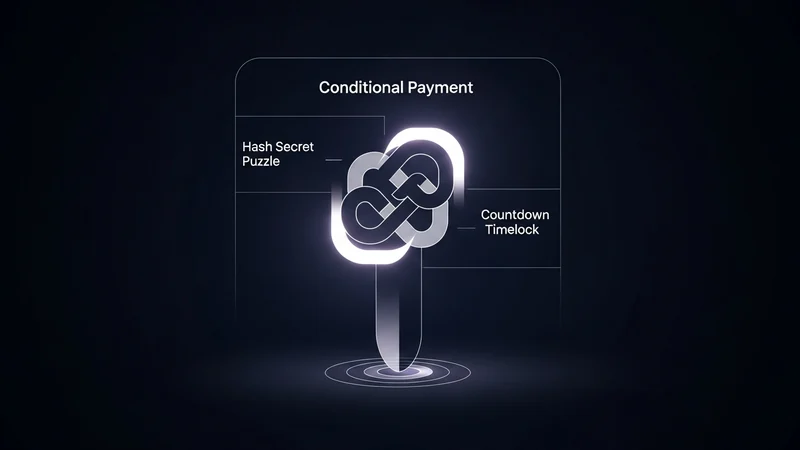
At its heart, a Hash Time-Locked Contract (HTLC) is a specialized type of smart contract designed to enable conditional payments across different blockchains or within payment channels. It's a clever mechanism that guarantees either the successful completion of a transaction or its safe reversal, eliminating the need for a trusted third party.
The power of an HTLC comes from combining two distinct, yet complementary, components: a hashlock and a timelock. These two elements work in tandem to create a secure, self-executing agreement that underpins many advanced cryptocurrency operations.
Understanding the Hashlock Component
The hashlock is the cryptographic cornerstone of an HTLC. It functions by requiring the recipient of a payment to reveal a specific secret value. Before the contract is initiated, the sender generates a secret and computes its cryptographic hash, for example, using a SHA-256 algorithm. This hash is then embedded into the contract.
For the recipient to claim the funds, they must provide the original secret that matches the embedded hash. If they can reveal the correct secret, the funds are released to them. This mechanism ensures that only the party who knows the secret can unlock the funds, providing a strong layer of cryptographic security.
- Secret Generation: The sender creates a random, unique secret.
- Hash Calculation: The sender computes the cryptographic hash of this secret.
- Contract Embedding: The hash is included in the HTLC.
- Recipient's Task: To claim funds, the recipient must reveal the original secret that produces the embedded hash.
Understanding the Timelock Component
While the hashlock ensures cryptographic security, the timelock provides a crucial safety net. It's a conditional timer embedded within the contract that dictates an expiry period. This timelock specifies a duration during which the recipient has to reveal the secret and claim the funds.
If the recipient fails to reveal the secret before this specified expiry time, the timelock automatically triggers a refund to the original sender. This means the sender's funds are never permanently locked away, even if the other party fails to cooperate or disappears. The timelock protects both parties from indefinite waiting and potential loss of funds.
How HTLCs Power Atomic Swaps
One of the most compelling applications of Hash Time-Locked Contracts is in enabling atomic swaps. An atomic swap is a peer-to-peer exchange of two different cryptocurrencies directly between two parties, without the need for a centralized exchange or a trusted intermediary. The term 'atomic' implies that the transaction is indivisible: either both legs of the swap execute successfully, or neither does.
Here's a simplified breakdown of how HTLCs facilitate atomic swaps:
- Agreement: Alice wants to swap her Coin A for Bob's Coin B. They agree on the exchange rate and amounts.
- Secret Generation: Alice generates a secret 'S' and computes its hash 'H'.
- Alice's HTLC: Alice creates an HTLC on Coin A's blockchain, locking her Coin A. This contract specifies that anyone who reveals 'S' can claim Coin A, but if 'S' isn't revealed within a certain timelock (e.g., 24 hours), her Coin A is refunded to her.
- Bob's HTLC: Bob then creates an HTLC on Coin B's blockchain, locking his Coin B. This contract also embeds hash 'H' and specifies that anyone who reveals 'S' can claim Coin B. However, Bob's timelock is shorter than Alice's (e.g., 12 hours).
- Execution: Alice, knowing 'S', can now claim Bob's Coin B by revealing 'S' on Coin B's blockchain. When she does this, 'S' becomes publicly known on Coin B's chain.
- Completion: Bob, seeing 'S' on Coin B's chain, can now use it to claim Alice's Coin A on Coin A's blockchain.
The staggered timelocks are crucial. If Alice claims Bob's funds, Bob has enough time to claim Alice's funds before her timelock expires. If Alice doesn't claim Bob's funds, her initial timelock will expire, and her Coin A will be refunded to her. Bob's shorter timelock ensures that if Alice never initiates the swap, his funds are returned to him relatively quickly, preventing them from being locked indefinitely.
This ingenious use of HTLCs ensures that neither party can cheat the other. If one party fails to cooperate, their funds are simply returned, guaranteeing an 'all or nothing' outcome for the swap. This is a powerful feature for enabling true peer-to-peer trading without counterparty risk.
HTLCs as the Backbone of the Lightning Network
Beyond atomic swaps, HTLCs are also the fundamental technology underpinning the Lightning Network, a layer-2 scaling solution for Bitcoin and other cryptocurrencies. The Lightning Network aims to enable fast, low-cost, off-chain transactions, drastically improving throughput and reducing fees compared to mainnet transactions.
In the Lightning Network, users open payment channels with each other. For a payment to traverse multiple nodes in the network (a 'multi-hop payment'), HTLCs are used to secure the path. Imagine Alice wants to pay Carol, but they don't have a direct channel. They might route the payment through Bob.
Here's how HTLCs make this multi-hop payment trustless:
- Carol generates a secret 'S' and sends its hash 'H' to Alice.
- Alice creates an HTLC with Bob, promising to pay him if he can provide 'S' within a certain timelock.
- Bob then creates a *new* HTLC with Carol, promising to pay her if she can provide 'S' within a *shorter* timelock than his own HTLC with Alice.
- Carol reveals 'S' to Bob to claim her payment.
- Bob, now knowing 'S', reveals it to Alice to claim his payment (minus a small routing fee).
This chain of HTLCs ensures that Bob, the intermediary node, cannot run off with Alice's funds. If Carol doesn't reveal 'S' to Bob, Bob's HTLC with Alice will expire, and Alice's funds will be returned. If Carol does reveal 'S' to Bob, Bob is incentivized to reveal 'S' to Alice to claim his payment before his own timelock expires. The cascading timelocks ensure that each intermediary node has sufficient time to pass on the secret and claim their payment, but not enough time to hold funds indefinitely.
This mechanism is critical because it allows payments to be routed across a network of nodes without any single node needing to trust the others. Each node only trusts its direct peers in the payment channel, and the HTLCs ensure the integrity of the entire multi-hop transaction. This trust-minimization is a cornerstone of decentralized systems.
The Future of HTLCs in a Decentralized World (2026 and Beyond)
As we advance into 2026, the principles behind Hash Time-Locked Contracts remain as relevant as ever. The demand for seamless, secure, and trustless interactions across different blockchain ecosystems is only growing. HTLCs will continue to be a foundational element for interoperability solutions, enabling value transfer between disparate chains without relying on centralized bridges or custodians.
The ongoing development of layer-2 solutions, not just for Bitcoin but for other major blockchains, will likely see HTLCs play an expanded role. Their ability to secure off-chain transactions and facilitate rapid micro-payments is invaluable for scaling blockchain technology to meet mainstream adoption.
Furthermore, as DeFi matures, the need for more sophisticated, conditional payment logic will undoubtedly grow. HTLCs provide a robust primitive that developers can build upon to create new types of financial instruments and services that require atomic execution and trust minimization. Whether you're tracking the latest token prices and trading pairs on DEXTools or exploring new DeFi protocols, the underlying technology often relies on concepts pioneered by HTLCs.
In essence, HTLCs represent a powerful cryptographic tool that empowers users with greater control and security in their decentralized transactions. By understanding how they work, you gain a clearer picture of the intricate mechanisms that are building the future of finance and digital asset exchange.
Frequently Asked Questions
What is a Hash Time-Locked Contract (HTLC)?
An HTLC is a type of smart contract that requires a recipient to provide a cryptographic proof (a 'hash preimage') within a specified time limit to claim funds. If the proof isn't provided, the funds are returned to the sender. This mechanism ensures conditional and time-bound transfers.
How do HTLCs enable 'atomic swaps'?
HTLCs facilitate atomic swaps by creating a trustless exchange of cryptocurrencies across different blockchains. Both parties commit funds to an HTLC; one party reveals a secret, allowing the other to claim their funds on a different chain, all within a time limit. This ensures either both transactions complete or neither does.
What is an 'atomic swap' in the context of HTLCs?
An atomic swap is a direct, peer-to-peer exchange of cryptocurrencies between two different blockchains without needing a centralized intermediary. HTLCs provide the cryptographic and time-based assurances that make these swaps 'atomic,' meaning they are indivisible and either fully succeed or fully fail.
What is the role of HTLCs in the Lightning Network?
HTLCs are fundamental to the Lightning Network, enabling secure, multi-hop payment channels. They ensure that payments can be routed across several intermediate nodes without any single node needing to trust the others. Each hop uses an HTLC to guarantee funds are either forwarded or returned.
Why are HTLCs important for trustless transactions?
HTLCs are crucial for trustless transactions because they eliminate the need for third-party intermediaries or mutual trust between transacting parties. The cryptographic and time-lock mechanisms ensure that funds are exchanged only if predefined conditions are met, protecting both sender and receiver from fraud.