What Is a Keystore File? Encrypted Wallet Keys Explained (2026)
— By Whatsertrade in Tutorials
A keystore file is an encrypted, password-protected private key. How it works, how it differs from a seed phrase, and how to keep it safe.
Intent check: This is the plain-English guide to keystore files, the password-protected way some wallets store a private key. For the key it protects, read What Is a Private Key.
If you have ever exported a wallet and been handed a cryptic JSON file plus a password prompt, you have met a keystore. It looks intimidating, but the idea is simple and worth understanding, because a keystore is one of the ways your access to funds can be stored, backed up, and, if you are careless, lost. Knowing exactly what it is and is not will save you from some of the most painful mistakes in self-custody.
This guide explains what a keystore file is, how it works, how it differs from a raw private key and from a seed phrase, the two things you always need to use it, and the safety rules that keep it from becoming a single point of failure.
What Is a Keystore File?
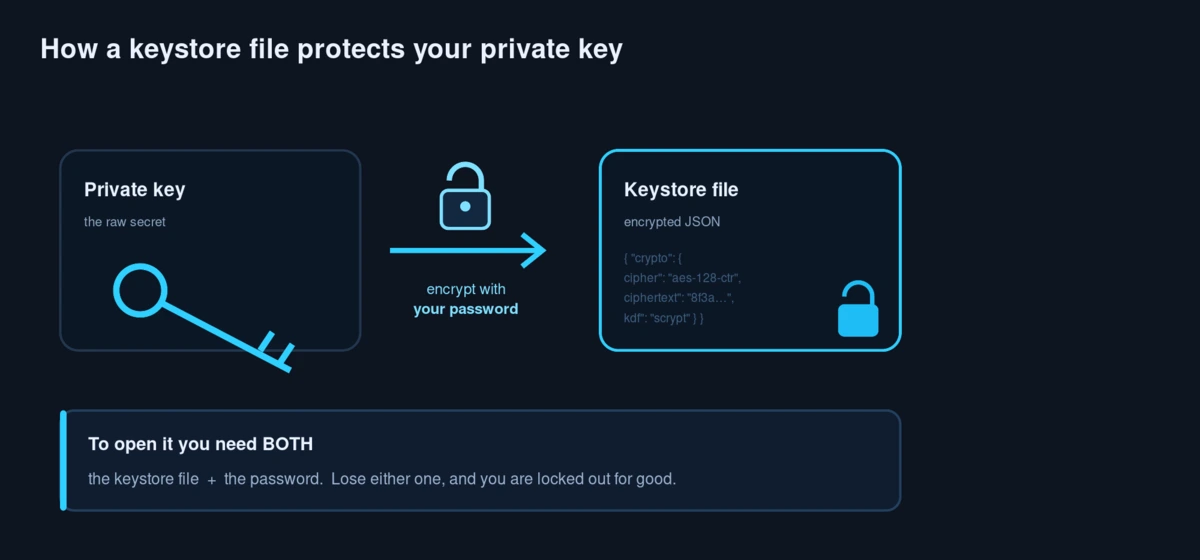
A keystore file is an encrypted file that stores your private key, locked with a password you choose. It is usually a small JSON file. Inside it, your private key is not sitting in plain text. It has been scrambled using your password, so the file on its own is useless to anyone who does not also know that password.
In other words, a keystore is your private key put in a safe, and the password is the combination. The safe can sit out in the open and still protect what is inside, as long as the combination is strong and secret.
How It Works
When you create a keystore, your wallet takes your private key and encrypts it using a key derived from your password. To use the wallet again, you import the keystore file and type the password, which decrypts the key so the wallet can sign transactions. Get the password right and it opens. Get it wrong and the contents stay locked.
The strength of a keystore rests entirely on your password. A strong, unique password makes the encrypted file extremely hard to crack. A weak password means an attacker who gets the file could simply guess their way in.
Keystore vs Private Key vs Seed Phrase
- A raw private key is the unprotected secret itself. Anyone who sees it has full control instantly, with nothing else needed.
- A keystore is that same private key, but encrypted behind a password. It adds a layer of protection, at the cost of needing two things to open it.
- A seed phrase is different again. It is a human-readable backup that can regenerate a whole family of keys and accounts, not just one. For how those two backups compare, see Seed Phrase vs Private Key.
A key detail: a keystore typically holds a single account's key, while a seed phrase can restore many. So a keystore backs up one wallet, not your whole seed-based collection.
The Two Things You Always Need
To access funds through a keystore, you need both the file and the password. This cuts both ways:
- Lose the file, and the password alone cannot recreate it.
- Lose the password, and the file cannot be opened. There is no reset link and no support desk that can recover it.
Unlike a seed phrase, which is itself the master backup, a forgotten keystore password is usually final. That is the single most important thing to internalise about keystores.
Safety Rules
- Use a strong, unique password. This is the whole security of the file. Never reuse a password you have used elsewhere.
- Back up both, separately. Store the file and the password securely, and ideally not in the same place, so one leak does not hand over both.
- Never share the file, and never enter it into a website you do not fully trust. A malicious page could try to lift both the file and the password.
- Do not treat it as your only backup. If your wallet is seed-based, your seed phrase is the real master key. Learn to read what you sign, a habit covered in How to Read a Wallet Signature Request.
Key Takeaways
- A keystore file is an encrypted file that stores your private key, locked with a password.
- The file alone is useless without the password, and its security depends entirely on that password's strength.
- It differs from a raw private key, which is unprotected, and from a seed phrase, which can restore many accounts.
- You always need both the file and the password, and a forgotten password usually means permanent loss.
- Use a strong unique password, back up both securely and separately, and never share the file.
A keystore file is a sensible way to store a private key, but only if you respect what it demands: a strong password you will never lose and never reuse. Treat the file as a locked safe and the password as the one combination that opens it, keep both safe and apart, and a keystore becomes a solid part of your self-custody. Forget the password, and even you cannot get back in.
This article is educational and is not financial advice. Never share a keystore file or its password, and never enter them into an untrusted site.