What Is a Runner in Memecoin Trading

Most memecoins flash and burn within an hour. We unpack the technical mechanics, accumulation phases, and structural chart behaviors of a true "runner.
What Is a Runner
- The decentralized micro-cap market is an ecosystem operating on pure velocity. On any given day, thousands of new token contracts are initialized across high-throughput blockchains like Solana, Base, and Ethereum. To the untrained eye, the standard graphical charting feeds for these newly minted assets look identical: a quick, hyper-aggressive upward spike fueled by initial automated sniper buys, followed almost instantly by a terminal downward correction as creators or insiders pull liquidity.
In this unforgiving landscape, over 99% of newly deployed assets fail to survive their first two hours of active trading.
- However, an elite fraction of assets manage to shatter this algorithmic distribution trap. In the slang of Web3 trading desks and on-chain terminal rooms, these anomalies are known as "Runners." A runner is a memecoin that experiences a sustained, multi-day or multi-week upward trend, continuously absorbing sell pressure, breaking structural resistance levels, and scaling its valuation from absolute obscurity into millions (or hundreds of millions) of dollars in market capitalization.
To safely deploy capital alongside these hyper-momentum assets, you must understand the underlying structural layout, volume dynamics, and warning signs of a true market runner.
1. The Anatomy of a True Runner vs. a Standard Pump
To evaluate a memecoin runner with analytical precision, you must look past the superficial memetic branding and analyze the behavior of the token's distribution ledger. A standard "pump-and-dump" is an artificially engineered transaction loop where a concentrated cabal or an automated bot cluster drives up a asset's price within a tiny timeframe, only to exit concurrently, leaving late retail buyers stranded.
A true runner exhibits a fundamentally different structural pattern characterized by liquidity dispersion and narrative retention:
Sustained Holder Expansion: Instead of a few isolated wallets controlling the majority of the token supply, a runner continuously redistributes its supply to a rapidly growing network of independent on-chain entities.
Organic Volume Ingestion: The trading volume isn't just high on block zero; it continuously climbs over rolling 24-hour periods, indicating that fresh capital pools are entering the market to offset early profit-taking.
Higher-Low Consolidation: When early buyers inevitably exit their positions, the chart does not suffer a terminal collapse. Instead, a runner forms robust, higher-low consolidation floors, signaling strong institutional and community backstops at elevated valuation tiers.
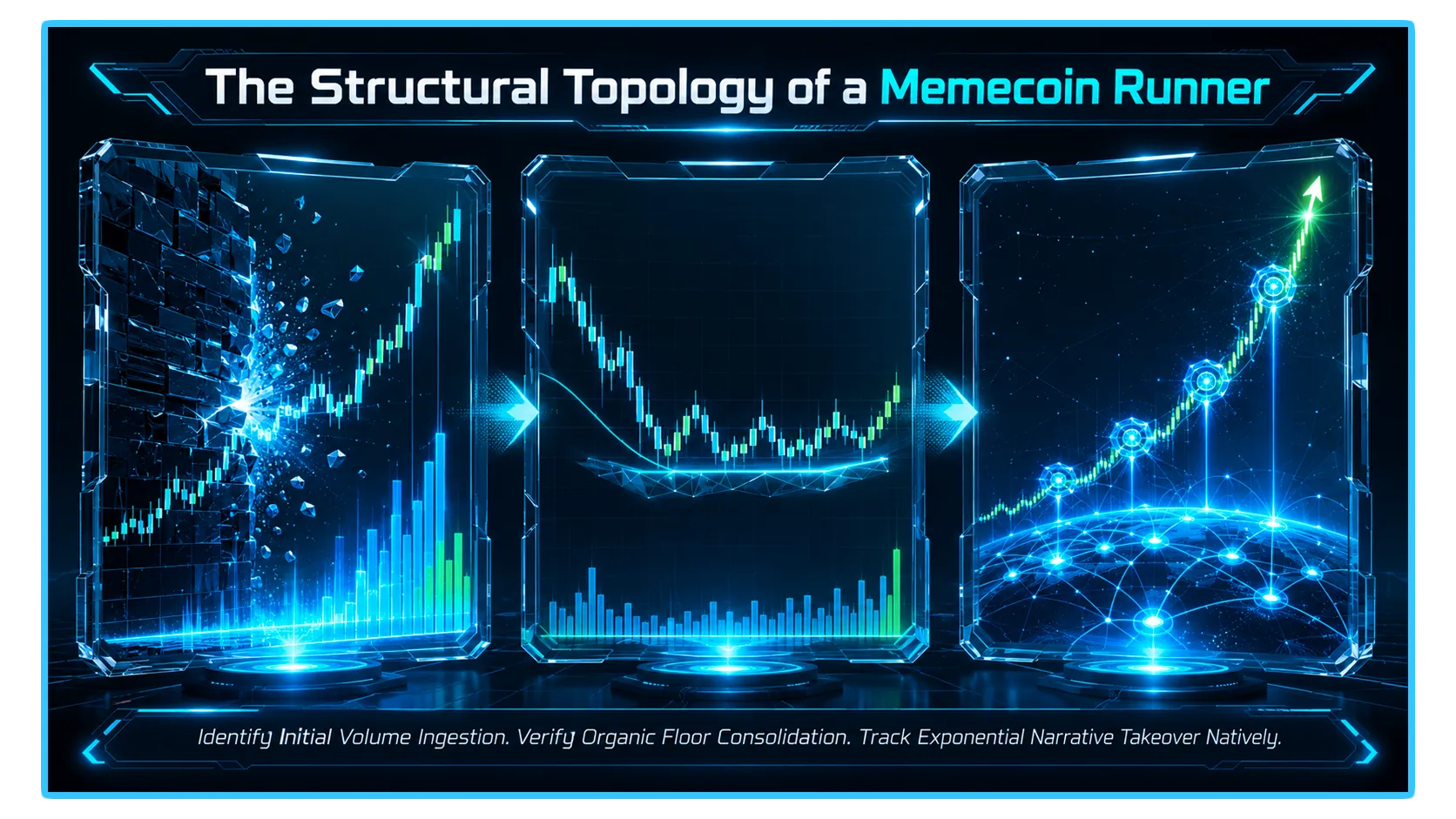
2. The Structural Lifecycle: The Three Phases of the Run
Interacting safely with a fast-moving memecoin runner requires identifying exactly where the asset sits within its chronological trend lifecycle. Professional momentum traders break down a runner's trajectory into three clear functional phases:
Phase 1: The Catalyst Breakout
This is the incubation period. The token breaks out from its initial low-cap accumulation zone, typically triggered by a sudden memetic narrative shift, high-profile social media tracking alerts, or a massive influx of alpha community coordination. Volume spikes sharply, and the asset clears its historical launch-day resistance lines.
Phase 2: The Core Retest and Consolidation
This is the definitive validation checkpoint. Early snipers and development insiders dump their cheap tokens to capture massive initial multiples. In a normal scam token, this phase is fatal. In a true runner, this heavy sell pressure is completely absorbed by incoming capital. The token consolidates sideways or puts in a shallow retraction, establishing a hard structural price floor that confirms the asset has completely changed hands.
Phase 3: The Parabolic Expansion
Once the sell walls are exhausted and the distribution ledger is thoroughly cleansed of short-term flippers, the asset enters its high-velocity expansion phase. The token trends continuously upward across independent daily sessions, catching the attention of automated "hot pairs" terminal scanners, tier-1 algorithmic market makers, and mainstream retail market participants.
3. The Comparison Grid
To maintain absolute scannability when filtering real-time token alerts, use this standardized data matrix to differentiate raw volatility spikes from legitimate market runners:
| Trading Metric | Temporary Volatility Spike | Structural Memecoin Runner |
| Ledger Distribution | Highly concentrated inside a few bundled insider wallets | Broadly decentralized across thousands of independent holders |
| Volume Velocity | Decelerates aggressively after the initial 15-minute window | Scales continuously across consecutive multi-hour sessions |
| Retest Behavior | Slashes straight through historical support lines to zero | Holds firm at higher-low consolidation floors during pullbacks |
| Order Book Depth | Thin, fragile liquidity easily cleared out by single sells | Deep, compounding market-maker buffers that absorb volatility |
4. The Core Danger: Identifying Malicious "Bubble Volume" Traps
- While entering a high-visibility runner early in its lifecycle can accelerate capital, navigating this frontier requires deep risk-management parameters. Malicious token creators routinely configure sophisticated cabal bots to simulate the physical appearance of a structural runner.
- Using hundreds of automated, interconnected sub-wallets funded via stealth cross-chain transfers, these entities continuously buy and sell the asset among themselves. This wash-trading loop prints a beautiful, upward-trending chart on decentralized terminal displays, intentionally triggering automated "top gainer" or "runner" scanner flags.
- However, because the volume and liquidity are entirely fabricated inside an artificial bubble, the moment an authentic retail participant deposits significant capital, the creators execute a coordinated mass-liquidation transaction, instantly rendering the asset completely worthless. Independent telemetry checks are your only shield against these traps.
5. Real-Time Telemetry and Verification via DEXTools
- Formulating an unassailable trading framework while tracking emergent memecoin runners requires absolute, look-through data telemetry. While social media chatrooms proclaim that a token has the legs to run into a nine-figure valuation, independently cross-referencing live liquidity-to-market-cap ratios, locked contract safety variables, and exact smart contract permission sets is the only way to insulate your wealth from predatory developer traps.
- DEXTools provides the critical analytical data infrastructure needed to perform these diagnostic checks in real-time. By utilizing advanced pair explorers, live transaction logs, and look-through wallet telemetry across alternative layer networks, market participants can independently verify if a token's upward momentum is backed by authentic, diversified community capital or if it is an artificial shell driven by automated insider bots.
Cross-referencing your momentum setups with live blockchain metrics ensures your risk parameters remain completely optimized, protecting your digital wealth from sudden market reversals.
You can access DEXTools here and start trading today!
Tags:Memecoin Runner, Meme Trading, Token Breakouts, Momentum Trading, Liquidity Pools, Volume Velocity, Ledger Distribution, Cabal Bots, Bubble Volume, Candlestick Charts, Technical Analysis, Consolidation Floors, Risk Management, Market Telemetry, DEXToolsDisclaimer: This article is for informational purposes only and does not constitute investment advice, financial advice, trading advice, or any other kind of advice. DEXTools does not recommend buying, selling, or holding any cryptocurrency or token. Users should conduct their own research and consult with a qualified financial advisor before making any investment decisions. Cryptocurrency investments are volatile and high-risk. DEXTools is not responsible for any losses incurred.