Cliff Unlock vs Linear Vesting: Sell Pressure
— By Whatsertrade in Tutorials
Cliff unlock vs linear vesting explained: learn how each affects sell pressure, liquidity, and volatility, and what to watch before token unlock events.
This page compares cliff unlock vs linear vesting from the sell-pressure angle. If you are researching token supply dynamics more broadly, pair it with our tokenomics guides.
Key Takeaways
- What Is a Token Unlock?
- What Is a Cliff Unlock?
- What Is Linear Vesting?
- Cliff Unlock vs Linear Vesting: The Key Difference
- Which One Creates More Sell Pressure?
- How Traders Can Analyze Unlock Risk
Token unlocks are one of the most important events traders should monitor in crypto markets. When locked tokens become available, early investors, team members, advisors or ecosystem participants may be able to sell. This can create uncertainty, volatility and potential sell pressure.
Two common unlock models are cliff unlocks and linear vesting. They both release tokens over time, but they affect the market in different ways. Understanding the difference can help traders avoid buying into avoidable risk.
What Is a Token Unlock?
A token unlock happens when previously locked tokens become transferable. These tokens may belong to private investors, founders, employees, treasury wallets, advisors or ecosystem funds.
Locked tokens are usually part of a project’s tokenomics. The goal is to prevent all supply from entering the market at once. However, once tokens unlock, the market must absorb the possibility of new selling.
The impact depends on several factors: unlock size, holder behavior, liquidity, market sentiment and whether the event was already expected.
What Is a Cliff Unlock?
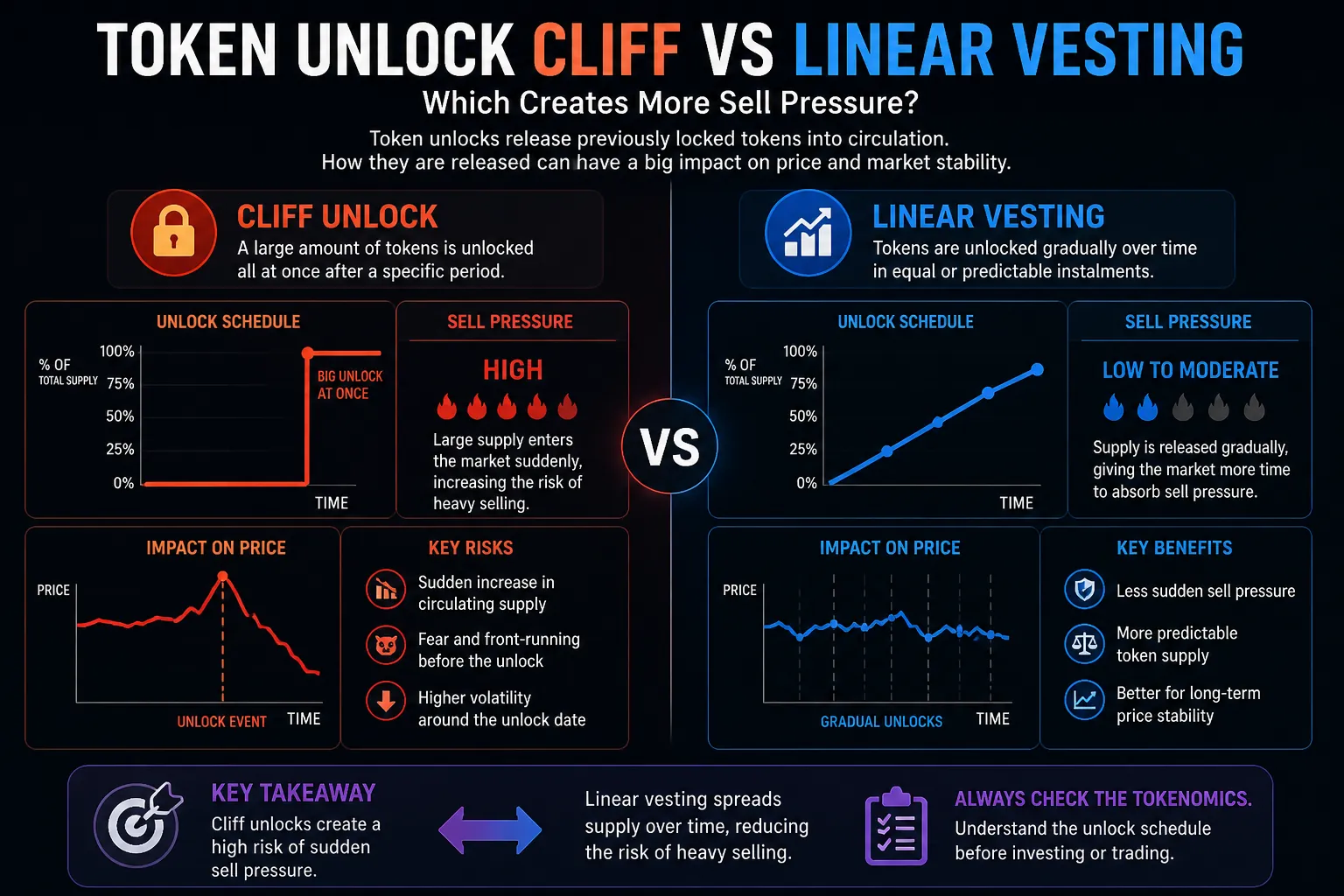
A cliff unlock releases a large amount of tokens at a specific date. Before that date, the tokens remain locked. When the cliff arrives, a significant portion can become available at once.
This type of unlock can create strong market anxiety because traders know that a large supply event is coming. Even if not all holders sell, the expectation of selling can affect price before the unlock happens.
A cliff unlock does not always cause a crash, but it can create a clear risk zone.
What Is Linear Vesting?
Linear vesting releases tokens gradually over time. Instead of unlocking a large amount on one date, tokens become available in smaller portions across days, weeks or months.
This structure can reduce sudden supply shocks. Since tokens enter the market gradually, liquidity may have more time to absorb the new supply.
However, linear vesting can still create persistent sell pressure if recipients consistently sell unlocked tokens.
Cliff Unlock vs Linear Vesting: The Key Difference
The key difference is timing.
A cliff unlock concentrates supply risk into one event. Linear vesting spreads that risk over time.
For traders, cliff unlocks can create sharp volatility around a specific date. Linear vesting can create slower and more continuous pressure that is harder to detect on a single chart.
Neither structure is automatically good or bad. The real question is whether market demand can absorb the newly available supply.
Which One Creates More Sell Pressure?
Cliff unlocks can create stronger immediate sell pressure because a large number of tokens becomes available at once. This is especially risky when the unlocked amount is large compared with current trading volume or available liquidity.
Linear vesting can create lower immediate pressure, but it may last longer. If recipients sell regularly, the token may struggle to sustain rallies because each move upward meets new supply.
A cliff unlock is like a visible supply event. Linear vesting is more like a constant supply leak.
How Traders Can Analyze Unlock Risk
Traders should compare the unlock size with daily trading volume and liquidity. If an unlock is large but liquidity is weak, the market may not be able to absorb selling without major price movement.
It is also important to understand who receives the tokens. Team unlocks, investor unlocks and ecosystem unlocks can behave differently.
Investor unlocks may create more selling risk if early backers are already in profit. Ecosystem unlocks may be less direct if tokens are used for incentives, grants or liquidity programs.
Why Price Sometimes Drops Before the Unlock
Markets often react before the actual unlock date. Traders may sell early because they expect others to sell. This can create a pre unlock decline even before new tokens enter circulation.
In some cases, price may recover after the unlock if the event was already priced in and actual selling is lower than expected.
This is why traders should not only ask when the unlock happens. They should also ask how much fear is already visible in the price.
How DEXTools Can Help Around Unlock Events
DEXTools can help traders monitor market reaction before, during and after unlock events. Price action, volume, liquidity changes and transaction behavior can reveal whether holders are selling aggressively or whether the market is absorbing supply.
Instead of reacting only to the unlock date, traders can study how the token behaves as the event approaches.
Cliff unlocks and linear vesting schedules create different types of risk. Cliff unlocks can produce sudden volatility, while linear vesting can create ongoing supply pressure.
For traders, the best approach is to combine tokenomics with live market data. A token unlock is not automatically bearish, but ignoring unlock structure can lead to poor timing and unnecessary exposure.
How to Bridge Crypto Between Chains: Complete Cross-Chain Tutorial 2026 How to Use 1inch: Complete DEX Aggregator Swap Tutorial (2026) How to Use OKX Web3 Wallet: Multi-Chain DeFi Hub Guide (2026)Related Guides
- How to Evaluate Crypto Tokenomics: Vesting and Cliffs 2026
- What Is Cliff Vesting in Crypto? Unlock Timing and Price Risk (2026)
- Token Unlocks: Navigating Microcap Sell Pressure
- Bonding Curve Math in Crypto: Linear, Exponential and Sigmoid Models (2026)
- What Is Token Vesting in Crypto? Complete Beginner Guide (2026)
Frequently Asked Questions
What is the difference between a cliff unlock and linear vesting?
A cliff unlock releases a large batch of tokens all at once after a waiting period, while linear vesting releases tokens gradually over time. Cliffs concentrate supply into a single moment, whereas linear vesting spreads it out.
Why do cliff unlocks often cause more sell pressure?
Because a cliff releases many tokens at the same time, holders can sell a large amount at once, which can flood the market suddenly. This concentrated supply increase can lead to sharper price moves around the unlock date.
Is linear vesting better for token stability?
Linear vesting tends to be gentler on the market because new supply enters in small, steady amounts rather than one large drop. It does not remove sell pressure but can make it more predictable and easier to absorb.
What should I watch before a token unlock event?
Check the size of the upcoming unlock, who receives the tokens, and how it compares to current circulating supply and liquidity. Large unlocks relative to liquidity tend to carry more risk of volatility.