What Is a Token Bonding Curve Migration to DEX?

The journey from token genesis to open-market trading has been completely automated. We unpack the atomic settlement loops, security parameters, and risk factors of liquidity graduation.
The Bonding Curve migration process
- The evolution of decentralized liquidity distribution has established the bonding curve migration process as a core architectural framework for micro-cap digital assets. In the early eras of decentralized finance (DeFi), launching a new token required significant upfront capital, technical smart contract expertise, and manual liquidity provisioning. A developer had to mint the total token supply, fund a decentralized exchange (DEX) liquidity pool with their own native assets (such as Ethereum or Solana), and establish a fixed initial price.
- This legacy model presented immense financial and structural hazards. Creators risked significant capital to seed early pools, while retail participants were constantly exposed to developer-led exit scams, where the creator could pull the underlying liquidity out of the pool at any moment, rendering the token untradeable and worthless.
- To insulate participants from these centralized vulnerabilities, modern Web3 infrastructure engineered the automated launchpad model, pioneered by protocols like pump.fun on Solana and subsequently adopted across multiple EVM-compatible networks via networks like Base and Ethereum. These ecosystems replace manual, trusted liquidity setups with an automated incubation phase governed entirely by mathematical code.
- The lifecycle of these contemporary assets is divided into two distinct structural regimes: an initial internal funding curve and an automated transition to the open marketplace. Understanding the deep mechanical underpinnings of how a token graduates from its internal incubator to a mainstream exchange is an absolute prerequisite for navigating the modern on-chain attention economy.
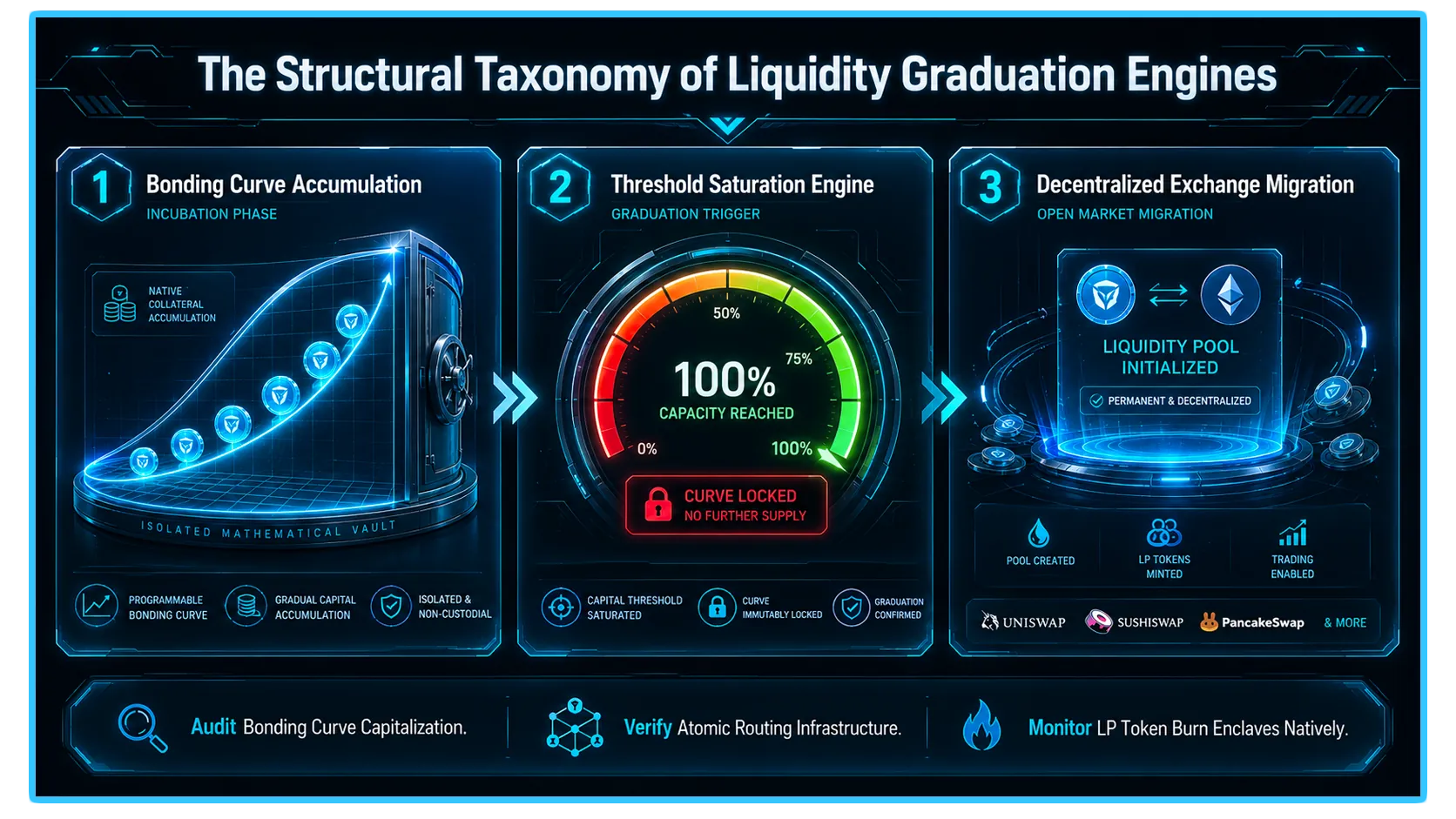
1. The Incubation Layer: The Bonding Curve Foundation
- The journey of an automated token launch begins inside the safe environment of the bonding curve. A bonding curve is a smart contract mechanism that establishes a deterministic relationship between a token's circulating supply and its current market price. Unlike traditional order book exchanges or open automated market makers, where the price is driven entirely by fluctuating buy and sell matching imbalances, a bonding curve determines the price using a hardcoded mathematical function.
- When a creator initializes a token on an automated launchpad, no external capital is required to seed a pool. The token is deployed inside an isolated virtual vault. The smart contract itself serves as the exclusive counterparty for every single transaction.
- When a participant purchases the token, they send native blockchain collateral (such as Solana or Ethereum) directly to the bonding curve escrow account. The contract calculates the current step of the pricing curve, mints the corresponding number of tokens out of its virtual reserve, and delivers them to the buyer's wallet.
- If a user chooses to divest, the process reverses: the user returns the tokens to the contract, which programmatically burns them and releases an equivalent value of the escrowed collateral asset back to the user based on the current step of the curve. Because the contract mathematically guarantees liquidity for every buy and sell order, the asset can safely undergo initial price discovery without the risk of a liquidity vacuum or premature developer manipulation.
2. The Saturation Threshold: The Graduation Trigger
- The bonding curve is not engineered as a permanent home for the asset; it functions strictly as a capital-accumulation incubator. The ultimately stated objective of the protocol is to satisfy a specific capital capitalization goal, known as the saturation threshold.
- The saturation threshold represents a hardcoded financial ceiling within the launchpad's factory smart contract. For instance, on standard Solana-based launchpads, this threshold is typically reached when the curve accumulates approximately 60 to 85 SOL worth of real-world collateral from participants. The protocol tracks this accumulation metrics with absolute precision. Every time a buy order executes on the curve, the contract increments its internal funding gauge.
- The moment the final fraction of native collateral enters the escrow vault and the funding gauge hits 100% capitalization, the token's incubation lifecycle concludes. The smart contract automatically initiates a permanent freeze on the bonding curve.
- All direct buying and selling functionality through the launchpad's internal interface is disabled. This automated halt is a critical structural safeguard: it locks the asset's final internal price, stabilizes the supply distribution, and prevents high-frequency front-running bots from injecting additional transactions into the mempool while the platform prepares to transition the capital to the open market.
3. The Technical Anatomy: The Migration Pipeline
- The technical execution of an automated bonding curve migration depends entirely on an atomic, multi-stage smart contract sequence. An atomic transaction is an all-or-nothing cryptographic operation; every single sub-step within the execution loop must succeed perfectly in historical order, or the entire transaction is completely aborted by the blockchain's virtual machine, ensuring that capital can never become trapped in an intermediate, semi-migrated state.
- Once the saturation threshold triggers the migration module, the platform's automated backend or an incentivized relayer broadcasts the graduation transaction to the blockchain ledger. The atomic execution loop unfurls across five synchronized phases.

Phase 1: Collateral Extraction
The smart contract unlocks the isolated escrow vault and extracts 100% of the accumulated native collateral (e.g., the pooled SOL or ETH). This capital represents the real-world financial backing accrued during the incubation phase.
Phase 2: Supply Standardization
The contract audits the total number of tokens purchased by users on the bonding curve. It then takes the remaining, unpurchased token supply sitting inside the virtual reserve and prepares it to be paired with the extracted collateral. This ensures that 100% of the token's total circulating supply is accounted for before entering the open market.
Phase 3: DEX Pool Initialization
The migration contract interfaces directly with the factory router of a primary decentralized exchange, such as Raydium on Solana or Uniswap v2/v3 on EVM networks. It invokes the exchange's standard pool creation function, injecting the extracted native collateral alongside the remaining token supply to construct a brand-new, permanent Automated Market Maker (AMM) trading pool.
Phase 4: Initial Price Pegging
The router sets the initial market price of the newly deployed DEX pool to match the exact terminal price achieved at the final step of the bonding curve. This seamless transition prevents violent arbitrage gaps between the launchpad's internal closing price and the exchange's opening print.
Phase 5: LP Token Liquidations
- Upon initializing the AMM pool, the decentralized exchange generates a set of Liquidity Provider (LP) tokens and delivers them back to the migration contract. These LP tokens represent the legal ownership claim over the underlying collateral and token reserves.
- To ensure the launch is completely un-ruglable, the migration contract automatically routes these LP tokens directly to a verified cryptographic burn enclave (such as the null address
0x000...deador Solana's system rent-exempt burn account), permanently destroying the ability for any entity to ever extract or manipulate the core backing liquidity.
4. Security Architecture: Revoking Administrative Controls
- The primary value proposition of the automated migration engine is the complete elimination of human intervention. In legacy token deployments, developers retained extensive administrative permissions over the asset's underlying architecture, allowing them to manipulate the token economy long after launch. A robust migration pipeline mandates the permanent relinquishing of these administrative capabilities at the contract layer.
- Simultaneously with the burning of the LP tokens, the migration engine coordinates with the base token contract to execute two critical security commands: the revocation of Mint Authority and the disabling of Freeze Authority.
- If a developer retains mint authority, they can programmatically generate billions of brand-new tokens out of thin air at any point in the future, dumping them directly into the newly created DEX pool to extract the pooled collateral. If they retain freeze authority, they can selectively freeze individual user wallets, preventing specific holders from selling their tokens during a market rally.
- By forcing the automated factory contract to strip these administrative rights permanently during the graduation block, the token transforms into a pure, immutable ledger asset. The developer is reduced to a standard market participant, possessing zero systemic advantages over retail allocators, which forms the structural basis of a true fair-launch paradigm.
5. Post-Migration Microstructure and Volatility
- The moment the migration transaction finalizes and the token goes live on a decentralized exchange, its underlying market microstructure experiences an instantaneous, radical transformation. Inside the incubator, the price was bound to a deterministic, mathematical line. On the open DEX, the asset enters a free-floating market regime governed entirely by a constant-product invariant formula ($x \times y = k$).
- This transition introduces extreme initial volatility. The open DEX market features highly advanced algorithmic infrastructure that does not exist inside the launchpad's internal environment. High-frequency MEV (Maximal Extractable Value) sniping bots, institutional trading desks, and automated arbitrage algorithms continuously monitor the blockchain's mempool, waiting for the exact block transaction where the migration completes.
- The moment the pool opens on Raydium or Uniswap, these automated systems inject massive buy or sell orders using specialized JITO bundles or priority fee overrides to secure prime positioning within the order book hierarchy. This high-velocity order flow can cause massive price swings within the first few seconds of graduation, as the market rapidly struggles to find equilibrium between speculative retail momentum and institutional valuation baselines.
6. Advanced On-Chain Diagnostics via DEXTools
- Navigating a high-velocity ecosystem where assets graduate continuously from mathematical curves into free-floating exchange pools requires advanced look-through visibility into live secondary market liquidity data. Advanced data verification tools allow investors to audit every step of a bonding curve migration to protect their capital from execution anomalies. While a launchpad's frontend dashboard may state that a token has successfully graduated, verifying the physical health, depth, and structural parameters of the newly deployed AMM pool on the open market is the only method to confirm genuine stability.
- DEXTools provides the critical analytical infrastructure needed to monitor these metrics in real-time, giving users the ability to track live spot pair volume, audit the exact lock or burn status of the newly generated LP tokens, verify contract security scores, and trace large-scale institutional wallet deposits or redemptions across multiple layer-1 and layer-2 networks. By leveraging these live diagnostics, allocators can verify that the velocity of platforms utilizing automated migration engines matches real-world secondary market liquidity depth, ensuring their positions remain fully liquid and insulated from unexpected liquidity anomalies.
Disclaimer: This article is for informational purposes only and does not constitute investment advice, financial advice, trading advice, or any other kind of advice. DEXTools does not recommend buying, selling, or holding any cryptocurrency or token. Users should conduct their own research and consult with a qualified financial advisor before making any investment decisions. Cryptocurrency investments are volatile and high-risk. DEXTools is not responsible for any losses incurred.