Aerodrome Finance nedir: Base DEX rehberi (2026)
— By Whatsertrade in Tutorials

Aerodrome, Base'in 2 milyar dolar TVL'li lider DEX'i. 2026 ve(3,3) ve veAERO rehberi.
If you have spent any time on Base in 2026, you have probably noticed that one decentralized exchange handles more swap volume than every competitor combined. That exchange is Aerodrome Finance, the ve(3,3) liquidity hub that powers nearly every major trade on Coinbase's layer 2 network. With over $2 billion locked, hundreds of active gauges, and a bribe economy that pays voters millions of dollars per week, Aerodrome has become the central liquidity engine of the Base ecosystem.
Aerodrome launched in August 2023 as a Velodrome v2 fork built specifically for Base, the layer 2 rollup developed by Coinbase. It inherited the ve(3,3) tokenomics model pioneered by Solidly and refined by Velodrome on Optimism, then added Slipstream concentrated liquidity in March 2024 to compete directly with Uniswap V3 and V4 style positions. The result is a hybrid exchange that supports stable pools, volatile pools, and concentrated liquidity all under one governance umbrella.
This guide walks through every component of Aerodrome from first principles. You will learn how AERO emissions work, how veAERO voting locks generate bribes income, how Slipstream concentrated liquidity differs from classic vAMM and sAMM pools, and how to provide liquidity, vote in gauges, and claim rewards step by step. You will also see how Aerodrome compares to Velodrome and Uniswap V4 on Base, what risks come with the model, and where the protocol fits inside the broader decentralized finance landscape.
What Is Aerodrome Finance?
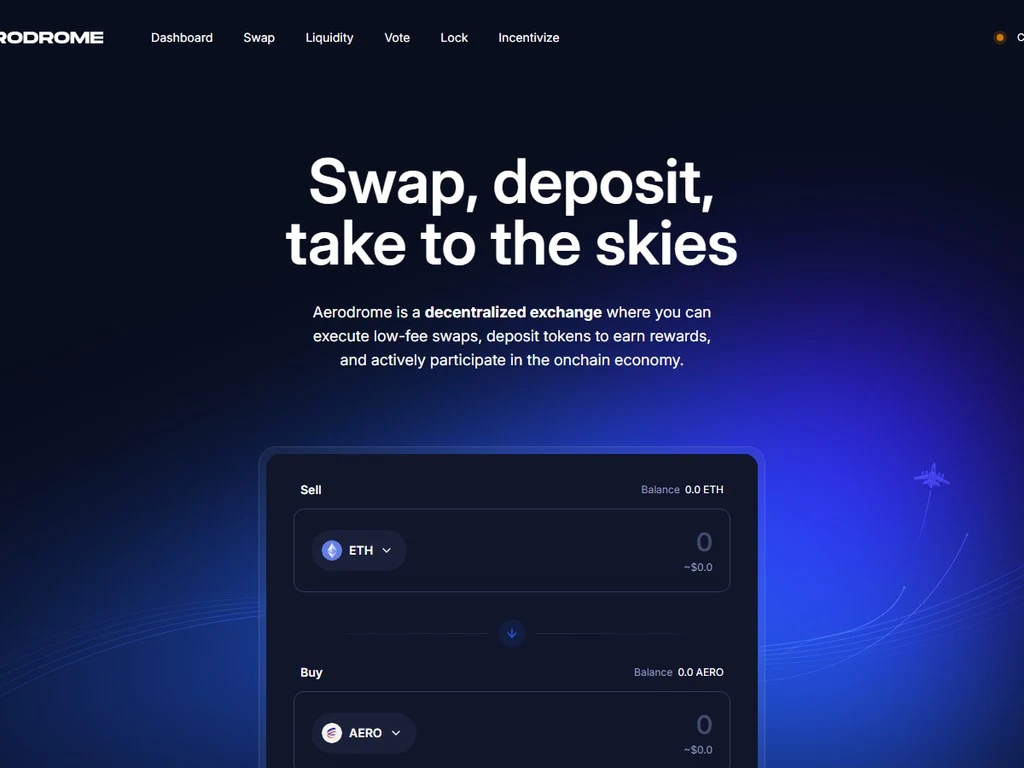
Aerodrome Finance is the largest decentralized exchange on Base by total value locked, operating as a Velodrome v2 fork that uses ve(3,3) tokenomics to direct liquidity. Users swap, provide liquidity, vote with locked AERO tokens, and collect emissions plus bribes from protocols competing for trading depth. It launched on August 28, 2023.
Three product layers stack on top of each other inside Aerodrome. The swap layer routes orders through volatile AMM pools (vAMM) for uncorrelated pairs, stable AMM pools (sAMM) for tight pairs like USDC and USDbC, and Slipstream concentrated liquidity pools for capital-efficient market making. The emissions layer mints AERO tokens every epoch and distributes them to liquidity providers in pools that veAERO voters select. The bribe layer lets protocols pay veAERO holders to direct emissions toward their preferred pools, creating a marketplace where liquidity follows the highest bidder.
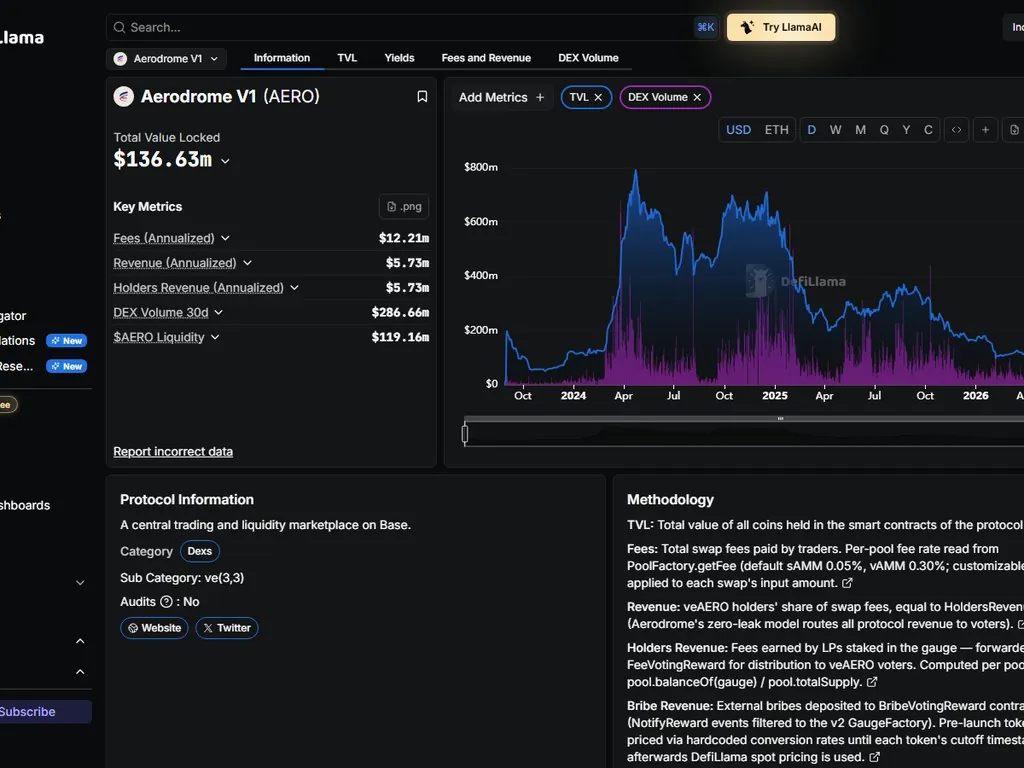
The protocol holds more than $2 billion in total value locked across approximately 600 active pools as of May 2026, accounting for roughly 60 percent of all liquidity on Base. Weekly trading volume regularly exceeds $3 billion, and bribe revenue distributed to veAERO lockers has surpassed $500 million cumulative since launch. These numbers make Aerodrome not just the dominant Base DEX but one of the top five DEXs across every chain.
Velodrome Origin and the Velodrome Team Partnership
Aerodrome's lineage traces back to Andre Cronje's Solidly experiment on Fantom in early 2022. Solidly introduced ve(3,3), a hybrid of Curve's vote-escrowed governance and Olympus DAO's (3,3) game theory, then collapsed within months due to governance issues. The Velodrome team took the Solidly codebase, audited it, fixed broken incentive curves, and relaunched on Optimism in June 2022.
Velodrome quickly became the largest DEX on Optimism and the engine that distributed Optimism's OP incentives during the Quests era. By early 2023 the team had iterated to Velodrome v2, which cleaned up emissions math and added permissionless pool creation. When Coinbase launched Base mainnet in August 2023, the Velodrome team partnered with Base contributors to ship a sister protocol using the same v2 codebase. That sister protocol is Aerodrome.
The partnership is not a simple fork. The two teams share contributors, audit budgets, and roadmap planning. New features migrate in both directions: Slipstream concentrated liquidity began on Velodrome and arrived on Aerodrome a few months later, while certain Aerodrome modules later ported back to Velodrome. The relationship is closer to two deployments of the same protocol on different chains than to a hostile fork.
AERO itself launched with no public sale, no investor allocation, and no team premine. All initial supply went to liquidity providers and early voters during a 30-day genesis epoch. veVELO holders on Optimism received a veAERO airdrop to bootstrap governance. This fair-launch structure gave Aerodrome a community-aligned cap table from day one.
How ve(3,3) Tokenomics Work on Aerodrome
The ve(3,3) model is the heart of Aerodrome and also the part most newcomers find confusing. It combines three concepts: vote-escrowed locking, gauge-directed emissions, and bribe markets. Once you understand how these three pieces interact, the rest of the protocol falls into place.
Vote-escrowed locking means AERO holders can lock their tokens for up to four years to receive veAERO, a non-transferable position that represents voting power. The longer the lock, the more veAERO you receive per AERO locked. A four-year lock gives 1 veAERO per 1 AERO, a two-year lock gives 0.5, a one-year lock gives 0.25, and so on. veAERO positions decay linearly toward zero as the lock expiration approaches, so voting power gradually shrinks unless you extend the lock.
Gauge-directed emissions means every Thursday at 00:00 UTC the protocol enters a new epoch and mints fresh AERO. veAERO holders vote during the week on which liquidity pools should receive the next epoch's emissions. Each gauge corresponds to one pool. The percentage of total veAERO votes a gauge receives equals the percentage of AERO emissions that pool receives that epoch. Pools with no votes get no emissions. Pools with concentrated voting attract heavy emissions and therefore attract liquidity providers chasing AERO yield.
Bribe markets are the layer that makes the model truly interesting. Protocols that need liquidity on Aerodrome can deposit bribe tokens (usually their own protocol token, plus sometimes USDC or AERO) into a bribe contract attached to their preferred gauge. Whatever bribes accumulate in that contract during an epoch get distributed proportionally to the veAERO voters who voted for that gauge. A protocol that pays $50,000 in weekly bribes to attract $10 million in AERO emissions might consider that a great deal if those emissions translate into deeper trading liquidity and more users.
The math behind the bribes economy is what makes ve(3,3) so different from a normal DEX. In a typical AMM like Uniswap, liquidity providers earn swap fees and that is it. On Aerodrome, the LP earns the AERO emissions that voters direct to their pool, while the voters earn the swap fees plus the bribes that protocols pay. This separation lets passive AERO lockers earn yield from protocol competition without ever touching impermanent loss, while active LPs earn higher emissions in well-voted pools.
AERO Emissions Schedule and Decay Model
AERO is not a fixed-supply token. New AERO mints every epoch according to a decay model designed to balance early liquidity bootstrapping against long-term scarcity. Understanding this emissions curve helps you forecast AERO inflation and decide whether long-term locking makes sense for your portfolio.
The initial emission rate at launch was 10 million AERO per week. Each subsequent epoch the emission rate decreased by 1 percent, creating a gradual exponential decay. This continued for the first 14 weeks. From epoch 15 onward the protocol entered the "tail emissions" phase where the per-epoch emission rate began to decay by 1 percent per epoch toward a long-term floor. The decay is not purely mathematical anymore. veAERO holders can vote to increase emissions if growth metrics justify expansion, creating a flexible monetary policy similar to how Curve manages CRV inflation.
A second mechanism called the rebase distributes a portion of each epoch's emissions back to existing veAERO lockers. The rebase exists to compensate veAERO holders for the dilution they would otherwise suffer when new AERO mints. If the protocol mints 5 million AERO this epoch and veAERO holders represent 60 percent of total AERO supply, then 60 percent of the 5 million (3 million AERO) goes proportionally to veAERO lockers as a rebase. This means active lockers can roughly hold their share of total supply even as emissions inflate the broader cap table.
There is no hard cap on AERO supply. The decay curve combined with rebase dynamics suggests circulating supply will continue growing for years but at a decelerating rate. As of May 2026 circulating AERO sits near 1.4 billion, with another 600 million locked as veAERO. Annual inflation has dropped from over 400 percent in early 2024 to roughly 80 percent in 2026, and that figure will continue to fall as the tail decay compounds.
vAMM vs sAMM Pool Types Explained
Aerodrome inherited two classic pool types from Velodrome and Solidly: volatile AMMs and stable AMMs. Each uses a different bonding curve optimized for different token pairs, and choosing the right type makes a significant difference in capital efficiency and slippage.
vAMM pools use the standard x*y=k constant product formula that Uniswap V2 popularized. They work for any token pair where the two assets can move independently. The classic example is AERO paired against USDC, where AERO might rise 50 percent while USDC stays flat. The constant product curve handles wild price swings gracefully but spreads liquidity across the entire price range, meaning most of the capital sits at prices that almost never trade.
sAMM pools use a stable swap curve similar to Curve Finance's formula, designed for pairs that should trade at near-parity. The most common sAMM pair is USDC paired with USDbC (the bridged USDC from Optimism). Both should equal $1, so the curve concentrates liquidity tightly around the 1:1 ratio. A swap of $1 million USDC into USDbC on a deep sAMM pool might suffer less than 0.01 percent slippage, whereas the same swap on a vAMM pool of equivalent size might suffer 0.3 percent or worse.
x*y=k curve. Use for uncorrelated pairs like AERO/USDC, ETH/AERO, WELL/USDC. Handles big price swings but spreads liquidity thin.
Curve-style stable swap. Use for pegged pairs like USDC/USDbC, cbETH/wstETH, USDz/USDC. Ultra-tight slippage near 1:1.
Concentrated liquidity v3 style. Use for ETH/USDC, cbBTC/USDC where you want capital efficiency 100x to 1000x higher than vAMM.
vAMM = 0.30% default. sAMM = 0.05% default. Slipstream = 0.01%, 0.05%, 0.30%, 1.00% tiers. All fees flow to voters.
The default swap fee on vAMM pools is 0.30 percent and on sAMM pools is 0.05 percent, although individual pool creators can choose custom fee tiers within protocol-defined bounds. Unlike Uniswap V2 where the fee goes entirely to liquidity providers, Aerodrome routes 100 percent of trading fees to veAERO voters of that pool. Liquidity providers earn their return from AERO emissions instead. This split is one of the most important design choices in ve(3,3) and explains why veAERO is such a valuable asset.
Aerodrome Slipstream: Concentrated Liquidity Launches March 2024
For its first six months Aerodrome operated only with vAMM and sAMM pools. That worked, but it left a clear gap. Uniswap V3 style concentrated liquidity offered 100x to 1000x better capital efficiency for pairs like ETH/USDC, and competitors on Base were starting to capture that volume. In March 2024 the Aerodrome team shipped Slipstream, their concentrated liquidity module, and the impact on TVL and volume was immediate.
Slipstream lets liquidity providers concentrate their capital within a custom price range instead of spreading it across all possible prices. A provider in the ETH/USDC pool might choose to provide liquidity only between $3,500 and $4,500 if they expect ETH to trade in that range. As long as the price stays inside the range, that capital earns fees just like a regular LP position. If the price moves outside the range, the position stops earning fees and becomes 100 percent of the token at the boundary.
The Slipstream launch attracted approximately $400 million of new TVL within the first two months. ETH/USDC, cbBTC/USDC, and AERO/USDC migrated significant portions of their liquidity from vAMM to Slipstream variants. Trading volume per dollar of TVL roughly tripled, which means swap routers like 1inch and Matcha started routing more orders through Aerodrome by default. The protocol's market share on Base climbed from around 35 percent pre-Slipstream to over 60 percent within a year.
Slipstream pools use the same gauge and emissions mechanism as classic pools. veAERO holders vote on Slipstream gauges just like they vote on vAMM and sAMM gauges. The emissions a Slipstream pool receives get distributed only to active liquidity inside the current price range, however, which means providers who manage their ranges actively can capture multiples of the emissions yield compared to passive providers whose ranges have drifted out of bounds. If you have used Uniswap V4 hooks and concentrated liquidity, the Slipstream UI will feel familiar.
Step by Step: How to Swap on Aerodrome
Swapping on Aerodrome is straightforward, but a few details about routing and slippage settings can save you money. Here is the full flow.
First, connect a Base-compatible wallet. MetaMask, Rabby, Coinbase Wallet, and any WalletConnect-compatible wallet all work. You need ETH on Base to pay gas. Bridging from Ethereum mainnet to Base can be done through the official Base Bridge, through Coinbase's deposit flow, or through cross-chain bridges like Across or Stargate. If you already hold ETH on Base from another activity, you can skip the bridge step.
Second, go to aerodrome.finance and click the Swap tab. Select the input token (the one you want to sell) and the output token (the one you want to buy). The interface will quote you an expected output amount and automatically route through the optimal combination of vAMM, sAMM, and Slipstream pools to minimize slippage. For unusual pairs the router might hop through AERO or USDC as an intermediate.
Third, check the slippage tolerance. The default is usually 0.5 percent for major pairs and 1 percent for less liquid pairs. If you are swapping a small position in a deep pool you can drop slippage to 0.1 percent. If you are dumping a large position in a thin pool you might need to increase it to 3 percent or more. Setting slippage too low causes failed transactions, and setting it too high invites MEV sandwich attacks. Most experienced traders use 0.3 to 1 percent.
Fourth, approve the input token if it is your first time swapping it on Aerodrome. This costs one small gas transaction and grants the Aerodrome router permission to move that specific token from your wallet. After approval, execute the swap. On Base the typical swap gas cost is under $0.05, which is one of the reasons Aerodrome dominates on this chain.
Step by Step: How to Provide Liquidity
Providing liquidity is where most of the AERO yield lives. The process differs depending on whether you choose a classic pool (vAMM or sAMM) or a Slipstream concentrated liquidity pool.
For a classic pool, start by clicking the Liquidity tab on aerodrome.finance and then New Position. Choose the two tokens for your pool. The interface will detect whether the pair already has a vAMM and an sAMM pool, and you select which one to join. Make sure to pick sAMM for pegged pairs and vAMM for everything else. If you pick the wrong type for a pegged pair, your impermanent loss exposure increases dramatically because the curve spreads liquidity across price ranges that should never trade.
Enter the amount of each token you want to deposit. The interface auto-calculates the required matching amount based on the current pool ratio. After deposit, you receive LP tokens representing your share of the pool. To start earning AERO emissions you must stake those LP tokens into the corresponding gauge by clicking the Stake button on your position. Unstaked LP tokens earn nothing because gauge emissions only flow to staked liquidity.
For a Slipstream pool, the flow includes one extra decision: choosing your price range. The interface shows a chart of recent price action. You select a lower bound and an upper bound for your liquidity. Tighter ranges earn more fees per dollar of capital but require more active management because the position stops earning the moment price exits the range. Wider ranges feel more passive but earn proportionally less. A common middle-ground strategy is to set the range at plus or minus 20 percent around the current price for ETH/USDC and rebalance every two to four weeks.
Once your Slipstream position is open, you receive an NFT representing it and stake the NFT into the gauge to earn AERO emissions. The same stake-to-earn requirement applies. Forgetting to stake is the most common mistake new Aerodrome LPs make.
Step by Step: How to Lock veAERO and Vote
Locking AERO to mint veAERO and voting in gauges is where the protocol's most lucrative yields live. veAERO bribe APRs in 2026 routinely range from 20 percent to 80 percent on AERO terms, with some weeks pushing above 100 percent during heavy bribe seasons.
To lock, go to the Lock tab on aerodrome.finance and click Create Lock. Choose the amount of AERO to lock and the lock duration up to four years. Locking 100 AERO for four years gives you 100 veAERO. Locking 100 AERO for two years gives you 50 veAERO. The interface previews the exact veAERO amount before you confirm.
After confirmation you receive a veAERO NFT. This NFT is your voting position. It can be transferred, sold on secondary markets, used as collateral on certain lending protocols, or merged with other veAERO NFTs you own. The lock cannot be unwound early, however. Once locked, AERO is locked until the expiration timestamp.
To vote, navigate to the Vote tab during the active epoch. Voting opens immediately after Thursday 00:00 UTC each week and closes one hour before the next epoch begins. The interface shows every active gauge with its current bribe rewards, projected emissions, and total votes cast. You allocate percentages of your veAERO voting power across as many gauges as you want. Common strategies include voting purely for the highest bribe APR, voting for gauges paying bribes in tokens you want to accumulate, or voting for pools where you also provide liquidity to maximize your own emissions.
- Lock 10,000 AERO for 4 years = 10,000 veAERO
- Weekly bribes pool = $50M across all gauges
- Your share of total veAERO = 0.0015%
- Weekly bribe income = approx $75 plus rebase
- Annualized = approx 40% to 60% on AERO terms
- Bribes claimable after epoch ends (Thursday)
- Trading fees claimable continuously
- Rebase auto-compounded into veAERO NFT
- LP emissions claimable continuously
- Claim all from Rewards tab in one batch tx
After voting, claims happen on the Rewards tab. veAERO voters claim bribes and fees once per epoch. Liquidity providers claim AERO emissions continuously. The interface batches claims so you only pay one gas transaction per claim cycle. Many active users claim every two weeks to balance gas efficiency against capital reinvestment speed.
Top Pools on Aerodrome in 2026
The top ten pools account for roughly 70 percent of TVL and 80 percent of swap volume. Knowing which pools dominate helps you find the deepest liquidity for large trades.
USDC/ETH Slipstream is the single largest pool, with TVL frequently exceeding $250 million and daily volume around $400 million. The 0.05 percent fee tier gets the bulk of routed volume.
cbBTC/USDC Slipstream grew rapidly through 2025 as Coinbase's wrapped Bitcoin product gained adoption. TVL sits around $120 million with steady Bitcoin trader volume and consistently high bribes from Coinbase ecosystem partners.
AERO/USDC vAMM is the central exit pool for AERO itself, with roughly $80 million in TVL serving as the canonical price oracle for the protocol token.
WELL/USDC is the largest non-stablecoin lending token pair on the protocol. Moonwell, the Compound fork that dominates Base lending, pays significant bribes to maintain deep WELL liquidity and earns one of the highest veAERO voter APRs.
cbETH/wstETH sAMM serves liquid staking arbitrageurs rebalancing between ETH derivatives, and USDC/USDbC sAMM bridges native USDC against the legacy bridged variant. Memecoin pairs like BRETT/WETH and DEGEN/WETH dominate the long tail with lower TVL but disproportionately high swap fees from constant volatility.
Bribes Economy and Aerodrome Voter ROI in 2026
The bribes economy is the most distinctive feature of ve(3,3) protocols and the primary reason serious DeFi participants lock AERO. Understanding the numbers helps you decide whether veAERO is the right yield instrument for your portfolio.
In a typical week of May 2026, protocols deposit between $40 million and $80 million in total bribes across all Aerodrome gauges. These bribes come from a mix of stablecoin protocols (Sky, USDz, Curve LP issuers), liquid staking protocols (Moonwell, cbETH staking partners), lending protocols (Moonwell, Aave on Base, Compound), real-world asset issuers (Ondo, Backed, Maple), and memecoin treasuries paying to retain trading depth. The bribes are paid in a mix of the bribing protocol's token (which voters then sell or hold), AERO (the most coveted bribe token), USDC, and ETH.
Voter ROI is typically expressed as the annualized yield a veAERO holder earns from bribes plus trading fees plus rebase, measured in AERO terms. In the calmer second half of 2025 this APR hovered between 25 and 40 percent. The early 2026 surge driven by Slipstream maturity and Base ecosystem growth pushed the figure into the 50 to 80 percent range, with brief spikes above 100 percent during heavily contested gauge weeks like the Sky integration vote in March 2026.
The model creates strong reflexive demand for AERO. When veAERO yields rise, more traders buy AERO to lock for veAERO, which pushes AERO price up. Higher AERO price means LP emissions are worth more in dollar terms, which attracts more liquidity, which attracts more swap volume, which generates more fees for voters, which raises veAERO yields further. The reflexive flywheel can also reverse during bear markets when bribes shrink and locked AERO loses dollar value, so the system is not symmetrically stable.
Base Ecosystem Context and Post-Dencun Fees
Aerodrome's rise is inseparable from Base itself. The chain went mainnet in August 2023, picked up serious adoption through the memecoin boom of early 2024, then accelerated after the Dencun upgrade in March 2024 dropped layer 2 gas fees by roughly 90 percent. By May 2026 Base hosts approximately $4 billion in DeFi TVL, making it the second largest Ethereum L2 by liquidity behind Arbitrum.
Aerodrome captures roughly 60 percent of all liquidity on Base, with the remainder split between Uniswap V3 and V4 deployments, Curve, Balancer, and a long tail of smaller AMMs. Memecoin volume from BRETT, DEGEN, TOSHI, and the rotating cast of newer launches drives a meaningful portion of fees. Coinbase's own Base integrations push retail flow directly into Aerodrome pools through the in-app DEX trading product. Roughly 80 percent of new Base wallets touch Aerodrome within their first week of activity.
Post-Dencun fees on Base average around $0.005 per swap during normal load and rarely spike above $0.10 even during memecoin frenzies. This fee structure is critical for AMM economics because micro-trades become profitable. Arbitrage bots that would never execute at Ethereum mainnet gas prices run constantly on Base, keeping prices tight across pools and creating consistent fee income for veAERO voters.

Aerodrome vs Velodrome vs Uniswap V4 on Base
Choosing where to swap, provide liquidity, or lock governance tokens often comes down to a comparison between the three main contenders. Each has strengths and weaknesses.
The short version: Aerodrome wins for anyone whose primary chain is Base and who wants exposure to the ve(3,3) bribe economy. Velodrome is essentially the same protocol on Optimism and serves the same role there. Uniswap V4 on Base is the better choice for sophisticated LPs running active concentrated liquidity strategies who want hook-level customization and do not care about ve(3,3) yields.
Risks of Using Aerodrome
Every DeFi protocol carries risks, and Aerodrome is no exception. The model has been battle-tested for over two years now, but several risk categories deserve careful consideration before you allocate significant capital.
Base chain risk is the most fundamental. Base is a Coinbase-developed optimistic rollup that posts data to Ethereum mainnet but uses a centralized sequencer operated by Coinbase. A Coinbase outage or regulatory action could pause Base activity, and the 7-day withdrawal challenge period makes emergency exits slow. Sequencer decentralization is on the roadmap but the timeline remains uncertain.
ve(3,3) inflation risk is structural. AERO supply continues to grow, and while the rebase mechanism partially compensates active lockers, unlocked AERO holders suffer continuous dilution. The model only works for participants who are willing to lock and actively vote.
Impermanent loss hits liquidity providers in volatile pools, especially vAMM positions on pairs like AERO/WETH. Concentrated liquidity Slipstream positions can be even more severe because the position rebalances aggressively at range boundaries. AERO emissions often outpace impermanent loss but not always.
Smart contract risk remains real despite audits from Spearbit and Code4rena. No critical exploits have hit the protocol since launch, but ve(3,3) is a complex system and a subtle bug in a future upgrade could lead to losses. Transaction simulation before approving large amounts is wise.
Bribe quality risk affects voters. Some protocols pay bribes in illiquid tokens that lose value fast. Voters chasing advertised APR blindly often end up holding a basket of dying tokens, so track realized USD value after slippage. Regulatory risk also hovers over the ve(3,3) bribe yield instrument, which could attract scrutiny as a securities-like product.
Best Practices for Aerodrome Users
After two years of observing what works and what does not on Aerodrome, several best practices have emerged among experienced users. Following these can meaningfully improve your returns and reduce risk.
Use a burner wallet for memecoin gauges. Many memecoin pools attract scam attempts, malicious approvals, and dust attacks. Keeping memecoin trading separate from your main wallet limits damage from a compromised approval.
Track realized bribe APR, not advertised APR. Build a habit of looking up the price chart of every bribe token immediately after claiming, and selling illiquid bribes on the day they unlock rather than holding. Bribe tokens from declining protocols often lose 50 percent of their value within the week.
Compound veAERO actively. Rebases are already automatic but locked AERO from bribe claims is not. Many voters convert their stablecoin and ETH bribes into AERO and immediately add to their veAERO position, compounding voting power over time.
Manage Slipstream ranges before they go stale. Set calendar reminders to check positions every two weeks. A position that has drifted 30 percent out of range is earning nothing while a competitor in range earns full emissions.
Use the official aerodrome.finance domain only. Phishing sites mimicking Aerodrome have stolen seven-figure amounts from careless users. Bookmark the real domain and check your URL bar before every transaction. Address poisoning attacks also affect Base users, so review our address poisoning prevention guide for full mitigation.
Aggregate large swaps through 1inch or similar aggregators when the trade size exceeds 0.5 percent of pool TVL. Aggregators split orders across multiple Aerodrome pools and competing DEXs to minimize slippage.
FAQ
What is Aerodrome Finance in simple terms?
Aerodrome Finance is the largest decentralized exchange on the Base network. It uses ve(3,3) tokenomics, meaning users who lock the AERO token receive veAERO voting power and earn trading fees plus bribes from protocols competing for liquidity emissions. It is essentially a Velodrome v2 fork built for Base.
Is Aerodrome safe to use?
Aerodrome has been audited by Spearbit and Code4rena, has been operational since August 2023 without a critical exploit, and holds over $2 billion in TVL as of May 2026. That said, all DeFi carries smart contract risk and Aerodrome depends on Base, which has a centralized sequencer operated by Coinbase. Use a hardware wallet for large positions and review every transaction before signing.
How much can I earn locking AERO as veAERO?
Voter ROI on veAERO ranges between 25 and 80 percent annualized in AERO terms during normal market conditions, with brief spikes above 100 percent during heavy bribe weeks. Yield depends on which gauges you vote for, the realized value of bribe tokens after market price moves, and the size of your lock. Maximum locks (4 years) give 1:1 veAERO and maximize earnings.
What is the difference between Aerodrome and Velodrome?
They are sister protocols using the same Velodrome v2 codebase. Velodrome runs on Optimism with the VELO token. Aerodrome runs on Base with the AERO token. The same team contributes to both. Choose the one matching your preferred chain.
What is Aerodrome Slipstream?
Slipstream is Aerodrome's concentrated liquidity module, launched in March 2024. It works like Uniswap V3 positions where liquidity providers select a custom price range to maximize capital efficiency. Slipstream pools coexist with classic vAMM and sAMM pools under the same gauge and voting system.
When does the Aerodrome epoch reset?
Every Thursday at 00:00 UTC. At that moment a new epoch begins, fresh AERO emissions mint, and the voting period for the next epoch opens. Voting closes one hour before the following Thursday reset. Bribe claims and fee claims become available right after each reset.
Can I unlock veAERO early?
No. veAERO locks cannot be unwound before expiration. The position decays linearly toward zero voting power as the unlock date approaches, but the underlying AERO remains locked until expiry. You can, however, sell the veAERO NFT on secondary markets like Relay or merge it with another veAERO position you own.
What is the AERO max supply?
AERO has no hard cap. The protocol uses a tail emissions decay schedule that reduces per-epoch minting by approximately 1 percent each week. Combined with the rebase mechanism that compensates veAERO holders, effective inflation has declined from over 400 percent annualized in early 2024 to roughly 80 percent in 2026 and continues to fall.
Do liquidity providers earn swap fees on Aerodrome?
No. This is one of the most important differences between Aerodrome and Uniswap. Liquidity providers earn AERO emissions, not swap fees. The trading fees go to veAERO voters who voted for the corresponding gauge. LPs effectively trade fee income for higher AERO emissions yield, which often produces better returns when AERO price is healthy.
Is Aerodrome better than Uniswap on Base?
Aerodrome handles more liquidity and more swap volume on Base than Uniswap V3 and V4 combined as of May 2026. For most users on Base, Aerodrome offers tighter prices because aggregators route through its deeper pools. Sophisticated LPs running custom concentrated liquidity strategies may still prefer Uniswap V4 hooks for advanced customization.
Final Thoughts on Aerodrome Finance
Aerodrome has earned its position as the dominant liquidity engine of Base through a combination of timing, partnership with the Velodrome team, and the inherent power of the ve(3,3) bribe economy. The model aligns incentives across three distinct user groups: liquidity providers chasing AERO emissions, swappers wanting tight prices, and veAERO lockers harvesting bribes from protocols. When all three groups benefit simultaneously the flywheel spins fast, and the metrics from 2024 through 2026 prove the design works at scale.
For new participants, the right entry path depends on your goals. If you want passive yield, lock AERO for 4 years and develop a disciplined weekly voting habit focused on realized bribe APR. If you want active LP returns, learn Slipstream range management and rebalance positions every two weeks. If you only swap, you are already benefitting from Aerodrome's deep liquidity through every aggregator route that touches Base.
The protocol is not without risks. Centralized sequencer dependency, ongoing AERO inflation, smart contract complexity, and the volatility of bribe quality all deserve respect. Sizing positions appropriately, using hardware wallets, and treating Aerodrome as one piece of a diversified DeFi portfolio rather than a one-protocol bet is the prudent approach. With those guardrails in place, Aerodrome stands as one of the most accessible and rewarding venues in the entire 2026 DeFi landscape, and learning its mechanics is time well spent for anyone serious about Base-native yield.