AMM vs Order Book DEXs: Crypto Trade Dynamics
— By Whatsertrade in Tutorials

Discover the key differences between AMM and order book DEXs and their impact on price, liquidity, and trading strategies.
Decentralized exchanges do not all work the same way. Two of the most important models in crypto trading are AMM DEXs and order book DEXs. Both allow users to trade tokens without relying on a traditional centralized exchange, but they create very different trading experiences.
Understanding the difference between an automated market maker and an order book can help traders make better decisions when analyzing liquidity, price impact, execution quality and risk. A trade that looks simple on the chart can behave very differently depending on the exchange model behind it.
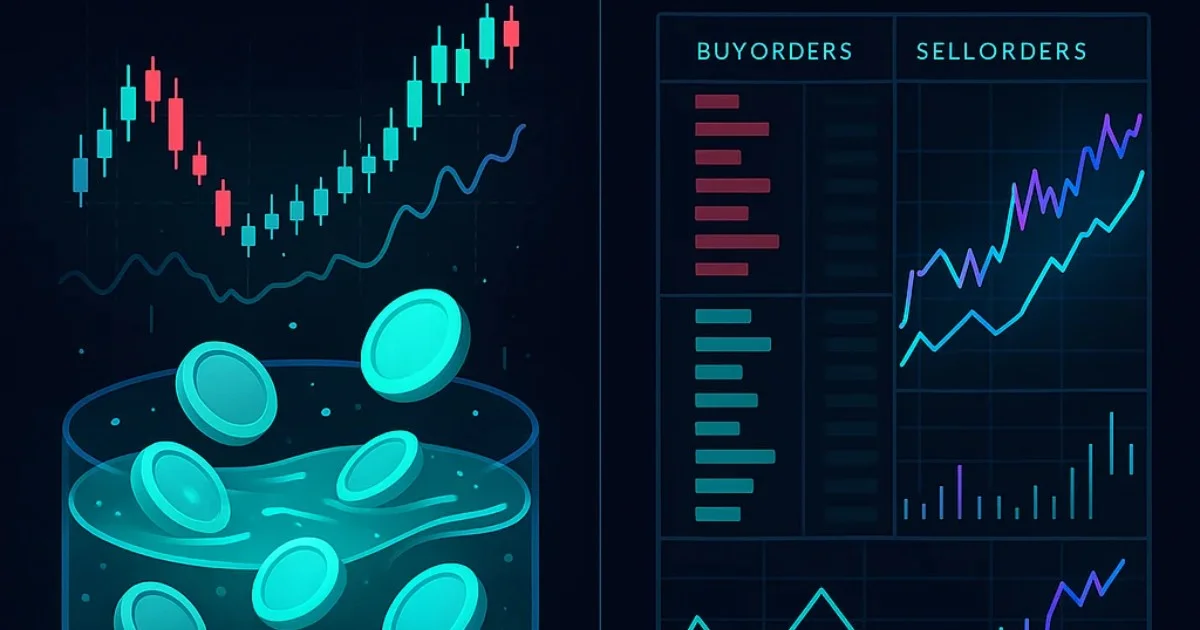
What Is an AMM DEX?
An AMM, or automated market maker, uses liquidity pools instead of a traditional list of buyers and sellers. Users trade against a pool of tokens supplied by liquidity providers. The price changes based on the relationship between the assets inside the pool.
This model is common across DeFi because it allows tokens to start trading quickly. A project can create a pool, add liquidity and make the token available to the market without needing professional market makers or a complex matching system.
The main advantage of an AMM is accessibility. New tokens can become tradable fast, and users can buy or sell directly from the pool. The main disadvantage is that trades can suffer from slippage, especially when liquidity is low.
What Is an Order Book DEX?
An order book DEX works more like a traditional exchange. Buyers place bids, sellers place asks and trades happen when orders match. Instead of trading directly against a pool, users trade against other market participants.
This model can offer more control. Traders can place limit orders, wait for a specific price and see visible market depth. However, order book DEXs usually need more active liquidity and better infrastructure to work smoothly.
Order books can be especially useful for more mature markets where there are enough buyers and sellers to keep spreads tight and execution efficient.
AMM vs Order Book DEX: The Main Difference
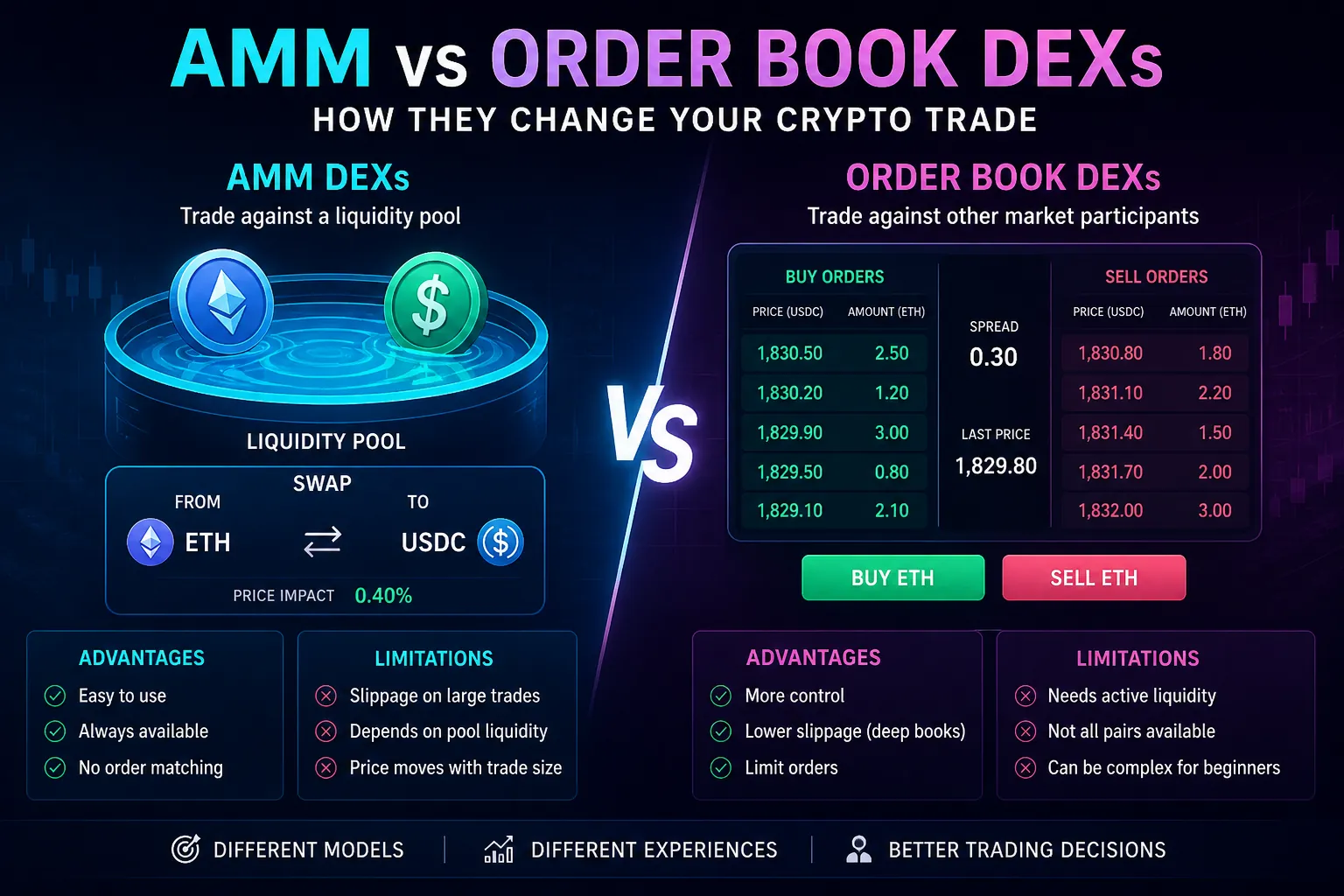
The biggest difference is how liquidity is organized.
In an AMM, liquidity sits inside a pool. The trader interacts with that pool, and price changes according to the pool formula.
In an order book DEX, liquidity comes from open orders placed by buyers and sellers. The trader interacts with available market orders or creates a new order.
This difference affects everything: price movement, execution, slippage, spreads and how easy it is to enter or exit a position.
Which Model Has More Slippage?
AMMs are more exposed to slippage when liquidity is thin. If a trader places a large order in a small pool, the price can move significantly during the trade.
Order book DEXs can also have slippage, but it appears differently. If the order book is shallow, a market order may consume several price levels, resulting in worse execution.
In both cases, the problem is not the model alone. The real issue is liquidity depth. A deep AMM pool can offer better execution than a weak order book, while a strong order book can outperform a thin pool.
Which Model Is Better for New Tokens?
AMMs are usually better for new tokens because they are easier to launch. A new project does not need to wait for enough buyers and sellers to create an active order book. It only needs initial liquidity.
This is why many early DeFi tokens begin trading through AMM pools. However, this also creates risk. Low liquidity pools can be volatile, easy to manipulate and difficult to exit safely.
For early token discovery, traders often need to check liquidity, volume, price impact and trading activity before entering.
Which Model Is Better for Active Traders?
Order book DEXs can be better for traders who need precision. Limit orders, visible depth and tighter control over execution can be useful for strategies that depend on exact entry and exit prices.
AMMs are often better for fast access to new markets. They are simple, direct and widely used across DeFi ecosystems.
The best model depends on the trader's goal. A user looking for early token opportunities may prefer AMM markets. A user looking for controlled execution may prefer order book systems.
How DEXTools Helps Traders Analyze AMM Markets
DEXTools is especially useful for traders analyzing AMM based markets because it helps users review price charts, liquidity, volume, pair activity and transaction behavior. Instead of relying only on the token price, traders can study how the market is behaving around a specific pair.
This matters because AMM trading is not only about direction. It is also about whether there is enough liquidity to support the trade.
AMM DEXs and order book DEXs both play important roles in crypto markets. AMMs make new token trading more accessible, while order books can offer more control and precision.
For traders, the key is not choosing one model as always better. The key is understanding how each model affects execution, risk and liquidity. Before entering any trade, especially in DeFi, analyzing the market structure can be just as important as analyzing the chart.
How to Bridge Crypto Between Chains: Complete Cross-Chain Tutorial 2026 How to Use 1inch: Complete DEX Aggregator Swap Tutorial (2026) How to Use OKX Web3 Wallet: Multi-Chain DeFi Hub Guide (2026)Frequently Asked Questions
What is an order book in crypto?
An order book is a list of buy and sell orders for a specific cryptocurrency, organized by price. It provides transparency into market depth and liquidity.
How does an order book DEX work?
Order book decentralized exchanges (DEXs) allow users to place limit or market orders directly on the blockchain. Trades are matched when a buy and sell order's prices align.
What is a limit order?
A limit order is an instruction to buy or sell a cryptocurrency at a specified price or better. It will only execute if the market price reaches the limit price.
What is a market order?
A market order is an instruction to buy or sell a cryptocurrency immediately at the best available current market price. It prioritizes execution speed over a specific price.
How do order books differ from AMMs?
Order books rely on buyers and sellers directly matching trades, while Automated Market Makers (AMMs) use liquidity pools and algorithms to facilitate trades against a pool of assets.