What is Ark? Bitcoin Off-Chain Scaling Explained

Managing inbound liquidity and channel management bottlenecks limits Lightning's consumer scale. We break down how the Ark protocol uses vUTXO transaction trees to achieve self-custodial offline payments.
The Next Generation Scaling Paradigm: Breaking Layer-2 Capital Constraints
- Bitcoin's base layer serves as the ultimate sovereign settlement network. However, its physical block space constraints limit native transaction throughput, creating fee competition during high-demand network cycles. While the Lightning Network successfully established a peer-to-peer micro-payment ecosystem, it introduced significant liquidity hurdles. Operating a self-custodial Lightning node requires users to actively manage inbound liquidity, manually fund static communication channels, and remain continuously online to receive inbound payments.
- Ark introduces a completely alternative architecture to the Bitcoin Layer-2 scalability landscape. Originally conceptualized by developer Burak, Ark is an open-source, server-coordinated layer-2 protocol that enables highly scalable, low-cost off-chain transactions without requiring users to open, fund, or manage dedicated liquidity channels. By utilizing trees of pre-signed off-chain transactions, Ark combines the user experience of a centralized banking application with the ironclad self-custody guarantees of native Bitcoin.
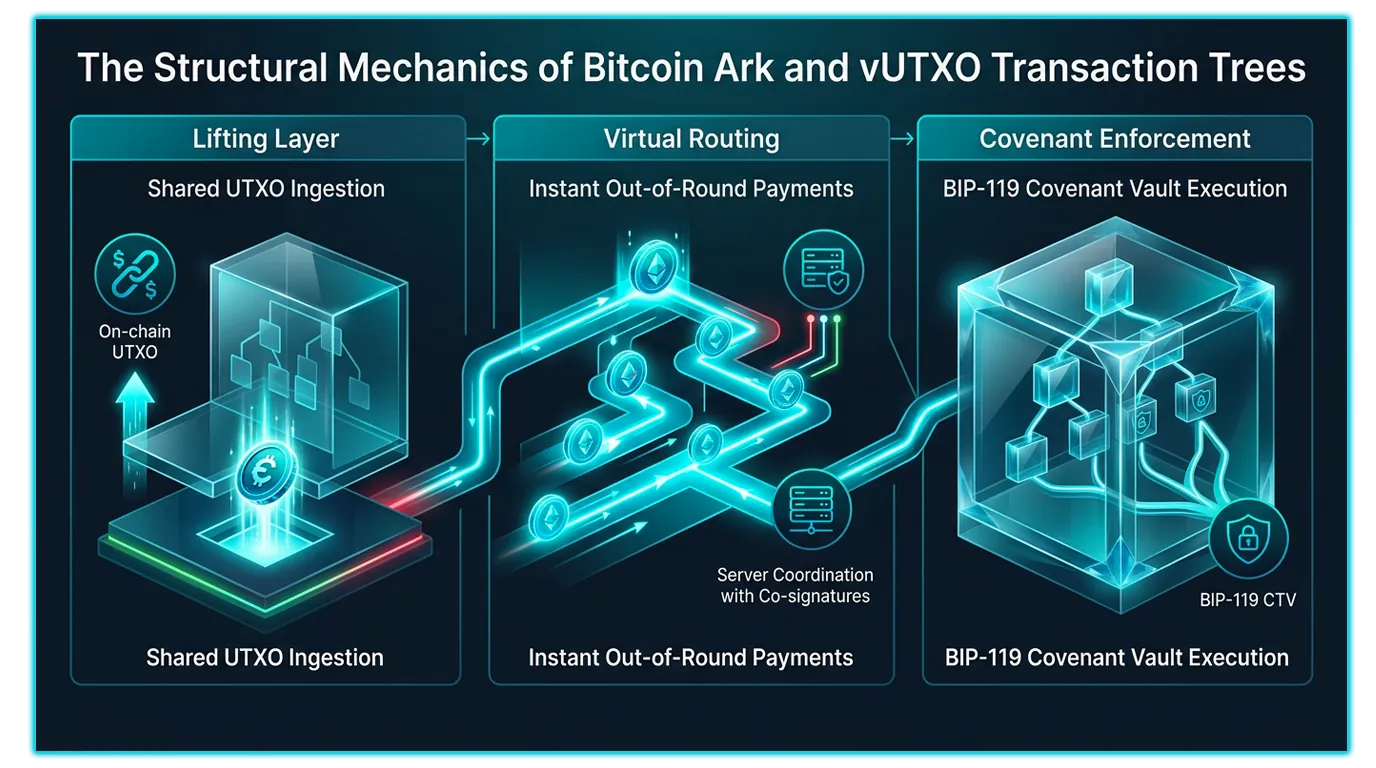
1. The Underwriting Engine: Server-Coordinated Rounds and ASPs
Ark does not rely on a decentralized web of interconnected peer channels. Instead, the network coordinates its transactional throughput using specialized, non-custodial intermediaries known as Ark Service Providers (ASPs).
ASPs function simultaneously as liquidity engines, blind CoinJoin coordinators, and payment settlement hubs.
The Atomicity of Rounds: Rather than settling payments individually, an ASP organizes transactions periodically into programmatic intervals called rounds or pools, which execute roughly every five seconds.
Transaction Trees: During a round, the ASP constructs a hierarchical tree of off-chain, pre-signed transactions. The root of this tree is a single, unified transaction broadcast to the Bitcoin base blockchain.
The Connector Check: To ensure absolute security, rounds are made atomic using connector outputs. This mechanism guarantees that a user's old funds are only forfeited the exact millisecond their newly received funds are cryptographically locked into the verified transaction tree, completely removing custodian default risks.
2. The Currency of Ark: Virtual UTXOs (vUTXOs)
- On-chain Bitcoin relies on the Unspent Transaction Output (UTXO) accounting model. Ark mirrors this framework off-chain by introducing Virtual UTXOs (vUTXOs or vTXOs).
- A vUTXO represents a fractional cryptographic claim or "leaf" inside the ASP's master transaction tree. When an Ark user initiates a payment, they are not moving digital tokens across a network path; they are exchanging their current leaf allocation in an existing shared on-chain UTXO for a fresh leaf allocation in a newly constructed shared UTXO round.
The Absolute Expiry Cycle
To maintain operational efficiency and free up liquidity allocated to older rounds, all vUTXOs are bound by an absolute programmatic timelock-typically calibrated to four weeks.
The Active Window: During the first two weeks of an ingestion cycle, only the designated recipient can claim or spend the vUTXO.
The Timeout Reversion: If a vUTXO sits completely stagnant and unclaimed past its initial window, the spending authority automatically reverts back to the sender's wallet via an automated timeout condition, similar to Lightning HTLC structures. To maintain long-term custody seamlessly, Ark user wallets automatically execute an internal background "refresh" or "batch swap" transaction during subsequent rounds before the absolute timelock hits zero.
Unilateral Exits
- If an ASP goes completely offline, attempts to censor transactions, or acts maliciously, Ark users are never locked out of their funds. Because every vUTXO is backed by a verifiable branch of pre-signed off-chain transactions, users can execute a unilateral exit.
- A user simply broadcasts their specific branch and leaf transaction scripts in sequential order directly to the Bitcoin base layer, forcing the network to release their shared capital allocation into an on-chain output under their sole control.
3. Ark vs. Lightning Network: A Last-Mile Payment Breakdown
Ark is not designed to replace the Lightning Network; rather, it serves to optimize the final distribution layer where Lightning hits economic scaling walls.
The Shared UTXO Advantage
- In the Lightning Network, an on-chain UTXO is locked inside a channel shared exclusively between two specific counterparties. If one hundred million global users want to onboard onto self-custodial Lightning, the network must execute hundreds of millions of on-chain setup transactions, which would overwhelm Bitcoin's base block space capacity. Ark radically solves this constraint by allowing hundreds of thousands of users to trustlessly share a single on-chain UTXO footprint simultaneously.
Offline Receive Functionality
- Receiving a payment via Lightning requires your node to be active, online, and connected to the network to sign state updates and avoid routing fraud. Ark completely eliminates the online requirement.
- Because the ASP and the sender handle the off-chain tree construction interactive signing process, a recipient can remain entirely offline. Their wallet will automatically ingest and sync the newly minted vUTXO the next time they connect to the internet.
4. The Covenant Link: BIP-119 (OP_CHECKTEMPLATEVERIFY)
The current iterations of Ark can be deployed on the live Bitcoin network today without requiring any soft fork upgrades, but they require users to interactively sign large, complex transaction trees to ensure trustless exits. To reach maximum fee efficiency and full non-interactive scaling potential, Ark depends heavily on the activation of covenants, specifically BIP-119 (OP_CHECKTEMPLATEVERIFY / CTV).
BIP-119 introduces a dedicated opcode that allows a transaction output to explicitly restrict the structure of the subsequent transaction that spends it.
Enforcing Deterministic Trees: By embedding a CTV template hash directly into the shared on-chain root output, an ASP can programmatically guarantee the entire downstream transaction tree structure before a single dollar is deposited.
Eliminating Interactive Signing: This covenant primitive allows users to safely receive non-interactive vUTXOs. They no longer need to exchange pre-signed signatures with other round participants, slashing data storage footprints and clearing the path for millions of users to securely scale within a single block confirmation.
Bitcoin Layer-2 Architecture Comparison Matrix
| Metric | Lightning Network | Ark Protocol (with BIP-119) |
| Capital Allocation | 1 UTXO per 2 Users | 1 UTXO per $100,000+$ Users |
| Liquidity Constraints | Strict Inbound/Outbound Caps | Zero Channel Caps / Fluid Sourcing |
| Receive State | Node Must Remain Online | Fully Native Offline Receive |
| Covenant Dependency | None (Optional for Eltoo) | Critical for Non-Interactive Scaling |
Tracking Scaling Layer Infrastructure Assets via DEXTools Telemetry
- As Bitcoin's scaling landscape expands through alternative protocols, BRC-20 environments, and supporting modular execution layers, keeping precise track of live trading pool velocities and contract securities becomes paramount. Sourcing analytics through advanced decentralized charting architectures like DEXTools gives market participants an essential universal platform to monitor live token behaviors, evaluate pool depths, and inspect contract parameters across all public execution networks.
- By leveraging core features like the Pair Explorer, Live New Pairs dashboard, and the integrated Trade Story or Top Traders diagnostic tools, technical traders can seamlessly audit localized volume trends, track large whale wallet capital reallocations via the Big Swap Explorer, and check automated contract safety scores before initiating any on-chain interactions, ensuring your hardened hardware setup interacts safely with verified market venues.
You can access DEXTools here and start trading today!
Disclaimer: This article is for informational purposes only and does not constitute investment advice, financial advice, trading advice, or any other kind of advice. DEXTools does not recommend buying, selling, or holding any cryptocurrency or token. Users should conduct their own research and consult with a qualified financial advisor before making any investment decisions. Cryptocurrency investments are volatile and high-risk. DEXTools is not responsible for any losses incurred.
Ark's Privacy Architecture: Beyond Basic Anonymity
While Ark's vUTXO trees are primarily designed for scalability and offline payments, a significant, often overlooked, benefit lies in its privacy characteristics. Unlike traditional Lightning channels where the opening and closing of channels, and even the routing of payments, can leave traces on the blockchain or through network analysis, Ark introduces a layer of obfuscation that profoundly enhances user privacy.
Each payment within an Ark pool is essentially a new vUTXO transaction, detached from the sender's original on-chain UTXO. This creates a fresh, unlinked output for every transaction, making it exceedingly difficult for external observers to trace the flow of funds from an on-chain origin to a specific Ark user, or even between users within the Ark system. It's a fundamental shift from channel-based privacy to a transaction-based model that offers stronger unlinkability.
Unpacking Ark's Privacy Gains
- Every Ark payment involves a new vUTXO, breaking the direct link to prior transactions.
- Payments within an Ark pool are indistinguishable from each other from an external perspective.
- The "blinded" nature of the vUTXO means the recipient's identity is not directly revealed to the sender or the pool operator.
- Ark's reliance on discrete transactions, rather than persistent channels, limits the ability to build a long-term transaction graph for users.
- The self-custodial aspect means no third party has a complete view of a user's transaction history or balances within the system.
Related Guides
- What Is a State Channel? Off-Chain Transactions Explained
- What Is THORChain: RUNE Cross-Chain Bitcoin DEX Guide 2026
- What Is BounceBit (BB)? CeDeFi Bitcoin Restaking Chain Guide 2026
- How to Use Glassnode: Read Bitcoin On-Chain Metrics Better (2026)
- How to Sell ETH on MetaMask in 2026: Cash Out and Off-Ramp Guide
Frequently Asked Questions
What is Ark in the context of Bitcoin?
Ark is a proposed off chain scaling approach for Bitcoin designed to make payments cheaper and faster while keeping users in self custody. It aims to reduce some of the liquidity setup burdens associated with other off chain systems.
How does off chain scaling help Bitcoin?
Off chain scaling moves many transactions away from the base layer so they settle faster and at lower cost, while still anchoring to Bitcoin for security. This helps the network handle more activity than on chain throughput alone would allow.
Does Ark keep users in control of their funds?
Ark is designed as a self custodial system, meaning users aim to retain control of their funds rather than handing them to a custodian. Self custody is a core principle behind many Bitcoin scaling efforts.
How is Ark different from the Lightning Network?
Both are off chain scaling approaches for Bitcoin, but they use different designs, and Ark seeks to ease challenges around inbound liquidity and channel management that affect Lightning. Each makes its own trade offs in cost, complexity, and user experience.