What Is Blockscout: Open-Source Multichain Explorer and Contract Search (2026)
— By Tony Rabbit in Tutorials
What is Blockscout? Learn how this open-source multichain explorer approaches contract verification, search, metadata and cross-chain exploration in 2026.
Intent check: If you want a chain-specific explorer tutorial, use our guides on explorers like BaseScan, Arbiscan or PolygonScan. This article is specifically about Blockscout as an open-source multichain explorer platform.
Blockscout is not just another explorer homepage. The more useful way to understand it is as an open-source multichain explorer platform that combines search, contract verification and richer metadata across networks. That makes it relevant not only to users reading transactions, but also to teams building and hosting explorer experiences.
This branded query has durable value because explorers are not interchangeable. People search Blockscout when they want to understand what makes it different from Etherscan-style chain explorers, how open-source deployment changes the picture and why developers care about it.
What Blockscout does in plain English
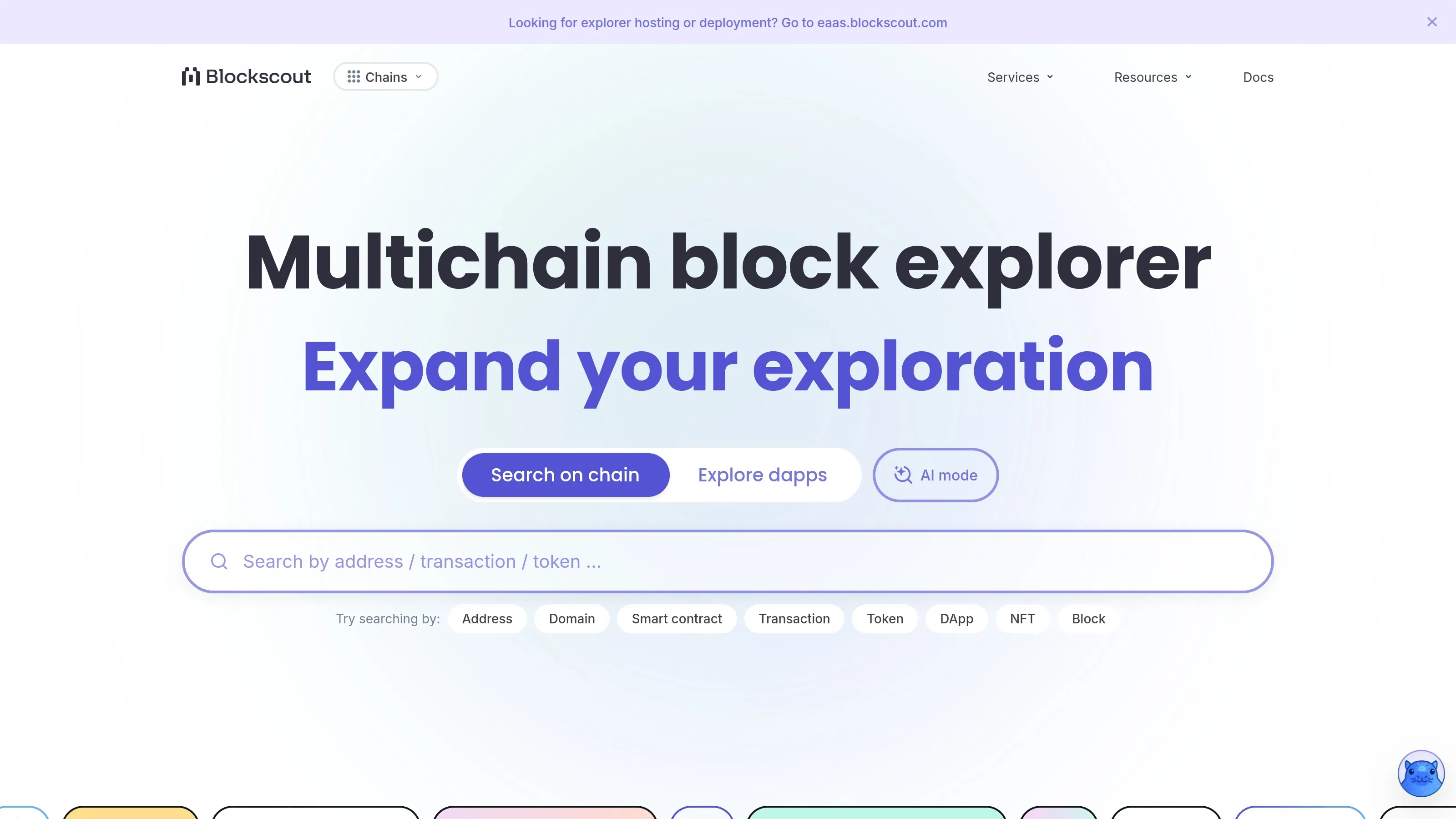
At a surface level, Blockscout helps users search addresses, contracts, tokens, transactions and dApps across supported chains. But the bigger distinction is that it also acts as infrastructure for teams that want open-source explorer capabilities rather than a closed product surface.
That is why contract verification, rich metadata, multichain search and developer-facing explorer options matter so much in the Blockscout story. The brand is about transparency and flexibility, not only about one chain search box.
Why teams look at Blockscout
Teams and users care about Blockscout for different reasons. Users want better cross-chain search and contract context. Developers and ecosystem teams care because open-source explorer infrastructure can be deployed, extended and adapted to their needs.
How Blockscout fits into a Web3 stack
Blockscout sits partly in the user-facing explorer layer and partly in the infrastructure layer. That hybrid identity is what makes it distinct from more familiar single-brand explorer experiences.
How this article avoids internal overlap
We already have general content on what explorers are and several chain-specific explorer tutorials. Repeating those would muddy this page and create unnecessary overlap.
The cleaner angle is platform-specific: what Blockscout is, why open source matters here, and how its multichain explorer model differs from a typical single-chain guide.
Who Blockscout is for, and where it can feel like overkill
Blockscout is most useful for users who want richer contract visibility and for teams that care about explorer infrastructure, deployability and multichain search.
It is less relevant if the only need is to occasionally check one chain through a more familiar branded explorer and nothing else.
Final take
Blockscout matters because it shows that explorers can be more than read-only interfaces. They can also be flexible, open infrastructure layers that help ecosystems and users understand onchain activity more deeply.
When Blockscout is stronger than a typical chain explorer
Blockscout stands out most when the conversation expands beyond checking a single transaction. Its open-source nature, multichain posture and contract tooling make it relevant for teams and ecosystems that want explorer capability as infrastructure, not only as a hosted interface. That is a very different value proposition from a chain-specific explorer page that mainly serves end users.
This is also why the platform deserves its own framing. Users may care about richer search and contract context, while builders care about deployment flexibility, verification flows and the ability to shape explorer experiences around their ecosystem. Those are not side notes. They are central to why Blockscout exists as a platform rather than as a narrow brand page.
Common mistakes when researching Blockscout
One mistake is to compare Blockscout only to a casual end-user explorer and conclude the category is identical. Another is to ignore the open-source dimension, which is exactly what makes the project strategically interesting for some chains, teams and communities. If that layer is ignored, the brand can look flatter than it really is.
A cleaner evaluation asks two questions. First, how good is Blockscout as a user-facing explorer? Second, how valuable is it as deployable explorer infrastructure? Once those are separated, the platform becomes much easier to understand and much easier to position without overlapping generic explorer tutorials.
FAQ
Related Guides
- What Is Sentient AI (SENT)? Open Source AGI on The GRID Guide 2026
- The Open League (TOL): TON Ecosystem Program Guide
- What Is Open Interest in Crypto? Full Guide
- Open Interest vs Volume in Crypto Trading (2026)
- Lightning Network Setup: How to Open Your First Channel
Frequently Asked Questions
What is Blockscout?
Blockscout is an open-source block explorer that supports many blockchains. It lets users search transactions, addresses, blocks, and smart contracts across supported networks.
What is contract verification on a block explorer?
Contract verification publishes a smart contract's source code and matches it to the deployed bytecode. This lets users read and confirm what a contract actually does, improving transparency.
How is Blockscout different from a closed-source explorer?
As open-source software, Blockscout can be inspected, self-hosted, and customized by anyone. Many networks deploy their own instances rather than relying on a single proprietary explorer.
What can you look up on a block explorer?
Block explorers let you view transaction details, address balances and history, blocks, and contract information. They are a common tool for verifying on-chain activity.