What Is Cardano (ADA): Complete Guide to the Academic Blockchain (2026)
— By Tony Rabbit in Tutorials
What is Cardano (ADA)? Complete 2026 guide: Ouroboros PoS, 5-era roadmap, Hydra L2, top dApps, ADA staking step-by-step and honest comparison with Ethereum and Solana.
Cardano is one of the most polarizing projects in all of crypto. To its supporters, it is the most rigorously engineered blockchain ever built, a peer-reviewed academic platform that prioritizes correctness over hype. To its critics, it is a slow-shipping ecosystem with billions in market cap but a fraction of the on-chain activity of competitors. Both sides have a point. In 2026, Cardano sits in a strange place: technically mature, with a complete five-era roadmap nearly behind it, yet still fighting to translate research into real users.
The native token, ADA, has been a top-ten cryptocurrency for years. It powers transactions, secures the network through staking, and serves as the governance token of the new Voltaire era. Cardano was designed from day one to be a third-generation blockchain, meaning it intended to solve the trilemma that Bitcoin and Ethereum struggle with: scalability, sustainability, and interoperability. The approach was radical at the time. Instead of moving fast and breaking things, founder Charles Hoskinson and the team at IOG (formerly IOHK) chose to publish peer-reviewed academic papers and formally verify the underlying protocols before writing a single line of production code.
In this complete guide, you will learn what Cardano actually is, how its Ouroboros proof-of-stake protocol works, why it uses an eUTXO model instead of the account model Ethereum uses, what the five Cardano eras actually accomplished, how to stake ADA in five minutes, and an honest assessment of how it compares to Ethereum and Solana in 2026. We will also cover the top dApps, the Hydra Layer 2 scaling solution, and the legitimate critiques that even Cardano fans need to acknowledge.
What Is Cardano? Definition and History
Cardano is a public, permissionless, proof-of-stake blockchain platform that supports smart contracts, native tokens, and decentralized applications. It launched its mainnet in September 2017 after roughly two years of research and development. The project was founded by Charles Hoskinson, one of the original co-founders of Ethereum who left that project in 2014 over a disagreement about how it should be governed and funded. Hoskinson wanted a non-profit, peer-reviewed, slow-and-steady approach. The rest of the Ethereum founding team wanted to ship faster and operate as a for-profit business. Hoskinson left and eventually started Cardano with Jeremy Wood, founding the company IOHK (now IOG, Input Output Global) to build it.
The name Cardano comes from Gerolamo Cardano, a sixteenth century Italian polymath. The native token ADA is named after Ada Lovelace, the nineteenth century mathematician widely considered the world's first computer programmer. These naming choices are not accidental. They reflect the project's self-image as a serious, intellectual endeavor rooted in mathematics and engineering rigor rather than crypto-bro culture.
Three entities are responsible for Cardano's development. IOG (Input Output Global) does the core engineering and research. The Cardano Foundation, based in Switzerland, oversees the protocol's development, adoption, and standardization efforts. Emurgo is the commercial arm that drives enterprise adoption and builds products on top of Cardano. This three-pillar structure was designed to prevent any single entity from controlling the project, in contrast to how the Ethereum Foundation dominates Ethereum's development.
By 2026, Cardano has been live for nearly nine years. It has processed hundreds of millions of transactions, secured tens of billions of dollars in value, and survived multiple bear markets without major outages. It has never been hacked at the protocol level. The chain has had 100% uptime since the Shelley hard fork in 2020, an achievement few competitors can match.
The Academic Approach: Peer-Reviewed Blockchain
What truly sets Cardano apart from every other major blockchain is its development methodology. Most blockchain projects follow the "move fast and break things" philosophy borrowed from Silicon Valley. Cardano explicitly rejected that approach. Every major protocol decision begins with an academic paper that is submitted to peer-reviewed journals or top-tier computer science conferences. Only after the research is published and accepted does engineering begin.
As of 2026, IOG has published well over 200 peer-reviewed papers in venues like Crypto, Eurocrypt, IEEE Security and Privacy, and ACM CCS. The flagship paper on the Ouroboros protocol, published in 2017, was the first proof-of-stake protocol with rigorous mathematical security guarantees comparable to Bitcoin's proof-of-work. This was not marketing. Academic cryptographers actually reviewed and accepted the proofs.
The implementation language reinforces this approach. Cardano's core nodes are written in Haskell, a functional programming language popular in academia and used for systems where correctness matters more than performance. Haskell is notoriously difficult to learn, but it allows for formal verification, meaning developers can mathematically prove that their code behaves correctly under all conditions. Critics say this slows everything down. Supporters say it produces software that does not break.
This academic rigor has real consequences. Cardano takes longer to ship features than competitors. Smart contracts did not arrive until 2021, four years after launch. But when they did arrive, they came with formal specifications and audit reports that most other chains cannot match. Whether that tradeoff is worth it remains the central debate around Cardano in 2026.
The 2-Layer Architecture: CSL and CCL
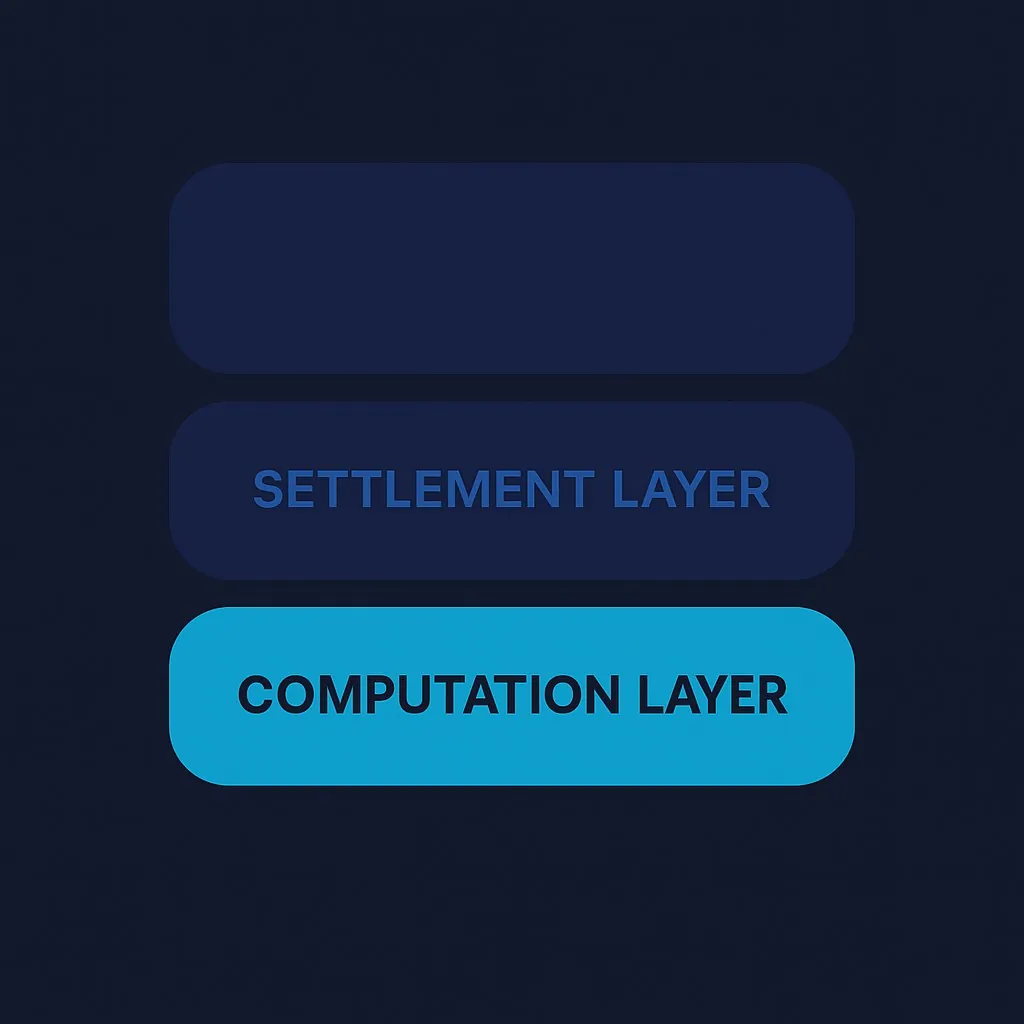
Cardano is built on a unique two-layer architecture that separates value transfer from computation. This is a fundamental design choice that distinguishes Cardano from monolithic chains like Ethereum, where everything happens in a single execution environment.
The Cardano Settlement Layer, or CSL, is responsible for the basic functions of the network: transferring ADA between addresses, registering native tokens, and distributing staking rewards. Think of it as the accounting layer. It is simple, robust, and deliberately limited in what it can do. This simplicity makes it easier to formally verify and reason about.
The Cardano Computation Layer, or CCL, is where smart contracts execute. This is where dApps live and where developers deploy logic that powers DeFi protocols, NFT marketplaces, and other applications. The separation between CSL and CCL means that updates to the smart contract engine, like the addition of Plutus V3 features, do not affect the underlying value transfer mechanism. This isolation reduces systemic risk. A bug in the smart contract layer cannot directly compromise ADA balances on the settlement layer.
Ethereum, by contrast, runs everything in one big virtual machine. If there is a fundamental flaw in the EVM, it affects both ETH transfers and every smart contract simultaneously. Cardano's architecture is designed to compartmentalize that risk. The tradeoff is added complexity in how data flows between the two layers, but the security and modularity benefits are real.
Ouroboros: The First Provably Secure Proof of Stake
Ouroboros is the consensus protocol that powers Cardano. It was the first proof-of-stake protocol to be mathematically proven secure under standard cryptographic assumptions. Before Ouroboros, most proof-of-stake systems were considered "good enough" but lacked formal security guarantees. Ouroboros changed that and set a new standard for the industry. To understand why this matters, you need to understand the basics of proof of work versus proof of stake.
Here is how Ouroboros works in plain English. Time is divided into epochs, and each epoch is divided into slots. Each slot is approximately one second long. In every slot, the protocol selects one slot leader through a verifiable random function that is weighted by stake. The more ADA you have delegated to a stake pool, the higher the chance that pool will be selected to produce the next block. The selected slot leader produces the block, includes valid transactions, and broadcasts it to the network. Other nodes verify the block and add it to their copy of the chain.
The genius of Ouroboros is that the slot leader selection is provably random and unbiased, even though it is deterministic given the inputs. This prevents attackers from predicting or manipulating who gets to produce the next block. Several versions of Ouroboros have been deployed over the years, including Ouroboros Classic, Ouroboros BFT, Ouroboros Praos, and Ouroboros Genesis. Each iteration improved security guarantees, decentralization properties, or bootstrap behavior. By 2026, the network runs a hybrid that incorporates lessons from all these variants.
Cardano uses delegation to keep staking accessible. You do not need to run a node to participate. You simply choose a staking pool and delegate your ADA to it. Your ADA stays in your wallet the entire time. You never give up custody. The stake pool operator runs the infrastructure, produces blocks when selected, and shares the rewards proportionally with delegators. This makes Cardano staking unique in two ways: zero lock-up period and zero slashing risk for delegators.
The eUTXO Model vs Ethereum's Account Model
One of the most important technical decisions Cardano made was to use an extended UTXO model, commonly written as eUTXO, rather than the account-based model that Ethereum and most other smart contract platforms use. This single architectural choice has cascading effects on how Cardano works in practice.
In an account model, the blockchain stores balances as a global state, similar to a bank ledger. Each address has a balance, and transactions update that balance. When you send ETH to someone, the network deducts from your balance and adds to theirs. Simple, intuitive, but with a downside: any transaction that touches a shared piece of state must be processed sequentially. Two transactions cannot update the same balance at the same time without coordination, which limits parallelism.
UTXO models work differently. They are based on Bitcoin's approach. Instead of balances, the chain tracks unspent transaction outputs. Your wallet balance is the sum of all unspent outputs that belong to addresses you control. To spend, you consume specific outputs and create new ones. Cardano extends this with eUTXO by attaching data and validation scripts to each output, enabling smart contracts. Each output can carry a datum, a script, and conditions that must be met before the output can be spent.
The practical benefits of eUTXO are substantial. Transaction validity is deterministic: you know before submitting whether a transaction will succeed, because the inputs and their conditions are fully specified. There are no failed transactions consuming fees on Cardano in the way you see on Ethereum, where a transaction can run out of gas mid-execution and still cost you money. Parallelism is also dramatically improved, because transactions that touch different outputs do not conflict and can be processed in parallel. The tradeoff is that eUTXO is harder to program against. Developers used to the account model need to adjust their mental model.
The 5 Cardano Eras: Roadmap Status in 2026
Cardano's roadmap was structured from the beginning as five distinct eras, each named after a literary or historical figure connected to Cardano's themes. Each era unlocked a new layer of functionality. As of 2026, all five eras have launched, with Voltaire still in active rollout.
Byron (2017): Named after Lord Byron, father of Ada Lovelace. This was the foundation era. The mainnet launched, ADA became transferable, and the original Daedalus wallet was released. Byron was federated, meaning the network was run by a small number of nodes operated by IOG, Emurgo, and the Cardano Foundation. It was functional but not yet decentralized.
Shelley (2020): Named after the poet Percy Bysshe Shelley, husband of Mary Shelley. This was the decentralization era. Stake pools were introduced, ADA holders could delegate to pools and earn rewards, and the network transitioned from federated to fully community-operated. By the end of Shelley, over 3,000 stake pools were operating globally. Cardano became one of the most decentralized chains by stake distribution.
Goguen (2021): Named after computer scientist Joseph Goguen. This was the smart contracts era. Plutus smart contracts went live on mainnet in September 2021 with the Alonzo hard fork. Native tokens were also introduced, allowing anyone to mint custom assets without writing a smart contract. This unlocked DeFi, NFTs, and the broader dApp ecosystem.
Basho (2023 and ongoing): Named after the Japanese poet Matsuo Basho. This is the scaling era. The Vasil hard fork in late 2022 set the stage with major Plutus improvements. Hydra heads launched on mainnet. Input endorsers, sidechains like Midnight, and parallel processing improvements continue to roll out through 2026. Throughput has increased substantially compared to the original Goguen baseline.
Voltaire (2024 and rolling out): Named after the Enlightenment philosopher. This is the governance era. The Chang hard fork in 2024 activated on-chain governance. ADA holders can now register as delegated representatives, or DReps, and vote on governance actions including treasury withdrawals, hard fork initiations, and constitutional amendments. By 2026, the system is operational with thousands of DReps and active proposals being voted on regularly. This makes Cardano one of the first fully on-chain governed major blockchains.

Native Tokens vs ERC-20: A Different Approach
One of Cardano's most underappreciated features is native asset support. On Ethereum, every token besides ETH itself is a smart contract that implements the ERC-20 (or ERC-721 for NFTs) standard. This means every token transfer requires executing smart contract code, which costs gas and introduces potential for bugs. There have been numerous incidents where ERC-20 tokens had bugs that locked funds or allowed exploits.
On Cardano, custom tokens are native to the protocol itself, just like ADA. When you create a token, you do not deploy a smart contract. You use the built-in multi-asset ledger to mint it directly. These Cardano Native Tokens behave exactly like ADA at the protocol level. They are transferred by the same machinery, secured by the same consensus, and validated by the same nodes. There is no separate smart contract logic that can be exploited.
This has real consequences. Cardano native tokens cannot have buggy transfer functions because there are no transfer functions to write. They cannot freeze user funds through a malicious upgrade because there is no upgrade. They cannot have hidden mint functions because mint policies are fixed at creation and visible on chain. This eliminates entire classes of bugs and scams that plague the ERC-20 ecosystem. The tradeoff is that native tokens are less flexible than fully programmable smart contract tokens. For most use cases, the security tradeoff is worth it. For complex tokens that need custom behavior, Plutus smart contracts are still available.
Smart Contracts on Cardano: Plutus, Marlowe, and Aiken
Cardano smart contracts are written in Plutus, which is a domain-specific language based on Haskell. Plutus contracts are split into two parts: on-chain code that runs as validation scripts on the chain, and off-chain code that constructs transactions in the user's wallet or application. This separation is unique to Cardano and reflects the eUTXO model. The off-chain code does most of the work, building the exact transaction that the on-chain validator will then approve or reject.
Plutus has a steep learning curve. Haskell is not widely taught, and writing safe Plutus code requires understanding both functional programming and the eUTXO model. To address this, the Cardano ecosystem developed alternative languages and tools. Marlowe is a domain-specific language for financial contracts, designed to be readable by non-programmers like lawyers and finance professionals. It is constrained by design to prevent unbounded execution and dangerous operations.
The most significant development is Aiken, a modern smart contract language for Cardano that compiles to the same underlying Plutus Core but with familiar syntax similar to Rust. Aiken has become the dominant choice for new Cardano dApp development by 2026. It dramatically reduces development time while preserving the safety guarantees of the underlying platform. Most new DeFi protocols on Cardano are built with Aiken rather than raw Plutus.
There are also higher-level tools like Plu-ts, which allows TypeScript-like syntax for Cardano contracts, and OpShin, which lets Python developers write Cardano scripts. The ecosystem has matured significantly from the early days when Plutus was essentially the only option. For developers comparing platforms, Cardano in 2026 is no longer "the Haskell chain that nobody can build on." It is a chain with multiple modern toolchains, even if it still lags Ethereum in raw developer count.
Hydra: Cardano's Layer 2 Scaling Solution
One of the most ambitious parts of the Basho era is Hydra, Cardano's Layer 2 scaling solution. Unlike optimistic and ZK rollups that dominate Ethereum L2 design, Hydra takes a completely different approach using state channels called "heads."
A Hydra head is essentially a multi-party state channel. A group of participants opens a head by locking funds in a special Layer 1 contract. Once the head is open, those participants can transact among themselves off-chain with sub-second finality and negligible fees. They run the same Cardano transaction format and the same Plutus contracts, just off the main chain. When they are done, they close the head and settle the final state back to Layer 1. Disputes, if any, can be resolved on Layer 1 using cryptographic evidence from the head.
The benefit of this design is that each head scales independently. If you run a thousand heads in parallel, your aggregate throughput is roughly a thousand times higher than a single head's throughput. This makes Hydra theoretically capable of millions of transactions per second across the network, though practical throughput depends on use cases and head sizes. The cost is that heads work best for groups of participants who interact frequently with each other, like a payment network between a fixed set of users or a high-frequency trading scenario.
By 2026, Hydra is production-ready and used by several applications, including micropayments for streaming, on-chain gaming with rapid state updates, and high-frequency DEX matching engines. It is not a universal scaling solution like a rollup, but it is exceptionally well-suited to specific use cases. The Cardano ecosystem has also developed Mithril, a stake-based threshold signature scheme for fast chain bootstrapping, and the Midnight sidechain, which provides privacy-preserving smart contracts. These complement Hydra to form a layered scaling story.
Cardano vs Ethereum vs Solana: An Honest Comparison
No Cardano article would be complete without a fair comparison to its biggest competitors. Cardano, Ethereum, and Solana represent three different philosophies of how to build a smart contract platform. Here is an honest look at how they stack up in 2026.
Cardano's strengths are clear: zero outages, formal verification, the lowest energy use among major chains, and a uniquely decentralized stake distribution with thousands of independent pools. The eUTXO model gives it deterministic transaction validity, meaning no failed transactions eating fees. Native assets eliminate entire categories of token bugs. Staking has no slashing risk and no lock-up.
Ethereum's strengths are equally clear: the largest developer ecosystem in crypto, the deepest DeFi liquidity by far, an enormous L2 ecosystem with rollups providing massive scaling, and Lindy-effect institutional adoption. If you want to build something that interoperates with the broader crypto economy, Ethereum or one of its L2s is the default choice.
Solana's strengths are raw performance and a strong consumer app story. Sub-cent fees and sub-second finality have made it the chain of choice for high-frequency trading, memecoins, and consumer dApps. The downsides include historical reliability problems and a more centralized validator set than either Cardano or Ethereum, though both gaps have narrowed in 2026.
An honest take: Cardano has the strongest engineering story but the weakest network effects of the three. Ethereum has the strongest network effects but the highest L1 fees. Solana has the best performance but the most centralization concerns. None of these chains is going away, and each has carved out a meaningful niche. For ADA holders, the question is whether Cardano's technical advantages can eventually translate into mainstream adoption, or whether the train has already left the station.
Top Cardano dApps and Ecosystem in 2026
Despite criticism about ecosystem maturity, Cardano has developed a real and growing dApp landscape. Here are the top applications that anyone exploring the Cardano ecosystem in 2026 should know about.
The largest DEX on Cardano by TVL. AMM model with concentrated liquidity. Backbone of Cardano DeFi.
Battle-tested AMM with strong farming incentives and one of the largest native token listings.
First major Cardano DEX. Order-book and AMM hybrid. SUNDAE governance token.
Synthetic assets on Cardano. Mint iUSD, iBTC, iETH against ADA collateral.
Fiat-backed stablecoin native to Cardano. Issued by Mehen with full reserve backing.
Decentralized algorithmic stablecoin by Anzens. Cardano native overcollateralized stablecoin.
Largest NFT marketplace on Cardano. Hundreds of millions in cumulative volume.
Algorithmic lending market for Cardano. Supply ADA, USDM, and others to earn interest.
Beyond these flagship dApps, Cardano hosts a growing collection of smaller protocols. Liqwid Finance offers lending and borrowing. DJED is an overcollateralized stablecoin paired with the SHEN reserve coin. Cornucopias and other GameFi projects are building consumer experiences. The ecosystem is smaller than Ethereum's or Solana's, but it is real, growing, and built largely from grassroots community projects rather than VC-funded launches.
How to Stake ADA Step by Step
One of the easiest things any ADA holder can do is stake their coins to earn rewards. Cardano's staking design is remarkably user-friendly compared to other chains. There is no lock-up period, no slashing risk, and you never lose custody of your funds. Your ADA stays in your wallet the entire time, and you can spend or withdraw it at any moment without waiting periods.
Here is the complete five-minute process for staking ADA. First, choose a wallet. The most popular options in 2026 are Daedalus, the full-node desktop wallet maintained by IOG; Yoroi, a lightweight browser and mobile wallet; Eternl, a feature-rich browser wallet with strong dApp connector support; Lace, IOG's modern light wallet; and Vespr or Typhon as additional alternatives. For most users, Eternl or Lace offers the best balance of features and ease of use.
Second, install your chosen wallet and create a new wallet or restore from a seed phrase. Write down your 24-word seed phrase and store it offline. This is the single most important step. Anyone with your seed phrase can steal your ADA. Anyone without it cannot, including support staff at IOG. There is no recovery.
Third, transfer ADA to your wallet from an exchange like Coinbase, Binance, or Kraken. Make sure you are sending to a Cardano address, not an exchange-specific intermediate address. Cardano addresses typically start with "addr1" for mainnet.
Fourth, navigate to the staking or delegation section of your wallet. You will see a list of available stake pools. Each pool has metrics displayed: live stake, saturation level, pledge, performance, and operator fees. Choose a pool that is not saturated, has a small to mid size operator (good for decentralization), strong historical performance, and reasonable fees. Avoid the largest single-operator multi-pools when possible. Tools like pool.pm, Adapools, and the official Cardano pool list help you research.
Fifth, delegate. Confirm the delegation transaction. You will pay a small fee plus a one-time 2 ADA refundable deposit. From here, the wallet does everything. Rewards accumulate every 5 days (one epoch) and are paid out automatically to your wallet. Current annual yield is approximately 3 to 4 percent on Cardano, paid in ADA. You can change pools or withdraw at any time without penalty.
That is it. No staking lock-up. No slashing. No node setup required. This is the simplest staking experience among major proof-of-stake networks, and it is one of the legitimate strengths Cardano has over competitors like Ethereum where solo staking requires 32 ETH and running validator software.

Cardano Tokenomics: Supply, Treasury, and Monetary Policy
Understanding Cardano's tokenomics is essential for any serious ADA holder. The total maximum supply of ADA is fixed at 45 billion tokens. This is hard-coded into the protocol and cannot be changed without a hard fork that the community would have to approve through Voltaire governance.
Of the 45 billion total, 25.9 billion were distributed in the initial coin offering between 2015 and 2017 to public buyers in Japan and other early Cardano supporters. The remaining 5.2 billion (out of the 31.1 billion non-reserve allocation) was allocated to IOG, Emurgo, and the Cardano Foundation for development funding. The other roughly 13.9 billion ADA is reserved and gradually released as block rewards over decades.
The monetary expansion schedule is deliberately decreasing. Every epoch (five days), a small percentage of the remaining reserve is unlocked. A portion goes to stake pool rewards, and another portion goes to the Cardano treasury. As the reserve shrinks, new ADA issuance slows, and at some point the network will rely entirely on transaction fees for security. This is similar in spirit to Bitcoin's halving schedule but smoother and more gradual.
The Cardano treasury is one of the most underappreciated aspects of the project. A portion of every block reward and every transaction fee is automatically deposited into the treasury, a community-owned pool of ADA. By 2026, the treasury holds well over 1 billion ADA. With Voltaire governance live, ADA holders vote on how this treasury is spent. Projects can propose budgets and request treasury funding through the new governance system. This is one of the largest decentralized funding pools in all of crypto.
Circulating supply in 2026 is approximately 35 to 36 billion ADA, depending on the exact epoch and treasury balance. The remainder is held in the reserve and the treasury. The fully diluted valuation versus circulating market cap calculation is more transparent on Cardano than on most chains because the emission schedule is fully deterministic and the reserve and treasury balances are publicly auditable on chain.
Voltaire: The Governance Era
Voltaire is potentially the most transformative era in Cardano's history. It moves Cardano from a chain governed informally by IOG, the Foundation, and Emurgo to a chain governed on-chain by ADA holders. This is a profound shift, and it is genuinely unique among major blockchains in scope and ambition. Think of it as Cardano becoming a giant DAO for protocol governance.
The core mechanism is Delegated Representatives, or DReps. Any ADA holder can register as a DRep by depositing 500 ADA and providing a metadata file describing their views. Other ADA holders can then delegate their voting power to a DRep, similar to how they delegate staking power to a stake pool. This is delegated governance: you do not need to vote on every proposal personally, but you can choose who represents your views.
Governance actions fall into several categories: protocol parameter updates (such as fee adjustments), treasury withdrawals, hard fork initiation, no-confidence votes, constitutional amendments, and committee updates. Each action type has specific requirements about who must vote and what thresholds are needed for approval. There is a Constitutional Committee, currently formed of trusted entities, that can veto proposals that violate the Cardano Constitution. There are also Stake Pool Operators who vote on certain proposals, providing a separate veto power.
The Cardano Constitution is itself an on-chain document that defines the principles and constraints under which governance operates. It was ratified through a global series of workshops and the final document was approved by stake-weighted vote in 2024. This is the first time a major blockchain has had an explicit, on-chain, community-ratified constitution. By 2026, Voltaire is operational, with hundreds of active DReps representing millions of ADA in delegated voting power. Real treasury funding decisions are being made by community vote. It is messy, slow, and contentious at times, but it works.
Honest Critiques: Where Cardano Falls Short
No serious guide to Cardano would be complete without acknowledging the legitimate criticisms. Cardano fans tend to dismiss critics as FUD-spreaders, but some of the criticism is fair, and ignoring it does the project a disservice.
Slow shipping. This is the most common and most legitimate critique. Smart contracts arrived in 2021, four years after mainnet launch. Hydra took years to get from research papers to production deployment. Voltaire governance was promised for years before activating in 2024. Compare this to chains like Solana that shipped a full smart contract platform, NFT marketplaces, and DeFi in a fraction of the time. Cardano's research-first approach produces robust software, but it also means competitors often beat Cardano to market with similar features.
Low TVL relative to market cap. Cardano typically ranks in the top 10 cryptocurrencies by market capitalization. Its DeFi TVL, however, ranks much lower, often outside the top 15. The ratio of market cap to TVL on Cardano is much higher than on Ethereum or Solana, which suggests the chain is valued more for its potential than its current on-chain economic activity. This is not necessarily wrong as an investment thesis, but it is a tension that should be acknowledged.
Developer ecosystem. The Plutus learning curve was a real barrier to early dApp growth. Aiken has helped enormously, but the developer pool remains smaller than for Ethereum or Solana. New protocols are launched on Cardano with less frequency than on competitor chains. This network effect is hard to reverse.
Ecosystem maturity. While Cardano has core DeFi primitives, the depth of products available pales in comparison to Ethereum. There are fewer perp DEXes, fewer derivatives platforms, fewer lending markets, and fewer yield aggregators. Sophisticated DeFi users will find Cardano limited compared to what is available on Ethereum or even competing chains.
Marketing and culture. Cardano has historically struggled with messaging. Charles Hoskinson is a polarizing figure whose YouTube videos and Twitter feuds have alienated some potential users. The community's defensiveness about criticism has also become a meme in the broader crypto space. None of this is fatal, but it has slowed adoption among neutral observers.
For all these critiques, Cardano has real strengths and a committed community. The chain works. The math is sound. The roadmap is being delivered, even if slowly. Whether the project ultimately reaches its potential depends on whether the ecosystem can translate engineering excellence into user adoption in the coming years. The answer is genuinely not clear in 2026.
Frequently Asked Questions
Is Cardano a good investment?
Cardano has strong technical fundamentals, zero downtime, the lowest energy use among major chains, and a clearly delivered roadmap. As an investment, ADA depends on whether ecosystem adoption catches up to the technical capabilities. It has been a top-10 altcoin for years but has lagged competitors during bull cycles. This is not investment advice. Always do your own research and only invest what you can afford to lose.
How is Cardano different from Ethereum?
Cardano uses an eUTXO model versus Ethereum's account model, Haskell-based Plutus and Aiken instead of Solidity, native tokens instead of ERC-20 contracts, and Ouroboros proof-of-stake from inception instead of Ethereum's PoS that arrived later. Cardano is built with peer-reviewed academic research first, while Ethereum ships faster and iterates in production. Each approach has real tradeoffs.
Can you stake ADA?
Yes. Any amount of ADA can be staked from compatible wallets including Daedalus, Yoroi, Eternl, and Lace. There is no minimum, no lock-up period, and no slashing risk. Annual yields are roughly 3 to 4 percent paid in ADA every five days. Your funds stay in your wallet at all times. You can withdraw or change pools whenever you want without penalty.
What is Hydra in Cardano?
Hydra is Cardano's Layer 2 scaling solution based on state channels called heads. Participants lock funds in a head, then transact off-chain at near-instant speed with negligible fees, then settle the final state back to Layer 1. Each head scales independently, so running many heads in parallel multiplies throughput. By 2026 it powers micropayments, gaming, and high-frequency trading applications on Cardano.
Is Cardano dead?
No. Cardano remains a top-tier blockchain with consistent uptime, active development, billions in market cap, thousands of stake pools, and a growing dApp ecosystem. The "Cardano is dead" narrative typically appears when ADA underperforms during bull cycles, but the underlying network and development continue regardless of price action. Voltaire governance launched in 2024 and is operational in 2026.
When is the Cardano Voltaire era?
Voltaire is the fifth and final planned era. It activated through the Chang hard fork in September 2024 and continues to roll out features through 2026 and beyond. Active on-chain governance with Delegated Representatives, the Constitutional Committee, treasury votes, and protocol parameter governance is all live by 2026. Cardano is now one of the few major blockchains with full on-chain protocol governance.
What wallets support ADA?
The official wallets include Daedalus (full-node desktop wallet by IOG) and Lace (modern light wallet by IOG). Popular community wallets include Yoroi, Eternl, Vespr, Typhon, and Nami. For maximum security, hardware wallets like Ledger and Trezor support ADA and can be used with most of these software wallets for cold storage.
Conclusion
Cardano in 2026 is a paradox. It is one of the most technically sophisticated blockchains ever built, with formal verification, peer-reviewed protocols, zero downtime since Shelley, and a clearly executed five-era roadmap that competitors only promise. At the same time, its on-chain economic activity does not yet match its technical promise. Its TVL trails its market cap. Its dApp ecosystem is real but smaller than Ethereum's or Solana's. Its development moves more slowly than competitors.
Whether you view this as a feature or a bug depends on what you value. If you value engineering rigor, formal verification, and the highest standards of cryptographic security, Cardano is unmatched among major chains. If you value rapid iteration, massive developer ecosystems, and deep DeFi liquidity, Ethereum and its L2s remain the default. If you value pure performance and consumer-friendly fees, Solana is hard to beat. Cardano occupies a specific position in the crypto landscape, and that position has real value for the right use cases.
For new users, the practical recommendation is simple: get a Cardano wallet, buy some ADA, stake it to earn the 3 to 4 percent yield with zero lock-up and zero risk, and explore the ecosystem through Minswap, Liqwid, JPG Store, and Indigo Protocol. Use a small amount to learn how the chain works before committing larger sums. Follow the Voltaire governance process, register as a DRep delegator, and participate in the chain's evolution. Whether ADA becomes a generational investment or remains a mid-tier altcoin, the Cardano experience is genuinely worth exploring on its own merits as one of the most ambitious experiments in decentralized infrastructure ever attempted.