Was ist CBDC: Guide zu Zentralbank-Digitalwahrungen (2026)
— By Tony Rabbit in Tutorials

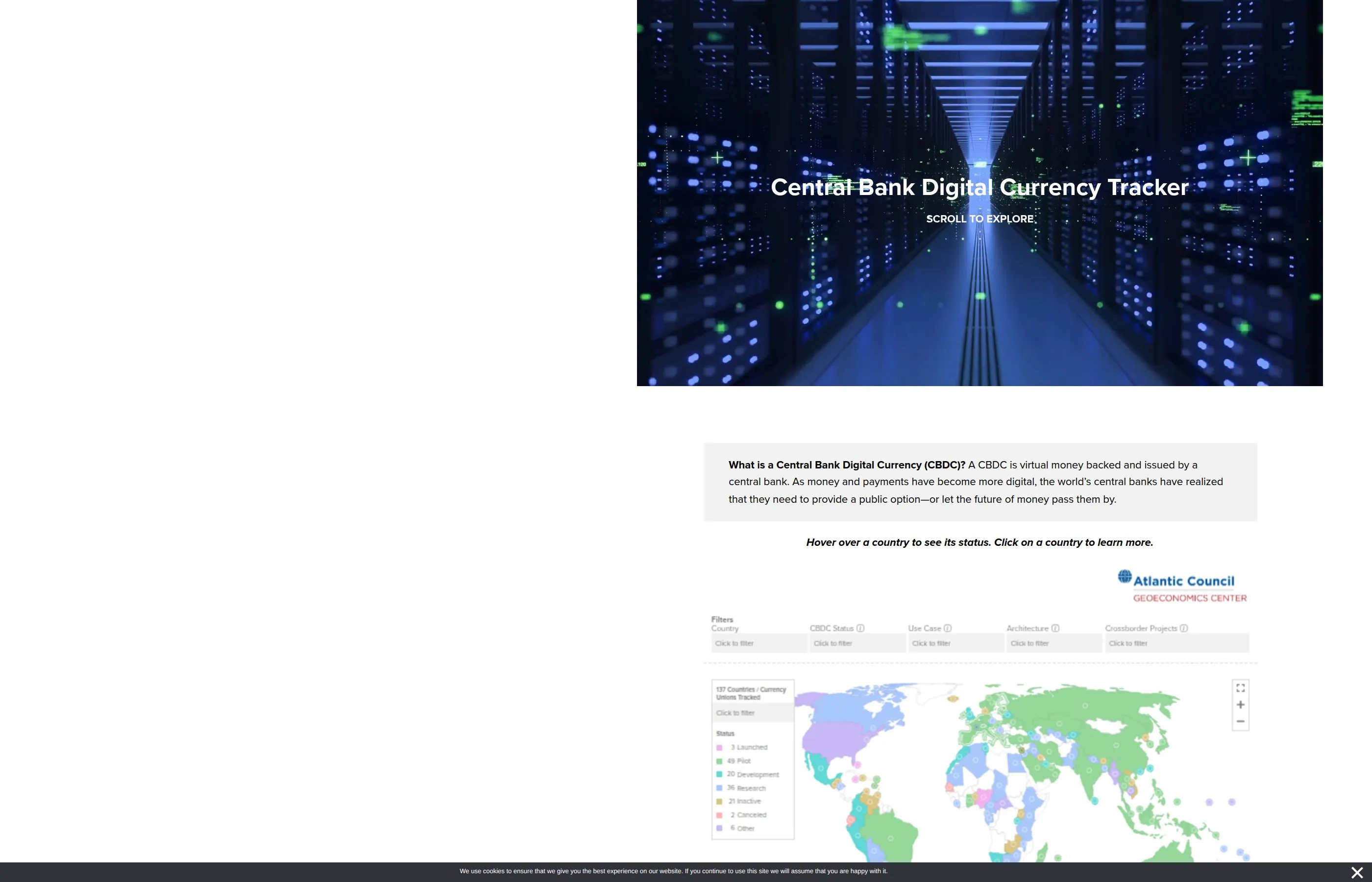
Was ist CBDC? 137 Lander forschen.
Central bank digital currencies have moved from theoretical white papers to real-world deployments across the globe. As of 2026, 137 countries representing 98% of global GDP are actively exploring, piloting, or operating some form of CBDC. China's digital yuan processes billions in transactions monthly. The Bahamas has been running its Sand Dollar since 2020. Nigeria's eNaira has reached millions of wallets. And the European Central Bank is deep into its Digital Euro pilot phase.
If you have been following cryptocurrency developments, you have probably noticed that CBDCs sit at the intersection of government monetary policy and digital finance. They are not Bitcoin. They are not stablecoins. They are something entirely different, and their rise will reshape how money works for billions of people in the coming decade.
This guide covers everything you need to know about CBDCs in 2026: what they are, how they work technically, which countries are leading the race, how they compare to crypto and stablecoins, what privacy concerns they raise, and what they mean for the future of decentralized finance. Whether you are a crypto native trying to understand the competition or a newcomer wondering why governments are building their own digital currencies, this is the most complete resource you will find.
What Is a CBDC?
A Central Bank Digital Currency (CBDC) is a digital form of a country's fiat currency, issued and backed directly by the central bank. Think of it as a digital version of the cash in your wallet, except it exists on a digital ledger managed by the government rather than as a physical banknote. Unlike commercial bank deposits that represent a claim on a private bank, a CBDC represents a direct liability of the central bank itself.
The distinction matters. When you hold money in a checking account at a commercial bank, you are trusting that bank to honor your deposit. If the bank fails (and you exceed deposit insurance limits), you could lose funds. When you hold a CBDC, you are holding the digital equivalent of cash issued directly by the monetary authority. There is no intermediary bank risk. The central bank stands behind every unit.
CBDCs come in two primary flavors: retail and wholesale. Retail CBDCs are designed for the general public and everyday transactions. You would use a retail CBDC to buy coffee, pay rent, or send money to family. Wholesale CBDCs are designed for financial institutions and are used to settle large interbank transactions, cross-border payments, and securities trades. Most of the public conversation around CBDCs focuses on the retail variety because it directly affects how ordinary people interact with money.
Retail CBDC vs Wholesale CBDC
Retail CBDCs aim to provide citizens with a digital payment instrument that functions like cash but in digital form. They would be held in digital wallets (either through a central bank app or through approved commercial intermediaries) and could be used for person-to-person transfers, point-of-sale payments, and online purchases. Retail CBDCs are designed to be universally accessible, including for populations without traditional bank accounts. This financial inclusion angle is one of the strongest arguments governments make for pursuing CBDCs.
Wholesale CBDCs operate at the institutional level. They are used by commercial banks, clearinghouses, and other financial entities to settle high-value transactions more efficiently. The Bank for International Settlements (BIS) has been running Project mBridge, connecting the central banks of China, Thailand, the UAE, and Saudi Arabia in a wholesale CBDC network that dramatically reduces cross-border settlement times from days to seconds. Wholesale CBDCs are less controversial than retail versions because they represent an evolution of existing interbank settlement systems rather than a new form of consumer money.
How CBDCs Work Technically
The technical architecture behind CBDCs varies significantly between countries, but most designs fall into two broad categories: account-based systems and token-based systems. Understanding this distinction is crucial if you come from the blockchain world, because CBDCs do not necessarily use the same technology as cryptocurrencies.
In an account-based CBDC, users have accounts maintained by the central bank (or by intermediaries acting on its behalf). Transactions involve debiting one account and crediting another, similar to how bank transfers work today. Identity verification is tied directly to the account, making it easy for authorities to enforce KYC (Know Your Customer) and AML (Anti-Money Laundering) requirements. This is the model favored by most central banks because it integrates naturally with existing regulatory frameworks.
In a token-based CBDC, the digital currency is represented as tokens that can be transferred directly between users, more similar to how physical cash or stablecoins work. Token-based systems can offer stronger privacy guarantees because the system verifies the validity of the token rather than the identity of the holder. However, pure token-based systems make it harder to comply with regulations, so most implementations use a hybrid approach.
Some CBDCs use distributed ledger technology (DLT), but many do not use a blockchain at all. China's e-CNY, for instance, uses a centralized database architecture with some DLT elements at the institutional layer. The European Central Bank has explored both DLT-based and traditional database approaches for the Digital Euro. The key takeaway: CBDCs borrow some concepts from blockchain technology but are fundamentally centralized systems controlled by governments.

CBDC vs Cryptocurrency vs Stablecoin
One of the most common questions in the crypto community is how CBDCs differ from existing cryptocurrencies and stablecoins. The differences are fundamental and go far beyond just who issues them.
Cryptocurrencies like Bitcoin and Ethereum are decentralized. No single entity controls the network, and transactions are validated by a distributed network of nodes. If you hold your private keys, nobody can freeze your funds or reverse your transactions. This censorship resistance is the core value proposition of crypto.
CBDCs are the opposite. They are fully centralized, issued and controlled by a government authority. The central bank can freeze accounts, reverse transactions, set spending limits, and even program the currency to expire or restrict certain purchases. While this gives governments powerful monetary policy tools, it also means CBDC holders have none of the sovereignty that crypto provides.
Stablecoins sit in a gray area between the two. Tokens like USDT and USDC are pegged to the dollar and issued by private companies, operating on public blockchains. They offer more programmability and global accessibility than CBDCs while being more centralized than pure cryptocurrencies. The issuing companies can freeze tokens (and have done so), but stablecoins still benefit from the permissionless infrastructure of blockchains.
For the DeFi ecosystem, the distinction matters enormously. CBDCs will not be composable with decentralized protocols the way stablecoins are. You will not be able to deposit your Digital Euro into Aave or trade it on Uniswap (at least not without significant regulatory bridges). This means CBDCs and DeFi are more likely to exist as parallel financial systems rather than integrated ones.
CBDC Global Status Timeline (2026)
Country Deep Dives
China: The e-CNY (Digital Yuan)
China is the undisputed leader in CBDC deployment among major economies. The People's Bank of China (PBOC) began pilot testing the e-CNY (also called the digital yuan or DC/EP) in 2020 and has steadily expanded its reach. By 2026, the e-CNY has been integrated into over 26 major cities, with more than 260 million individual wallets created and cumulative transactions exceeding 7 trillion yuan.
The e-CNY operates through a two-tier system. The PBOC issues the digital currency to authorized commercial banks and payment platforms (including Alipay and WeChat Pay), which then distribute it to consumers through their apps. Users can make payments by scanning QR codes, tapping NFC-enabled devices, or even using physical hardware wallets for offline transactions. The technical architecture uses a centralized ledger managed by the PBOC, not a public blockchain.
China's motivations for the e-CNY are multilayered. Domestically, it provides the government with granular visibility into money flows, strengthening anti-corruption and tax enforcement capabilities. It also gives the PBOC direct monetary policy transmission, bypassing the commercial banking layer when needed. Internationally, China sees the e-CNY as a tool to reduce dependence on the US dollar-dominated SWIFT system, particularly for trade settlement with Belt and Road partners.
European Union: The Digital Euro
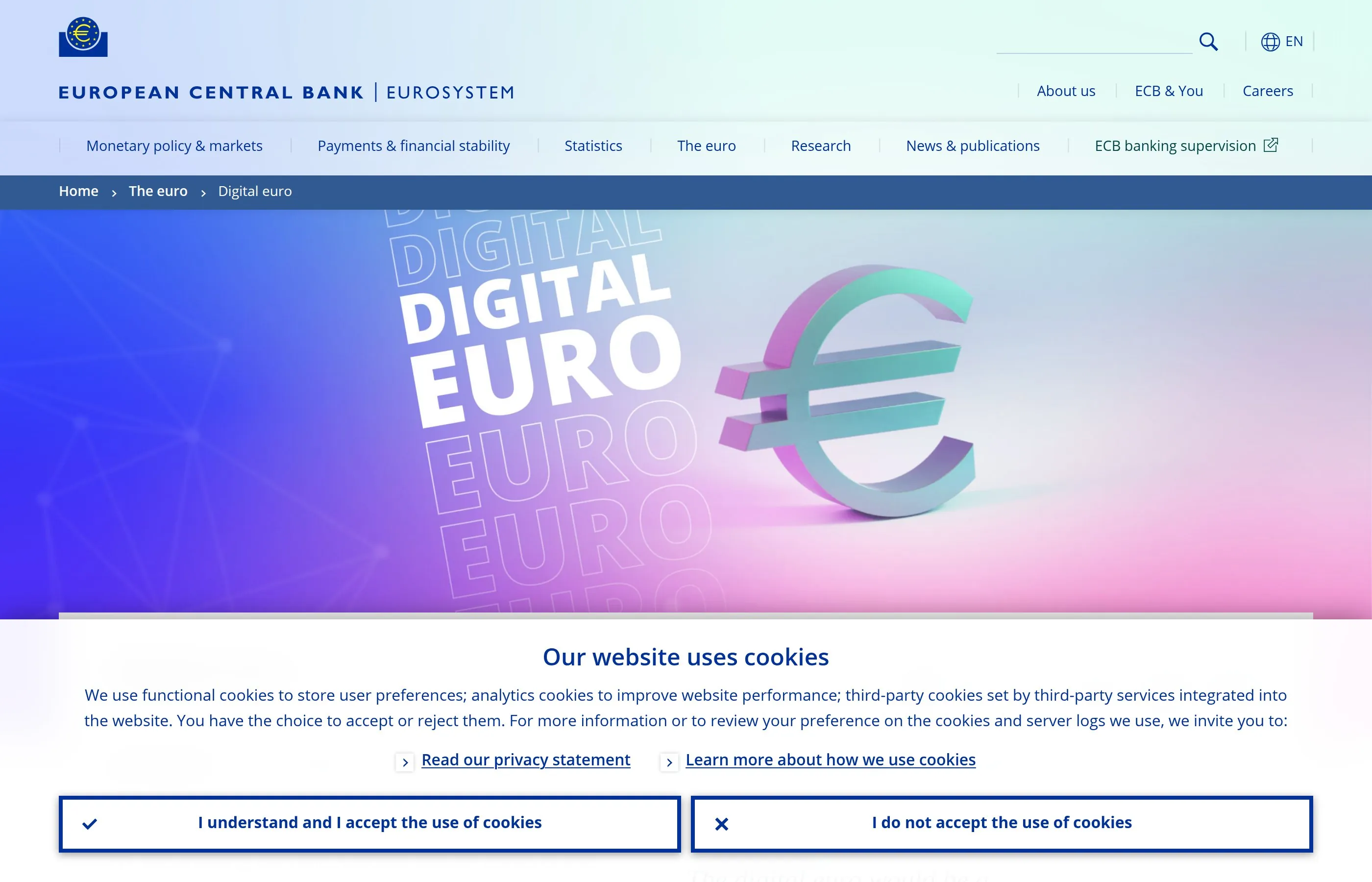
The European Central Bank (ECB) entered the preparation phase of the Digital Euro project in October 2023, following a two-year investigation phase. As of 2026, the ECB is conducting real-world pilot tests with selected financial institutions and merchants across the eurozone, with a public launch expected between 2027 and 2028, pending EU legislative approval.
The Digital Euro is designed to complement cash, not replace it. The ECB has emphasized that physical euro banknotes will remain legal tender. The digital version would serve as an additional payment option, particularly for online transactions and cross-border payments within the eurozone. A holding limit (potentially around 3,000 euros per person) has been proposed to prevent bank disintermediation, meaning the Digital Euro is not intended to replace your bank account.
Privacy has been a central concern in the Digital Euro design. The ECB has stated that it would not have access to individual transaction data for transactions below a certain threshold, and that small offline payments could be fully anonymous. However, privacy advocates remain skeptical, arguing that the technical infrastructure could be modified to enable surveillance at any time.
Nigeria: The eNaira
Nigeria became the first African nation to launch a CBDC when it introduced the eNaira in October 2021. The Central Bank of Nigeria (CBN) built the eNaira on the Hyperledger Fabric blockchain, making it one of the few CBDCs that actually uses distributed ledger technology in its core infrastructure.
Initial adoption was slow. Despite Nigeria having one of the highest crypto adoption rates in the world, the eNaira struggled to gain traction in its first year, with fewer than 1 million wallets created. The CBN responded by implementing aggressive adoption measures, including limiting ATM cash withdrawals to push citizens toward digital payments. By 2026, eNaira wallets have grown to over 13 million, though daily transaction volumes remain modest compared to traditional payment channels.
The Nigerian experience highlights both the promise and pitfalls of CBDC implementation in developing economies. Financial inclusion improved for some unbanked populations, but the perception of government surveillance and the forced nature of adoption created significant public resistance.
Bahamas: The Sand Dollar
The Bahamas holds the distinction of launching the world's first CBDC. The Central Bank of the Bahamas deployed the Sand Dollar in October 2020, motivated primarily by financial inclusion concerns. The archipelago nation's 700+ islands make traditional banking infrastructure expensive to maintain, and many residents in remote communities lacked access to basic financial services.
The Sand Dollar is pegged 1:1 to the Bahamian dollar (which is itself pegged to the US dollar). It can be used through mobile apps provided by authorized financial institutions, and transactions settle instantly at no cost. The system includes tiered wallets with different verification requirements and transaction limits, allowing basic access with minimal identification.
Russia: The Digital Ruble
The Bank of Russia launched its digital ruble pilot in August 2023 with 13 banks and expanded to 30 banks by 2025. Russia's interest in a CBDC has been amplified by Western sanctions following the Ukraine conflict, as the digital ruble could potentially facilitate trade with allied nations outside the SWIFT network. The digital ruble uses a two-tier distribution model similar to China's, with the central bank operating the core platform and commercial banks providing consumer-facing services.
India: The Digital Rupee
The Reserve Bank of India launched a wholesale CBDC pilot in November 2022 and a retail pilot (the e-rupee) in December 2022. The retail pilot started in four cities with four banks and has since expanded significantly. By 2026, over 5 million users have participated in the pilot. India's massive UPI (Unified Payments Interface) ecosystem, which already processes billions of digital transactions monthly, creates both an opportunity and a challenge for the digital rupee, as many citizens question why a CBDC is needed when UPI already works so well.
Privacy Concerns and Surveillance Risks
Privacy is the elephant in the room for every CBDC project. Unlike physical cash, which is anonymous by nature, digital currencies create a complete audit trail of every transaction. For governments, this is a feature. For privacy advocates, it is a nightmare. The concern is not hypothetical. A CBDC gives a central bank the theoretical ability to see every purchase you make, every person you transact with, and every financial decision in real time.
This level of financial surveillance has no precedent in human history. Even current digital payment systems (credit cards, bank transfers) distribute transaction data across multiple private institutions. With a CBDC, all of that data could be concentrated in a single government-controlled system. In countries with strong democratic institutions and privacy laws, safeguards may mitigate the risks. In authoritarian regimes, a CBDC becomes a powerful tool for social control.
Some CBDC designs attempt to address privacy concerns through tiered anonymity. Small transactions might be processed without identity verification, similar to how you can spend cash without showing ID. Larger transactions would require full KYC compliance. The ECB's Digital Euro proposal includes provisions for offline anonymous payments below a set threshold. But critics point out that these privacy features are policy choices that can be changed at any time, unlike the cryptographic privacy guarantees offered by technologies like zero-knowledge proofs in the crypto world.
This is precisely why many in the Web3 community view CBDCs as antithetical to the values that crypto was built on. Bitcoin was created specifically to enable peer-to-peer transactions without trusted intermediaries. CBDCs represent the exact opposite: a digital currency where the ultimate intermediary (the government) has total visibility and control. Understanding how to protect your financial sovereignty with tools like private key management becomes even more important in a world where CBDCs coexist with decentralized alternatives.
Impact on Traditional Banking
One of the biggest risks CBDCs pose to the existing financial system is bank disintermediation. If citizens can hold digital currency directly with the central bank, why would they keep deposits at a commercial bank? During a financial crisis, a CBDC could accelerate bank runs as depositors move their funds from commercial banks to the "safe haven" of central bank digital currency with a few taps on their phone.
Central banks are well aware of this risk. Most CBDC designs include mechanisms to prevent excessive disintermediation. The ECB has proposed holding limits for the Digital Euro (around 3,000 euros). China's e-CNY does not pay interest, making it less attractive as a savings vehicle compared to bank deposits. Some designs include tiered remuneration, where CBDC holdings above a certain threshold earn negative interest rates to discourage hoarding.
Despite these safeguards, the structural impact on banking could be profound. If even a small percentage of deposits migrate from commercial banks to CBDCs, banks would have less capital to fund loans, potentially tightening credit availability. Central banks would need to find alternative mechanisms to supply banks with liquidity, fundamentally altering the plumbing of the financial system that has operated largely unchanged for decades.
Impact on DeFi and Crypto
The relationship between CBDCs and decentralized finance is complex and often misunderstood. Some fear that CBDCs will kill crypto by providing a government-backed digital alternative that renders cryptocurrencies unnecessary. Others argue that CBDCs will actually accelerate crypto adoption by making the privacy and sovereignty of decentralized systems more valuable by contrast.
In practice, CBDCs and crypto serve fundamentally different purposes. CBDCs are tools of monetary policy and government control. Crypto is about financial sovereignty, censorship resistance, and permissionless innovation. People who use Bitcoin as a store of value outside the traditional financial system will not switch to a government-controlled digital currency. People who use DeFi protocols for yield farming, lending, and decentralized trading will not abandon those capabilities for a CBDC that cannot interact with smart contracts.
Where CBDCs may genuinely compete with crypto is in the payments and remittance space. If a Digital Euro enables instant, zero-fee payments across the entire eurozone, the use case for stablecoins in European domestic payments diminishes. Similarly, if wholesale CBDC networks like mBridge make cross-border settlement fast and cheap, the argument for using crypto as a cross-border payment rail weakens.
However, this competition may actually strengthen the crypto ecosystem by forcing it to double down on its unique advantages: censorship resistance, composability, programmability through smart contracts, and global accessibility without government gatekeepers. The tokenomics of decentralized networks will continue to offer opportunities that centralized CBDCs simply cannot replicate.
Programmable Money
One of the most powerful and controversial features of CBDCs is programmability. Unlike physical cash, digital currency can be programmed with rules that govern how, when, and where it can be spent. This capability is a double-edged sword that excites policymakers and terrifies civil libertarians in equal measure.
On the positive side, programmable CBDCs could enable targeted stimulus payments that automatically reach eligible recipients and can only be spent at qualifying businesses. Welfare payments could be programmed to cover food and housing but not gambling or alcohol. Government subsidies to farmers could be programmed to only work at agricultural supply stores. International aid could be sent directly to recipients with built-in spending restrictions that prevent corruption.
On the dystopian side, the same technology could be used to implement social credit-style spending restrictions. A government could program CBDCs to prevent citizens from purchasing items deemed undesirable, restrict spending to certain geographic areas, or impose expiration dates that force people to spend their money within a set timeframe (a tool some economists advocate for stimulating consumption during recessions). China has already experimented with expiring digital yuan vouchers in pilot programs.
The programmability of CBDCs stands in stark contrast to both physical cash and cryptocurrencies. Cash has no rules attached. You hand it over, and the transaction is complete. Crypto has user-defined programmability through smart contracts, but the rules are set by the users and developers, not by a government. CBDCs give the government the power to define the rules of money itself, a capability that has never existed before.
Offline Payments
For CBDCs to truly replace cash, they need to work without an internet connection. This is particularly important in developing countries where internet coverage is spotty, and during natural disasters or infrastructure failures when connectivity may be unavailable. Multiple CBDC projects are developing offline payment capabilities, though the technical challenges are significant.
China's e-CNY has been tested with hardware wallets that support NFC-based offline transactions. These physical devices (which can take the form of cards, wristbands, or standalone devices) store digital yuan locally and can complete transactions by tapping against another device, even without cellular or Wi-Fi connectivity. The transaction is recorded locally and synchronized with the central ledger once connectivity is restored.
The ECB has also prioritized offline functionality for the Digital Euro, recognizing that cash replacement without offline capability would leave vulnerable populations worse off. The technical challenge is preventing double-spending in offline mode, something that blockchain solves with network consensus but that offline CBDC transactions must handle through trusted hardware and cryptographic security measures.
Implementation Challenges
Despite the global momentum, CBDC implementation faces enormous technical, political, and social challenges. Scaling a CBDC to handle the transaction volume of an entire national economy is a massive engineering undertaking. The Visa network processes around 65,000 transactions per second at peak. A national CBDC would need to match or exceed this capacity while maintaining security, privacy, and resilience.
Cybersecurity is another critical concern. A CBDC represents a single point of failure for an entire national monetary system. A successful cyberattack on a CBDC infrastructure could freeze the economy. Central banks must build systems with military-grade security, redundancy, and disaster recovery capabilities. This is fundamentally different from the security model of decentralized cryptocurrencies, where the distributed nature of the network provides inherent resilience.
Public adoption is perhaps the biggest challenge. In countries where existing digital payment systems work well (like India's UPI, Sweden's Swish, or China's Alipay/WeChat Pay), citizens may see little reason to switch to a CBDC. Nigeria's experience shows that forced adoption through cash restrictions generates backlash. Finding the right incentive structure to drive voluntary adoption without coercion remains an unsolved problem for most CBDC projects.
Legal and regulatory frameworks also need to be built from scratch. Questions around CBDC legal tender status, liability in case of system failure, dispute resolution, cross-border interoperability, and data protection all require new legislation. The EU's Digital Euro legislative process is a prime example of how complex and time-consuming this regulatory work can be.
CBDC Timeline: What to Expect
The next five years will be decisive for CBDCs globally. Here is what the landscape looks like heading into the second half of the decade.
In 2026-2027, expect the Digital Euro pilot to expand, with a legislative decision on whether to proceed with a full launch. India's digital rupee pilot will likely expand to nationwide availability. Brazil's DREX platform, which focuses on tokenized assets settled with a wholesale CBDC, will enter advanced testing. Russia's digital ruble will expand beyond the pilot phase as Moscow seeks sanctions-resistant payment channels.
By 2028-2030, the first major Western economy CBDC is likely to launch (most probably the Digital Euro). Cross-border CBDC networks like mBridge will mature, enabling faster settlement between participating nations. The US will likely remain on the sidelines, with the political debate around a digital dollar continuing to be highly polarized. Developing nations in Africa and Southeast Asia will accelerate their CBDC projects, driven by financial inclusion goals and the desire to reduce remittance costs.
The timeline for widespread CBDC adoption is likely longer than enthusiasts hope but shorter than skeptics expect. By the end of the decade, it is reasonable to expect that several billion people will have access to a CBDC in some form, even if daily usage remains modest compared to existing payment methods.
Pros and Cons of CBDCs
Advantages
Financial inclusion: CBDCs can provide basic financial services to unbanked populations who lack access to traditional banking. A person with only a basic mobile phone could hold and transact digital currency directly with the central bank.
Faster payments: Domestic and cross-border payments could settle in seconds rather than days. This is particularly impactful for remittances, where migrant workers currently pay 5-7% fees to send money home.
Monetary policy tools: CBDCs give central banks direct channels to implement monetary policy. Stimulus payments could be distributed instantly. Interest rate changes could be transmitted directly to CBDC holdings rather than through the slow mechanism of commercial bank rate adjustments.
Reduced cash handling costs: Printing, distributing, securing, and processing physical cash is expensive. The Federal Reserve spends over $1 billion annually just on producing new banknotes. CBDCs dramatically reduce these costs.
Anti-money laundering: The transparency of CBDC transactions makes money laundering, tax evasion, and terrorist financing harder to execute. Law enforcement gains powerful new tools for tracking illicit financial flows.
Disadvantages
Surveillance risk: Governments gain unprecedented visibility into the financial lives of every citizen. Even with privacy safeguards, the infrastructure for mass financial surveillance exists once a CBDC is deployed.
Censorship capability: The ability to freeze or restrict accounts gives governments a powerful tool for suppressing dissent. Political opponents, protesters, or disfavored groups could be financially cut off.
Bank disintermediation: CBDCs could destabilize the commercial banking system by drawing deposits away from banks, reducing their ability to fund loans and potentially triggering financial instability.
Single point of failure: Unlike distributed cryptocurrency networks, a centralized CBDC system represents a catastrophic risk if the infrastructure fails or is compromised by cyberattack.
Digital divide: Elderly populations, rural communities, and people without smartphones could be disadvantaged by a shift away from physical cash toward digital-only currency.
Mission creep: Privacy features and spending freedom granted at launch can be eroded over time through policy changes. Once the infrastructure exists, the temptation to expand government control over money is significant.
Video: CBDC Explained
Visual overview of central bank digital currencies.
Frequently Asked Questions
What does CBDC stand for?
CBDC stands for Central Bank Digital Currency. It refers to a digital form of a nation's official currency that is issued and regulated by the country's central bank. Unlike commercial bank digital money (your checking account balance), a CBDC is a direct liability of the central bank, making it as "safe" as physical cash from a credit risk perspective.
Is a CBDC the same as Bitcoin?
No. Bitcoin is a decentralized cryptocurrency with no central authority, a fixed supply of 21 million coins, and pseudonymous transactions. A CBDC is centralized, issued by a government, has no fixed supply cap (the central bank controls issuance), and typically requires identity verification. They share the trait of being digital, but their design philosophy and purpose are fundamentally opposite.
Will CBDCs replace cash?
Most central banks explicitly state that CBDCs are intended to complement cash, not replace it. The ECB has committed to maintaining physical euro banknotes alongside the Digital Euro. However, the practical reality may differ from official statements. As CBDC adoption grows and cash usage declines, maintaining physical cash infrastructure becomes increasingly expensive, which could lead to de facto cashless economies even without formal policies to eliminate cash.
Can CBDCs be used for DeFi?
In their current designs, CBDCs are not compatible with DeFi protocols. CBDCs run on permissioned, centralized infrastructure, while DeFi operates on permissionless public blockchains. For a CBDC to interact with DeFi, it would need to be bridged to a public blockchain, which raises regulatory and technical challenges that no central bank has been willing to address. The two systems are more likely to evolve as parallel tracks.
Are CBDCs safe?
From a credit risk perspective, CBDCs are among the safest forms of money because they are direct liabilities of the central bank. You cannot lose your CBDC due to a commercial bank failure. However, they carry other risks: cybersecurity threats (system-wide attacks), operational risks (technical failures), and sovereignty risks (government freezing or restricting your funds). Safety depends heavily on context and what threats you are most concerned about.
How do CBDCs affect stablecoins?
CBDCs could reduce demand for stablecoins in domestic payment scenarios, particularly for simple transfers and merchant payments. However, stablecoins offer advantages CBDCs lack: they work across borders on public blockchains, they are composable with DeFi protocols, and they are available 24/7 without geographic restrictions. Stablecoins are likely to retain their role in the crypto ecosystem even as CBDCs expand.
Will the US launch a CBDC?
As of 2026, the United States has effectively paused CBDC development. An executive order signed in January 2025 prohibited federal agencies from establishing, issuing, or promoting CBDCs, reflecting strong political opposition rooted in privacy and government overreach concerns. The Federal Reserve had been conducting research through Project Hamilton (with MIT) and exploring design options, but active development is on hold. The US remains one of the few major economies without a CBDC pilot program.
Can governments freeze CBDC funds?
Yes. Unlike decentralized cryptocurrencies where funds controlled by private keys cannot be seized without access to those keys, CBDC accounts can be frozen, restricted, or debited by the issuing central bank. This capability is presented as necessary for law enforcement and sanctions compliance, but it also means that your CBDC balance is ultimately under government control. This is fundamentally different from holding self-custodied crypto in a wallet like MetaMask.
Do CBDCs use blockchain technology?
Some do, some do not. Nigeria's eNaira runs on Hyperledger Fabric, a permissioned blockchain. China's e-CNY uses a centralized database with some distributed ledger elements. The ECB has tested both blockchain-based and traditional database approaches. The key insight is that CBDCs are technologically agnostic. They use whatever infrastructure best serves the central bank's goals, and that often means centralized systems rather than true blockchains.
What is programmable money in the context of CBDCs?
Programmable money means the currency itself can carry embedded rules about how it can be spent. A government could issue stimulus payments programmed to expire in 90 days, restricting savings. Aid payments could be programmed to only work at food retailers. Tax payments could be automatically deducted. While this offers efficiency gains, it also gives issuers unprecedented control over individual spending behavior, something impossible with physical cash or decentralized crypto.
How do CBDCs handle offline payments?
Several CBDC projects include offline payment capabilities through hardware wallets or secure elements in smartphones. China's e-CNY has tested NFC-based offline transactions using physical cards and wearables. Transactions are stored locally on the device and synced to the central ledger when connectivity resumes. The main technical challenge is preventing double-spending in offline mode, which requires trusted hardware and cryptographic safeguards rather than the network consensus mechanisms used by cryptocurrencies.
What are the biggest risks of not adopting a CBDC?
Countries that do not develop CBDCs risk falling behind in the digital payments race and becoming dependent on foreign digital currency infrastructure. If China's e-CNY becomes the default settlement currency for Belt and Road trade, nations without CBDC alternatives may find themselves locked into China's financial ecosystem. Similarly, the growing dominance of dollar-denominated stablecoins issued by private US companies (Tether, Circle) means that nations without their own digital currencies are effectively ceding monetary sovereignty to foreign private entities.
How will CBDCs affect cross-border payments?
Cross-border payments are one of the most promising CBDC use cases. Current international transfers through the SWIFT/correspondent banking system are slow (2-5 business days), expensive (3-7% fees for remittances), and opaque. Wholesale CBDC networks like Project mBridge aim to enable instant settlement between participating central banks at a fraction of the current cost. If successful, this could dramatically reduce remittance fees for migrant workers and make international trade settlement more efficient.