What is Compound (COMP)? Lending Protocol Beginner Guide
— By AliceOnChain in Tutorials

This comprehensive guide introduces newcomers to the architectural foundation of Compound Finance. Discover how algorithmic interest rates discover asset value and learn to track cross-chain lending pools via DEXTools.
What is Compound (COMP)? The Complete DeFi Lending Guide
The Foundation of Algorithmic Money Markets
The emergence of decentralized finance dismantled traditional banking intermediaries by replacing manual credit checks with immutable code. At the forefront of this structural evolution stands one of the oldest money market protocols on-chain. Understanding what is Compound (COMP) requires shifting your perspective away from traditional peer-to-peer lending toward pooled, algorithmic liquidity frameworks. Instead of waiting for a specific counterparty to match a loan request, users interact directly with audited smart contracts that dynamically manage billions of dollars in digital assets.
For anyone entering the on-chain trading arena, analyzing these liquidity environments is a vital skill. Lending protocols serve as the systemic baseline for yield generation and capital efficiency across Web3 networks. By supplying assets to an automated ecosystem, users unlock the ability to earn non-custodial interest or secure over-collateralized loans instantly. This beginner-focused guide unpacks the foundational mechanics of Compound Finance, providing a technical blueprint to interpret its on-chain behavior using real-time analytical platforms.
Understanding the Architecture: What is Compound (COMP) Functionality?
To conceptually define what is Compound (COMP) to a newcomer, we must look at its core engine: the liquidity pool model. Traditional lending structures require a borrower and a lender to agree on specific terms, timelines, and interest parameters. Compound eliminates this friction entirely by aggregating user funds into unified asset reservoirs.
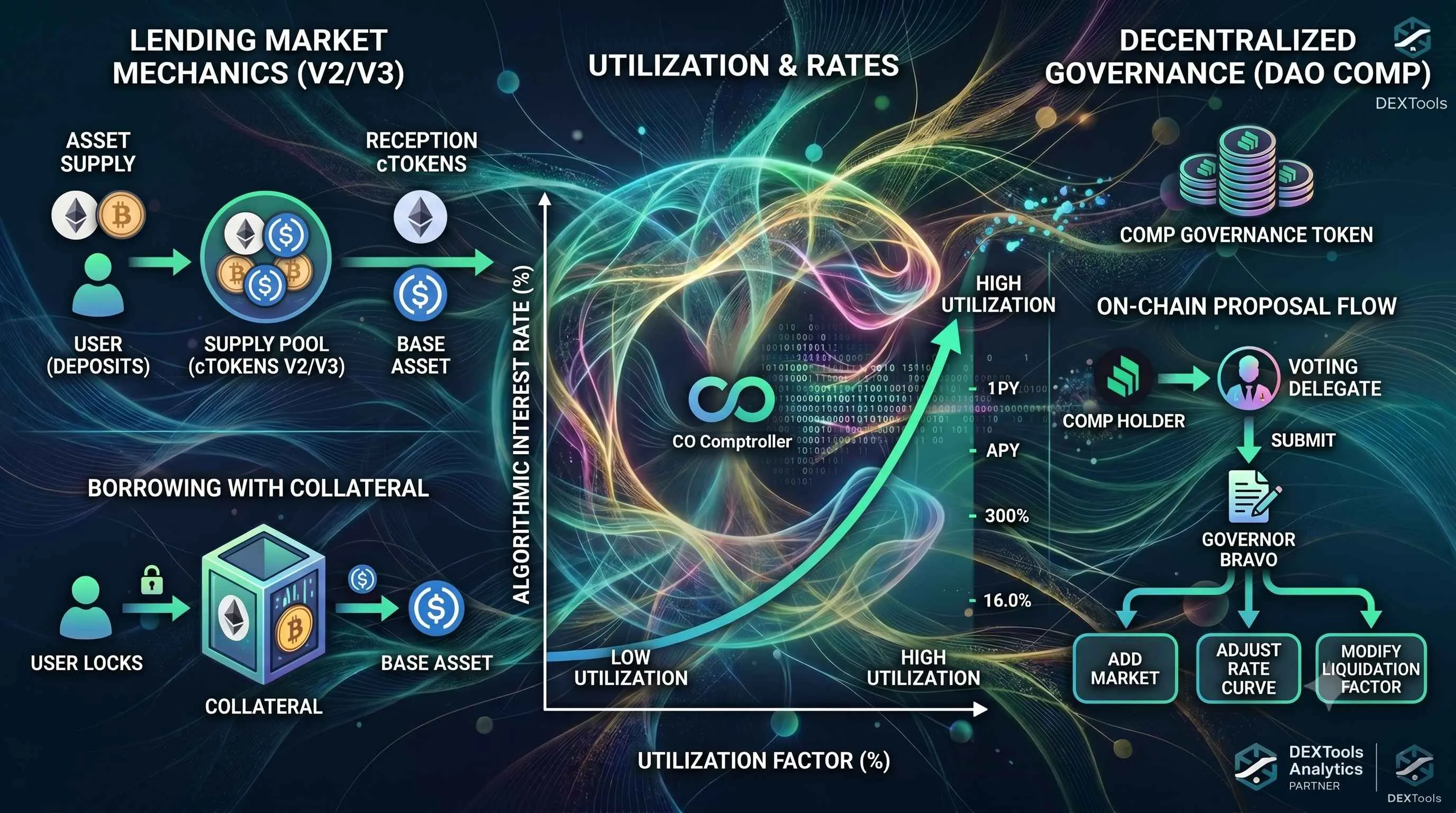
When depositors supply cryptographic capital to the protocol, they do not lose access to their liquidity. Instead, the smart contract issues a representative balance token known as a cToken. For example, depositing Ethereum into the protocol yields a corresponding balance of cETH. These interest-bearing tokens serve as a continuous ledger entry, automatically accruing fractional value relative to the underlying asset over every single block execution.
Conversely, borrowing from the platform necessitates over-collateralization. Because decentralized networks lack centralized identity systems or legal recourse for defaults, a user must lock up a greater dollar value of collateral than the sum they intend to withdraw. If a market participant desires to borrow a stablecoin like USDC, they might first secure their position by depositing a structurally larger quantity of Bitcoin or Ethereum into the protocol's vault framework.
The Evolutionary Leap to Compound III (Comet)
As the decentralized asset landscape matured through recent protocol upgrades, the original multi-asset pool architecture evolved to manage risk more aggressively. This structural optimization culminated in the deployment of the Compound III framework, natively referred to as Comet.
The legacy architecture allowed systemic vulnerabilities to cross-contaminate pools; if a single collateral asset experienced a sudden liquidity drain or oracle failure, the entire multi-asset pool faced solvency pressure. Compound III completely re-engineered this dynamic by introducing single-asset borrowing markets. In this modern setup, users deposit specific collateral assets to borrow exactly one specific "base currency," usually a high-liquidity asset like native USDC or USDT.
This single-base asset model drastically improves capital efficiency for institutional and retail traders alike. Collateral supplied within a Comet deployment is no longer commingled or lent out to other participants, which drastically mitigates counterparty risk. Instead, your locked collateral remains static within the contract, serving exclusively to back your explicit debt position until the obligation is completely settled or dissolved.
Algorithmic Interest Rates and the Critical Utilization Factor
The yield generated within the money market is completely autonomous, governed entirely by real-time supply and demand imbalances. This equilibrium is dictated mathematically by a metric called the utilization rate.
The utilization rate calculates the percentage of supplied capital that is actively being borrowed within a specific market line. If a pool holds one hundred million dollars of an asset and forty-two million dollars are checked out by borrowers, the utilization rate sits precisely at forty-two percent. This percentage directly dictates the borrowing cost and the corresponding lending yield via a predefined algorithmic interest rate curve.
When utilization is low, the smart contract automatically drops borrowing fees to incentivize capital withdrawal. As borrowing demand spikes and capital depletes, the utilization rate climbs toward the "kink"-a specific threshold in the contract's formula where interest rates scale vertically. This aggressive price adjustment serves a dual purpose: it forces existing borrowers to repay their positions to avoid compounding debt burdens, while simultaneously projecting an elevated yield profile that attracts fresh depositors back into the ecosystem.
Monitoring Protocol Health and Liquidations via DEXTools
For active DeFi participants, keeping an eye on the liquidity status of lending markets is a vital safety practice. The DEXTools Pair Explorer offers a crucial window into the health of these fundamental credit ecosystems.
When monitoring pairs containing governance components like COMP or watching the velocity of wrapped assets associated with lending deployments, watching the pool depth helps identify systemic anomalies. If large whale addresses begin pulling extensive capital out of decentralized liquidity pools, it may indicate impending shifts in protocol utilization factors that will rapidly change yield percentages across the wider market.
Furthermore, an asset's liquidation threshold requires close consideration. If a borrower's collateral value falls below the minimum required ratio due to market volatility, the smart contract triggers an automated liquidation event. External liquidators are permitted to step in, pay down a portion of the borrower's debt, and seize the underlying collateral at a fixed discount as an arbitrage reward. By monitoring real-time spot asset movements on DEXTools, savvy traders can anticipate large-scale liquidation cascades before they trigger localized liquid asset de-pegging events on decentralized exchanges.
The Role of the COMP Governance Token
A complete exploration of what is Compound (COMP) must highlight the role of its native governance token, COMP. Launched as a pioneer of liquidity mining, the COMP asset functions as the architectural steering wheel of the entire protocol infrastructure.
Possessing COMP tokens gives holders direct voting power within the decentralized autonomous organization. Rather than relying on a centralized corporate board, every structural variable-ranging from adding new collateral types and altering liquidation penalties to adjusting the interest rate curves-is executed via on-chain governance proposals.
Traders can track the token's distribution using DEXTools Bubblemaps to inspect whether governance weight is distributed among a diverse retail base or highly concentrated within specific venture capital addresses. Understanding token velocity and governance alignment provides a clearer view of the protocol’s structural stability and long-term upgrade path.
The Analytical View for New DeFi Users
Mastering the mechanics of what is Compound (COMP) transitions a beginner from a passive observer to an informed participant in decentralized credit. The platform functions as an open financial utility, enabling continuous asset optimization through code transparency.
By learning to interpret metrics like the utilization rate, tracking asset pool depth via the DEXTools Pair Explorer, and monitoring the concentration of governance assets, market participants can utilize algorithmic money markets safely. Whether you are supplying stable assets to lock in consistent baseline yields or leveraging existing positions to navigate shifting market cycles, keeping your eyes on raw on-chain data remains the ultimate risk mitigation strategy.
How to Bridge Crypto Between Chains: Complete Cross-Chain Tutorial 2026How to Use 1inch for Swaps: Classic, Fusion and Limit Orders (2026)
How to Use OKX Web3 Wallet: Multi-Chain DeFi Hub Guide (2026)
Disclaimer: This article is for informational purposes only and does not constitute investment advice, financial advice, trading advice, or any other kind of advice. DEXTools does not recommend buying, selling, or holding any cryptocurrency or token. Users should conduct their own research and consult with a qualified financial advisor before making any investment decisions. Cryptocurrency investments are volatile and high-risk. DEXTools is not responsible for any losses incurred.
Related Guides
- Aave vs Compound: DeFi Lending Protocols Compared (2026)
- What Is Suilend? Sui Lending Protocol & SEND Token Guide 2026
- What Is Spark Protocol? Sky, USDS & DeFi Lending Guide 2026
- What Is MakerDAO: Complete Decentralized Lending Protocol Guide (2026)
- What Is Fluid Protocol? Instadapp Lending + DEX Guide 2026
Frequently Asked Questions
What is Compound in DeFi?
Compound is a decentralized lending protocol where users can supply assets to earn interest or borrow assets against collateral. Interest rates are set algorithmically based on supply and demand in each market.
What is the COMP token?
COMP is the governance token associated with the Compound protocol, used to propose and vote on changes. Holding it gives a say in how the protocol evolves.
How are interest rates determined on Compound?
Rates adjust automatically based on the utilization of each market, meaning how much of the supplied asset is being borrowed. Higher demand to borrow generally pushes rates up, while lower demand pushes them down.
What is collateral in a lending protocol?
Collateral is the asset a borrower deposits to back a loan, which can be liquidated if the loan becomes undercollateralized. Borrowers usually must keep collateral worth more than what they borrow.