What is EigenLayer? Restaking Explained

Extending Ethereum's economic security to protect external middleware networks maximizes capital efficiency but introduces unique validation risks. We break down EigenLayer restaking mechanics, AVS leases, and mainnet slashing rules.
For the complete, up-to-date guide, read our full guide here.
The Trust Bottleneck: Solving Fragmented Blockchain Security
- In the traditional proof-of-stake landscape, launching a new decentralized infrastructure service (such as an oracle network, a cross-chain bridge, or a data availability layer) presents a massive economic barrier. These systems require their own distributed verification environments to protect against malicious behavior. Historically, developers were forced to build an independent cryptographic trust pool from scratch.
- This meant launching a native utility token, designing complex inflationary incentive models, and convincing a global network of operators to purchase and stake the new asset to secure the system.
- This fragmented design introduces severe vulnerabilities. The security of these startup networks is directly bound to the highly volatile market cap of their native tokens, making them attractive targets for capital-heavy economic attacks. Furthermore, pooling billions of dollars in primary ecosystems like Ethereum while smaller ecosystem bridges rely on fragile, low-cap security pools creates a structural systemic bottleneck.
- EigenLayer dismantles this limitation. Operating as a decentralized marketplace for programmable trust, EigenLayer introduces a technical primitive known as Restaking. This architecture allows Ethereum validators and liquid staking token holders to reuse their existing economic weight to secure multiple external networks simultaneously, extending Ethereum's massive economic security blanket to the broader web3 infrastructure stack.
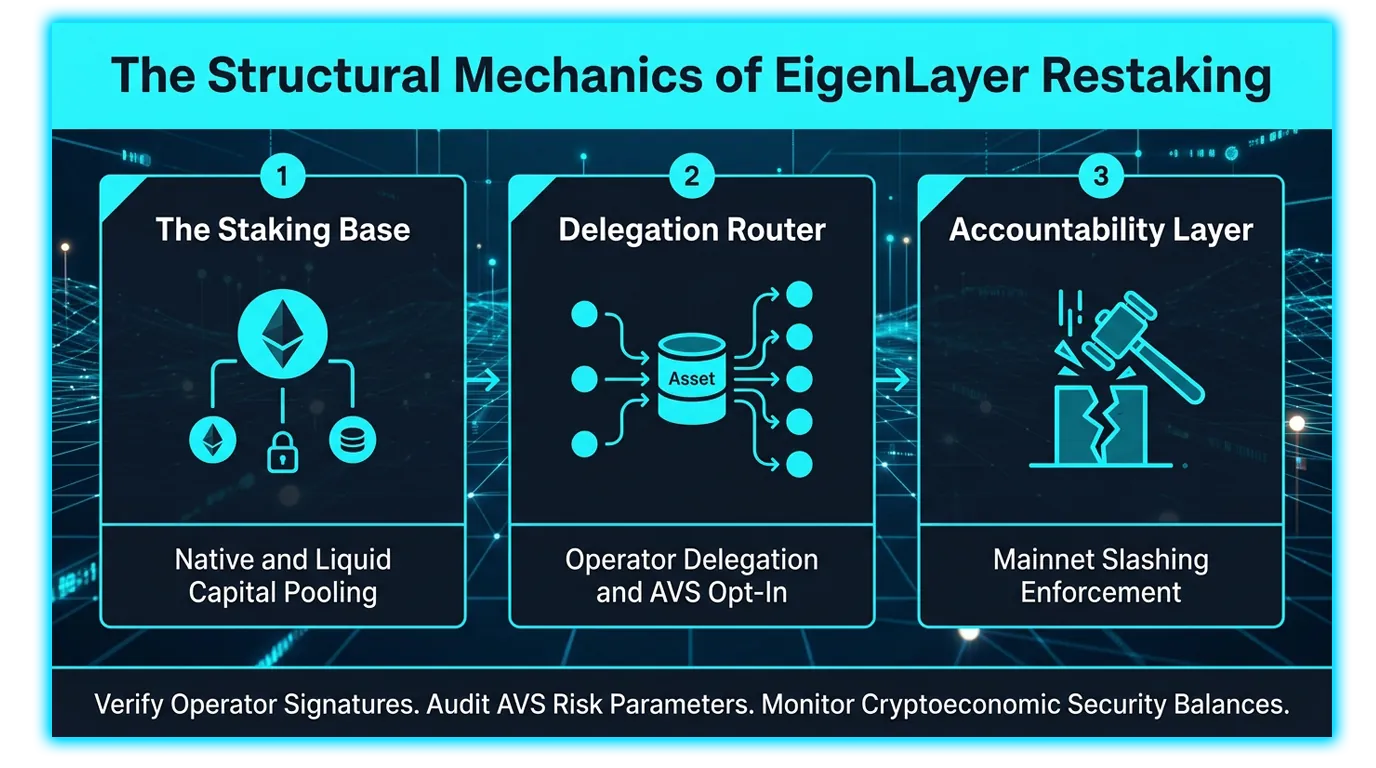
1. Core EigenLayer Infrastructure: The Marketplace for Programmable Trust
At its structural layer, EigenLayer consists of a suite of smart contracts deployed on top of the Ethereum network. It allows stakers to opt into a secondary verification marketplace without requiring them to unstake their principal assets from the primary consensus layer.
The protocol organizes this marketplace through three main participants:
Stakers: Individuals or institutions who pool their native Ethereum or Liquid Staking Tokens (LSTs) into the EigenLayer contracts, providing the underlying economic collateral that backs the ecosystem.
Operators: Specialized entities who run the high-performance physical server infrastructure. Stakers delegate their restaked assets to these operators, who manage the technical requirements of running validation nodes.
Actively Validated Services (AVSs): The external networks, middleware systems, or decentralized applications that lease economic security from the pooled resource marketplace instead of launching their own token.
2. Actively Validated Services (AVSs): The Modular Security Lease
- An Actively Validated Service (AVS) represents any decentralized system that requires its own validation ledger but chooses to outsource its economic security to EigenLayer's pooled trust engine.
- AVSs can span diverse technical categories, including decentralized rollup sequencers, fast-finality bridges, zero-knowledge proof aggregators, and data availability solutions like EigenDA.
- Instead of deploying massive capital to source independent node networks, an AVS creates a custom profile specifying its hardware demands, transaction fee payouts, and slashing rules. Operators evaluate these profiles and opt-in to validate for the services that match their technical expertise and risk appetite. In return, the AVS distributes transaction fees and reward premiums straight to the delegated pool, creating a multi-layered yield stack for participants.
3. Mainnet Slashing: Enforcing Economic Accountability
- To ensure that restaked economic security provides real, credible protection for external networks, the protocol implements strict programmatic accountability via Mainnet Slashing.
- Slashing provides the necessary economic teeth to deter malicious behavior or catastrophic operator neglect. When an operator opts into an AVS, they grant the EigenLayer smart contracts the authority to lock and burn their delegated assets if specific, pre-agreed validation rules are broken.
To protect operators from facing cascading losses across unrelated tasks, the infrastructure utilizes specialized design updates:
Unique Stake Allocation: Operators can isolate specific portions of their pooled assets to back a single AVS. This ensures that if a technical exploit or software bug triggers a slashing penalty on one network, the operator's remaining capital blocks backing other services are completely insulated from the loss.
Operator Sets: AVSs utilize these tools to group operators into distinct verification clusters, allowing the service to assign specialized tasks and enforce customized penalties with extreme precision.
4. The EIGEN Token and Intersubjective Coordination
- The economic architecture of the platform is anchored by its native utility token, EIGEN. Unlike traditional staking assets that only handle objective mathematical validations, the EIGEN tokenomics framework introduces a powerful capability designed to resolve complex, off-chain disputes.
- The token setup is engineered to manage intersubjective faults: malicious actions or system distortions that are easily recognized by human consensus but cannot be verified or parsed strictly via on-chain smart contract code (such as data withholding attacks or oracle price manipulation).
- If an operator commits an intersubjective violation, the EIGEN token contract permits a specialized programmatic fork. The community can isolate, freeze, and burn the tokens allocated to the offending operator on the newly derived ledger branch without disrupting the core security of the underlying Ethereum blockchain. This mechanism establishes a reliable economic coordination layer that protects the integrity of complex, high-level Web3 applications.
Ecosystem Capabilities Matrix: Operational Framework
| Parameter | Traditional Base Staking | EigenLayer Restaking Architecture |
| Security Scope | Limited exclusively to Ethereum consensus | Scaled across multiple external networks (AVSs) |
| Capital Efficiency | Baseline standard yield generation | Multi-layered stacked yield from diverse services |
| Slashing Risk Field | Bound strictly to Ethereum validator rules | Layered across all opt-in AVS compliance guidelines |
| Dispute Resolution | Restricted to objective on-chain code | Manages intersubjective faults via EIGEN forks |
| Infrastructure Overhead | Medium; running a standard validator node | High; requires orchestrating multiple software clients |
Universal On-Chain Forensics and Trading Telemetry via DEXTools
- Utilizing advanced decentralized charting architectures like DEXTools provides market participants with an essential, universal platform to monitor live token behaviors, evaluate pool depths, and inspect contract parameters across all public execution networks.
- By leveraging core features such as the Pair Explorer, the Live New Pairs dashboard, and Trade Story, among other options, technical traders can audit localized volume trends and verify automated contract safety scores before initiating any on-chain interactions. This ensures that your secure hardware setup only engages with verified market venues.
- You can access DEXTools here and start trading today.
Disclaimer: This article is for informational purposes only and does not constitute investment advice, financial advice, trading advice, or any other kind of advice. DEXTools does not recommend buying, selling, or holding any cryptocurrency or token. Users should conduct their own research and consult with a qualified financial advisor before making any investment decisions. Cryptocurrency investments are volatile and high-risk. DEXTools is not responsible for any losses incurred.
Related Guides
- What Is Restaking: Complete EigenLayer & EtherFi Guide (2026)
- What Is Renzo (REZ)? ezETH Liquid Restaking on EigenLayer Guide 2026
- What Is KelpDAO (rsETH)? Liquid Restaking on EigenLayer Guide 2026
- What Is EigenLayer: Complete Restaking Protocol Guide (2026)
- Top 5 Restaking Protocols in 2026: EigenLayer, EtherFi, Symbiotic and More
Frequently Asked Questions
What is EigenLayer?
EigenLayer is a protocol that introduces restaking, allowing staked assets to help secure additional services beyond the base network. It aims to extend existing economic security to other systems.
What is restaking?
Restaking lets already-staked assets be committed to securing extra services or networks. This can increase capital efficiency and potential rewards while adding new layers of risk.
What is an AVS in EigenLayer?
An AVS, or Actively Validated Service, is an external system that uses restaked security to operate. Restakers help secure these services in exchange for potential rewards and additional risk.
What are the risks of restaking with EigenLayer?
Restaking can expose assets to additional slashing conditions and the risks of the services they help secure. Smart contract risk and concentration of security across systems are also considerations.