What is FDUSD? First Digital Stablecoin Guide

FDUSD serves as a key liquidity rail in the stablecoin sector. We analyze its trust-backed reserve model, exchange integration, and Hong Kong regulatory compliance.
The 2026 Guide to First Digital USD and Regulated Stablecoins
- The global cryptocurrency market relies on stablecoins as the foundational layer for liquidity, risk management, and market settlement. While early stablecoin development was dominated by entities based in western jurisdictions or offshore hubs, the industry has shifted toward localized compliance frameworks. At the center of this transition is First Digital USD (FDUSD), a fiat-backed stablecoin anchored in Asia's premier financial node.
- Launched in June 2023 by First Digital Labs, FDUSD has matured into a multi-billion-dollar transactional asset. This guide examines the structural design of FDUSD, its reserve architecture, its deep integration into the global trading environment, and its positioning within Hong Kong's strict regulatory framework.
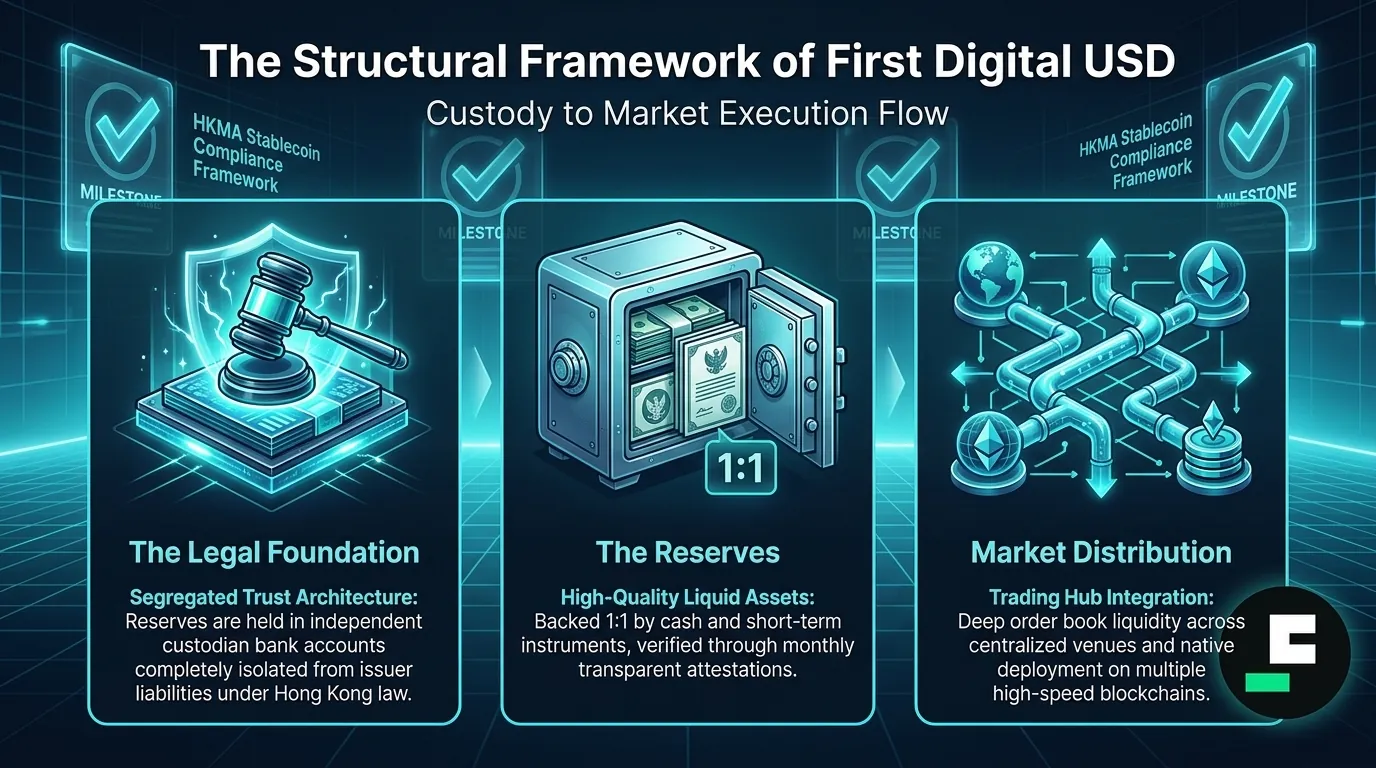
1. The Issuer and Structural Reserve Architecture
FDUSD is a digital fiat-backed token designed to maintain a stable one-to-one peg with the U.S. dollar. The architecture behind FDUSDs coins focuses on counterparty isolation and strict asset backing.
The Issuer: The stablecoin is issued by FD121 Limited, operating under the umbrella of First Digital Trust, a fully registered public trust company incorporated under Hong Kong trust law.
Segregation of Reserves: To mitigate bankruptcy risk, the reserves backing FDUSD are held in independent, segregated accounts at qualified custodian banking institutions. This legal structure ensures that the underlying reserve assets are protected from any liquidation claims or operational liabilities of the parent issuing company.
Composition of Backing: The reserves consist exclusively of highly liquid, low-risk instruments, primarily cash deposits and short-term U.S. Treasury bills. The issuer releases monthly independent attestations verifying that the outstanding circulating supply of tokens matches or is exceeded by the dollar value of the assets held in custody.
2. The Strategic Binance Integration
The rapid ascent of FDUSD within the global market was heavily catalyzed by structural shifts in the centralized exchange landscape. Following the regulatory-mandated wind-down of Binance USD (BUSD), the exchange required a highly liquid, compliant fiat-backed stablecoin to serve as a primary pairing base.
Binance designated FDUSD as a core transactional asset, launching prominent zero-fee trading promotions for major pairs like Bitcoin and Ethereum. This integration established deep, institutional-grade order books for the token. Even as promotional programs have adjusted over time, FDUSD remains a dominant quote asset across global spot and perpetual trading markets, commanding a permanent top-tier position in daily global stablecoin trading volume.
3. The Hong Kong Stablecoin Regulatory Environment
Hong Kong has actively positioned itself as a highly transparent, fully regulated digital asset hub. The regulatory baseline for stablecoins underwent a major transformation with the implementation of the Stablecoins Ordinance administered by the Hong Kong Monetary Authority (HKMA).
The framework requires any entity issuing a fiat-referenced stablecoin within the jurisdiction to obtain an official HKMA license. The licensing criteria enforce bank-grade operational standards:
Capital and Liquidity Safeguards: Issuers must maintain mandatory paid-up share capital buffers alongside separate reserves.
Strict Redemption Guarantees: Token holders possess an absolute legal right to redeem their digital tokens for underlying fiat at par value, with processing mandates restricted to short operational turnaround windows.
The 2026 Milestones: In April 2026, the HKMA officially granted its first batch of stablecoin issuer licenses to institutional players, signaling a new phase of fully regulated, compliant stablecoin usage. First Digital operates within this evolving ecosystem, aligning its corporate custody and compliance pipelines with Hong Kong's rigorous anti-money laundering and technical audit expectations.
Technical Trade-offs and Market Realities
Strengths and Opportunities
Legal Protections: The use of Hong Kong trust structures isolates the underlying cash reserves, providing legal assurances to institutional participants.
Deep Exchange Liquidity: The integration within massive centralized exchange networks guarantees minimal slippage for high-volume traders converting volatile positions to stable cash.
Jurisdictional Diversification: For market participants seeking alternatives to U.S.-regulated or pure offshore stablecoins, an Asian-anchored asset offers vital geographic and regulatory diversification.
Limitations and Challenges with FDUSD Stablecoin
Concentration Risks: FDUSD's trading volume and utility are heavily concentrated within specific global exchanges, reducing its organic distribution across broader, independent decentralized applications.
Transparency Horizons: While monthly attestations are provided, the specific identities of the underlying custodian banks are less transparent than disclosures provided by some western competitors.
Cross-Chain Complexity: Operating natively across multiple chains (including Ethereum, BNB Chain, and Sui) requires ongoing monitoring of bridge security and liquidity pool balances to avoid localized fragmentation.
4. Cross-Chain Utility and On-Chain Liquidity Analytics
While FDUSD handles immense volume on centralized platforms, its presence within decentralized finance (DeFi) continues to expand across diverse automated market makers and lending protocols. When interacting with stablecoin trading pairs or seeking yields on decentralized networks, independent data validation is a necessity.
Traders utilize DEXTools to analyze stablecoin market health:
Evaluating Pool Depth: The platform allows users to cross-reference market caps against actual on-chain liquidity depth on networks like PancakeSwap or Uniswap, avoiding high-slippage executions.
Smart Contract Safeguards: Automated audits visible on the interface check for hidden contract permissions, ensuring that wrapped or bridged variations of the token are safe to interact with.
Monitoring Real-Time Flow: Track capital movements during risk-off market rotations to evaluate how quickly traders migrate volatile assets into the safety of the stablecoin pool.
You can access DEXTools here and start trading today!
Disclaimer: This article is for informational purposes only and does not constitute investment advice, financial advice, trading advice, or any other kind of advice. DEXTools does not recommend buying, selling, or holding any cryptocurrency or token. Users should conduct their own research and consult with a qualified financial advisor before making any investment decisions. Cryptocurrency investments are volatile and high-risk. DEXTools is not responsible for any losses incurred.
Related Guides
- What Is Unstoppable Domains: Web3 Domains, Identity and Digital Ownership (2026)
- What Is Fireblocks: Digital Asset Custody, Treasury and Wallet Infrastructure (2026)
- What Is Fireblocks: Digital Asset Custody, MPC Wallets and Treasury Infrastructure (2026)
- What Is CBDC? Central Bank Digital Currency Guide 2026
- Top 5 NFT Marketplaces in 2026: Where to Buy and Sell Digital Assets
Frequently Asked Questions
What is FDUSD and how does it work?
FDUSD is a fiat-backed stablecoin designed to track the value of the US dollar at roughly a one-to-one ratio. Like other reserve-backed stablecoins, its issuer holds assets intended to back the tokens in circulation.
Is FDUSD pegged to the US dollar?
FDUSD is designed to maintain a value close to one US dollar per token. As with any stablecoin, the peg depends on the issuer's reserves and on market demand, so brief deviations can occur.
What backs the FDUSD stablecoin?
FDUSD is described as a reserve-backed stablecoin, meaning the issuer is intended to hold assets that correspond to the tokens issued. The specific composition and management of reserves are determined by the issuer.
How is FDUSD different from other stablecoins?
FDUSD competes with other US-dollar stablecoins and is differentiated mainly by its issuer, reserve approach and the regulatory framework it operates under. Users typically compare stablecoins by transparency, liquidity and where they are supported.