What Is Hedera (HBAR)? Hashgraph Explained

What is Hedera (HBAR)? Learn how Hashgraph consensus works, why aBFT security matters, and how council governance shapes enterprise use.
This page answers what Hedera is and how Hashgraph differs from normal blockchains. It is a network architecture guide, not a short-term price piece.
Analyzing the 2026 Enterprise Distributed Ledger
- As of May 7, 2026, the distributed ledger technology (DLT) landscape has matured significantly. The "speculative era" has largely been replaced by a focus on "Invisible Ubiquity", the integration of ledger technology into the plumbing of global finance, supply chains, and AI systems.
- At the center of this shift is Hedera (HBAR), a network that distinguishes itself from traditional blockchains through its unique consensus mechanism and institutional governance model.
- In the current 2026 market, HBAR is trading between $0.088 and $0.10, having recently stabilized following the passage of the CLARITY Act, which provided long-awaited regulatory definitions for digital commodities in the United States.
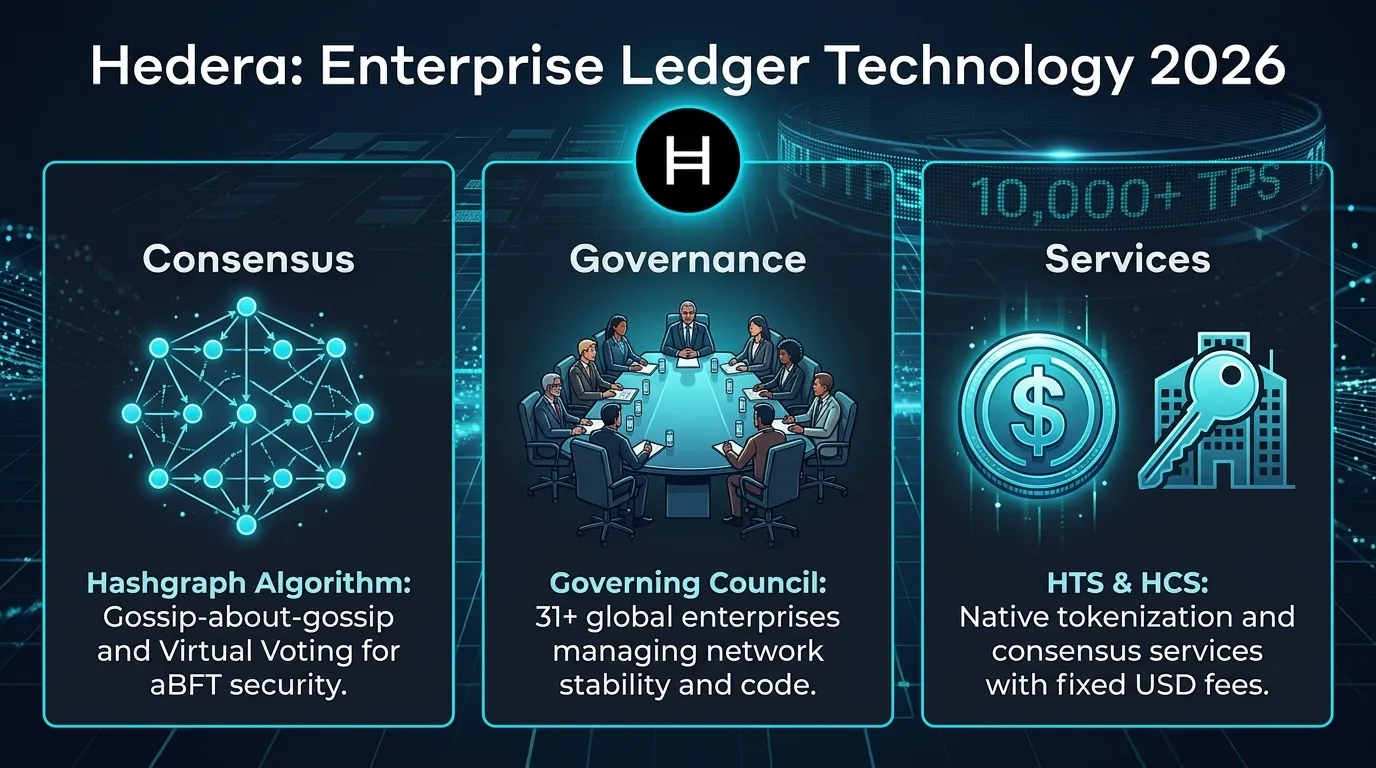
1. The Core Tech: Hashgraph and aBFT Consensus
Hedera does not use a traditional blockchain. Instead, it utilizes a Directed Acyclic Graph (DAG) structure powered by the Hashgraph consensus algorithm.
Gossip-about-Gossip and Virtual Voting
The network reaches agreement through two primary mechanisms:
Gossip-about-Gossip: Nodes share transaction data along with a small amount of metadata about the last node they talked to. This creates a "history of communication" that propagates exponentially.
Virtual Voting: Because every node has the same "hashgraph" (a map of who talked to whom and when), they can independently calculate how every other node would vote on a transaction's validity. No actual "vote" messages are sent across the network, saving immense bandwidth.
The aBFT Standard
Hedera is one of the few decentralized networks to achieve asynchronous Byzantine Fault Tolerance (aBFT). This is the highest level of security for a distributed system, ensuring the network can reach consensus even if some nodes are malicious or messages are delayed indefinitely. In early 2026, this claim was further verified through formal proofs using the Coq proof assistant.
2. The Hedera Governing Council: Enterprise at the Helm
One of Hedera's most debated features is its governance. The network is owned and governed by the Hedera Governing Council, a group of up to 39 global organizations with term limits.
2026 Council Status: The council currently stands at 31 members. Recent additions like Accenture, McLaren Racing, and FedEx have joined legacy members such as Google, IBM, and Deutsche Telekom.
The Hiero Initiative: In a significant move toward decentralization, Hedera transitioned its core codebase to the Linux Foundation under the "Hiero" project in early 2026. This allows for broader open-source contribution while maintaining institutional oversight.
Role: The council makes decisions on software upgrades, treasury management, and network pricing, which is pegged to the USD to ensure cost predictability for enterprises.
3. Hedera Token Service (HTS) vs. Smart Contracts
Hedera takes a "Native First" approach to tokenization. While it supports Solidity-based smart contracts (EVM compatible), it encourages the use of the Hedera Token Service (HTS).
Native Efficiency: Tokens created via HTS (like stablecoins or RWA tokens) do not require a smart contract to move. Transfers happen at the protocol level, resulting in 10,000+ TPS and instant finality.
Compliance Tools: HTS includes built-in "hooks" for KYC/AML compliance, allowing issuers to freeze accounts or manage supply without the security risks of custom contract code.
USD-Pegged Fees: Transaction fees are fixed in USD (e.g., $0.0001 for an HBAR transfer) and paid in HBAR, protecting businesses from the price volatility of the underlying asset.
Technical Trade-offs and Market Realities
Strengths and Opportunities
Predictable Utility: The fixed-fee model is arguably the most business-friendly in the industry, allowing for precise budget forecasting.
Institutional Credibility: The presence of Fortune 500 companies in the council provides a level of "regulatory comfort" that attracts risk-averse enterprise capital.
Real-World Tokenization: In 2026, Hedera has become a hub for Real-World Assets (RWA), with projects tokenizing everything from institutional real estate (RedSwan) to investment-grade diamonds (Diamond Standard).
Limitations and Challenges
Perceived Centralization: Despite the Hiero initiative, critics often argue that a council-governed network is "centralized in spirit," which may limit adoption among decentralization purists.
Permissioned Validation: While Hedera has a roadmap for "permissionless nodes," validation in May 2026 is still largely handled by council-operated nodes, creating a higher barrier to entry for the general public to secure the network.
Token Liquidity: While enterprise usage is high, the "velocity" of HBAR hasn't always translated to price appreciation, partly due to the large 50-billion-token total supply and a circulating supply that is only now approaching 86%.
Disclaimer: This article is for informational purposes only and does not constitute investment advice, financial advice, trading advice, or any other kind of advice. DEXTools does not recommend buying, selling, or holding any cryptocurrency or token. Users should conduct their own research and consult with a qualified financial advisor before making any investment decisions. Cryptocurrency investments are volatile and high-risk. DEXTools is not responsible for any losses incurred.
Related Guides
- Blockchain Technology Explained 2026: Beginner's Complete Guide
- What Is Snapshot: Complete DAO Governance Voting Guide (2026)
- Lido on Ethereum: stETH, wstETH and Dual Governance Explained (2026)
- What Is a Governance Token in Crypto? Complete Beginner Guide (2026)
- How Do DAOs Work? Governance, Treasury and Voting Explained (2026)
Frequently Asked Questions
What is Hedera (HBAR) and how does it differ from traditional blockchains?
Hedera (HBAR) is a distributed ledger technology that utilizes a Directed Acyclic Graph (DAG) structure and the Hashgraph consensus algorithm, distinguishing it from traditional blockchains.
How does Hedera ensure security and consensus?
Hedera achieves security through its asynchronous Byzantine Fault Tolerance (aBFT) standard, which allows the network to reach consensus even if some nodes are compromised.
What role does the Hedera Governing Council play?
The Hedera Governing Council, composed of up to 39 global organizations, oversees the network's governance, including decisions on software upgrades and treasury management.
What is the Hedera Token Service (HTS) and its advantages?
The Hedera Token Service (HTS) allows for efficient tokenization without the need for smart contracts, enabling faster transactions and built-in compliance features.
What challenges does Hedera face in terms of decentralization?
Despite efforts like the Hiero initiative, Hedera faces criticism for perceived centralization due to its council-governed structure, which may deter adoption among those who prioritize decentralization.