What Is HODL in Crypto? Meaning and Strategy 2026
— By Tony Rabbit in Tutorials
HODL explained: learn the meaning and history behind the famous crypto typo, how holding compares to trading, and how to HODL safely as a strategy.
Few words in crypto carry as much weight as HODL. It started as a drunken typo on an obscure Bitcoin forum in December 2013, and somehow turned into the unofficial battle cry of an entire generation of cryptocurrency investors. When markets crash 80% and CNBC anchors are reading eulogies for Bitcoin, HODLers are the ones still buying. When prices rip to new all-time highs and everyone on Twitter is suddenly a genius, HODLers are still just holding. It is part meme, part philosophy, and part investment strategy, and over the last decade it has quietly outperformed most of the active traders who laughed at it.
The literal meaning is simple: HODL means to hold your crypto for the long term, refusing to sell during volatility. But the cultural meaning runs deeper. To HODL is to make peace with not timing the market perfectly. It is to admit that you cannot beat the algorithms, the whales, or the insiders at their own game, so instead you play a longer game where time itself becomes your edge. The strategy has minted more millionaires than day trading, options speculation, or any other crypto activity combined. And yet, it remains one of the most psychologically difficult things to do in finance, precisely because it asks you to do nothing while everything around you is on fire.
In this guide you will learn where HODL came from, what it actually means as an investment philosophy, why it works particularly well for Bitcoin, how it compares to active trading and dollar-cost averaging, when the strategy fails, and how to set yourself up to HODL safely without losing your coins to hacks, lost keys, or human error. We will walk through a realistic worked example, examine the cultural mythology of diamond hands versus paper hands, and look at famous HODLers, both legendary and tragic. By the end you will know whether HODLing fits your personality, your portfolio, and your timeline.

What Does HODL Mean?
HODL is internet slang for "hold," with the letters scrambled. The most accepted backronym, invented retroactively, is "Hold On for Dear Life," which captures the emotional intensity of refusing to sell through brutal bear markets. To HODL a coin means to buy it and keep it, ignoring short-term price swings, hype cycles, fear cycles, and the constant temptation to trade in and out. A HODLer is a person who follows this strategy, often for years at a time, sometimes for a decade or more.
The word has become so embedded in crypto culture that it is now used as a verb (I HODL my Bitcoin), a noun (he is a HODLer), and even an adjective (the HODL mentality). It transcends Bitcoin and applies to any cryptocurrency held with conviction. You can HODL Ethereum, Solana, your favorite Layer 2 token, or even a memecoin if you really want to test your psychological limits. The strategy is asset-agnostic, but the philosophy has its roots firmly in Bitcoin maximalism and the belief that scarce digital assets compound in value over long time horizons.
Crucially, HODLing is not the same as forgetting about your portfolio. A serious HODLer pays attention to fundamentals, security, custody, and macro conditions. What they do not do is panic-sell during crashes or chase pumps. The discipline is in the inactivity, not in the absence of awareness. As legendary investor Charlie Munger once said about traditional markets, "the big money is not in the buying and selling, but in the waiting." HODLers took that idea, gave it a typo, and made it their religion.
The Origin Story: GameKyuubi's Drunk Forum Post
The origin of HODL is one of the great pieces of internet folklore. On December 18, 2013, Bitcoin had just experienced a vicious crash. After peaking near $1,150 weeks earlier, the price had collapsed below $500, and the BitcoinTalk forum was filled with traders trying to call the bottom, debating whether to sell, buy more, or short the market. At 10:03 AM UTC, a user named GameKyuubi posted a now-legendary thread titled "I AM HODLING," with the body containing the typo "I AM HODLING" instead of "HOLDING" in the first line.
The post was a confession. GameKyuubi admitted he was a bad trader, that he kept getting whipsawed by short-term moves, and that he had decided to simply hold his Bitcoin rather than continue losing money trying to time the market. The post included memorable lines like "WHY AM I HOLDING? I'LL TELL YOU WHY. It's because I'm a bad trader and I KNOW I'M A BAD TRADER" and "You only sell in a bear market if you are a good day trader or an illusioned noob." It was raw, self-aware, slightly intoxicated, and deeply relatable.
What makes the story remarkable is that GameKyuubi was not preaching a strategy. He was venting. He was admitting defeat as a trader and surrendering to the simpler approach of just holding. But that surrender turned out to be the optimal strategy for an asset that compounded at over 100% annualized through its first decade of existence. The community took the typo, embraced it, made T-shirts, hoodies, mugs, NFTs, songs, and tattoos out of it, and turned a moment of personal humility into a global identity. There is something deeply Bitcoin about that. The most successful investment thesis of the 21st century came from a guy who admitted he was bad at investing.
HODL as a Strategy
Strip away the memes and HODL is a straightforward investment thesis: cryptocurrencies, especially Bitcoin, are in a long-term secular uptrend driven by adoption, scarcity, and macro tailwinds. Trying to trade those moves on shorter timeframes is a negative-sum game for most participants because of fees, taxes, slippage, and behavioral biases. Therefore, the best risk-adjusted return for most retail investors is to accumulate, hold, and resist the urge to interact with their position.
The recommended HODL time horizon is at least one full bull and bear market cycle, which for Bitcoin has historically been about four years and is closely tied to the halving cycle. Practitioners with a more aggressive HODL stance plan for two cycles, or roughly eight years, before considering any sale. The longest-term HODLers are often Bitcoin maximalists who view BTC the way an earlier generation viewed gold: a multi-decade store of value to be passed down to children, not traded.
One key behavioral aspect of the strategy is that HODLing does not require predicting the top or the bottom. The HODLer does not need to be smarter than the market. They just need to be more patient than it. In a market dominated by short-term speculators, leverage, and headline-driven volatility, simply choosing to ignore short-term noise becomes a structural edge. Patience is not glamorous, but it has been one of the highest-paying skills in crypto for the entire history of the asset class.
Why HODL Works for Bitcoin Specifically
HODL works for many assets, but it works especially well for Bitcoin because of three structural features that compound over long time horizons. First, the supply is mathematically capped at 21 million coins, and the rate of new issuance halves approximately every four years through the Bitcoin halving. As new supply slows and demand from adoption rises, basic economics suggests upward price pressure over the long term. Short-term volatility can mask this trend, but multi-year holders historically capture it.
Second, network effects keep widening Bitcoin's moat. Every new miner, exchange, custodian, ETF issuer, payment integration, and country that adopts BTC increases the security, liquidity, and legitimacy of the network. Network effects compound non-linearly, which is one reason why monetary networks tend to settle on one or two dominant assets rather than fragmenting evenly across thousands of competitors. Bitcoin is the Schelling point of digital scarcity, and that lead has only grown over the last decade.
Third, Bitcoin's macro narrative aligns with structural trends in fiat money. Persistent deficits, rising sovereign debt, and aggressive monetary expansion in developed economies provide an ongoing tailwind for hard assets. Whether you believe Bitcoin is digital gold, an inflation hedge, or simply the highest-conviction risk-on asset in a portfolio, the macro setup has favored long-term holders for over a decade. None of this guarantees future performance, but it explains why HODL has been such a durable strategy for this particular asset.
HODL vs Active Trading vs DCA vs Swing Trading
HODL is one of several strategies long-term crypto investors consider, and it helps to see it next to the alternatives. Active trading involves frequent entries and exits, often using leverage and going long or short on intraday or multi-day moves. Dollar-cost averaging (DCA) is the practice of buying a fixed dollar amount of an asset at regular intervals, smoothing out entry prices over time. Swing trading sits in between, holding positions for days to weeks based on technical or narrative setups.
For most retail investors, the best approach is a combination of DCA into a HODL position. You DCA your way in by buying a set amount each week, month, or paycheck, and then you HODL the resulting stack. This pairing removes both the entry-timing problem (DCA solves that) and the exit-timing problem (HODL solves that). It is boring, mechanical, and historically very effective. Active and swing trading look more exciting on a Twitter feed, but the data on retail trader performance is brutal: most lose money over time, and the few who do win consistently are treating it as a full-time profession with serious risk management.
Worked Example: HODLing vs Trading 1 BTC Since 2017
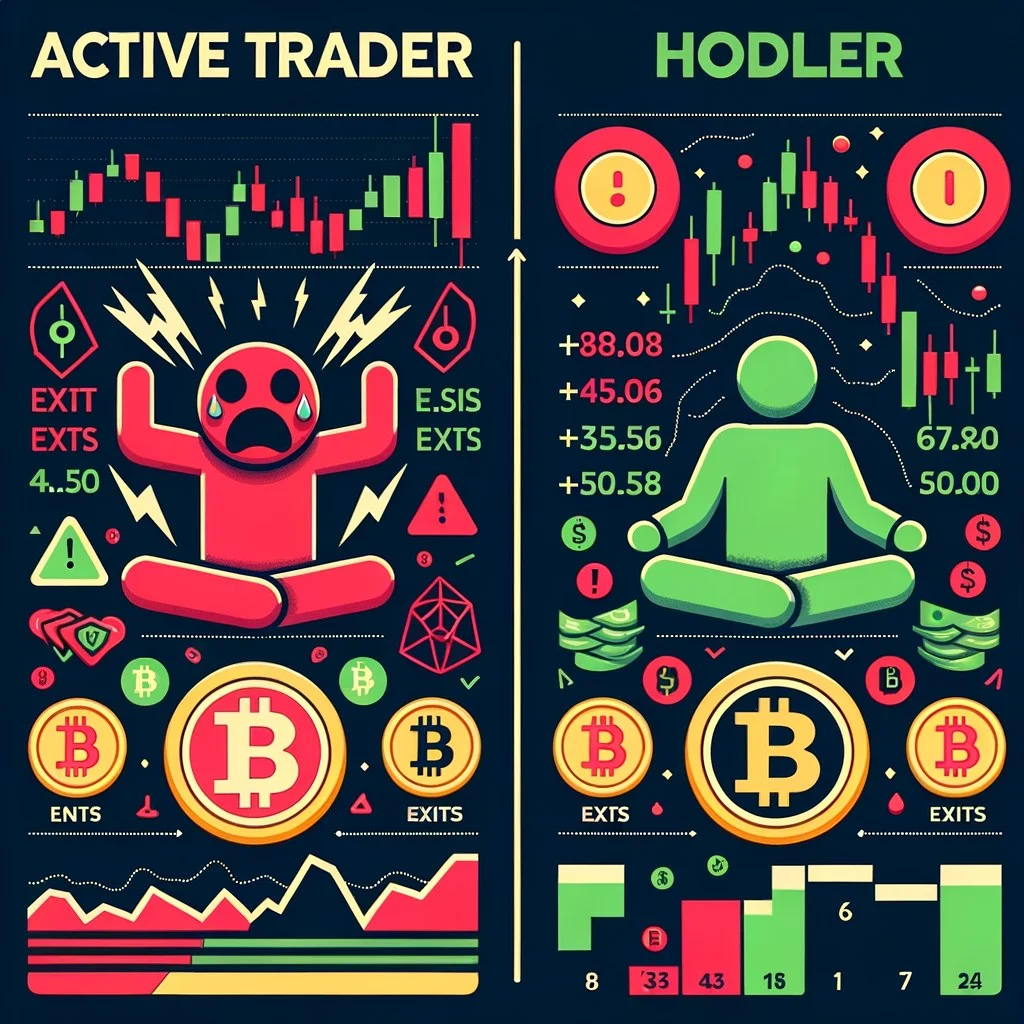
Numbers are more persuasive than philosophy, so let us walk through a realistic comparison. Imagine two investors, Alice and Bob, who each bought 1 BTC in early 2017 at around $1,000. Alice is a HODLer. She sticks her BTC in a hardware wallet, writes down her seed phrase, and barely looks at the price for the next nine years. Bob is an active trader. He uses charts, indicators, news, and his gut to trade in and out of BTC, hoping to compound aggressively.
- Buys 1 BTC at $1,000 in Jan 2017
- Holds through 2018 crash to $3,200
- Holds through 2022 crash to $15,500
- Holds through every bear and bull
- Final position: 1 BTC at ~$95,000
- Net result: ~95x, fully long-term tax
- Buys 1 BTC at $1,000 in Jan 2017
- Sells half at $5,000 (April 2017)
- Buys back at $8,000 chasing the top
- Stops out at $6,000 in 2018 crash
- Misses 2020 rally, FOMOs at $50,000
- Net result: ~10-20x with worse tax bill
The reality reflected in this example matches almost every empirical study of retail trading behavior. Brokerage data, exchange data, and academic research repeatedly find that the top decile of retail traders barely match a passive benchmark, while the median and bottom traders lag significantly. In a market as volatile as crypto, the temptation to trade is even greater, and the cost of mistiming is even larger. The simple act of doing nothing is one of the highest-expected-value trades available to the average investor.
Diamond Hands vs Paper Hands
The HODL meme has spawned its own vocabulary for describing how committed someone is to the strategy. Diamond hands describes a holder so committed that they would not sell even if the market dropped 90% overnight. They are the people who held through 2018, 2022, and any future bear with the same calm. The diamond is unbreakable, like their resolve. The phrase is usually accompanied by the diamond and hand emojis on social media.
The opposite is paper hands, used (often pejoratively) to describe someone who sells at the first sign of trouble. Paper hands are weak hands. They crumple under pressure. The term weak hands is a more general expression for any holder likely to sell during a drawdown. Bear markets in crypto are sometimes described as "shaking out the weak hands," meaning the price drops force panicked sellers to capitulate, transferring their coins to stronger holders at lower prices.
Other related terms include sat stacking, which refers to accumulating satoshis (the smallest unit of Bitcoin) on a regular schedule with no plans to sell. There is also the concept of the "HODL wave," a famous on-chain metric that tracks how long Bitcoin has been held in different wallet age cohorts. As the wave of "older coins" grows, analysts interpret it as more of the supply being held by patient long-term investors, which historically precedes bullish periods.
When HODL Strategy Fails
HODL is not a magic spell. It works extraordinarily well for Bitcoin, and reasonably well for a small number of large, established cryptocurrencies. But it can absolutely destroy a portfolio if applied to the wrong asset. Below are the main scenarios where HODLing fails, often catastrophically.
The most common failure is HODLing a terminal asset. Most cryptocurrencies launched over the past decade are now worth a tiny fraction of their peak, and many are effectively dead. ICO-era tokens from 2017, NFT projects from 2021, and countless memecoins have gone to zero or close to it. HODLing through a 99% drawdown does not make sense if the asset has no future. The discipline of HODL must be paired with the discipline of choosing assets that have a credible long-term thesis. A dead project is not coming back, no matter how diamond your hands are.
The second failure mode is single-asset concentration risk. Even Bitcoin is not certain to keep performing, and putting 100% of your net worth into any single asset is dangerous. HODL discipline is about not selling reactively, not about ignoring portfolio construction. A common rule of thumb is to allocate based on risk tolerance, never investing more than you can afford to lose entirely, and to diversify across the very small number of assets that have proven durability.
The third failure is security failure. The history of crypto is littered with stories of HODLers who held perfectly and then lost everything because their exchange got hacked, their seed phrase was stolen, or they died without giving their family access to the coins. HODLing without proper custody is like leaving gold bars on your front lawn for ten years. The strategy assumes the coins are still there when you finally need them. We will get to setup in the next section.
The fourth failure is life timing. If you HODL into your retirement and the market happens to be in the middle of an 80% drawdown when you need to start selling, you are forced to liquidate at the worst possible time. Smart HODLers gradually de-risk as their time horizon shortens, taking partial profits across cycles rather than relying on a single exit at an unknown future date.
Practical HODL Setup
If you are going to HODL for years, your setup matters more than your conviction. Coins that sit on a centralized exchange for a decade are coins you do not really own. The mantra "not your keys, not your coins" exists because exchanges fail, freeze withdrawals, restrict accounts, get hacked, or go bankrupt. A proper HODL setup minimizes those risks across the entire holding period.
Step one is moving meaningful holdings off exchanges and into self-custody. For most HODLers, that means using a hardware wallet, also called a cold wallet. Hardware wallets keep your private keys offline, isolated from the internet, making them dramatically harder to compromise than software wallets or exchange accounts. The difference between a hot wallet and a cold wallet is fundamental for anyone planning to hold for years.
Step two is properly backing up your seed phrase. Your seed phrase is the master key to your wallet, and if you lose it your coins are gone forever. Best practices include writing it on paper or steel, storing copies in geographically separated locations, never photographing it, never typing it into a computer or phone, and never sharing it with anyone, ever. There is no customer support for a lost seed phrase. The math does not care that you are sorry.
Step three, for larger holdings, is to consider a multisig wallet setup, where multiple keys are required to authorize a transaction. Multisig is significantly more secure than single-key wallets because compromising any one key is not enough to steal funds. Common configurations include 2-of-3 (you need any two of three keys to sign) or 3-of-5 for higher-value holdings.
Step four is inheritance planning. This is the part most HODLers ignore until it is too late. If you die or become incapacitated without a clear plan, your family may never recover the coins. There are several models: encrypted instructions sealed with a lawyer, multisig with a trusted backup keyholder, or specialized inheritance services. The point is that long-term HODLing is also a long-term estate planning problem. Solve it once and update it as your circumstances change.
Tax Implications of HODLing
One of the underrated advantages of HODL as a strategy is its tax efficiency in many jurisdictions. In the United States and many other countries, assets held for more than one year qualify for long-term capital gains tax rates, which are significantly lower than short-term rates. A trader who flips positions monthly is taxed on every gain at their full ordinary income rate, while a HODLer who holds for years pays the lower long-term rate when (and if) they eventually sell.
In some jurisdictions, the benefit is even more dramatic. Germany, for example, has historically applied a zero percent capital gains tax on cryptocurrency held for more than one year by private individuals (rules can change, so always verify current law). Portugal and several other countries have offered similar long-term holder treatment. Even in countries with less favorable rules, simply not realizing gains by not selling defers tax indefinitely, allowing the entire position to compound pre-tax. Compounding pre-tax for a decade is mathematically very powerful.
This is not tax advice, and the rules vary widely by country, state, and individual situation. Always consult a qualified tax professional in your jurisdiction. But as a general structural observation, HODL strategies tend to be tax-friendly almost everywhere that has clear crypto tax rules, while active trading tends to be tax-unfriendly. The tax benefit alone often closes much of the performance gap between a great trader and a passive HODLer once you measure after-tax returns rather than gross returns.
Famous HODLers and Lost HODLs
Crypto folklore is filled with stories of legendary HODLs and tragic losses, and both teach important lessons. On the legendary side, you have early Bitcoin investors who bought at sub-dollar prices and held through every cycle. The Winklevoss twins, for instance, became billionaires by buying around $11 per BTC in 2013 and largely holding through every drawdown that followed. Michael Saylor's company has accumulated and held hundreds of thousands of BTC as a corporate treasury strategy, refusing to sell despite enormous mark-to-market swings. Countless anonymous wallets are still sitting on coins acquired in 2010-2013 that have never moved.
Then there are the cautionary tales, and they are heartbreaking. The most famous is probably the Bitcoin pizza story. In May 2010, Laszlo Hanyecz paid 10,000 BTC for two pizzas, marking the first known commercial Bitcoin transaction. At 2026 prices those coins would be worth roughly a billion dollars. Laszlo has said he does not regret it because the transaction helped legitimize Bitcoin as a usable currency, but the math is brutal. The pizza was very expensive.
The story of James Howells is even more painful. A Welsh IT worker who mined Bitcoin in its early days, Howells accidentally threw away a hard drive containing the private keys to roughly 7,500 BTC. The hard drive ended up in a landfill in Newport, Wales, and Howells has spent years trying to get permission to excavate the site. As of 2026 the coins remain stranded under tons of garbage, illustrating how a perfect HODL strategy is worthless without perfect key management.
Mt. Gox, the once-dominant Bitcoin exchange that collapsed in 2014, lost approximately 850,000 BTC, much of which belonged to users who were effectively trying to HODL on the exchange. Many of those users have since been partially reimbursed through long bankruptcy proceedings, but most lost the bulk of their position. The lesson, repeated endlessly, is that exchange custody is not HODL custody. If you want to hold for years, take your coins off the exchange.
Finally, there is the story of Stefan Thomas, a programmer who owns 7,002 BTC but forgot the password to the hardware device storing his keys. He has used most of his allowed password attempts and risks permanently losing access. Stories like this drive home the importance of redundant, well-documented backup procedures for any long-term HODL setup. The strategy assumes you can actually access your coins when you finally decide to sell.
HODL Beyond Bitcoin
HODL was born for Bitcoin, but the strategy can be applied to other crypto assets with appropriate caveats. Ethereum is the most obvious second candidate. ETH has a credible multi-year thesis as the dominant smart contract platform, with deep developer activity, real economic throughput, and ongoing protocol upgrades. Long-term Ethereum HODLers have generally been rewarded, although ETH has experienced its own brutal drawdowns and its monetary properties differ meaningfully from Bitcoin's.
Beyond ETH, you find blue-chip altcoins like Solana, BNB, and a handful of other top-20 assets that have demonstrated some staying power across cycles. HODLing these can work, but the failure rate among altcoins historically is high. Many top-10 coins from a decade ago are no longer in the top 100, and some no longer exist. The further you go down the market cap list, the more HODL behaves like buying a lottery ticket and storing it in a safe. Some will pay off enormously. Most will not pay off at all.
This is where the concept of altseason becomes relevant. Altcoin cycles tend to be more violent than Bitcoin's, with steeper rallies and even steeper crashes. Many active traders argue that altcoins should be traded rather than HODLed, because the cycle peaks tend to be vicious and the bear markets can wipe out entire ecosystems. A common compromise strategy is to HODL Bitcoin as a core position while actively rotating a smaller satellite portfolio of altcoins during specific cycle phases. This blends the long-term conviction of HODL with the cyclical reality of the alt market.
Pros and Cons of HODLing
- Historically outperforms most retail trading
- Minimal time and skill required
- Tax-efficient in most jurisdictions
- No fees from constant trading
- Removes emotional trading mistakes
- Aligns with macro tailwinds for hard assets
- Compounds pre-tax over long horizons
- Brutal during 80% drawdowns
- Catastrophic if applied to dead projects
- Concentration risk if undiversified
- Vulnerable to custody mistakes
- Bad timing at retirement can hurt
- Requires extreme patience for years
- Misses out on legitimate trading edges
HODL in the Broader Financial Picture
Stepping back, HODL is essentially a crypto-flavored version of the long-term buy-and-hold strategy that has worked across asset classes for centuries. Jack Bogle preached it for index funds. Warren Buffett built a $1 trillion company around it. Even gold bugs effectively HODL their physical metal across multi-decade horizons. Crypto added the memes, the typos, and the emotional intensity of 80% drawdowns every few years, but the underlying principle is timeless: own quality assets, hold them for a long time, and let compounding do the heavy lifting.
Where crypto differs from traditional buy-and-hold is in the volatility and the asymmetric outcomes. A traditional 60/40 portfolio rarely has a 90% drawdown. Bitcoin has had several. Conversely, a 60/40 portfolio rarely 100x's over a decade, and Bitcoin has. The strategy works the same way mathematically, but the emotional path to the destination is far more turbulent in crypto. That is why HODL is also a personality test. If you cannot stomach watching your position lose 75% of its value while you do nothing, then crypto HODL is probably not the right vehicle for you, regardless of how compelling the long-term thesis is.
For those who can stomach it, HODL is one of the simplest, most accessible, and most historically rewarding strategies in modern finance. You do not need a Bloomberg terminal, an algorithm, or a degree from MIT. You need conviction, patience, and a hardware wallet. The strategy that started as a drunken typo on a Bitcoin forum has minted more millionaires than most professional trading firms. There is a lesson in that, and it is one the original GameKyuubi probably never expected to teach.
Frequently Asked Questions
Where does HODL come from?
HODL originated from a December 18, 2013 BitcoinTalk forum post by a user named GameKyuubi titled "I AM HODLING," where the writer misspelled "holding" while venting about being a bad trader during a major Bitcoin crash. The typo went viral and was later given the backronym "Hold On for Dear Life," capturing the experience of refusing to sell through extreme volatility.
Is HODLing better than trading?
For most retail investors, yes. Empirical data on retail trading consistently shows that the majority of active traders underperform a simple buy-and-hold strategy after fees, taxes, and emotional mistakes are factored in. Professional traders with deep skill, infrastructure, and risk discipline can outperform HODL, but they are a small minority. For someone who wants exposure to crypto without making it a full-time job, HODL is usually the higher-expected-value approach.
How long should I HODL Bitcoin?
A common minimum HODL horizon is one full Bitcoin cycle, which is approximately four years and is tied to the halving cycle. More committed HODLers plan for two cycles or longer, roughly eight to ten years, to maximize the benefits of compounding and to ride out any single-cycle anomalies. The right horizon depends on your personal financial goals, but anything less than a full cycle is closer to swing trading than HODLing.
Can I HODL altcoins safely?
You can, but the failure rate is much higher than with Bitcoin. Most altcoins from any given era underperform BTC over a full cycle, and many go to zero. If you choose to HODL altcoins, focus on the small number of large-cap projects with proven multi-cycle track records, strong development activity, and real economic usage. Even then, position size accordingly and avoid putting concentrated bets into a single altcoin you plan to hold for years.
What is HODL waves?
HODL waves is an on-chain analytics chart that groups Bitcoin's circulating supply into age bands based on the last time each coin moved. The chart shows what percentage of all BTC has been held for one week, one month, six months, one year, two years, and so on. When a large share of the supply sits in older bands, analysts interpret it as accumulation by long-term holders, which has historically preceded bullish phases. When older coins start moving, it can signal long-term holders taking profit.
What is the difference between HODL and DCA?
HODL is about how long you hold, while DCA (dollar-cost averaging) is about how you buy. DCA means investing a fixed amount at regular intervals regardless of price, smoothing out your entry. HODL is what you do after you have bought. The two strategies pair extremely well: most disciplined investors DCA their way into a HODL position and then refuse to sell, combining a smoothed entry with long-term conviction.
Are diamond hands the same as HODL?
They are closely related. HODL is the strategy of holding for the long term. Diamond hands is the cultural shorthand for a holder so committed that they refuse to sell even in the worst drawdowns. All diamond hands are HODLers by definition, but not every HODLer would describe themselves as diamond hands. The phrase has become common across crypto and meme stock communities to praise extreme holding conviction.
Conclusion
HODL is more than a typo. It is more than a meme. It is one of the most successful investment philosophies of the past decade, dressed up in casual internet clothing. Anyone who bought Bitcoin in 2013 and simply held it has outperformed nearly every fund manager, hedge fund, and active trader of the same era. The strategy is mathematically simple, behaviorally brutal, and culturally rich. It rewards patience, punishes panic, and exposes both the strength and the fragility of the human mind under financial stress.
Whether HODL is right for you depends on your time horizon, your risk tolerance, your custody discipline, and your personality. If you can stomach 70-80% drawdowns without selling, if you can keep your seed phrase safe for a decade, and if you genuinely believe in the long-term thesis of the asset you are holding, then HODL has a strong historical case. If any of those conditions are uncertain for you, then a smaller allocation, a DCA-based entry, and a diversified approach may be more appropriate.
Either way, you now know the full story behind one of crypto's most powerful four-letter words. The next time you see "HODL" plastered across a chart, a hoodie, or a Twitter bio, you can think of GameKyuubi typing late into a December night in 2013, mistyping "holding," and accidentally writing one of the most influential pieces of financial vocabulary of the 21st century. From a drunk typo on a niche forum to a strategy followed by sovereign wealth funds. That is a very Bitcoin trajectory, and it is exactly the kind of story this asset class will keep producing for decades to come.