What is MakerDAO and Sky? DAI and USDS Explained
— By AliceOnChain in Tutorials

This technical guide breaks down the evolutionary transition from MakerDAO to Sky Protocol. Discover how the coexisting DAI and USDS stablecoins operate, and learn how to track their systemic liquidity pools using advanced DEXTools analytics.
What is MakerDAO and Sky? The Complete On-Chain Guide
The Structural Evolution of Decentralized Credit
The decentralized finance landscape has fundamentally shifted from isolated liquidity pools to institutional-grade financial infrastructure. At the center of this paradigm shift is the major structural overhaul of crypto's oldest credit protocol. Understanding what is MakerDAO and Sky requires analyzing the multi-year transformation known as the "Endgame" initiative. This strategic transition was designed to scale decentralized credit while simultaneously addressing the stringent demands of global regulatory frameworks. For the on-chain analyst, monitoring this ecosystem is vital because the protocol represents one of the largest aggregators of collateralized debt positions in existence. By splitting its core offerings into two distinct branches, retaining the time-tested, censorship-resistant legacy infrastructure while launching an institutional-grade payment layer, the system has established a dual-stablecoin framework. This tutorial unpacks the technical mechanics behind this dual framework, highlighting how to leverage real-time metrics to gauge systemic health.
The Genesis and the Transition: Rebranding Credit
To accurately define what is MakerDAO and Sky, one must examine the legacy architecture versus the updated design. MakerDAO pioneered decentralized credit by allowing users to deposit over-collateralized crypto assets into smart contracts to mint DAI, a soft-pegged digital dollar. This framework successfully proved that crypto-collateralized assets could maintain stability without a centralized custodian. However, scaling limitations and governance friction necessitated a more modular approach to capital allocation.
In late 2024 and throughout 2025, the governance community implemented a comprehensive rebrand to Sky Protocol. This update was not merely cosmetic; it established a streamlined architecture designed to scale the protocol's utility. The legacy governance token, MKR, began transitioning to the new SKY token via a 1:24,000 redenomination contract, modernizing the economic model to encourage broader governance participation.
A foundational component of the new architecture is the introduction of Sky Stars, which were formerly referred to as SubDAOs. These are specialized, autonomous business units operating under the umbrella of the main protocol. Each Sky Star features its own localized governance token, balance sheet, and risk parameters. This decentralized business model prevents a single point of failure in collateral risk management, isolating experimental lending strategies from the core protocol treasury.
DAI vs. USDS: A Complementary Dual-Stablecoin Architecture
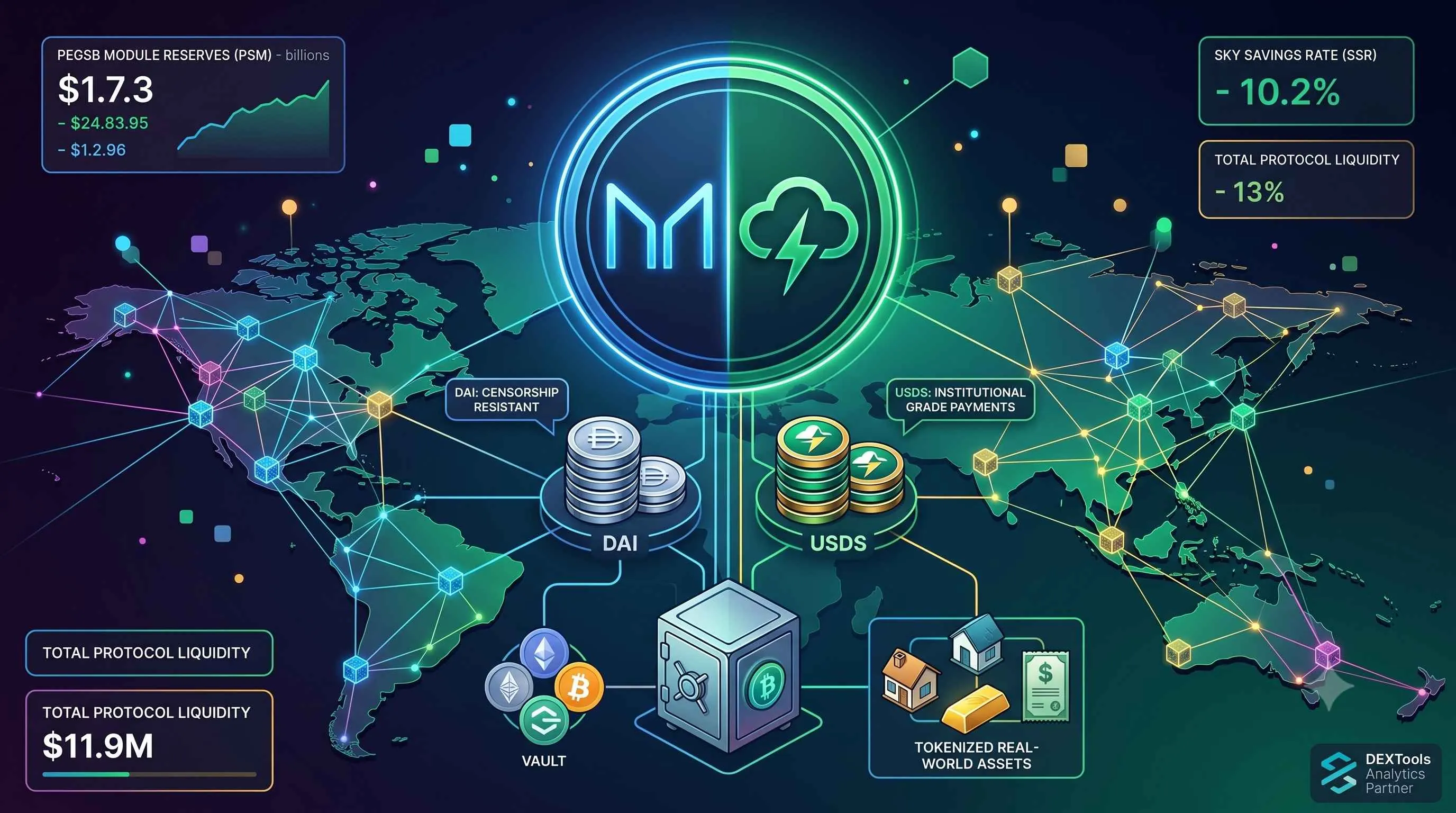
The defining characteristic of the updated ecosystem is the co-existence of two primary stablecoins: DAI and the newly introduced USDS. While both maintain a 1:1 soft peg to the U.S. Dollar and are interchangeable at parity within the system's native smart contracts, they serve entirely different market segments. This approach allows the protocol to capture different user bases without compromising its core values.
DAI remains the premier decentralized asset for DeFi-native applications. It is fundamentally engineered for permissionless utility. Its collateral structure is backed by ETH, liquid staking derivatives, and wrapped Bitcoin assets held within decentralized vaults. The key feature of DAI is its censorship resistance. It lacks arbitrary freeze functions, making it the preferred medium of exchange for permissionless smart contracts, decentralized lending pools, and cross-border settlement where non-custodial purity is required.
Conversely, USDS represents the flagship token designed for mainstream adoption, compliance integration, and massive scaling. Built with upgraded smart contract capabilities, USDS includes infrastructure capable of supporting balance freeze functions and address compliance filtering. This architecture is purpose-built to satisfy strict institutional custody mandates. While utilizing standard crypto collateral, USDS relies heavily on the protocol’s Peg Stability Module and tokenized Real-World Assets, such as short-term U.S. Treasury bills.
Analyzing the Infrastructure: What is MakerDAO and Sky Layering?
To grasp how these assets interact, analysts must evaluate the layer of smart contracts that connect them. The co-existence of these two tokens means that capital can seamlessly migrate depending on the risk tolerance of the holder. A user holding DAI can swap it one-for-one for USDS through the official converter interface at any time, ensuring that market arbitrage keeps both tokens aligned to the exact same value baseline.
This structural layering effectively insulates the core decentralized codebase from external regulatory adjustments. By confining freeze functions and compliance structures to the USDS token contract, the protocol ensures that DAI can continue to function as pure, un-censorable internet money. Meanwhile, USDS can aggressively expand into institutional custody platforms, corporate treasuries, and traditional payment rails that require asset protection features to legally deploy capital.
Furthermore, this modular layering is extended across multiple blockchains. While the core credit architecture remains anchored to Ethereum, the deployment of native USDS on high-throughput chains like Solana has transformed the protocol's capital velocity. This cross-chain expansion relies on advanced mint-and-burn bridges that maintain supply equilibrium across networks without introducing the systemic vulnerability of traditional wrapped asset bridges.
Advanced On-Chain Metrics: The Peg Stability Module (PSM)
Evaluating the health of both DAI and USDS requires analyzing the protocol's underlying liquidity engine, known as the Peg Stability Module. The PSM allows market participants to swap centralized stables like USDC for DAI or USDS at a strict 1:1 ratio, serving as the main clearing house for the entire ecosystem.
On-chain data reveals that the protocol routinely holds billions in USDC within its PSM smart contracts. This pool serves as a massive buffer against market-wide deleveraging events. If a systemic market crash occurs, arbitrageurs deposit USDC into the PSM to mint DAI or USDS to buy discounted crypto assets. This mechanism effectively keeps the stablecoins tightly anchored to their peg. In fact, analytical platforms show that the single largest individual USDC wallet on-chain is controlled by this exact module, representing a corner-stone of decentralized liquidity.
The protocol manages supply and demand using two core interest rate levers. The first is the Sky Savings Rate, formerly the Dai Savings Rate, which is a module that allows users to lock their stablecoins to earn native yield generated by the protocol's revenues, including upstream treasury bill yields. The second lever is Stability Fees, which represent the interest rate charged to users who open vaults to borrow stablecoins against their crypto collateral. When the Sky Savings Rate is high, capital flows into the savings module, reducing the active circulating supply and putting upward pressure on the peg. Conversely, lowering the stability fee incentivizes traders to mint new stablecoins, increasing circulating liquidity.
Utilizing DEXTools to Monitor Ecosystem Liquidity
For professional on-chain traders, tracking the distribution and depth of DAI and USDS across automated market makers is necessary for preventing slippage and detecting structural shifts. The DEXTools Pair Explorer provides real-time access to these shifts across multiple decentralized exchanges.
When executing large trades, analyzing the pool composition via DEXTools is critical. For example, looking at the USDS/USDC or DAI/USDC pools on Uniswap V3 can signal changing market sentiment. If the ratio within a pool shifts drastically, such as a pool becoming 80% stablecoin and only 20% USDC, it may suggest that whales are rotating out of the protocol's ecosystem due to risk adjustments, or conversely, capitalizing on high Sky Savings Rate yields elsewhere. A normal pool balance maintains a balanced distribution that ensures low slippage, while an imbalanced pool state flags potential sell pressure to an analyst.
Traders should also closely monitor the volume-to-liquidity ratio for pairs containing USDS and DAI on DEXTools. A high ratio indicates significant utilization of the asset for trading pairs, confirming high capital efficiency. If liquidity drops while volume remains high, it alerts the technical analyst that subsequent large block trades could trigger short-term de-pegging events on specific decentralized exchanges.
Furthermore, using DEXTools Bubblemaps allows analysts to easily track the concentration of the SKY governance token and the distribution of stablecoin supplies. Large interconnected clusters typically point to institutional market makers, decentralized credit protocols, or multi-sig treasury smart contracts managed by various Sky Stars. Monitoring these clusters helps traders determine whether token distribution is organically decentralizing or remaining highly concentrated among founding addresses.
Delta-Neutral Arbitrage and Yield Strategies
The interplay between DAI, USDS, and the broader DeFi lending markets creates unique opportunities for advanced trading strategies. Because DAI and USDS can be swapped 1:1 through the native interface, minor variations on external decentralized exchanges create arbitrage opportunities. If high selling pressure causes DAI to trade at a slight discount on an external automated market maker pool tracked by DEXTools, an analyst can purchase the discounted DAI, convert it 1:1 to USDS via the protocol, and deposit it into the Sky Savings Rate module or swap it for USDC via the Peg Stability Module. This process safely captures a risk-adjusted return while returning the asset back to its peg.
Advanced market participants also regularly deploy delta-neutral strategies by pairing a short position on a volatile asset with a spot purchase, using USDS or DAI as the collateral foundation. By locking the stablecoin asset to earn the native yield while simultaneously maintaining a balanced hedging profile across perpetual markets, traders extract consistent yield independent of macro market direction.
When assessing what is MakerDAO and Sky, analysts must look past basic tokenomics and evaluate the platform as a decentralized financial network. The co-existence of DAI and USDS effectively bifurcated the protocol's target market, capturing native DeFi users and compliance-bound institutional participants simultaneously.
By analyzing real-time liquidity distributions, checking for protocol pool imbalances via the DEXTools Pair Explorer, and keeping a close eye on the composition of the Peg Stability Module reserves, traders can navigate this credit ecosystem with high accuracy and minimal counterparty exposure. The transition highlights how legacy decentralized organizations can modernize their architecture to maintain dominance in an increasingly sophisticated digital asset market.
- How to Bridge Crypto Between Chains: Complete Cross-Chain Tutorial 2026
- How to Use 1inch for Swaps: Classic, Fusion and Limit Orders (2026)
- How to Use OKX Web3 Wallet: Multi-Chain DeFi Hub Guide (2026)
Disclaimer: This article is for informational purposes only and does not constitute investment advice, financial advice, trading advice, or any other kind of advice. DEXTools does not recommend buying, selling, or holding any cryptocurrency or token. Users should conduct their own research and consult with a qualified financial advisor before making any investment decisions. Cryptocurrency investments are volatile and high-risk. DEXTools is not responsible for any losses incurred.
Related Guides
- What Is Sky Protocol (USDS)? MakerDAO Rebrand Complete Guide 2026
- What Is Spark Protocol? Sky, USDS & DeFi Lending Guide 2026
- What Is a Stablecoin: Complete Guide to USDT, USDC, DAI (2026)
- What Is MakerDAO: Complete Decentralized Lending Protocol Guide (2026)
- USDT vs USDC vs DAI: Differences and Risks
Frequently Asked Questions
What is the relationship between MakerDAO and Sky?
Sky is the rebranded evolution of the MakerDAO protocol, and it introduced the USDS stablecoin alongside the existing DAI. Both stablecoins continue to operate within the broader protocol.
What is DAI and how is it kept stable?
DAI is a decentralized stablecoin designed to stay close to one US dollar, backed by collateral locked in smart contracts. The system uses mechanisms like overcollateralization and stability fees to help maintain the peg.
What is the difference between DAI and USDS?
DAI is the original stablecoin from the protocol, while USDS was introduced under the Sky branding as part of the protocol's evolution. They are both dollar-pegged stablecoins issued within the same ecosystem.
What does overcollateralized mean for a stablecoin?
Overcollateralized means the value of collateral backing the stablecoin exceeds the value of the stablecoin issued. This buffer helps protect the peg if collateral prices fall.