What Is Mining Difficulty? Crypto Mining Explained (2026)
— By Whatsertrade in Tutorials
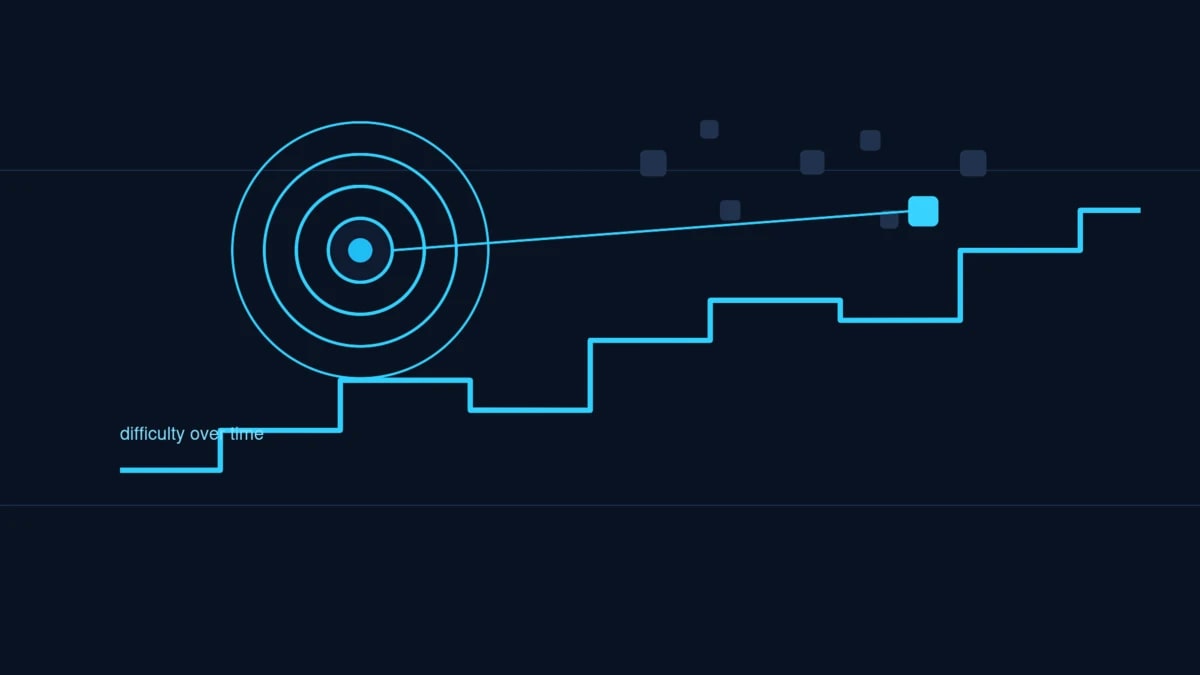
Mining difficulty keeps proof-of-work blocks arriving on schedule. How it adjusts, how it tracks hashrate, and why it matters for security.
Intent check: This is the plain-English guide to mining difficulty, the self-adjusting dial that keeps proof-of-work chains ticking at a steady pace. For the wider context of how mining secures a chain, read Proof of Work vs Proof of Stake.
Bitcoin produces a new block roughly every ten minutes, and it has done so for years, even though the amount of computing power aimed at it has grown by orders of magnitude. That steadiness is not luck. It is the work of a single clever mechanism called mining difficulty, a number the network automatically raises and lowers to keep blocks coming at a predictable rhythm no matter how many miners show up or leave.
This guide explains what mining difficulty is, why it exists, how it adjusts itself, how it relates to hashrate, and what it means for miners and for the security of the whole network.
What Is Mining Difficulty?
Mining difficulty is a measure of how hard it is to find a valid new block on a proof-of-work blockchain. Miners compete by repeatedly hashing data, searching for a result that falls below a target value the network sets. The lower that target, the fewer valid answers exist, and the harder miners have to work to find one. Difficulty is simply a way of expressing how demanding that search currently is.
When people say difficulty went up, they mean the network made the target harder to hit, so miners now need more attempts on average to produce a block. When difficulty falls, the target loosens and blocks become easier to find.
Why Difficulty Exists
The purpose of difficulty is to keep the average time between blocks roughly constant. A network wants blocks to arrive on a steady schedule, both so that new coins are issued at a predictable rate and so the system behaves consistently. But the total mining power pointed at a chain is always changing as miners join, leave, or upgrade their hardware. Without a counterbalance, more power would mean faster blocks and less power would mean slower ones.
Difficulty is that counterbalance. It rises when blocks are coming too fast and falls when they are coming too slow, always nudging the network back toward its target block time.
How Difficulty Adjusts
The network checks its own recent performance on a schedule and retargets. On Bitcoin, this happens roughly every two weeks, after a fixed number of blocks. The logic is simple:
- Blocks came too fast? That means miners have more power than before, so difficulty increases to slow production back to the target.
- Blocks came too slow? Miners have less power, so difficulty decreases to speed things back up.
- Right on schedule? Difficulty stays about the same.
This adjustment is automatic and rule-based. No committee decides it. The network simply looks at how long the last batch of blocks took and corrects itself.
Difficulty vs Hashrate
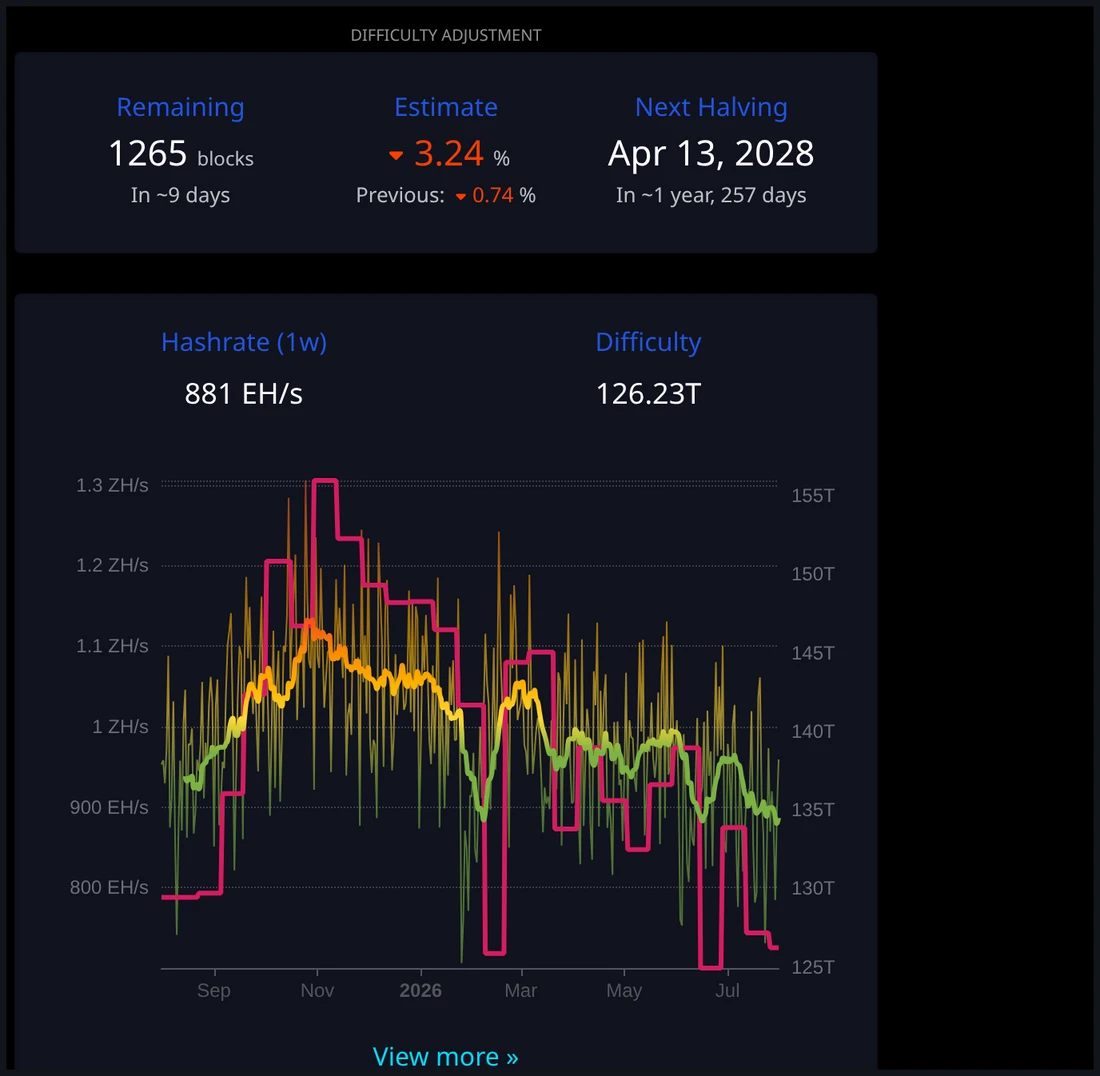
These two are closely linked but not the same. Hashrate is the total computing power actively mining, the number of hashing attempts per second across the whole network. Difficulty is the target that power is aimed at.
They move together over time. When hashrate rises, blocks start arriving faster, and at the next adjustment difficulty climbs to match. So difficulty is, in effect, the network's memory of how much hashrate has been showing up. Rising difficulty over the long run is a sign that more and more power is competing to secure the chain.
What It Means for Miners and the Network
- For miners, higher difficulty means each unit of hardware finds fewer blocks, so rewards per machine shrink unless they add more power. It is a constant competitive pressure.
- For issuance, difficulty keeps new coins arriving on schedule, which is what makes a chain's supply predictable and ties into events like the halving and the block reward.
- For security, high difficulty backed by huge hashrate makes rewriting history astronomically expensive, because an attacker would have to out-compute the entire honest network.
How to See Difficulty
You can watch difficulty on many block explorers and network dashboards. They often show the current difficulty, how the next adjustment is trending, and the estimated time until it happens. It is a satisfying way to see the network quietly balancing itself in real time.
Key Takeaways
- Mining difficulty measures how hard it is to find a valid block on a proof-of-work chain.
- It exists to keep the average block time steady as mining power changes.
- It adjusts automatically on a schedule, rising when blocks come too fast and falling when they come too slow.
- Difficulty tracks hashrate over time, so a long-term rise means more power is securing the chain.
- High difficulty backed by high hashrate is a core part of what makes a proof-of-work chain secure.
Mining difficulty is one of those elegant ideas that hides in plain sight. A single self-adjusting number absorbs every swing in the world's mining power and hands back the same steady heartbeat of blocks, year after year. The next time you hear that Bitcoin difficulty hit a new high, you will know exactly what it means: more machines than ever are competing to write the next page of the ledger.
This article is educational and is not financial advice.