What is Morpho: Optimized Lending Explained
Morpho separates baseline lending infrastructure from active risk strategy. We analyze the technical layout of Morpho Blue markets and curated vaults.
The Lending Shift: Separating Infrastructure from Risk Strategy
- The decentralized finance (DeFi) credit market has historically been dominated by monolithic, multi-asset liquidity pools. Protocols like traditional Aave or Compound instances aggregate diverse assets into a shared collateral layer, requiring a one-size-fits-all risk parameter managed by slow, centralized DAO governance votes.
- When an exotic collateral asset experiences an unexpected exploit or liquidity failure, the entire shared pool is exposed to systemic bad debt cascades. Morpho dismantles this fragile architecture by decoupling the baseline core lending infrastructure from passive risk management strategies, pioneering an aggregated, two-layer credit marketplace.
- Operating across multiple blockchain layers with billions in total value locked, the protocol provides an open marketplace for isolated lending, custom vault aggregation, and professional risk curation. This guide provides a detailed analysis of Morpho Blue, the operational architecture of Morpho Vaults, the mechanics of pluralistic risk curation, and the platform's position within the global credit ecosystem.
1. The Minimalist Lending Primitive
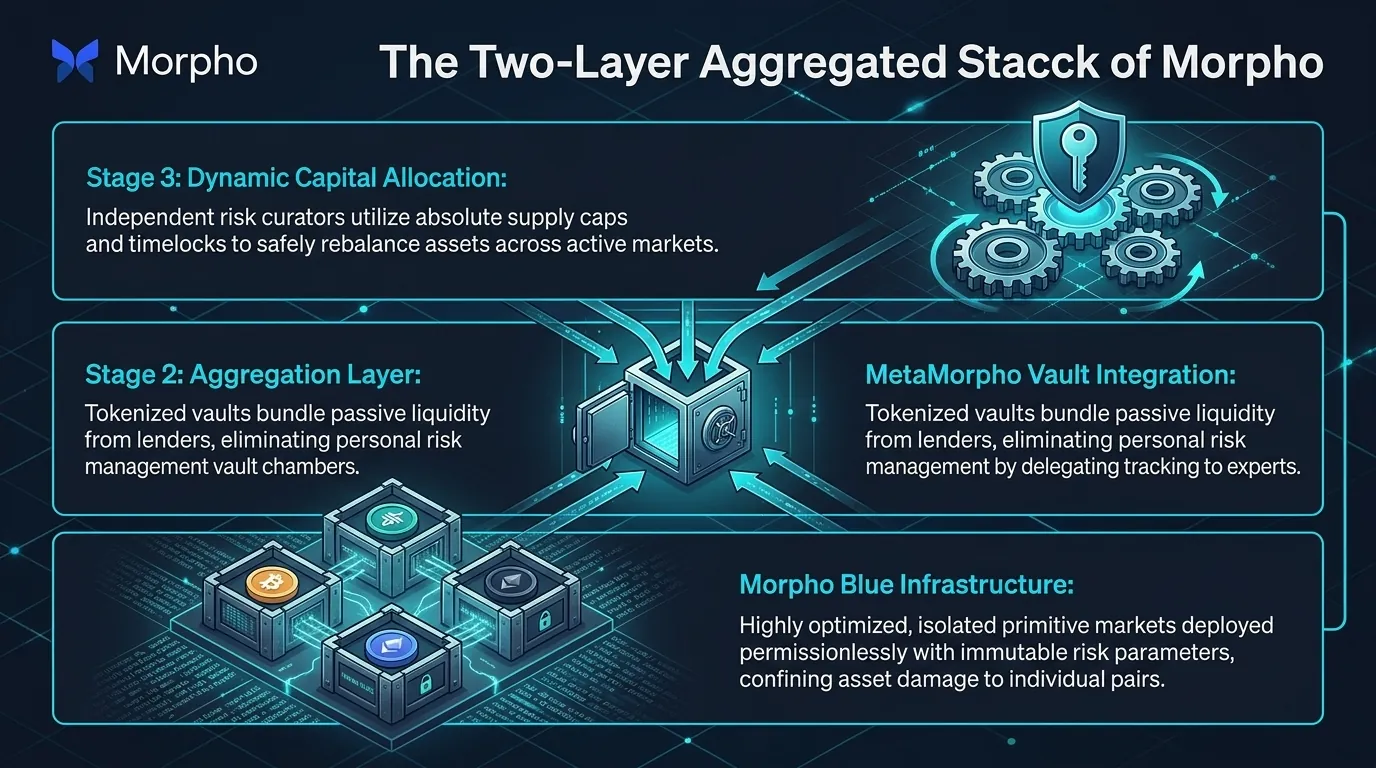
- Morpho Blue serves as the immutable foundation of the Morpho lending stack. Shifting away from complex, upgradeable multi-asset pools, it is implemented as a highly compressed, non-upgradable Solidity contract containing fewer than 650 lines of code. This extreme code minimization dramatically shrinks the potential smart contract attack surface while maximizing execution speed and gas optimization.
Isolated Market Architectures: Instead of cross-collateralizing all assets, Morpho Blue treats every loan pair as a completely isolated financial market. If a specific collateral asset collapses, the financial loss is strictly contained within that isolated pair, leaving the rest of the protocol untouched.
The Five Immutable Parameters: Anyone can deploy a lending market permissionlessly. Once deployed, the market is defined forever by five fixed variables: the loan asset, the collateral asset, the Liquidation Loan-to-Value (LLTV) threshold, the specific oracle address, and the chosen interest rate model.
2. Vaults: Passive Capital Aggregation Layer
While isolated primitive markets prevent systemic risk contagion, they split liquidity across thousands of independent avenues, creating a fragmented and complex user experience for passive lenders who do not want to manage individual loan metrics manually. Morpho bridges this gap through Morpho Vaults (historically known as MetaMorpho).
The ERC-4626 Standard Gateway: Morpho Vaults are non-custodial, open-source lending vaults built directly on top of Morpho Blue. LPs deposit a single asset (such as USDC or WETH) into a vault and receive a liquid, tokenized vault share.
Liquidity Re-aggregation: The vault automatically bundles passive capital and distributes it across multiple whitelisted Morpho Blue isolated markets. This layer preserves the simple, automated user experience of a legacy monolithic lending pool while retaining the underlying safety guarantees of fully isolated structural credit pairs.
3. The Curation Paradigm: Risk Allocation and Institutional Adoption
The deployment of capital inside Morpho Vaults is delegated to specialized, third-party risk management entities known as Curators and Allocators.
Pluralistic Risk Markets: Rather than forcing all network depositors to accept the consensus view of a single DAO governance body, Morpho allows diverse risk curators (such as Gauntlet, Steakhouse Financial, or Block Analitica) to manage independent vaults. Lenders can consciously opt into a vault whose explicit collateral parameters and risk tolerances align with their personal strategy.
Enforceable On-Chain Guardrails: Curators utilize specialized role configurations (Owner, Curator, Allocator, and Guardian) to dynamically rebalance funds across whitelisted isolated markets to optimize yields. To secure depositor capital, curators configure absolute supply caps per market and utilize timelock functions, allowing safety guardians to veto malicious or unverified allocation shifts before execution.
Enterprise Validation: This modular configuration has enabled major web3 integrations. High-profile retail applications and institutional credit groups utilize custom Morpho Vault infrastructure to route billions in corporate or retail collateral through isolated risk avenues, validating the protocol as an enterprise-grade financial routing network.
4. Technical Architecture Matrix: Monolithic Pools vs. Morpho Stack
| Structural Vector | Legacy Monolithic Lending Pools | Advanced Morpho Aggregated Stack |
| Risk Architecture | Shared, cross-collateralized pool layer. | Fully isolated independent primitive markets. |
| Market Onboarding | Slow, multi-week DAO governance votes. | Instantaneous, fully permissionless deployment. |
| Risk Customization | One-size-fits-all parameters for all users. | Pluralistic curation tailored by independent curators. |
| Systemic Contagion | High; single bad collateral exposes the system. | Absolute zero; losses are safely contained per market. |
| Code Footprint | Massive, upgradeable multi-contract arrays. | Under 650 lines of immutable, core Solidity logic. |
Universal On-Chain Forensics and Trading Telemetry via DEXTools
Navigating contemporary decentralized credit and liquidity networks requires reliable, independent market telemetry to evaluate pool balance parameters, inspect contract behaviors, and track high-volume transactions. Advanced analytical environments like DEXTools provide an essential universal dashboard for modern traders, operating independently of individual blockchain systems or specific network applications.
You can access DEXTools here and start trading today.
How to Bridge Crypto Between Chains: Complete Cross-Chain Tutorial 2026 How to Use 1inch for Swaps: Classic, Fusion and Limit Orders (2026) How to Use OKX Web3 Wallet: Multi-Chain DeFi Hub Guide (2026)Disclaimer: This article is for informational purposes only and does not constitute investment advice, financial advice, trading advice, or any other kind of advice. DEXTools does not recommend buying, selling, or holding any cryptocurrency or token. Users should conduct their own research and consult with a qualified financial advisor before making any investment decisions. Cryptocurrency investments are volatile and high-risk. DEXTools is not responsible for any losses incurred.
Related Guides
- How to Use Morpho: Complete Vault and Lending Tutorial (2026)
- What Is TrueFi (TRU)? Uncollateralized DeFi Lending and Credit Guide 2026
- What Is Suilend? Sui Lending Protocol & SEND Token Guide 2026
- What Is Spark Protocol? Sky, USDS & DeFi Lending Guide 2026
- What is Maple Finance? Institutional Lending Explained
Frequently Asked Questions
What is Morpho in DeFi?
Morpho is a decentralized lending protocol that provides infrastructure for borrowing and lending crypto assets. It is designed to separate the base lending layer from the risk management strategies built on top of it.
What are Morpho markets?
Morpho markets are isolated lending markets defined by parameters such as the assets involved and risk settings. Isolating markets can help contain risk so issues in one market do not automatically affect others.
What is a lending vault in Morpho?
A vault is a managed strategy that allocates deposited funds across lending markets according to defined risk parameters. Vaults let users access curated strategies rather than configuring each market themselves.
How does DeFi lending work in general?
In DeFi lending, users supply assets to earn interest while borrowers post collateral to take out loans. Smart contracts manage the deposits, collateral and interest without a traditional intermediary.