What Is Smurf Cat? Solana Viral Memecoin from TikTok Trend Explained in 2026
— By Whatsertrade in Tutorials
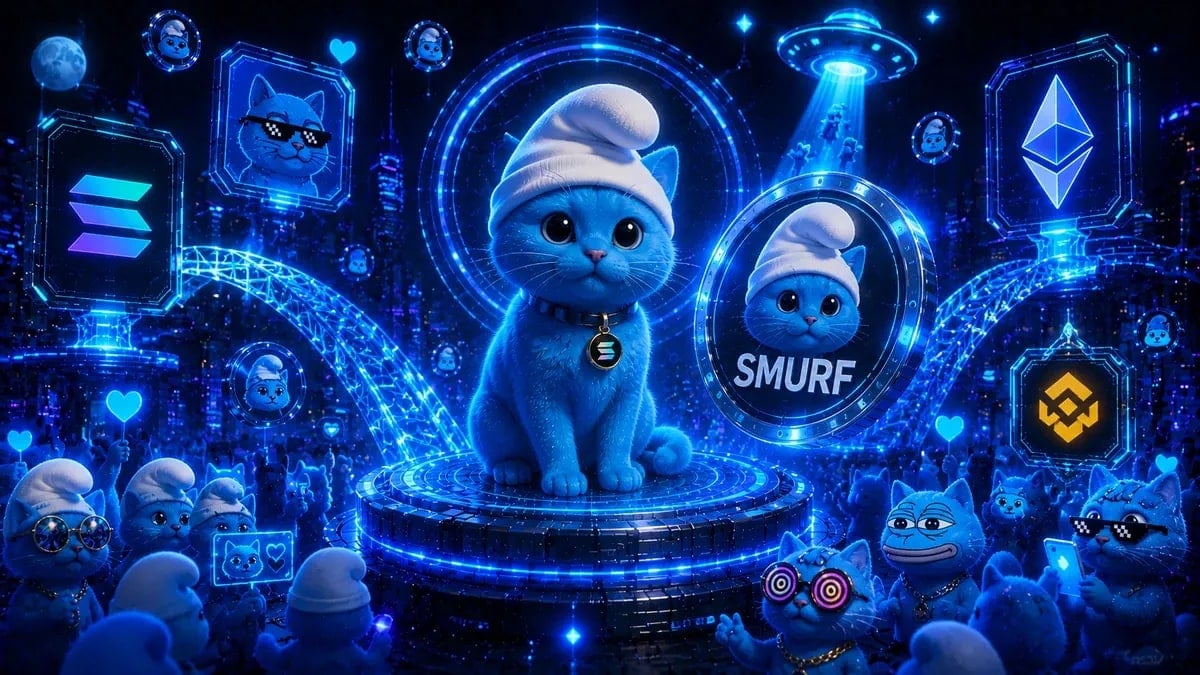
Smurf Cat, also known as Shailushai, is the blue furred mushroom hatted character that exploded across TikTok in 2023 and spawned a Solana memecoin called Real Smurf Cat on SOL. This guide traces the meme from artist Nate Hallinan's 2011 illustration through the Russian TikTok loop that conquered Generation Z, walks through the Solana SPL launch on Pump.fun and Raydium, compares the SOL version against the Ethereum fork, and benchmarks Smurf Cat against POPCAT, MEW, BONK, and the rest of the 2024 to 2026 cat memecoin tribe.
What Is Smurf Cat? Solana Viral Memecoin from TikTok Trend Explained in 2026
Every once in a while a meme escapes the boundaries of any single platform and becomes a generational reference point. Smurf Cat, the blue furred creature with a tiny mushroom hat that wandered across TikTok feeds in 2023 humming an absurd Russian song, is one of those rare cultural objects. It was originally a digital illustration created by a working artist more than a decade earlier, then resurfaced through a Russian TikTok account that paired the image with a looping vocal clip, conquered Generation Z in a matter of weeks, and finally arrived on Solana as a memecoin called Real Smurf Cat on SOL.
The Smurf Cat token is part of the cat themed Solana memecoin tribe that includes POPCAT, MEW, MICHI, and a long tail of smaller experiments. Within that tribe Smurf Cat occupies a specific niche. It is not a real cat photograph like POPCAT, not a stylized cartoon like MEW, and not a viral zoo animal like MOO DENG. It is an obscure digital art piece that became a TikTok phenomenon, then a token, and now an evergreen reference inside the broader Solana memecoin culture.
This guide unpacks Smurf Cat from end to end. We trace the original illustration back to artist Nate Hallinan in 2011, walk through the Russian TikTok loop that turned it into a 2023 viral moment, examine the Solana SPL token launch and the parallel Ethereum version, and compare Smurf Cat to POPCAT, MEW, and the rest of the cat memecoin landscape.
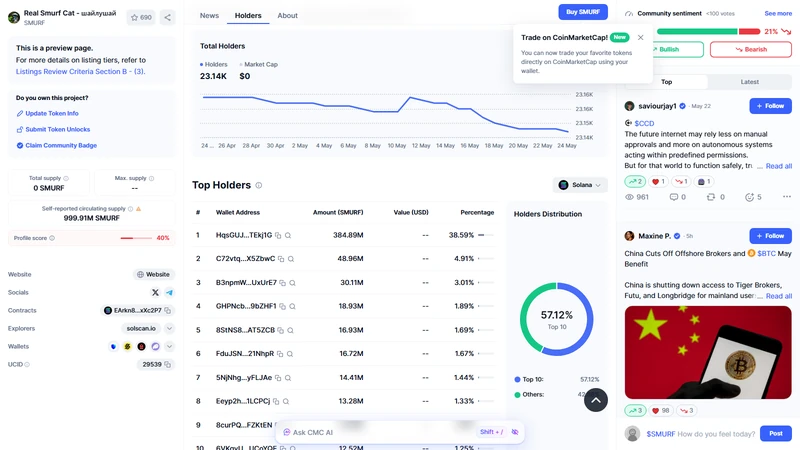
Smurf Cat is a Solana based SPL memecoin built around the viral Shailushai character, a blue furred creature with a small mushroom hat originally illustrated by artist Nate Hallinan in 2011 and re popularized in 2023 by a Russian TikTok loop that became one of the most reposted memes of that year. The Solana version trades as Real Smurf Cat on SOL, a separate community fork from the original Ethereum deployment that emerged later in the cycle, and lives within the cat themed memecoin tribe alongside POPCAT, MEW, MICHI, and BONK. Smurf Cat has no utility, no revenue, and no formal team. Its value is grounded in meme recognition, holder commitment, and the structural credibility of a fixed supply SPL launched through a publicly visible Pump.fun and Raydium liquidity setup.
What Is Smurf Cat in Plain English
Smurf Cat is a fungible token issued on Solana using the standard SPL token program. The contract itself is unremarkable. It does not stake into validators, it does not represent governance in any protocol, and it does not earn fees from any application. It is a plain SPL token, and the value comes from what people decide it represents.
What makes Smurf Cat distinctive is the underlying cultural artifact. The token brands itself around Shailushai, a small blue furred quadruped with a mushroom cap on its head, large round eyes, and an expression that hovers between curious and bewildered. The image entered the internet around 2011 through a working artist's portfolio, sat in relative obscurity for years, and then exploded across TikTok in mid 2023 when a Russian account paired the character with a looping vocal track. Within months it had been remixed across every major short video platform and reposted by hundreds of millions of users.
The Solana token, branded as Real Smurf Cat on SOL, captures that cultural energy and translates it into a tradable asset. Like most pure memecoins, it has no roadmap, no staking emissions, no governance rights. The trade is a bet on whether the underlying meme stays alive in mainstream culture. Real Smurf Cat sits alongside the canonical Ethereum version of Smurf Cat, and the two tokens compete and complement each other in the way that forked memecoins typically do across chains. For broader context on the category, our memecoin trading guide walks through the economic mechanics in detail.
The Nate Hallinan Origin Story: 2011
Most viral memes have an obscure point of origin, and Smurf Cat is no exception. The original illustration was created by digital artist Nate Hallinan in 2011 as part of a personal art project that imagined Smurfs not as the cartoon characters from the Peyo comic, but as a real biological species. Hallinan rendered the Smurf as a small primate like creature with blue fur, an oversized mushroom hat, and a forest dwelling habitat. The illustration was posted to his portfolio and shared on art communities at the time, gaining modest visibility but never becoming a mass cultural phenomenon.
For over a decade the image lived in the long tail of the internet. It surfaced occasionally on Tumblr, Reddit, and Pinterest as a curiosity, sometimes attached to discussions about cryptids, sometimes to digital painting tutorials. Smurf Cat did not appear suddenly out of nowhere in 2023. It was a sleeper image that a new platform rediscovered and amplified into something far larger than its creator intended.
Over the course of the 2023 viral cycle the image was redrawn, simplified, and animated in dozens of ways. By the time the Solana memecoin launched, the canonical Smurf Cat used in most token branding was a cleaner, more cartoony version that traced its lineage back to the Hallinan original but had passed through multiple remix generations. As is typical of memecoins, the cryptocurrency project has no formal ownership relationship to Hallinan, and the community treats the cultural appropriation as part of the joke. This is the normal pattern from DOGE to PEPE to POPCAT.
The 2023 Russian TikTok Explosion
The event that converted Smurf Cat from a sleeper image into a global meme happened on TikTok in mid 2023. A Russian language account paired a stylized version of the Hallinan character with a short looping vocal track that sounded like a nonsense melody. The audio, sometimes transliterated as a string of phonetic syllables that English speakers heard as a kind of singsong chant, paired with the visual loop became hypnotically rewatchable. TikTok's recommendation engine, which favors high completion rate short clips, surfaced the content aggressively across global feeds.
Within weeks the loop had spread from Russian and Eastern European TikTok into Western feeds. The character was also referred to as Shailushai, a phonetic interpretation of the audio that became one of the secondary names attached to the meme. Across the summer and autumn of 2023, Smurf Cat overlays appeared on countless original TikToks, reaction stitches, Discord servers, Telegram channels, and Twitter threads. Major non crypto meme accounts repeatedly used the character in unrelated jokes, the classic sign that a meme has crossed from niche to mainstream.
The viral cycle had several reinforcing features. The character was visually striking, with the blue fur, mushroom cap, and large eyes creating an instant recognition pattern. The audio loop was short, melodic, and easy to remix. The Russian language origin gave the meme an air of foreignness that English speaking audiences found compelling without needing to understand it. By late 2023 Smurf Cat had become one of the most reposted memes of the year, and the Solana memecoin scene was entering its second major wave with BONK rallying, WIF emerging, and POPCAT freshly launched. Conditions were perfect for someone to deploy an SPL token using the meme as branding.
From TikTok Loop to Solana Token
The first Smurf Cat tokens emerged on Ethereum, where the early speculative wave hit before Solana caught up. An Ethereum SPL equivalent, technically an ERC 20, deployed around mid to late 2023 carrying the original Smurf Cat branding and capturing the first wave of speculative attention. The Ethereum version reached a meaningful market cap during the initial viral window, although it was gated by Ethereum's high gas fees that priced out smaller retail participants.
The Solana version came later, branded as Real Smurf Cat on SOL to distinguish it from the Ethereum incumbent and from the various fork attempts that appeared on other chains. The launch followed the standard 2024 Solana memecoin playbook. Anonymous deployers minted the SPL token, paired it with SOL on a Raydium pool, burned the LP tokens to permanently lock liquidity, and let the community do the rest. The launch took place against the backdrop of a maturing memecoin infrastructure on Solana, with Pump.fun already operating as the dominant memecoin factory.
For tokens launched via the Pump.fun bonding curve, the process is even more streamlined. A user creates the token through the Pump.fun interface, deposits an initial bag of SOL, and the bonding curve handles price discovery automatically. Once the market cap crosses a graduation threshold, the remaining tokens and SOL migrate to a Raydium pool with burned LP. Real Smurf Cat on SOL fits within this pattern, and the graduation event marked the transition from speculative bonding curve play to a permanent liquidity asset on Raydium. The launch market cap was modest. As awareness grew through Solana memecoin Telegram channels and Twitter threads, volume picked up, larger traders rotated in, and the chart began to climb into the cat tribe leaderboard.
The Smurf Cat Timeline: 2011 to 2026
Real Smurf Cat on SOL Tokenomics
Real Smurf Cat on SOL follows the standard Solana memecoin tokenomics blueprint. The total supply is fixed at launch, with no inflation, no staking emissions, and no scheduled unlocks. The mint authority was revoked after the initial deployment so no further tokens can ever be created. This kind of fixed supply structure is uncommon in DeFi protocols and almost universal in serious memecoins, where simplicity is a credibility signal.
The bulk of supply was committed as one side of a Raydium liquidity pool at the graduation event from Pump.fun. When a token graduates from the Pump.fun bonding curve, the protocol automatically migrates the remaining bonding curve liquidity into a Raydium pool and burns the LP tokens that represent ownership of that pool. This is the on chain way of declaring that no party, including the original deployer, can ever withdraw the underlying liquidity. The mechanic is the same one used by POPCAT, WIF, and many other major Solana memecoins, and it is the single most important honesty signal a memecoin can provide.
The LP burn is verifiable on Solana block explorers. Anyone can look up the Raydium pool address for Real Smurf Cat on SOL, find the LP token mint, and confirm that all of the LP tokens were sent to the canonical burn address. Tools like DexTools show wallet concentration, liquidity history, and large transactions in real time, which makes the LP lock easy to audit. Because liquidity is fixed, large trades move price along the constant product curve in predictable ways, and no party can drain the pool to flash crash the pair.
For a deeper dive into what an SPL token actually is at the protocol level, our guide to SPL tokens on Solana covers the mint authority, freeze authority, and decimal scheme that underlie every Solana fungible token including Real Smurf Cat on SOL. Understanding those primitives is essential before you trade any SPL because the difference between a properly renounced token and a token with active mint authority is the difference between fixed supply and rug pull risk.
The Pump.fun Launch Mechanics: Step by Step
It is worth walking through the technical sequence that defines how Real Smurf Cat on SOL and most modern Solana memecoins reach market, because understanding it helps you evaluate any new memecoin you encounter. The Pump.fun bonding curve plus Raydium graduation pattern is now the standard launch flow on Solana, and Smurf Cat is one of dozens of high profile examples of it executed cleanly.
After step three the token is live and trading on Raydium, with a permanent liquidity floor and full integration into the Solana DEX aggregator ecosystem. From that point forward the price is determined entirely by the order flow into and out of the Raydium pool, plus any additional liquidity that gets added by external LPs. This pattern differentiates the post Pump.fun memecoin generation from the pre Pump.fun cohort. Earlier tokens like POPCAT and WIF were deployed manually, with the team handling each step. Smurf Cat and most 2024 to 2026 Solana memecoins use the automated Pump.fun pipeline, which standardizes the honesty signal across the entire ecosystem.
Ethereum Smurf Cat vs Solana Real Smurf Cat
One of the more interesting wrinkles in the Smurf Cat story is that there are two major versions of the token on two different chains. The Ethereum version came first and captured the initial speculative wave during the 2023 viral peak. The Solana version came later as a community fork, branded explicitly as Real Smurf Cat on SOL to distinguish itself. The two coexist rather than directly competing in the way that a bridged token would.
The Ethereum version benefits from Ethereum's larger institutional liquidity, deeper integration with Uniswap, and a longer history of memecoin trading at scale. It is also burdened by Ethereum's gas costs, which make small retail trades uneconomical during periods of high network activity. Memecoin trading on Ethereum is fundamentally for larger wallets, which limits the retail amplification that has historically been so important for memecoin valuation.
The Solana version inverts those tradeoffs. Real Smurf Cat on SOL benefits from Solana's low fees and fast confirmation, which let small retail traders execute hundreds of trades per day. It is part of a memecoin specific ecosystem that includes Pump.fun, Jupiter aggregator, Phantom and Backpack wallets, and Telegram trading bots like BonkBot and Trojan. The downside is that the Solana version is a fork rather than the original, which gives the Ethereum version a claim to canonical status that some traders weight heavily. For most retail traders, the practical question comes down to which chain they prefer. If you live on Solana with Phantom and Jupiter, Real Smurf Cat on SOL is the natural choice.
The Cat Memecoin Tribe: Smurf Cat vs POPCAT vs MEW vs BONK
Solana memecoins are a tribal landscape with overlapping but distinct communities, and Smurf Cat sits inside a specific niche within the broader cat tribe. The comparisons most often raised are with POPCAT, MEW, and the dog memes like BONK that occupy the adjacent category.
POPCAT is the elder of the modern Solana cat tribe, launched in December 2023 from the 2020 Oatmeal popping cat meme. It crossed two billion dollars in market cap during the 2024 cycle, secured listings on Binance and Coinbase, and is widely treated as the canonical alpha cat. POPCAT's strength is the maturity and recognition of its underlying meme, which had been culturally embedded for years before the token launched. Smurf Cat's underlying meme is younger and tied more directly to TikTok rather than to long form internet culture.
MEW, full name Cat in a Dogs World, launched in March 2024 with explicit branding around the cat versus dog rivalry, taking direct aim at DOGE, SHIB, BONK, and WIF. MEW peaked above one billion dollars in 2024. The MEW cultural angle is meta, since the token is essentially a tribal statement about the cat dog memecoin war. Smurf Cat is more purely about the meme itself rather than about its position within the broader memecoin landscape. Smurf Cat does not need to fight anyone, it just is.
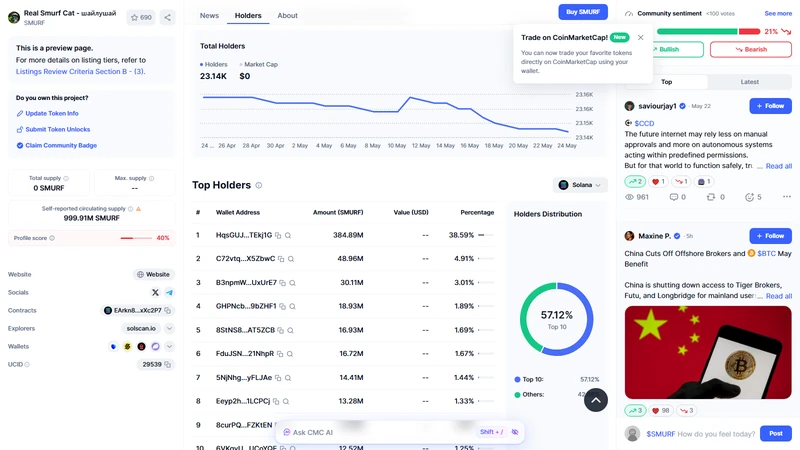
BONK is the elder statesman of the entire Solana memecoin scene. It launched in December 2022 and was distributed as a free airdrop to active Solana users, which gave it the largest holder count of any Solana memecoin. BONK is also dog themed rather than cat themed, which puts it in the adjacent tribe rather than the same one. Smurf Cat is a more concentrated speculative play with a smaller holder count but a sharper cultural angle.
Beyond Solana, the comparison most often raised is PEPE, the Ethereum frog memecoin. PEPE and Smurf Cat both depend on the strength of an underlying image based meme and both have crossed billion dollar valuations during their peaks. PEPE is older and more culturally embedded, but Smurf Cat has the TikTok native advantage that makes it more accessible to Gen Z audiences who never lived through the original Pepe waves. A related comparison is with FARTCOIN, the AI memecoin that broke out around Truth Terminal. Different cultural angles, same underlying memecoin economics.
Other Solana memecoins worth mentioning in the same breath include PNUT, the squirrel memecoin that exploded after a real world incident involving the death of a pet squirrel, and the broader long tail of animal welfare themed memecoins. Smurf Cat fits within that animal welfare adjacent cluster, with a community that occasionally organizes around animal rescue causes and fan art celebrating the character's gentle, curious nature.
Cultural Impact and Community Building
The most underrated thing about Smurf Cat is how much of its valuation is community labor. The token has no marketing budget, no central team running paid campaigns, no PR firm. Every viral TikTok edit, every animated remix of the character overlaid on a chart, every Telegram raid is produced by volunteers who happen to own the token. Holders are also the marketing department.
The community organizes primarily on Twitter, Telegram, and TikTok, with each platform serving a different function. Twitter is where the trading discourse happens, with charts, on chain analytics, and listing news. Telegram is where the community coordinates raids, drops fan art, and pumps each other up during dips. TikTok is where the meme itself continues to spread organically, with new edits going viral periodically and reintroducing Smurf Cat to fresh audiences.
The aesthetic is consistent: blue and forest green color palettes, mushroom and woodland themes, intentionally low brow humor. The community leans into the TikTok native heritage, with most content optimized for short vertical video rather than traditional crypto Twitter formats. There is also a notable crossover between Smurf Cat culture and the broader animal welfare community, with fan art accounts often segueing into discussions of rescue cats and fantasy creature design. This wider cultural footprint gives Smurf Cat a soft moat that a freshly launched token would not have.
Solana Speed and Low Fees: Why the Chain Matters
Real Smurf Cat on SOL could exist on any blockchain that supports fungible tokens, and the original Ethereum version proves that the meme works across chains. But the Solana version is where the modern retail memecoin economy happens, and that fit is not accidental.
Solana uses a hybrid consensus combining Proof of History with Proof of Stake. The combined design lets Solana process thousands of transactions per second with sub second confirmation at fractions of a cent per transaction. For memecoin trading this matters because typical retail traders make many small trades in rapid succession. On Ethereum mainnet, where gas can reach tens of dollars per swap during congestion, this style is economically impossible for retail. On Solana the same trader can place hundreds of trades per day and pay total fees of a few dollars.
Solana also has a deep ecosystem of memecoin specific tools. Aggregators like Jupiter route trades across all major Solana DEXes for best execution. Wallets like Phantom and Backpack offer one click swap interfaces. Telegram bots like BonkBot, Trojan, and Bullx let traders execute swaps from messaging apps. Analytics platforms like DexTools and Birdeye surface trending tokens and wallet behavior in real time. Real Smurf Cat on SOL benefits from this entire ecosystem the moment it lists on Raydium.
How Smurf Cat Sustains Valuation Without Utility
The hardest question for any newcomer is what justifies any valuation for a token that produces no revenue and grants no rights to anything. The answer requires letting go of the fundamental value framework that applies to equities and reaching for a different model. Smurf Cat, like POPCAT and MEW and every other pure memecoin, is closer to a tradable cultural unit than to a financial asset in the traditional sense.
In a cultural unit model, value is sustained by three forces. The first is the strength of the underlying meme, measured by how recognizable it remains in mainstream culture. Smurf Cat scores well here because the TikTok loop continues to surface organically across feeds. The second is the depth of holder commitment, measured by holder count and wallet age. The third is structural credibility: fixed supply, burned LP, renounced mint authority. Real Smurf Cat on SOL satisfies all three.
This model also explains why Smurf Cat does not need a roadmap. A roadmap would weaken the proposition by implying the token needs to do something to justify its value. The whole point of a pure memecoin is that the meme is the product. Adding staking or a play to earn game would dilute the brand. The discipline of doing nothing, of letting the meme carry the entire weight, is part of the value proposition. Smurf Cat is younger than POPCAT or BONK and has navigated fewer cycles, but the underlying meme has shown unusual resilience across multiple TikTok algorithm shifts.
Risks and Honest Tradeoffs
The honest Smurf Cat thesis includes real risks any buyer should sit with. None are unique to Smurf Cat, but all are amplified by the memecoin structure, and ignoring them is the most common way retail traders lose money in this category.
The first risk is volatility. Real Smurf Cat on SOL has swung 20 to 40 percent in a single day during high attention periods, and drawdowns of 80 percent from local highs are normal across the cycle. Position sizing for memecoins should always assume total loss. Any sizing that would meaningfully impact your life if zeroed is too large.
The second risk is meme decay. The Smurf Cat TikTok wave peaked in 2023, and while the character has shown remarkable staying power, there is no guarantee the cultural relevance persists into 2027 or beyond. TikTok memes generally have shorter half lives than Discord or Reddit memes because the platform algorithm rotates content aggressively. If the loop fades from organic circulation, the token loses one of its three pillars of value.
The third risk is fragmented liquidity across versions. The existence of both Ethereum Smurf Cat and Solana Real Smurf Cat splits attention and capital. New entrants sometimes buy the wrong version, fall for fake forks on third chains, or get caught up in confusion about which token is canonical. Always verify the exact contract address through trusted sources like DexTools, the official Solana version's social channels, and the Solana block explorer before sending funds.
The fourth risk is regulatory. Memecoins exist in a legal grey zone, and posture toward retail speculative tokens has been hardening in several jurisdictions. If a major regulator designates memecoins as securities, exchange listings could be reversed. Smurf Cat has the advantage of being a community token without identifiable promoters, which reduces some legal exposure, but the risk is not zero.
The fifth risk is operational. Despite the LP burn, the token relies on infrastructure that can fail. Solana has had multi hour outages. Centralized exchanges can delist. Wallet phishing and address poisoning scams target memecoin holders because they are typically newer to crypto. Treat security as personal responsibility and use hardware wallets for significant positions. The rug pull detection guide covers the broader memecoin scam landscape in detail.
Finally, the universal risk is that Smurf Cat is exactly what it claims to be. It is not productive, it pays no yield, it grants no governance. The upside scenario requires the meme to keep spreading. The downside scenario requires nothing. The chart simply drifts down over months until the token becomes another forgotten artifact in the history of internet money.
Smurf Cat Pros and Cons
- Burned LP makes liquidity permanent and removes the most common rug pull vector
- Fixed supply with no inflation, no unlocks, and no insider allocations
- One of the most viral TikTok memes of 2023 with strong Gen Z recognition
- Pump.fun and Raydium native, fully integrated with Jupiter and DexTools
- Active community across Twitter, Telegram, and TikTok with consistent aesthetic
- Lives on Solana, which has the best memecoin infrastructure in crypto
- Cross platform meme that survived multiple TikTok algorithm shifts
- Animal welfare adjacent community gives soft cultural moat beyond pure trading
- Zero utility, zero revenue, zero claim on cash flows
- Historical drawdowns of 80 percent plus from local highs are normal
- Fragmented liquidity between Ethereum and Solana versions confuses new buyers
- TikTok memes generally have shorter cultural half lives than older meme formats
- Anonymous deployers means no formal team accountability
- Younger and less proven than POPCAT, MEW, or BONK across cycles
- Regulatory uncertainty around retail memecoin trading in some jurisdictions
- Bridge and wallet phishing risks target memecoin holders specifically
Best Practices for Smurf Cat and Memecoin Traders
If Smurf Cat belongs in your portfolio, the rest is execution. Memecoin trading rewards discipline more than insight. The traders who do well over multiple cycles are the ones with consistent risk management, clear position sizing, and the ability to walk away when a position turns against them.
Start with position sizing. Cap memecoin exposure at 5 to 10 percent of your total crypto portfolio, and any single memecoin position at 1 to 2 percent. Smurf Cat can be part of a balanced cat tribe exposure but should not be the centerpiece of your portfolio. Use limit orders rather than market orders when possible, because memecoins are volatile enough that fast moves can fill 5 to 15 percent worse than quoted price during high attention windows.
Plan your exit before you enter. Decide what gain triggers a partial sell, what loss closes the position, and what time horizon you are operating on. The biggest memecoin losses come from holders who turned a 200 percent gain into a 50 percent loss by failing to take profit, or a 30 percent drawdown into a 90 percent one by refusing to cut. Smurf Cat has had multiple cycles where disciplined exit planning would have preserved meaningful gains.
Use hardware wallets for any size position. Memecoin traders are prime phishing targets because they interact with new contracts frequently and often paste contract addresses copied from Twitter or Telegram. A Ledger or Trezor stops most attack vectors cold. Learn to read on chain data through DexTools, Birdeye, and Solscan, which show wallet concentration, large transaction patterns, and liquidity changes in real time.
Always verify the contract address. The fragmented liquidity between Ethereum Smurf Cat, Solana Real Smurf Cat, and various forks on other chains creates real confusion. Cross check the address through DexTools, the official social channels of the version you intend to trade, and a Solana block explorer like Solscan. Never trust an address pasted in a Telegram or Twitter direct message without independent verification.
Finally, accept that the goal is survival across cycles. The traders who get rich in memecoins are the ones who held through the boring stretches between euphoric peaks. Treat every position as a probabilistic bet, not a permanent conviction.
Smurf Cat FAQ
Related Guides
- What Is POPCAT? The Solana Cat Memecoin That Hit $2 Billion Explained in 2026
- What Is Toshi (TOSHI)? Base Memecoin from Coinbase CEO's Cat Explained in 2026
- Pair Explorer Data Trend Reversals: A Pro Trading Guide
- What Is TRUMP Coin: Official Trump Memecoin Guide (2026)
- What Is SLERF? Solana Sloth Memecoin and the Burn Incident Guide 2026