What Is a TON Memo Tag and When Do You Need One? Guide (2026)
— By Tony Rabbit in Tutorials

Learn what a TON memo tag is, when exchanges and services require it, how to send Toncoin or USDT on TON correctly, and what to do if you forgot the memo.
Memo mistakes are one of the most frustrating kinds of crypto errors because the address can be correct and the transfer can still go wrong. TON users run into this especially when moving Toncoin or USDT on TON to an exchange or service that uses one shared wallet address for many users. In those cases, the memo, tag, or comment field is not decorative. It is part of the routing logic.
Quick answer: a TON memo tag is an extra identifier used by some exchanges and services to match your deposit or withdrawal to the correct internal account. If the recipient requires a memo and you leave it out, the transfer may arrive on-chain but not be credited correctly inside the service. If no memo is required, adding random text does not make the transfer safer. The right move is to follow the recipient's exact instructions and test first when the route is new.
- The address alone is not always enough on TON. Some recipients use one address for many users and need a memo to know whose funds arrived.
- Memos are mostly a service-side routing tool. Personal wallets often do not need them, while exchanges frequently do.
- Leaving a required memo blank can cause painful delays. The funds may land on-chain but remain unmatched internally.
- Adding a memo when none is requested is not a security feature. It can create confusion instead of protection.
- A test transfer is cheap insurance on TON. Low fees make memo verification one of the easiest habits to adopt.
What a TON memo tag actually is
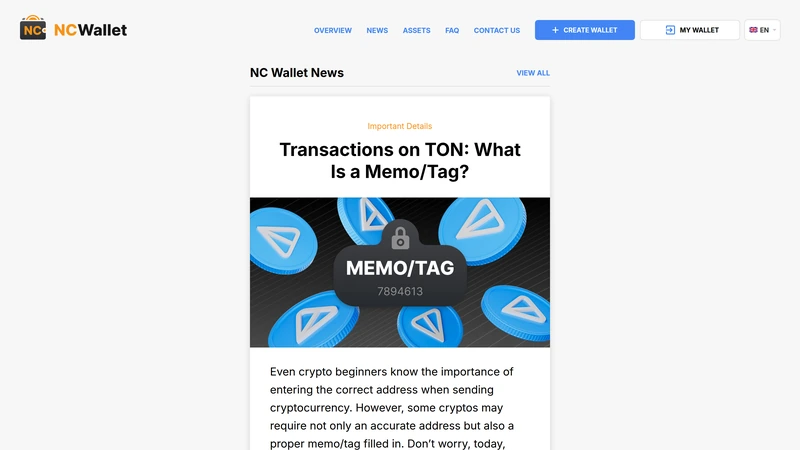
A memo tag on TON is an extra field attached to a transfer, usually a string of letters, numbers, or symbols that the receiving platform uses to sort incoming funds correctly. NC Wallet's TON memo explainer puts the core logic clearly: when you withdraw Toncoin or USDT on TON to an exchange or service that uses one wallet address for many users, the memo or tag helps ensure the funds are credited to the right account.
Trade TON with Not.Trade, the fastest terminal on TON
Not.Trade is purpose built for TON traders: real-time on-chain charts for every jetton, insider safety scoring (Top 10 wallets, snipers, dev movement, bundlers, LP lock), MCAP-trigger limit orders, multi-wallet sniping, MEV protection and one-click swaps routed across STON.fi and DeDust. It runs natively inside Telegram and as a fast web terminal, with TON Connect non-custodial wallet support.
Read the full Not.Trade guide →That means the memo is not replacing the wallet address. It is supplementing it. The address tells the blockchain where the funds are going. The memo tells the receiving service which internal user should get credit after the transfer arrives.
This is why memo mistakes are so annoying. On-chain, the transaction may have succeeded perfectly. Off-chain, the service may still not know the deposit belongs to you. From the user's point of view, it feels like the crypto disappeared. In reality, it usually means the service cannot map the deposit automatically.
When TON users usually need a memo tag
The most common situation is an exchange deposit. Some exchanges assign a separate address to each user. Others reuse one address for many users and rely on a memo, tag, or comment to split the flow internally. TON users also see this with certain service deposits, wallets, or Telegram-adjacent flows that have a shared-address model behind the scenes.
The important point is that the recipient decides this, not the sender. If the destination platform says a memo is required, then it is required for that destination. If your personal self-custody wallet does not mention a memo for incoming transfers, then forcing one into the transfer does not help anything.
| Destination type | Memo likely? | Why |
|---|---|---|
| Personal self-custody wallet | Usually no | The wallet is typically controlled by one owner and does not need internal routing. |
| Exchange deposit address | Often yes | The service may use one address for many users and needs a memo to credit deposits correctly. |
| Service payment or shared wallet system | Sometimes | The platform may need an internal identifier even when the blockchain destination is shared. |
If the instructions are unclear, stop and verify them before sending. Memo uncertainty is not the kind of problem you solve by hoping the service can figure it out later.
How to send TON or USDT on TON with the right memo
The workflow is simple when done slowly. Copy the destination address from the official recipient source, copy the memo or tag from the same place, paste both carefully, and compare them again before approving the transfer. That is all. The problem is that users often split those steps across tabs, chats, and rushed moments, which is how the wrong memo or no memo at all sneaks in.
- Get the address and memo from the recipient's official deposit screen.
- Check whether the asset and network are correct. Toncoin is not USDT on TON, and USDT on TON is not every other version of USDT.
- Paste the memo exactly as shown. Do not improvise or shorten it.
- Send a small test amount first if the route is new.
- Only then send the larger amount.
TON's low fees make step four especially smart. A test transfer can verify not only the address but also the memo logic and the crediting behavior of the recipient service.
The most common TON memo mistakes
The first mistake is assuming the address is all that matters. On a self-custody transfer, that may be true. On a shared exchange deposit system, it may be dangerously incomplete.
The second mistake is using an old memo from a previous deposit. Some platforms keep the same routing logic for long periods, but users should not assume this blindly. Always copy the latest deposit details from the live recipient screen.
The third mistake is mixing network and memo confusion together. A transfer can fail economically in two separate ways: the wrong network can be chosen, or the right network can be chosen with the wrong or missing memo. TON users sending USDT on TON should be especially careful here because the ticker USDT exists across several networks.
The fourth mistake is trying to correct the error emotionally after the fact. Blockchain transfers reward calm procedure before sending, not panic after sending.
What to do if you forgot the memo
If you already sent the transfer without a required memo, do not send more funds immediately and do not keep guessing. First, confirm on-chain that the transaction reached the address. Then contact the receiving platform's support using its official channel and be ready to provide the transaction hash, asset, amount, timestamp, and the account you intended to fund.
Recovery often depends on the platform's process, workload, and willingness to manually credit unmatched deposits. Some services can help. Some take time. Some may not support recovery for small amounts. This is exactly why the memo field should be treated as part of the destination, not as a cosmetic extra.
It is also wise to keep screenshots or records of the intended deposit screen before you send, especially when working with a large transfer. If a mismatch happens, clear records make the recovery conversation easier.
Tonkeeper, Telegram Wallet, and exchange deposits
For self-custody wallets such as Tonkeeper, the memo problem usually appears when funds are leaving the wallet and going into an exchange or service, not when the wallet receives a direct personal transfer. That is why users who are comfortable sending TON between friends can still get tripped up the first time they deposit to a platform with shared routing.
The same practical rule applies whether you are using Tonkeeper, Telegram Wallet-style flows, or another TON-capable wallet. The wallet is not the authority on whether a memo is needed. The recipient is. If the deposit page says the memo is required, believe the deposit page over your memory of a previous transfer on another platform.
TON users who move stablecoins should also pair this page with the broader TON onboarding tutorial and Tonkeeper guide, because many memo errors happen during the exact moment a user shifts from simple wallet familiarity into exchange funding or service routing.
Where DEXTools fits into the memo conversation
DEXTools is not where you manage the memo field, but it still has a role in the broader workflow. If the transfer is being made so you can trade a TON-native asset, fund a wallet for token activity, or move stable value before a market decision, then DEXTools remains the place where you verify the token or market setup before acting on it.
That matters because some users rush the deposit step due to market urgency. They think the trade idea is the important part and the transfer is just plumbing. In practice, the transfer plumbing is where the avoidable operational mistake happens first. A strong market thesis is worthless if the funds get stuck in a support queue because the memo was ignored.
In other words, treat memo discipline as part of trade discipline. Clean transfers make better trading decisions possible.
The proof you should save before a TON deposit goes wrong
Users often start collecting evidence only after a memo mistake happens, which is backward. The calmer and smarter workflow is to save a small proof pack before or during the transfer. That way, if a service does not credit the deposit automatically, you are not reconstructing the event from memory while stressed.
A useful proof pack is simple. Save the deposit screen that shows the address and the memo. Save the wallet confirmation view before sending. Save the transaction hash after sending. And if the transfer is large, save a screenshot of the recipient account you intended to fund. None of this prevents the mistake directly, but it turns recovery from a vague complaint into a documented request.
This matters because support teams usually do not respond well to “my funds vanished.” They respond better to a clean package: transaction hash, asset, amount, intended destination, required memo, and account identifier. The more structured the request, the less likely the case gets stuck in a back-and-forth loop.
On a low-fee chain like TON, the best operational style is deliberate and documented. Fast transfers are good. Fast undocumented transfers are not.
A practical checklist for USDT on TON and exchange funding
USDT on TON is where memo discipline becomes especially important because users may already be mentally juggling three variables at once: the token ticker, the network selection, and the recipient's routing instructions. That combination is exactly where sloppy mistakes happen.
Before sending USDT on TON to any exchange or service, pause on five checks. First, confirm that the destination supports USDT on TON specifically, not just “USDT” in general. Second, copy the address and memo from the same live screen. Third, check whether the memo changed since your last deposit. Fourth, send a small test amount if the route is new or if the platform has changed its deposit UX. Fifth, wait for successful credit before moving the larger amount.
| Pre-send check | Why it matters |
|---|---|
| Token and network match | USDT mistakes often start with assuming the ticker alone is enough. |
| Address and memo copied together | Splitting the process across tabs increases mismatch risk. |
| Latest deposit screen used | Old screenshots and old memos are a common source of avoidable errors. |
| Test transfer completed | Low fees make verification cheap relative to recovery stress. |
That checklist may feel slow, but it is much faster than waiting on manual deposit recovery because one memo field was treated like an optional extra.
The recovery reality most users should assume
One reason memo discipline deserves so much emphasis is that recovery is never guaranteed to be fast. Even when a platform is cooperative, unmatched deposits often need manual review, queue time, and internal verification. Users should assume that forgetting a memo turns a simple transfer into an administrative problem, not a quick self-service fix.
That assumption improves behavior. If the likely consequence of a memo mistake is delay, proof collection, and support dependence, then slowing down before the transfer becomes the rational choice instead of the paranoid one.
Final takeaway: a TON memo tag is not a small detail. When the recipient requires it, the memo is part of the destination itself. The safest habit is to copy the address and the memo from the same official source, test first when the route is new, and never let urgency talk you into skipping the field.
Disclaimer: This draft is for educational purposes only and does not constitute financial or customer-support advice. Recovery policies for missing memos depend on the receiving service.
Related Guides
- What Is a Memo in Crypto? Complete Beginner Guide (2026)
- What Is XRP Ledger? XRPL Explained for 2026
- Meme Coins On Coinbase: what You Need to Know
- How Many ETH (Ethereum) Do You Need to Be a Validator?
- Cryptocurrency for Beginners: Everything You Need to Know (2026)
Frequently Asked Questions
What is a TON memo tag?
It is an extra identifier used by some exchanges and services to match an incoming TON transfer to the correct user account.
Do personal wallets usually need a memo?
Usually no. Memo requirements are most common when the destination uses one address for many users.
Can the address be correct and the transfer still fail for crediting?
Yes. The transfer can succeed on-chain while remaining unmatched by the recipient service internally.
Should I add a memo even when none is requested?
No. The safer approach is to follow the recipient instructions exactly instead of improvising.
What should I do if I forgot the memo?
Confirm the transfer on-chain, then contact the receiving platform through its official support process with the transaction details.