Qu'est-ce que Velodrome Finance: guide DEX ve(3,3) Optimism (2026)
— By Whatsertrade in Tutorials
Velodrome est le DEX ve(3,3) pionnier sur Optimism. Guide 2026 sur VELO, veVELO, bribes et Slipstream.
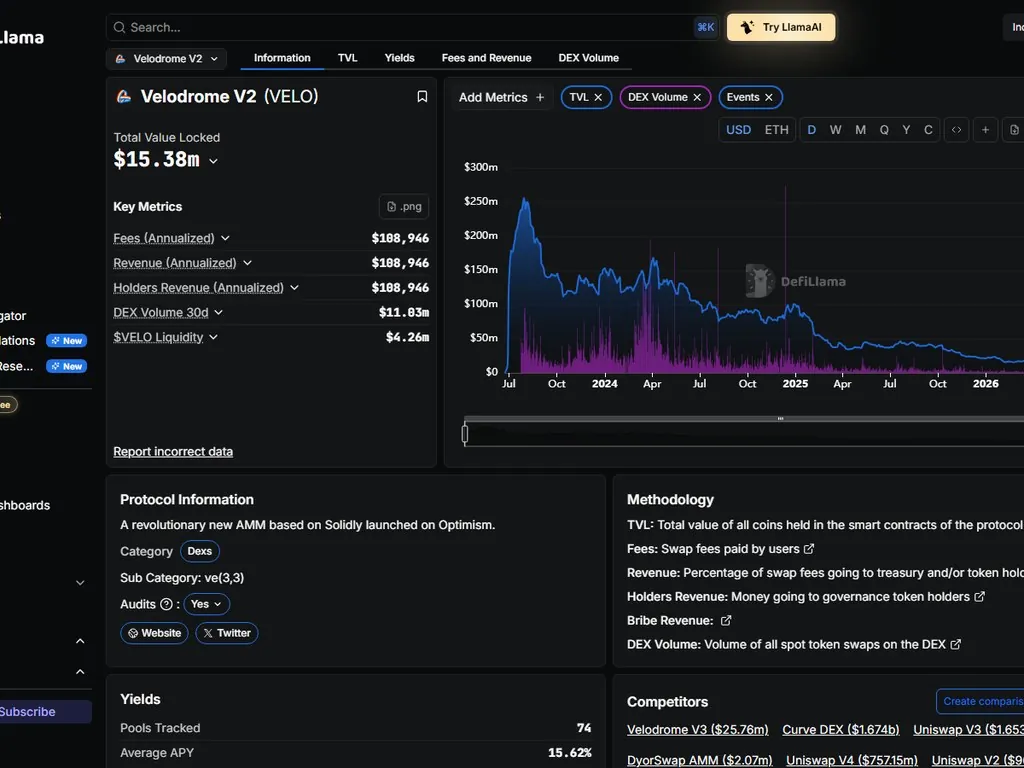
If you have spent any time on Optimism, you have almost certainly bumped into Velodrome Finance. It is the largest decentralized finance exchange on the Optimism mainnet and the protocol that turned the experimental ve(3,3) tokenomics model into a battle-tested production system. By May 2026, Velodrome routinely settles between $50 million and $150 million in daily volume and holds more than $300 million in total value locked.
Velodrome launched in June 2022 as a refined fork of Andre Cronje's Solidly experiment. The team, led by pseudonymous founders Tao and Alex, rebuilt the broken-but-brilliant tokenomics into something that works at scale. Four years later, the protocol has expanded into concentrated liquidity through Slipstream, launched an automated relay for vote compounding, and rolled out SuperchainSwap on the OP Stack interop layer.
This guide covers how ve(3,3) functions, why bribes form a weekly multi-million-dollar economy, how Slipstream compares to Uniswap V4, what makes Velodrome and Aerodrome a coordinated two-chain machine, and exactly how to swap, add liquidity, lock veVELO, vote, and claim rewards.
What Is Velodrome Finance?
Velodrome Finance is a decentralized exchange on Optimism that uses a ve(3,3) tokenomics model. Liquidity providers earn VELO emissions, veVELO holders direct those emissions through weekly gauge votes, and protocols pay bribes to attract votes. It combines volatile pools, stable pools, and Slipstream concentrated liquidity in one venue.
That is the snippet-sized definition, but it hides several important details. Velodrome is not just a venue for swapping tokens. It is also a liquidity coordination layer. Other protocols use Velodrome to attract and retain the liquidity they need for their own tokens to trade efficiently. Instead of paying expensive market makers or running their own emissions programs, projects bribe veVELO voters to direct VELO emissions toward their pools. This bribe-for-emissions loop is what makes ve(3,3) different from every other AMM design, and it is the reason Velodrome has become the de facto liquidity layer for the Optimism Superchain.
The History: From Solidly to Velodrome
To understand Velodrome you have to start with Andre Cronje. In early 2022, Cronje released Solidly on Fantom, an AMM that introduced the ve(3,3) model. The name combined "vote-escrowed" tokenomics from Curve with the (3,3) game theory popularized by Olympus DAO. Lock the governance token to earn voting power, use that voting power to direct emissions to pools, and the pools that generate the most fees attract the most votes, which attract the most emissions, which attract the most liquidity. A self-reinforcing flywheel.
Solidly launched in February 2022 and immediately ran into problems. Token distribution was unfair, emissions were misconfigured, and Cronje stepped back from DeFi shortly after launch. The protocol survived but never reached its potential on Fantom. Several teams forked Solidly to fix the design flaws. The most successful fork was Velodrome.
The Velodrome team launched in June 2022 on Optimism, with founders Tao and Alex coordinating a small contributor group. The launch was timed perfectly. Optimism had just airdropped its OP token and the chain was hungry for serious liquidity. Within months, Velodrome had become the largest DEX on Optimism, a position it has held ever since.
Velodrome V2 followed in mid-2023 with a redesigned voter contract, better gauge math, and improved fee handling. Slipstream, the concentrated liquidity module, launched in Q1 2024. Velodrome Relay launched later in 2024. SuperchainSwap, using OP Stack Interop for cross-chain swaps between Optimism, Base, Mode, Lisk, and other Superchain rollups, matured into production by early 2026.
How ve(3,3) Actually Works
The ve(3,3) model is the single most important concept for understanding Velodrome. Strip away the branding and you are left with three interacting pieces: VELO emissions, veVELO voting, and bribes.
Every week, Velodrome mints a fixed amount of VELO tokens distributed to liquidity providers as emissions, but not equally. Each pool has a gauge, and veVELO holders vote each week to decide how new emissions are split across gauges. Pools with more votes receive more emissions.
To get veVELO, you lock VELO for a period between one week and four years. The longer the lock, the more veVELO you receive per VELO. A four-year lock gives one veVELO per VELO. A two-year lock gives roughly 0.5 veVELO per VELO. The lock is represented as an NFT, transferable and sellable on secondary markets. As time passes, your veVELO balance decays linearly toward zero unless you extend the lock.
The voting epoch runs Thursday to Thursday, 00:00 UTC. veVELO holders cast votes for the pools they want to support, with voting power splittable across multiple pools so long as percentages sum to 100. At epoch end, the protocol allocates next-week emissions accordingly.
Here is what makes ve(3,3) different from regular Curve-style ve tokens. In Velodrome, voters do not earn trading fees from pools they vote for. Those fees go to the LPs. Voters earn two things: bribes from protocols wanting their pool to receive emissions, plus a share of trading fees flowing through a separate fees contract attached to each gauge. This split between LP fees and voter fees distinguished Velodrome from Solidly's original implementation.
The Bribes Economy
If ve(3,3) is the engine, bribes are the fuel. Each week, projects and DAOs deposit tokens into bribe contracts attached to Velodrome gauges. veVELO holders who vote for that gauge earn a share of the bribes proportional to their share of total votes.
A typical bribe: a small project wants liquidity for their TOKEN/USDC pool. They deposit $10,000 worth of TOKEN as a bribe on that gauge. If the bribe-to-emissions ratio is favorable, votes flow to the gauge and the pool receives a large VELO emission for the week. The project gets liquidity, voters earn the bribe, LPs earn emissions plus fees. Everyone wins.
In practice, the bribes market is sophisticated. Aggregators like Hidden Hand and Votemarket let projects buy and sell bribes across multiple ve(3,3) protocols, including Velodrome and Aerodrome. Sophisticated voters use these to maximize yield, often automating through Velodrome Relay.
By May 2026, weekly bribes on Velodrome typically total between $400,000 and $1.2 million. With around 250 million veVELO outstanding, that translates into an annualized bribe APR somewhere between 15% and 40% on locked VELO, before fee rebates and VELO appreciation. The income is recurring and usually paid in stablecoins or blue-chip tokens, which is why voters accept long lockups.
vAMM, sAMM, and Slipstream: The Three Pool Types
Velodrome supports three pool types, each optimized for a specific use case.
Volatile AMM (vAMM) pools use the classic constant product formula from Uniswap V2. x times y equals k, suitable for any pair of tokens whose prices move independently. Pairs like OP/USDC and VELO/USDC live here. Trading fees typically sit between 0.05% and 0.3%.
Stable AMM (sAMM) pools use a different invariant for assets that should trade near a fixed ratio. The formula is x cubed times y plus y cubed times x equals k, producing a flatter curve around the equilibrium. Stableswaps like USDC/USDT, frxETH/WETH, and DAI/USDC execute with very low slippage. Fees usually sit at 0.01% to 0.05%.
Slipstream is Velodrome's concentrated liquidity implementation, launched in early 2024. LPs specify a price range within which their liquidity is active, similar to Uniswap V3 and V4. Capital efficiency is dramatically higher, but liquidity outside the chosen range earns nothing, so providers must actively manage positions or use automated managers.
Classic x*y=k formula. Best for uncorrelated pairs like OP/USDC or ETH/VELO. Higher slippage but works with any token pair.
Stableswap invariant for assets near 1:1 ratio. USDC/USDT, frxETH/WETH. Very low slippage and fees, ideal for stablecoin arbitrage.
Concentrated liquidity with custom price ranges. Up to 4000x capital efficiency. Requires active management or automation.
The smart router on Velodrome automatically finds the best execution across all three pool types. When you submit a swap, the router considers vAMM pools, sAMM pools, and Slipstream pools, and may split your order across multiple pools to minimize slippage. As a trader you do not need to know which pool type you are using. As a liquidity provider, however, the choice matters significantly. vAMM and sAMM pools are passive. You deposit and forget. Slipstream pools demand attention or third-party management.
Velodrome Relay: Automated Voting and Compounding
Voting every Thursday is a chore. You have to navigate the app, decide which gauges to support, account for gas fees on Optimism, and claim your bribes and rebases. For small veVELO holders the time cost can easily exceed the financial benefit. Velodrome Relay solves this problem by automating the entire voting and compounding loop.
Relay works like a managed vault. You deposit your veVELO NFT into a relay strategy, and the strategy operator handles voting, bribe claiming, and compounding on your behalf. Different relays follow different strategies. Some maximize bribe yield by chasing the highest weekly bribes. Some focus on stablecoin bribes only, treating Velodrome as a pseudo-fixed-income product. Some compound everything back into VELO and relock to grow the veVELO position over time.
Relay charges a performance fee, typically 5% to 10% of yields, which is usually well worth it for veVELO holders below a certain size threshold. The exact threshold depends on Optimism gas prices and the number of gauges you would otherwise vote across. For most veVELO positions under 100,000 veVELO, Relay is the rational choice. Above that, doing your own voting might capture a few extra basis points of yield, but only if you have the time to research bribes weekly.
SuperchainSwap: Cross-Chain Swaps via OP Stack Interop
The Optimism ecosystem has expanded dramatically since 2022. Base, Mode, Lisk, Worldchain, Zora, Ink, Unichain, and dozens of other rollups now share the OP Stack codebase, collectively branded as the Optimism Superchain. The OP Stack Interop layer enables fast, trustless message passing between Superchain rollups, and Velodrome was one of the first DEXs to integrate it.
SuperchainSwap is Velodrome's product on top of Interop. From a user perspective, it lets you swap a token on one Superchain rollup for a different token on another Superchain rollup in a single transaction. You might hold ETH on Base and want USDC on Optimism. Instead of bridging ETH to Optimism through a slow bridge or a third-party aggregator, you submit a SuperchainSwap that bundles the cross-chain message and the swap atomically. The whole thing completes in roughly the same time as a single chain swap because Interop confirmations are near-instant within the Superchain.
By May 2026, SuperchainSwap supports all major Superchain rollups and routes through both Velodrome on Optimism and Aerodrome on Base. The router picks the venue with the deepest liquidity for each leg. For traders this means you can effectively treat the entire Superchain as a single liquidity layer for any token that lists on either Velodrome or Aerodrome.
Top Pools on Velodrome in 2026
The Velodrome pool landscape shifts week to week as bribes redirect emissions, but several pools have remained dominant for most of the protocol's history. Knowing the top pools helps you understand where liquidity concentrates on Optimism and where the deepest swap routes live.
OP/USDC is the flagship pair on Velodrome. As the native gas token of Optimism, OP is involved in a huge percentage of all transactions on the chain, and the OP/USDC pool typically holds $30 million to $50 million in TVL across vAMM and Slipstream versions. Daily volume regularly exceeds $20 million on this pair alone.
ETH/USDC is the second pillar. ETH bridged to Optimism, usually as WETH, pairs with native USDC for the largest non-OP venue. This pool benefits from constant routing demand because any swap involving ETH or USDC on Optimism tends to touch this pool at some point. TVL of $20 million to $40 million is typical.
VELO/OP is the protocol's own liquidity anchor. Trading the governance token against OP rather than ETH or USDC creates a tighter coupling between Velodrome and Optimism's broader ecosystem. The pool is heavily incentivized because it is essential for the protocol's own price discovery and lock decisions.
USDC/USDT is the dominant stableswap, typically holding $15 million to $25 million in a sAMM pool with extremely low slippage. Stablecoin arbitrageurs and aggregator routers heavily use this pool.
wstETH/ETH, rETH/ETH, and other liquid staking pairs are critical because they connect Optimism to the broader liquid staking ecosystem. These sAMM pools allow Lido and Rocket Pool stakers to move between staked and unstaked ETH on Optimism without paying mainnet gas.
Smaller but strategically important pools include OP/ETH, USDC.e/USDC for the native to bridged USDC migration, and various LST/LRT pairs tied to Ethereum restaking protocols. Bribes shift the rest of the emissions weekly, so any project willing to spend can get a meaningful gauge for a few weeks.
Velodrome vs Aerodrome: The Two-Chain Machine
Aerodrome Finance launched on Base in August 2023 as a sister protocol to Velodrome. Built by the same core team, Aerodrome runs essentially the same codebase as Velodrome V2 plus Slipstream, with the AERO token replacing VELO. The two protocols share design philosophy, contributor talent, and even some governance overlap, but they operate as separate economic units on separate chains.
The numbers tell the story of how the two have diverged. Aerodrome, riding the Base boom of 2024 and 2025, has grown much faster than Velodrome. By May 2026, Aerodrome typically holds two to three times the TVL of Velodrome and processes higher daily volume. That said, Velodrome is far from irrelevant. Optimism remains a major L2 with a healthy economy, and Velodrome benefits from being the only ve(3,3) DEX on that chain, with no significant competitors splitting the liquidity.
TVL roughly $300M. Daily volume $50-150M. Launched June 2022. VELO token. Pioneered ve(3,3) at scale.
TVL roughly $900M. Daily volume $200-500M. Launched August 2023. AERO token. Largest DEX on Base.
Same ve(3,3) model, same team origin, same Slipstream module. Connected by SuperchainSwap for cross-chain routing.
For a liquidity provider deciding between the two, the choice usually comes down to which chain you want exposure to and where your tokens already live. For a veVELO or veAERO voter, the bribe markets are similar in mechanics but can differ in yield depending on weekly conditions. Some sophisticated participants split positions across both protocols, hedging exposure to any single chain.
Velodrome vs Curve vs Uniswap V4
Velodrome occupies a specific niche in the DEX landscape. To understand its competitive position, it helps to compare it against the two most influential AMM designs.
Curve is the original vote-escrowed governance model. Curve's veCRV system lets holders direct CRV emissions to pools, and Curve has built deep liquidity for stablecoins and pegged assets. The differences from Velodrome are subtle but important. On Curve, voters earn a share of the trading fees from the pools they vote for, alongside their CRV. Curve is also fundamentally a stableswap protocol, with most of its liquidity concentrated in pegged-asset pools. Velodrome handles volatile pairs natively as a first-class case, not as an afterthought.
Uniswap V4, the latest version of the largest DEX in crypto, takes a completely different approach. Uniswap has no governance token incentives flowing to LPs. Instead, V4 introduces customizable hooks that let developers attach arbitrary logic to pools, including custom fee schedules, on-chain limit orders, or dynamic curve adjustments. Uniswap V4 launched on Optimism in 2024 and now competes directly with Velodrome for some volume. The result has been complementary rather than purely adversarial. Sophisticated traders route through whichever venue offers better pricing, and aggregators like 1inch stitch quotes together across both.
The key distinction is that Velodrome bundles a liquidity-acquisition mechanism with the AMM itself. When a new project launches on Optimism, they can bribe veVELO voters to get emissions, and those emissions attract LPs at a known yield. Uniswap V4 has no equivalent mechanism. New projects on Uniswap have to source their own liquidity or pay external market makers. This is why Velodrome remains the preferred launch venue for tokens specifically optimized for the Optimism ecosystem.
Step-by-Step: How to Use Velodrome
Now we get to the practical part. The following four walkthroughs cover the main flows on Velodrome, from a basic swap up to a full veVELO voter setup. You will need an Optimism-compatible wallet such as MetaMask, Rabby, or any wallet supporting OP-style chains, and some ETH on Optimism for gas. If you need to bridge funds, use the official Optimism bridge or a third-party bridge with a good transaction simulation feature.
How to Swap on Velodrome
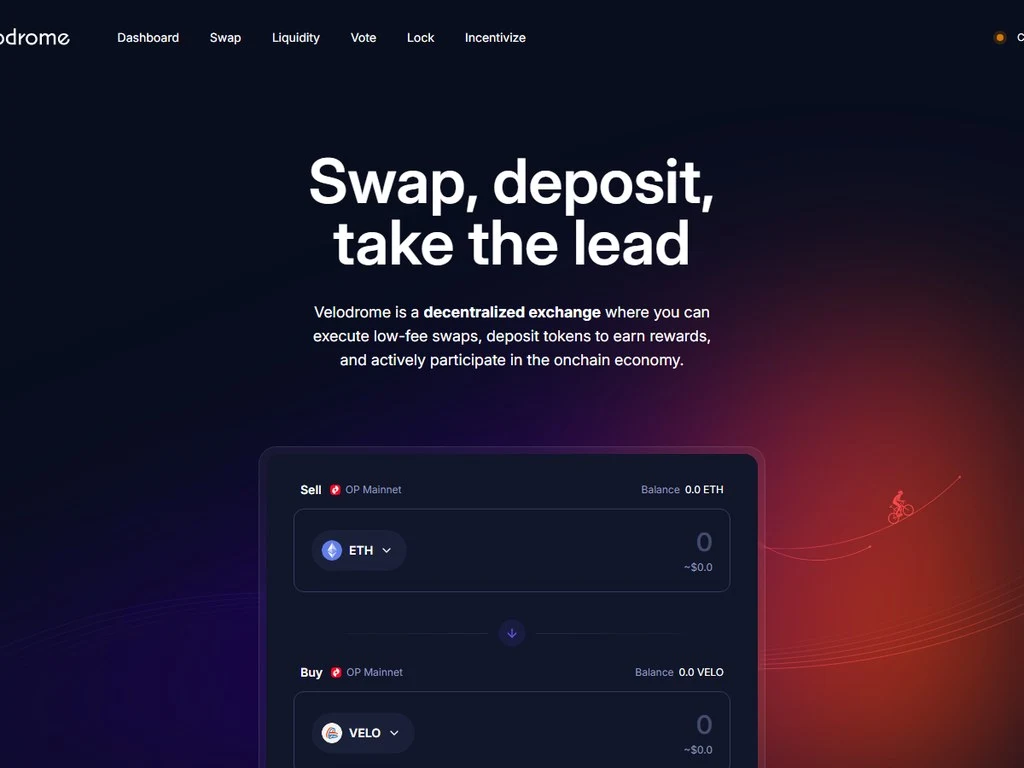
Swapping is the simplest flow. Visit velodrome.finance, connect your wallet, and confirm you are on Optimism. Select the token you want to sell and the token you want to buy. The interface will display the expected output, the price impact, and the routing breakdown, showing which pools your trade will pass through. Approve the token spend if this is the first time you have swapped that asset on Velodrome, then submit the swap.
For best results, set a reasonable slippage tolerance, usually 0.1% to 0.5% for liquid pairs and higher for thin markets. Avoid leaving slippage at default for large trades on illiquid pairs because MEV bots will pick off any extra tolerance. Always check the price impact before confirming. If it exceeds 1% for a major pair, you are probably trading too large for the available liquidity and should break the order into smaller chunks.
How to Add Liquidity
Adding liquidity differs by pool type. For a vAMM or sAMM pool, navigate to the Liquidity tab, choose the pair you want to provide for, and deposit both tokens in equal value. The protocol calculates the exact ratio based on the current pool reserves. You receive an LP token representing your share of the pool. Stake that LP token into the corresponding gauge to start earning VELO emissions. If you skip the staking step you earn trading fees but no emissions, which is almost always worse.
For Slipstream pools, the process is similar but requires choosing a price range. The interface will show you the current price and let you set a lower and upper bound. Choose wider ranges for less management and lower yields, or narrower ranges for higher capital efficiency at the cost of needing active rebalancing. Once you confirm, the pool issues you a position NFT that represents your concentrated liquidity stake. You also stake this NFT to a Slipstream gauge to earn emissions.
How to Lock veVELO
Locking VELO is straightforward. Acquire VELO either by swapping or by earning it as LP emissions. Go to the Lock tab on the Velodrome interface, enter the amount of VELO you want to lock and the lock duration between one week and four years. The interface will show you exactly how much veVELO you will receive. Confirm the transaction and you receive a veVELO NFT in your wallet.
The NFT is the voting power. You can hold multiple veVELO NFTs at once if you want, each representing a separate lock. You can also extend an existing lock by depositing more VELO into the same NFT, or by increasing the lock duration if it is below the four-year maximum. Some users prefer multiple smaller NFTs for flexibility. Others prefer one large NFT for simplicity. Either approach works.
How to Vote and Claim Rewards
Voting happens once per epoch, Thursday at 00:00 UTC. Navigate to the Vote tab, select your veVELO NFT, and choose the gauges you want to support. Allocate percentages across gauges so they sum to 100. Most voters check the bribes for the upcoming epoch on tools like Hidden Hand and vote for the gauges offering the best bribe per veVELO ratio. Once you submit the vote, your decision is locked in until the next epoch.
After the epoch ends, you can claim your bribes and your share of the gauge fees. The interface shows the claimable amount in each token, and you can claim everything in one batch transaction. Many users also relock their accumulated VELO to compound their voting power. For an automated experience, deposit your veVELO into Velodrome Relay and the relay will vote, claim, and compound for you on a weekly schedule.
Bribes APR Analysis in 2026
The headline question for any prospective veVELO voter is "what APR can I actually expect?" The answer requires breaking the income into its components.
First, the bribes themselves. As of May 2026, average weekly bribes on Velodrome run between $400,000 and $1.2 million, depending on market conditions. With around 250 million veVELO outstanding, average bribe APR for a voter who votes optimally lands in the 15% to 35% range annualized. This is a wide band because voters who target the highest bribes per vote can do meaningfully better than voters who spread votes evenly.
Second, the gauge fee rebates. Voters earn a share of trading fees from the gauges they vote for, paid alongside bribes. Fee rebate APR is much smaller, typically 1% to 5%, but it is paid in trading-pair assets, which means it often arrives in stablecoins or major tokens rather than VELO.
Third, the rebase. Velodrome distributes a portion of new emissions to existing veVELO holders to compensate for dilution. This rebase typically adds another 5% to 10% to the effective APR, paid in VELO. Combined, a sophisticated veVELO voter can target a blended APR of 25% to 50% annualized, comfortably exceeding what most other DeFi yields offer for comparable lockup risk.
The catch is liquidity. To capture these yields, your VELO must be locked, often for years. If VELO price drops significantly during your lock, the dollar APR can look much worse in retrospect. This is why veVELO is best treated as a long-term position by participants who genuinely want to participate in Velodrome's governance and economic flywheel rather than as a high-yield trade for short-term capital.
Voter ROI Calculation: A Worked Example
Suppose you lock 10,000 VELO for four years, receiving 10,000 veVELO. Over the lock period your veVELO will decay linearly to zero, so your average voting power across the four years is roughly 5,000 veVELO.
If average bribe APR is 25% across the four-year period, you earn approximately 25% of your average position value each year in bribes, or 1,250 veVELO equivalent per year for four years, summing to 5,000 veVELO worth of bribes. Add 7% rebase APR for another 1,400 VELO over the period and 3% fee rebate APR for another 600 VELO equivalent. Total income over the lock: roughly 7,000 VELO equivalent on a starting position of 10,000 VELO, or 70% cumulative ROI over four years before VELO price changes.
At a flat VELO price, this is roughly 14% to 18% effective annual yield once you account for the time-weighted average position size. With favorable VELO price movement, the dollar ROI could double. With unfavorable movement, you may end up worse off than just holding VELO unlocked. This is the central risk of veVELO: you trade liquidity for income, and the trade only pays off if VELO holds value over the lock period.

Risks of Velodrome
Velodrome is not risk-free. Before locking VELO or providing significant liquidity, understand the major risk categories.
VELO emissions inflation. Velodrome continues to mint new VELO every week. The emissions decay over time according to a programmed schedule, but the total supply still grows. If demand for veVELO does not keep pace with new supply, the VELO price can decline, eroding the value of your locked position. The protocol's long-term success depends on the bribes economy generating enough demand to absorb new emissions.
Impermanent loss. Like every AMM, Velodrome exposes liquidity providers to impermanent loss when paired token prices diverge. The VELO emissions you earn as an LP must exceed your impermanent loss for the position to be profitable. In volatile markets this is not guaranteed, especially in concentrated Slipstream positions where IL can be magnified relative to wider-range positions.
Optimism chain risk. Velodrome lives entirely on Optimism. Any chain-level issue, whether a sequencer failure, a security exploit at the OP Stack level, or a regulatory action against Optimism's operators, would directly affect your funds. Optimism is one of the most battle-tested L2s, but it is not zero risk. The chain has paused or reorganized in the past, and could do so again.
Smart contract risk. Velodrome's contracts have been audited multiple times by reputable firms and have been live since 2022. Still, every smart contract carries some risk of bugs or exploits. Slipstream in particular is a complex piece of code that interacts with concentrated liquidity math that has been a source of subtle bugs in similar systems. Never lock more VELO than you can afford to lose entirely.
Bribe market collapse. The veVELO yield depends on protocols paying bribes. If bribe activity dries up, either because of a bear market, a rotation to other ve(3,3) DEXs, or simply because projects find better ways to source liquidity, the income stream that justifies long locks would shrink. Voters need to monitor weekly bribe trends and be willing to exit veVELO if the economics shift.
Token approval and wallet risks. Like any DeFi protocol, interacting with Velodrome involves signing transactions and granting token approvals. Always verify the contract addresses, use a hardware wallet for large positions, and consider using Permit2 safety practices when applicable. Bookmark the official Velodrome interface and double-check the URL each time to avoid phishing sites.
Velodrome in the Broader Optimism Ecosystem
Velodrome does not exist in isolation. It is one anchor of a wider Optimism economy that includes Aave Optimism, Synthetix, Lyra, Pyth oracles, Beethoven X, and dozens of other protocols. Many of these protocols use Velodrome as their primary liquidity layer, paying bribes to ensure their tokens have deep markets.
The Optimism Foundation itself has been a major participant in Velodrome's bribe economy. Through grants and direct allocations from the OP treasury, the Foundation has bribed gauges to direct emissions to strategically important pools. This makes Velodrome a tool for Optimism's monetary policy, not just an independent DEX.
Velodrome also touches the tokenized real-world asset sector. Several RWA protocols have launched pools on Velodrome to bootstrap secondary market liquidity for tokenized treasuries and credit products. The pattern is the same as for other tokens. The RWA project bribes voters, voters direct emissions, LPs supply liquidity at attractive yields, and traders get deep markets for assets that would otherwise sit illiquid.
Pros and Cons of Velodrome
- Largest DEX on Optimism with deep liquidity
- Mature ve(3,3) economics with proven bribe market
- Three pool types: vAMM, sAMM, Slipstream concentrated
- Cross-chain swaps via OP Stack Interop SuperchainSwap
- Velodrome Relay automates voting for small positions
- High effective APR for engaged veVELO voters
- Locking VELO sacrifices liquidity for years
- VELO emissions inflate token supply over time
- Slipstream LP requires active management
- Bribe APR depends on continuous protocol demand
- Smaller TVL and volume than sister Aerodrome
- Optimism chain risk concentrates exposure
Best Practices for Velodrome Users
If you are using Velodrome seriously, a few habits will save you money and headaches over time.
Trade with intent on routing. The Velodrome router is good, but it does not always find the optimal split across pools. For trades above $50,000, compare quotes against 1inch or another aggregator before submitting. The difference can be meaningful.
Time large swaps around volume peaks. Optimism gas fluctuates with chain activity. Large swaps go through cheaper when Optimism is less busy, usually during off-peak US hours. Monitor gas conditions via standard chain explorers.
Layer your veVELO locks. Instead of locking everything for four years on day one, consider splitting your VELO across multiple locks with staggered expirations. This gives you the option to take profits or rotate strategy as conditions change.
Watch bribe trends weekly. Bribe markets shift fast. A gauge that paid 40% APR last week might pay 15% this week. Use Hidden Hand or Votemarket to compare before voting.
Test small first. Especially for Slipstream positions, start with small amounts to learn how the math behaves in practice. Watch your position for a week or two before scaling up.
Use a hardware wallet. For any meaningful veVELO position, sign through a Ledger or similar hardware device. This protects against the most common wallet compromise vectors. Combine with strong wallet security practices like distinct browser profiles for DeFi.
Account for taxes. Bribes and rebases are typically taxable as income on receipt in most jurisdictions. Track every claim with a portfolio tool from day one. Trying to reconstruct a year of weekly bribe claims at tax time is painful.
Frequently Asked Questions
Is Velodrome safe to use?
Velodrome has operated on Optimism since June 2022 and has been audited multiple times by reputable security firms. The core contracts have not suffered any successful exploits. That said, every DeFi protocol carries smart contract risk, and locking VELO exposes you to additional risks like price decline and emission inflation. Treat Velodrome as a battle-tested but not zero-risk protocol, and never deposit more than you can afford to lose.
What is the difference between VELO and veVELO?
VELO is the liquid ERC-20 governance token of Velodrome Finance. veVELO is the vote-escrowed version you receive when you lock VELO for between one week and four years. veVELO grants voting power, bribes, and rebase rewards, but it cannot be transferred as a fungible token. Instead it is held as an NFT. The longer you lock, the more veVELO you receive per VELO, with a four-year lock giving the maximum one-to-one ratio.
How do I earn yield on Velodrome?
There are three main yield paths on Velodrome. First, provide liquidity to a pool and stake the LP token in the gauge to earn VELO emissions plus trading fees. Second, lock VELO into veVELO and vote weekly to earn bribes, fee rebates, and rebases. Third, deposit your veVELO into Velodrome Relay to automate voting and compounding. The right path depends on your time, capital, and risk tolerance.
What is a bribe on Velodrome?
A bribe is a token reward that a project deposits into a bribe contract attached to a Velodrome gauge. Voters who direct their veVELO to that gauge earn a share of the bribe proportional to their share of the total votes. Projects use bribes to incentivize veVELO holders to vote for the projects' pools, which in turn directs VELO emissions to those pools and attracts liquidity. Bribes form a multi-million-dollar weekly economy on Velodrome.
Should I provide liquidity in vAMM, sAMM, or Slipstream pools?
It depends on the pair. For volatile pairs like OP/USDC, vAMM is the default passive choice and Slipstream offers higher yield in exchange for active management. For correlated pairs like USDC/USDT or wstETH/ETH, sAMM minimizes slippage and is the right venue. Slipstream gives the best capital efficiency for any pair if you are willing to manage price ranges, but new LPs should usually start with vAMM or sAMM until they understand the mechanics.
How does SuperchainSwap work?
SuperchainSwap uses the OP Stack Interop layer to bundle a cross-chain message and a token swap into a single user transaction. You can swap a token on Base for a token on Optimism, or any other combination across Superchain rollups, without manually bridging first. The router selects whichever venue, Velodrome or Aerodrome or other Superchain DEXs, offers the best liquidity for each leg. The whole process completes in roughly the time of a regular swap thanks to near-instant Interop confirmations.
Is Velodrome better than Aerodrome?
Neither is strictly better. Velodrome dominates on Optimism while Aerodrome dominates on Base, and they share the same core team and codebase. Aerodrome has larger TVL and daily volume because Base has grown faster than Optimism since 2024. For users, the right choice depends on which chain holds your assets and where the specific pool you want lives. Many sophisticated participants split positions across both protocols to diversify chain exposure.
What APR can I expect from veVELO?
Effective APR for veVELO voters in 2026 typically ranges from 15% to 50% annualized, combining bribes, fee rebates, and rebases. The exact figure depends on how strategically you vote and on market conditions. Average voters who spread votes evenly across major gauges land toward the lower end. Sophisticated voters who target the highest bribes per veVELO ratio land at the higher end. Remember that APR is denominated in mixed tokens and that VELO price changes can significantly affect realized dollar returns.
Can I unlock my veVELO early?
No. Velodrome locks are not unlockable on demand. Once you commit VELO for a duration, you have to wait for the lock to expire to access the underlying tokens. However, because veVELO is held as an NFT, you can sell it on secondary marketplaces if you want liquidity. Pricing depends on the remaining lock duration and current market sentiment. Plan your lock duration carefully because there is no easy escape hatch.
What is Slipstream and how is it different from Uniswap V3?
Slipstream is Velodrome's concentrated liquidity implementation, launched in early 2024. Mechanically, it is similar to Uniswap V3 and V4, with LPs choosing a price range for their liquidity and earning fees only when price trades within that range. The key difference is that Slipstream pools are integrated into Velodrome's gauge and emissions system. LPs in Slipstream earn VELO emissions alongside trading fees if they stake their position NFT in the corresponding gauge. Uniswap V3 and V4 do not have any equivalent emissions program.
Conclusion
Velodrome Finance is the clearest example of how a flawed first attempt at a tokenomics design can be refined into a production system that anchors an entire chain's economy. From the failed Solidly launch on Fantom in early 2022 to Velodrome's $300 million in TVL and durable bribes economy on Optimism in 2026, the protocol has proven that ve(3,3) is more than a meme. It is a working mechanism for coordinating liquidity, distributing governance, and aligning incentives across protocols, voters, and traders.
For traders, Velodrome offers deep liquidity, three pool types, and cross-chain reach through SuperchainSwap. For liquidity providers, the combination of trading fees and VELO emissions can produce attractive yields, especially in well-incentivized pools. For governance participants, veVELO voting and bribes form a sophisticated income stream for long-term Optimism believers willing to commit capital for years.
The risks are real. VELO inflation, impermanent loss, Optimism chain dependence, and the constant need for bribes to sustain the flywheel are all genuine concerns. But for users who understand the model and size positions accordingly, Velodrome remains one of the most interesting and economically meaningful DeFi protocols outside of Ethereum mainnet. As the Optimism Superchain continues to expand through 2026 and beyond, Velodrome's role as the liquidity coordinator of that ecosystem will only grow.
If you want to go deeper into related topics, our guide on DEX aggregators shows how Velodrome plugs into the broader liquidity routing landscape, the Uniswap V4 guide explains how the largest DEX competes on Optimism, and the broader DeFi primer sets the foundation. For more on Optimism's gas economics, check our gas fees explainer, and for restaking and liquid staking pairs that flow through Velodrome, see the Rocket Pool guide. Whether you are voting, providing, or just trading, Velodrome rewards users who take the time to understand its mechanics, and the payoff for that understanding is some of the most interesting yield in DeFi today.