What Is zkSync Era? Account Abstraction L2
What is zkSync Era? Learn how its native account abstraction, the Boojum proof system, and the Elastic Network shift shape this Ethereum Layer 2.
ZKsync Era in 2026: The Elastic Network and Native Account Abstraction
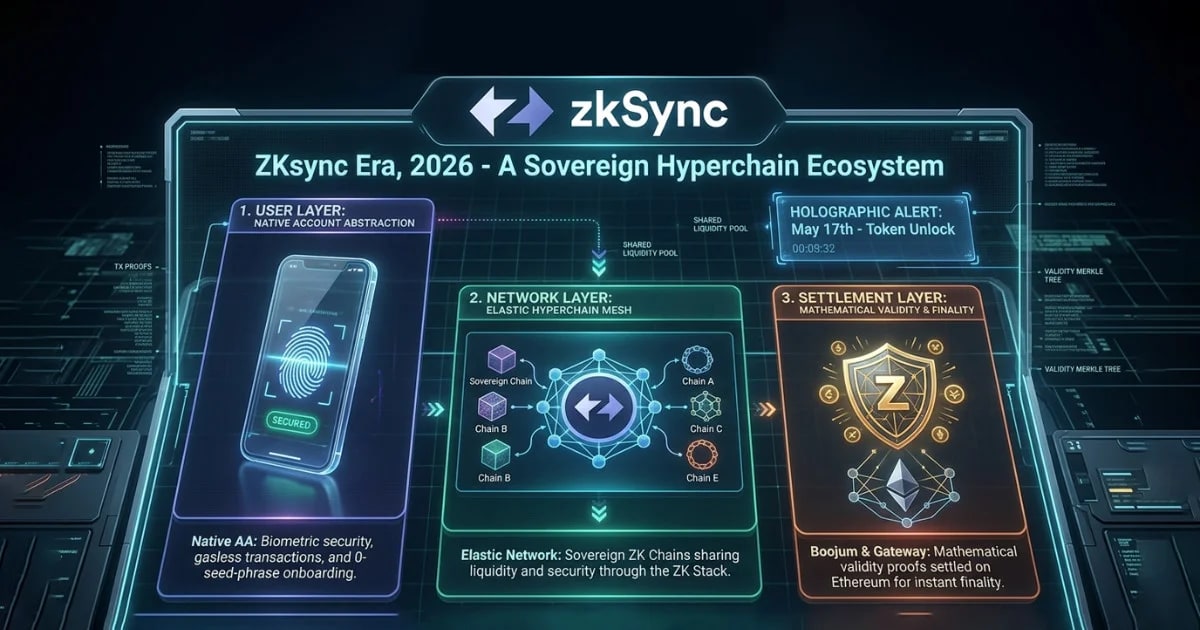
- As of May 12, 2026, ZKsync Era has evolved from a standalone Layer 2 solution into the centerpiece of the Elastic Network. Following the "ZKsync 3.0" transition, the ecosystem now functions as an interconnected web of ZK Chains (formerly known as Hyperchains) that share liquidity and security via the ZK Stack.
- With the recent launch of the Cari Network (the first tokenized deposit network for U.S. regional banks) ZKsync has pivoted heavily toward institutional infrastructure while maintaining its lead in user experience through native account abstraction.
- Currently, the ZK token is navigating a significant period of price discovery, with a major supply unlock scheduled for May 17, 2026, which will release shares to early investors and the team.
1. The Core Technology: Boojum and ZK Stack
ZKsync Era’s performance is anchored by Boojum, a STARK-based proof system that allows the network to run on consumer-grade hardware while remaining compatible with the Ethereum Virtual Machine (EVM).
The Boojum Upgrade: Unlike legacy ZK-proof systems that required massive server farms, Boojum’s efficiency has lowered the "prover" barrier. This has enabled the rollout of ZKsync Gateway, a proof aggregation layer that bundles proofs from multiple ZK Chains into a single settlement on Ethereum, dramatically reducing L1 gas costs.
The Elastic Network: In 2026, ZKsync is no longer just "one chain." Developers use the ZK Stack to launch sovereign ZK Chains that interoperate natively. This means a user can move assets from the ZKsync Era mainnet to a gaming-specific ZK Chain in ~1 second without using a traditional third-party bridge.
2. Native Account Abstraction: The UX "Killer App"
The defining feature of ZKsync in 2026 is Native Account Abstraction (AA). While Ethereum L1 and other L2s use "wrapped" solutions like EIP-4337, ZKsync built AA directly into the protocol's core.
Smart Accounts as Default: Every address on ZKsync Era is a smart contract. This allows for Passkey (Biometric) security, replacing 12-word seed phrases with FaceID or Fingerprint authentication.
Paymasters: Applications can now sponsor their users' gas fees or allow them to pay for gas in any token (e.g., paying for a transaction with USDC or even a game's native token).
Social Recovery: Users can designate "guardians" (trusted friends or other devices) to recover access to their funds if they lose their primary device, making crypto-custody feel as safe as modern banking.
3. The 2026 Ecosystem: Institutional & DeFi Convergence
The ZKsync landscape in May 2026 is a blend of high-speed DeFi and regulated finance:
Institutional Rails (Prividium): ZKsync's "Prividium" chains allow banks like those in the Mid-Size Bank Coalition of America to issue tokenized deposits with user-level privacy, settling billions of dollars with minutes-to-Ethereum finality.
DeFi Leaders: SyncSwap remains the primary liquidity hub, while Holdstation has emerged as the leading "Smart Wallet" exchange, utilizing native AA to provide a CEX-like trading experience.
Gaming Hubs: Chains like Pudgy World and Mementos leverage the ZK Stack to handle millions of NFT transactions with zero gas fees for the end user.
Technical Trade-offs and Market Realities
Strengths and Opportunities
Capital Efficiency: Validity proofs provide mathematical certainty, allowing users to withdraw to Ethereum L1 in minutes rather than the 7 days required by optimistic rollups.
Institutional Moat: The "Elastic Network" architecture is currently the preferred choice for banks requiring private execution with public verifiability.
Superior UX: Native AA makes ZKsync the easiest ecosystem for non-crypto users to navigate.
Limitations and Challenges
Token Dilution: The May 17, 2026, unlock is part of a multi-year vesting schedule that keeps the circulating supply (currently ~9.7B out of 21B) under constant pressure.
Computational Overhead: While Boojum is efficient, ZK-proof generation still requires more computational work than optimistic models, which can occasionally lead to higher sequencer fees during extreme congestion.
Market Fragmentation: As more "ZK Chains" launch, liquidity can become fragmented across the Elastic Network if protocols don't implement unified liquidity pools effectively.
Verification and Security via DEXTools
In an era of "Hyper-scaling" where a new ZK Chain can be launched in minutes, the risk of interacting with unverified tokens or "ghost" liquidity is high. DEXTools is the essential standard for real-time verification and market forensics.
To monitor the DeFi market in an agile and secure way in real-time and trade assets with the help of the best crypto tools, you can access DEXTools here and start trading today.
Disclaimer: This article is for informational purposes only and does not constitute investment advice, financial advice, trading advice, or any other kind of advice. DEXTools does not recommend buying, selling, or holding any cryptocurrency or token. Users should conduct their own research and consult with a qualified financial advisor before making any investment decisions. Cryptocurrency investments are volatile and high-risk. DEXTools is not responsible for any losses incurred.
Related Guides
- What Is Biconomy: Account Abstraction, Gasless UX and Cross-Chain Execution (2026)
- What Is Biconomy: Account Abstraction, Gasless UX and Smart Account Infrastructure (2026)
- What Is Account Abstraction: ERC-4337 Explained Simply (2026)
- What is a Smart Account? Account Abstraction Wallets Guide
- zkEVM Types Compared: Polygon vs zkSync vs Scroll 2026
Frequently Asked Questions
What is ZKsync Era in 2026?
In 2026, ZKsync Era has evolved into the Elastic Network, featuring interconnected ZK Chains that enhance liquidity and security through the ZK Stack.
How does Native Account Abstraction work in ZKsync?
Native Account Abstraction in ZKsync allows every address to function as a smart contract, enabling features like biometric security and flexible gas fee payments.
What are the benefits of using the Boojum proof system in ZKsync?
The Boojum proof system enhances ZKsync's performance by allowing it to operate efficiently on consumer-grade hardware while remaining compatible with the Ethereum Virtual Machine.
What is the significance of the ZK token unlock on May 17, 2026?
The ZK token unlock on May 17, 2026, is a crucial event that will release shares to early investors and the development team, impacting the token's supply dynamics.