Ethereum's Split Screen: ETH Sits Near $1,900 While the Network Settles Nearly Half of Every Stablecoin
— By Tony Rabbit in Markets

Ethereum is living two lives at once. Ether the asset trades near $1,890, stuck well below its highs. Ethereum the network settles about $147.5 billion in stablecoins, nearly half of the entire $307 billion market and more than Tron, Solana and every layer 2 combined. It is also where the institutional dollar, USDC, concentrates, and the chain Open USD picked first. We pull the on-chain data and explain why the most-used settlement layer in crypto can dominate while its token lags, and what would finally close the gap.
Pull up two numbers side by side and Ethereum looks like it is living in two realities at once. The first: Ether, the asset, is changing hands at about $1,890, stuck in the range it has traded for much of the year and a long way below its old highs. The second: the Ethereum network now settles roughly $147.5 billion in stablecoins, nearly half of the entire $307 billion stablecoin market. The chain everyone builds their dollars on cannot get its own token to move. That gap between usage and price is the most interesting thing about Ethereum right now.
We pulled the stablecoin distribution straight from the data rather than argue from vibes. Across every chain, about $307 billion in stablecoins is circulating. Ethereum holds 48.9% of it, more than Tron, Solana, BSC and every layer 2 combined. When a bank consortium wanted a home for its new institutional dollar, Open USD, it chose Ethereum first. And yet ETH the asset trades as if none of that is happening.
Where the world's stablecoins actually live
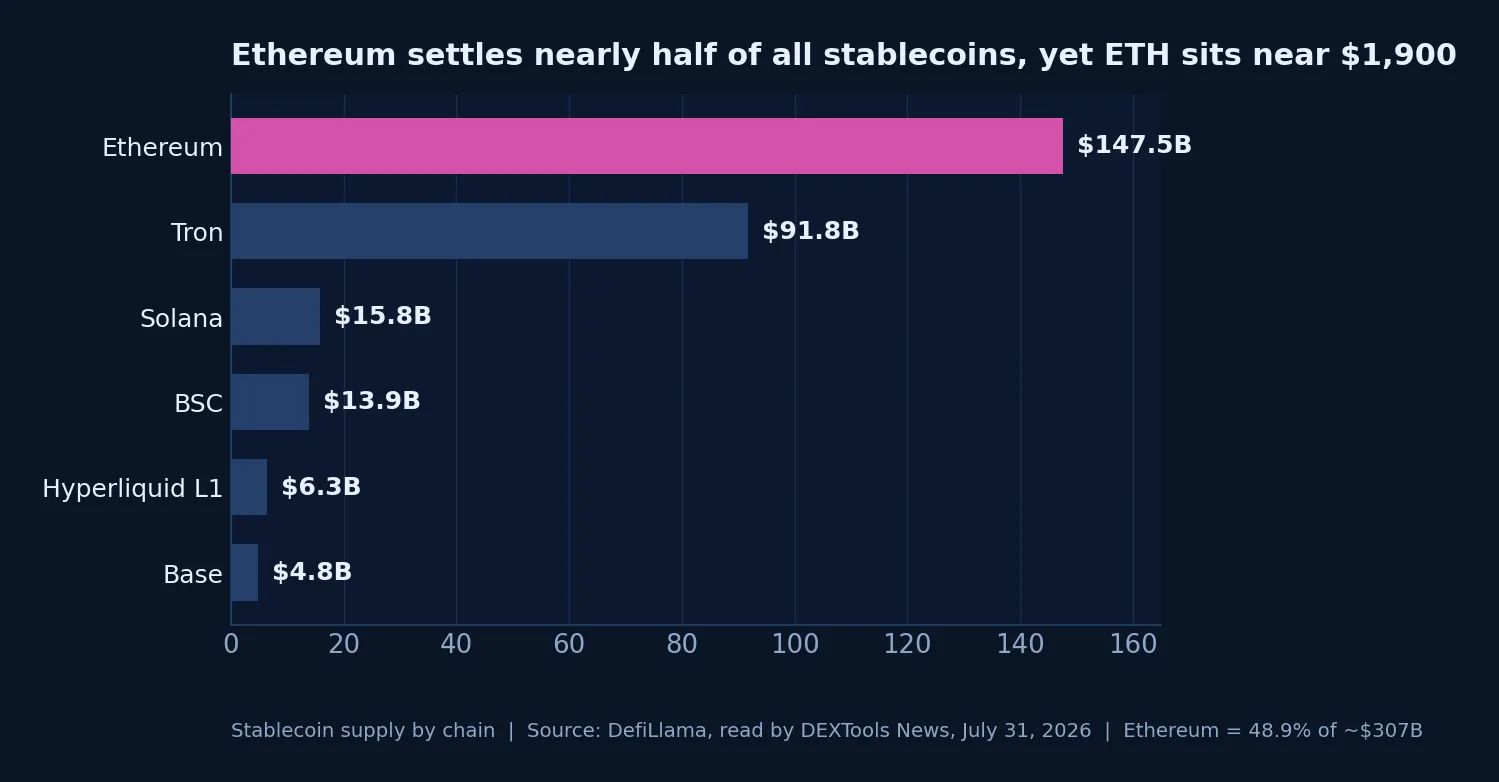
Ethereum's stablecoin base is also the most institutional. Circle's USDC, the dollar that regulated firms reach for, holds about $71.9 billion and lives mostly on Ethereum. Tron's larger $91.8 billion is almost entirely Tether, the dollar of offshore and emerging-market flows. So Ethereum is not just the biggest settlement layer; it is where the compliant, institution-facing money concentrates. That is a genuine, defensible moat.
Why the network can win while the token lags
The uncomfortable truth for ETH holders is that a stablecoin sitting on Ethereum does not automatically bid up ETH. Someone holding USDC on Ethereum needs a small amount of ETH for gas, not a large position in it, and since the network moved most data into cheap blob space, fees are low, so each transaction burns very little ETH. Activity that once tightened supply now barely registers. On top of that, a record share of ETH is locked in staking, which supports the long-term thesis but does nothing for spot demand today, and the token still trades heavily on macro sentiment and its old reputation as a high-beta bet rather than on its role as financial plumbing.
In other words, Ethereum has quietly become boring infrastructure, and infrastructure is priced differently from a growth story. The market is treating ETH like a toll road whose traffic is booming but whose toll is nearly zero. Whether that is a mispricing or a fair read depends on your view of one question: does settling the world's dollars eventually have to accrue value to the asset that secures the settlement, or not.
What would close the gap
Three things would turn network dominance into price. The first is fees: a sustained rise in real economic activity, not just idle balances, would burn more ETH and make the "ultrasound money" case concrete again. The second is the institutional bid moving up the stack, from holding stablecoins on Ethereum to holding and staking ETH itself, something a staked-ETH ETF structure is designed to enable. The third is simply time and narrative: assets that look like plumbing tend to be ignored until a catalyst forces a repricing. None of that is guaranteed. But the split screen is real, and it is unusual for the most-used settlement network in crypto to have one of the more disappointing charts. That tension is worth watching more closely than any single price target.
Data note. Stablecoin supply by chain (Ethereum ~$147.5B, 48.9% of a ~$307B market; Tron ~$91.8B; Solana ~$15.8B) and stablecoin issuer sizes (USDC ~$71.9B, USDT ~$183.5B) were read by DEXTools News from DefiLlama on July 31, 2026. ETH's price near $1,890 was cross-checked against Coinbase and Kraken spot on the same day. This is market analysis, not financial advice or a price prediction.
Frequently asked questions
How much of the stablecoin market settles on Ethereum?
About $147.5 billion, or 48.9% of the roughly $307 billion total stablecoin supply, settles on Ethereum, per DefiLlama data read on July 31, 2026. That is more than Tron ($91.8B), Solana ($15.8B), BSC and every layer 2 combined. Ethereum is also where the institutional dollar, Circle's USDC, concentrates, and the chain Open USD chose to launch on first.
Why is ETH's price low if Ethereum is so widely used?
A stablecoin sitting on Ethereum does not mechanically bid up ETH. Holders need only a little ETH for gas, and since most data moved to cheap blob space, fees, and therefore the amount of ETH burned per transaction, are low. A record share of ETH is also locked in staking, which supports the long-term case but not spot demand, and ETH still trades heavily on macro sentiment. The network can dominate settlement while the token trades like ignored infrastructure.
What would make ETH's price reflect the network's usage?
Three catalysts: a sustained rise in real fee-generating activity that burns more ETH, the institutional bid moving from holding stablecoins on Ethereum to holding and staking ETH itself (which staked-ETH ETF structures enable), and a narrative catalyst that forces a repricing of an asset the market currently treats as low-yield plumbing. None is guaranteed.
Is Ethereum still the leading stablecoin chain over Tron?
Yes by total supply. Ethereum settles about $147.5B in stablecoins versus Tron's ~$91.8B. The difference in composition matters too: Tron's balance is almost entirely Tether (USDT), the dollar of offshore and emerging-market flows, while Ethereum hosts most of Circle's USDC, the dollar regulated institutions prefer.