How Many ETH (Ethereum) Do You Need to Be a Validator?

Learn how much ETH is required for staking, how to become a validator in 2026, and understand the risks involved, including slashing, liquidity constraints, and smart contract vulnerabilities.
This page answers the capital question. If you want the broader decision framework, read Validator Node vs ETH Staking. If you still need the underlying concept, read What Is a Node in Crypto?.
The 2026 Staking Guide
- As of April 10, 2026, the Ethereum ecosystem has reached a level of stability and institutional trust that was only a dream during the "Merge" era. Following the successful implementation of the Pectra upgrade in late 2025 and the subsequent Fusaka refinements, the rules governing validators have evolved significantly.
- For anyone looking to secure the network and earn a native yield, understanding the current capital requirements and technical paths is essential. This article breaks down exactly how much ETH you need to participate and the best platforms to use in today's market.
What is Ethereum Staking?
- Ethereum staking is the process by which participants secure the network by locking up their ETH to support the Proof of Stake (PoS) consensus mechanism. Instead of using energy-intensive mining hardware, Ethereum uses "validators" who are responsible for processing transactions, storing data, and adding new blocks to the blockchain.
- When you stake your ETH, you are essentially acting as a digital guardian of the network. In exchange for your service and the risk of locking up your capital, you receive rewards in the form of newly minted ETH and a portion of the transaction fees (including MEV or Maximal Extractable Value). However, staking is not without responsibility. If a validator fails to stay online or acts maliciously, they can be penalized through a process called "slashing," where a portion of their staked ETH is taken away.
The Core Requirement: How Many ETH (Ethereum) Do You Need?
In April 2026, the answer to "how many ETH" depends entirely on how you choose to stake. There are two primary thresholds to keep in mind: the minimum to start a solo validator and the maximum effective balance.
The 32 ETH Solo Minimum
To run your own independent validator node (known as solo staking), the magic number remains 32 ETH. This is the amount required to activate a validator on the Ethereum Mainnet. When you deposit exactly 32 ETH into the official deposit contract, you are assigned a validator index and enter the queue to begin securing the network.
The MaxEB Revolution: Up to 2,048 ETH
- The biggest change in the 2026 landscape is the result of the Pectra upgrade, specifically EIP-7251. Previously, a validator's effective balance was capped at 32 ETH. If you had 64 ETH, you were forced to run two separate validators. Today, the Maximum Effective Balance (MaxEB) has been raised to 2,048 ETH.
- This means that while you still only need 32 ETH to start a validator, you can now consolidate up to 2,048 ETH into a single validator node. This has been a massive benefit for institutional stakers and "whales," as it reduces the number of messages sent across the network and allows for automatic compounding of rewards directly within the same validator.
Example:
Imagine an investor, Thomas, who owns 100 ETH. Before the Pectra upgrade, he would have needed to manage three separate validators (using 96 ETH) and keep 4 ETH sitting idle. In 2026, Thomas can run one single validator with an effective balance of 100 ETH. All the rewards he earns are added to that balance and immediately start earning more rewards, up to the 2,048 ETH cap.
Staking for the Rest of Us: Lowering the Barrier
Not everyone has 32 ETH to spare. In April 2026, the vast majority of retail participants use alternative methods that allow them to stake with as little as 0.01 ETH.
Liquid Staking Tokens (LSTs)
- Liquid staking is the most popular method for smaller holders. Protocols like Lido or Rocket Pool allow you to deposit any amount of ETH into a pool. In return, you receive a liquid token (like stETH or rETH) that represents your stake.
- These tokens increase in value or quantity as the underlying ETH earns rewards. The best part is that you can still use these tokens in DeFi apps to trade or provide liquidity while you stake.
Centralized Exchanges (CEXs)
For those who prefer a "set it and forget it" approach, centralized exchanges like Coinbase or Kraken offer custodial staking. You simply click a button in your account dashboard to stake your ETH. The exchange handles all the technical work and takes a commission (usually 15% to 25%) of the rewards.
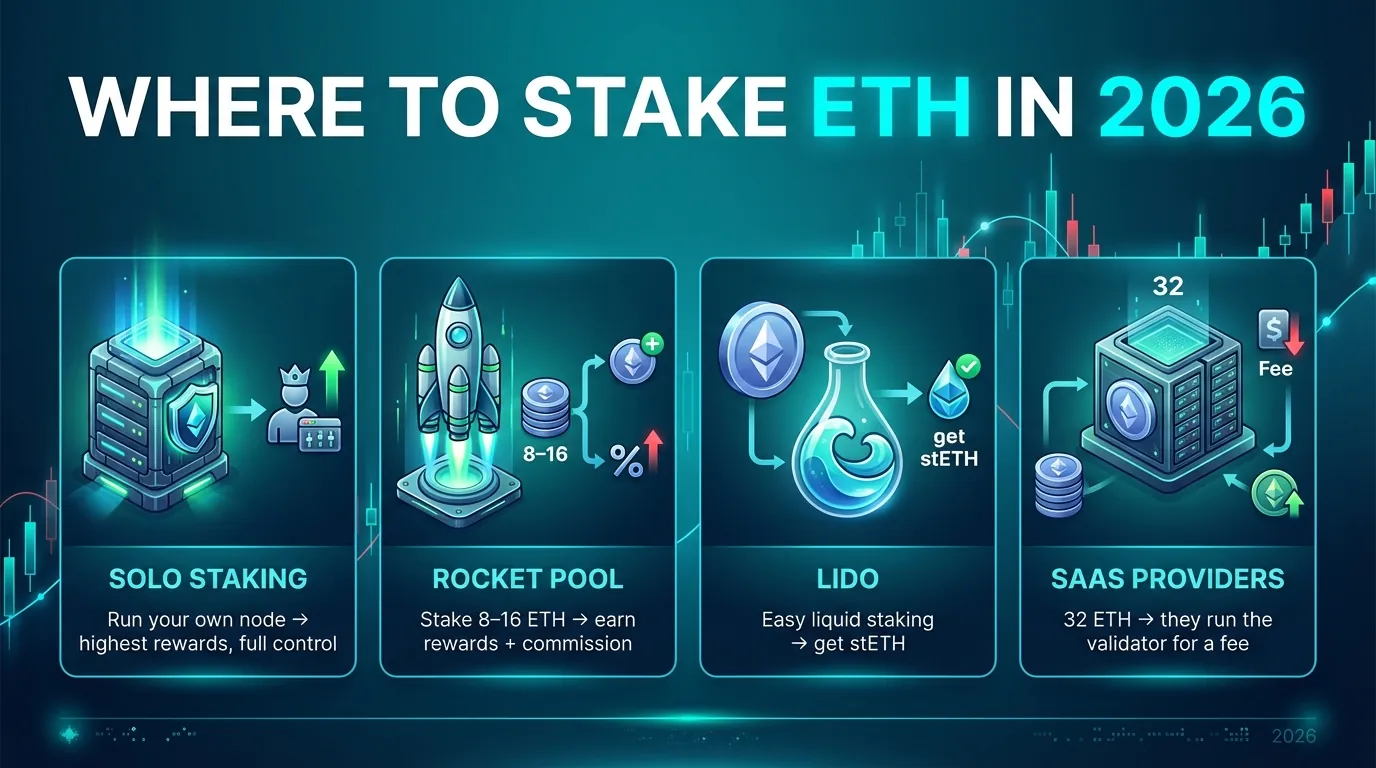
Where to Stake ETH (EThereum) in 2026
The "where" is just as important as the "how much." Your choice of platform will determine your yield, your security, and your level of control.
At Home (Solo Staking): This is the gold standard for decentralization. You buy a dedicated server (like a NUC or a specialized DappNode), install the consensus and execution clients, and run it 24/7. This offers the highest rewards because there are no fees to a third party.
Rocket Pool (Decentralized Pool): If you have 8 or 16 ETH, you can run a "minipool" on Rocket Pool. This allows you to be a node operator with less than 32 ETH while earning extra commission from the pool.
Lido (Liquid Staking): Lido remains a dominant force in 2026. It is the easiest way to get stETH, which is the most liquid and widely accepted LST in the ecosystem.
Staking-as-a-Service (SaaS): If you have 32 ETH but do not want to run hardware, companies like Figment or Blockdaemon will run the validator for you on their professional infrastructure for a monthly fee.
The Mathematics of Rewards in 2026
The yield you receive from staking is not a fixed interest rate. It fluctuates based on how much total ETH (Ethereum) is staked across the entire network. The more people that stake, the lower the individual reward becomes.
As of April 10, 2026, with over 40 million ETH staked, the base consensus reward is approximately 2.8%. However, when you add in transaction tips and MEV rewards, the "Total Yield" is higher. The current formula for annual yield looks roughly like this:
Where $C$ is a constant determined by the protocol. In today's market, most stakers are seeing a total net return of around:
Risks to Consider
While staking is generally considered the safest way to earn yield on Ethereum, it is not risk-free. In 2026, stakers must remain vigilant about three specific risks:
Slashing: If your validator acts in a way that threatens the network (like double-signing a block), you can lose a portion of your 32 ETH.
Smart Contract Risk: If you use a liquid staking protocol, you are trusting that their code is bug-free. Even in 2026, smart contract vulnerabilities remain a reality.
Liquidity Risk: While LSTs are meant to be liquid, during extreme market crashes, the price of stETH or rETH can "de-peg" from the price of native ETH, making it expensive to exit your position quickly.
Summary of Key Points
Solo Staking still requires a minimum of 32 ETH to activate a validator.
MaxEB (EIP-7251) now allows a single validator to hold up to 2,048 ETH, enabling automatic compounding.
Liquid Staking is the best option for users with less than 32 ETH, allowing participation with as little as 0.01 ETH.
Where to Stake: Options range from solo hardware at home to decentralized protocols like Rocket Pool or centralized exchanges like Coinbase.
Rewards: Current net yields are hovering around 3.3% to 3.6% APY, including tips and MEV.
Decentralization: Solo staking is the most beneficial for the network's health and provides the highest rewards.
Navigating the complexities of the Ethereum staking landscape is a vital skill for any investor in 2026. Whether you are aiming to run your own validator or simply looking for a reliable yield on a small amount of ETH (Ethereum), having access to real-time data is your greatest advantage. We invite you to explore the Ethereum dashboard on DEXTools to monitor market movements, verify contract security, and find the best trading opportunities in the post-Pectra era.
Disclaimer: This article is for informational purposes only and does not constitute investment advice, financial advice, trading advice, or any other kind of advice. DEXTools does not recommend buying, selling, or holding any cryptocurrency or token. Users should conduct their own research and consult with a qualified financial advisor before making any investment decisions. Cryptocurrency investments are volatile and high-risk. DEXTools is not responsible for any losses incurred.
Related Guides
- How Many ETH Are There? Ethereum Supply Guide 2026
- Validator Node vs ETH Staking: Which Path in 2026?
- What Is Ethereum Staking? How It Works, Rewards and Risks (2026)
- What Is Ethereum (ETH)? Beginner Guide 2026
- What is ETH? A Comprehensive Ethereum chain 2026 Guide
Frequently Asked Questions
How much ETH do I need to become a validator?
To become a solo validator on the Ethereum Mainnet, you need a minimum of 32 ETH.
What is the Maximum Effective Balance for Ethereum validators?
As of April 2026, the Maximum Effective Balance (MaxEB) for Ethereum validators has been raised to 2,048 ETH.
Can I stake less than 32 ETH?
Yes, many retail participants can stake with as little as 0.01 ETH using liquid staking protocols like Lido or Rocket Pool.
What happens if a validator acts maliciously?
If a validator fails to stay online or acts maliciously, they can be penalized through a process called 'slashing,' resulting in a loss of a portion of their staked ETH.
What are Liquid Staking Tokens?
Liquid Staking Tokens (LSTs) are tokens like stETH or rETH that represent your stake in a liquid staking pool, allowing you to earn rewards while still using these tokens in DeFi applications.