How to Use STON.fi on TON Safely: 2026 Guide
— By Tony Rabbit in Tutorials

How to use STON.fi on TON safely: wallet connection, first swaps, slippage checks, liquidity provision risk, and how DEXTools helps before you execute.
To use STON.fi safely, connect a trusted TON wallet, then verify the asset's identity before searching or swapping. Always review the route, slippage, and minimum received amount before every trade, and understand if you are only swapping or also entering liquidity and farming. This prevents bad entries, fake-token exposure, or weak exits.
STON.fi sits close to the center of the user-facing TON DeFi experience because it solves the question many TON users eventually ask: how do I actually swap assets once the wallet is funded? The interface is simple enough to feel friendly, but simple swap screens are where many users stop thinking. That is exactly where mistakes begin. A fast DEX on a low-fee chain can still produce bad entries, fake-token exposure, or weak exits if the user treats the app like a vending machine instead of a market tool.
Quick answer: to use STON.fi safely, connect a trusted TON wallet, verify the asset identity before you search or swap, review the route, slippage, and minimum received amount before every trade, and understand whether you are only swapping or also stepping into liquidity and farming. STON.fi is an execution venue, not a substitute for token verification or market judgment.
- STON.fi is a TON DEX. Official docs describe it as a permissionless exchange for token swaps and liquidity provision on TON.
- Non-custodial does not mean risk-free. You keep control of funds, but you still decide what to approve and what to trade.
- The search box is not the trust layer. Real token identity still matters more than names or icons.
- Liquidity tools are different from swap tools. LP positions and farming add a new risk stack beyond a simple token buy.
- DEXTools belongs in the workflow. STON.fi helps you execute, while DEXTools helps you judge whether execution is wise.
What STON.fi is and who it is for
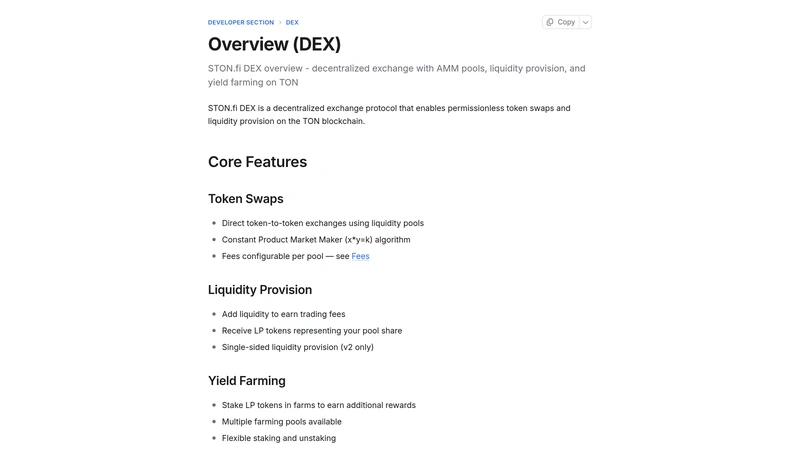
STON.fi documentation describes the protocol as a decentralized exchange on TON that enables permissionless token swaps and liquidity provision. In plain English, it is one of the main places TON users can exchange assets without handing custody to a centralized platform. That makes it naturally important for anyone using Tonkeeper, TON Connect, or Telegram-adjacent TON apps who eventually needs to move from one asset to another.
Trade TON with Not.Trade, the fastest terminal on TON
Not.Trade is purpose built for TON traders: real-time on-chain charts for every jetton, insider safety scoring (Top 10 wallets, snipers, dev movement, bundlers, LP lock), MCAP-trigger limit orders, multi-wallet sniping, MEV protection and one-click swaps routed across STON.fi and DeDust. It runs natively inside Telegram and as a fast web terminal, with TON Connect non-custodial wallet support.
Read the full Not.Trade guide →The docs also summarize the core product set clearly: swaps, liquidity provision, and yield farming. That matters because many users arrive wanting only the first feature and accidentally drift into the other two without fully noticing the risk change. Swapping a token is one thing. Providing liquidity or staking LP tokens is another. The interface may feel continuous, but the operational and market risks are not identical.
This guide is intentionally narrower than the generic Jettons-on-TON safety guide. That page is about the general token-buying workflow. This one is about using the STON.fi venue itself in a disciplined way, from wallet connection through route review and beyond.
How swaps on STON.fi work
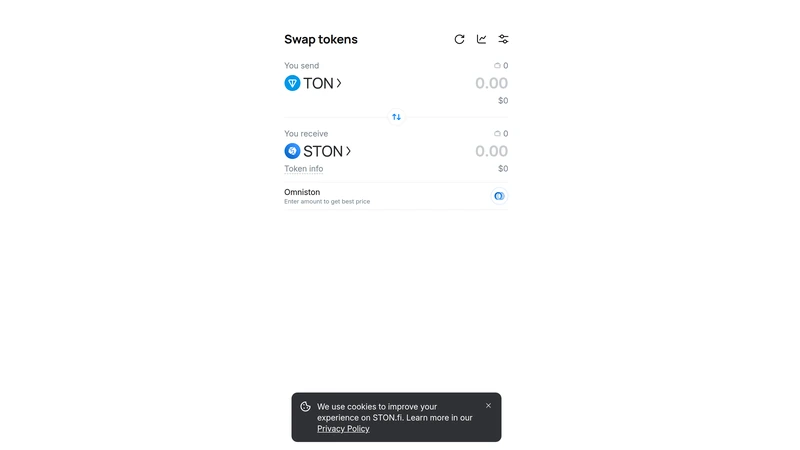
STON.fi docs explain that token swaps happen through liquidity pools and use the constant-product market-maker model, the classic x*y=k logic common in automated market makers. The important user takeaway is that your swap is being quoted against pool liquidity, not magically executed at some guaranteed external price.
That means three things matter before approval. First, the asset identity must be correct. Second, the pool must be liquid enough for your size. Third, the slippage tolerance and minimum received amount need to make sense for the market you are touching. If any of those look weak, the low-fee TON environment can make it too easy to keep clicking anyway.
On-chain speed and user-friendly UX are a feature of STON.fi. But they are only a good feature when the user stays deliberate. The danger is not that the app is too hard to use. The danger is that it is easy enough to make a bad trade feel normal.
How to make your first STON.fi swap safely
The clean starting flow is simple. Open STON.fi from a trusted source, connect a wallet you control, pick the asset pair carefully, review the quote, and confirm only after the destination asset has been verified. If you are new to TON self-custody, the wallet layer should already be clear from the Tonkeeper guide and the session-approval layer should make sense from the TON Connect guide.
Use the first swap to learn the review screens, not to maximize speed. The most common beginner error is treating token search results as proof. They are not. Search helps discovery. It does not verify that the result is the real asset you intended to trade. Use official token references, compare carefully, and size small when the route or asset is new.
- Fund the wallet and keep some TON for fees.
- Confirm the exact input and output asset.
- Read the quote review instead of skimming it.
- Check slippage and minimum received amount.
- Use a test size first if the market is unfamiliar.
TON's low fees make test swaps cheap enough that most users should do them more often, not less. If the trade route, token, or pair is new, a small test is usually smarter than blind confidence.
Slippage, routing, and when the quote is telling you to stop
STON.fi can make routing look smooth, but smooth routing does not always mean healthy execution. If price impact is already uncomfortable at your intended size, the market may be too shallow. If the output token is one you only half verified, then a nice quote screen does not help much. If the minimum received amount looks ugly, the market is already warning you.
This is where slippage logic becomes practical instead of theoretical. A small price difference may be fine on a liquid pair. A bigger one on a smaller token can mean you are forcing size through a pool that is not built for it. That matters even more on faster-moving assets, where poor entry conditions often become worse exit conditions later.
| Quote signal | What it usually means |
|---|---|
| Large price impact on a modest order | The pool is probably too shallow for your size. |
| Minimum received looks far below expectation | You are accepting more execution uncertainty than you may realize. |
| Asset identity is still fuzzy at quote time | Stop. Identity comes before execution. |
| Trade only makes sense with very loose slippage | The market may be too weak or too unstable to deserve the trade. |
Liquidity provision and farming on STON.fi
STON.fi docs also highlight liquidity provision and yield farming. Users can deposit token pairs, receive LP tokens representing their pool share, and in some cases stake those LP tokens for additional rewards. The docs even note single-sided liquidity provision in v2. All of that is useful. None of it is a free extension of a simple swap habit.
Providing liquidity changes the job. You are no longer just buying or selling a token. You are becoming part of the market-making side of the pool. That creates exposure to pool composition, fee generation, and impermanent loss dynamics. If you then farm the LP token, you add another layer of protocol and incentive risk.
That is why users should mentally separate three STON.fi modes: swap mode, liquidity mode, and farming mode. Each mode has a different risk profile. Mixing them together under the label of “just using STON.fi” is how users take on complexity they never intended to own.
What STON.fi docs say about security, and what that means for users
Official STON.fi documentation emphasizes a non-custodial design, immutable pool contracts, time-locked router upgrades with a seven-day delay, and open-source contracts. Those are meaningful signals. They tell users the protocol takes transparency and upgrade discipline seriously.
Still, no documentation page can remove the need for user discipline. Most losses around DEX usage are not caused by someone misunderstanding the phrase “constant product market maker.” They are caused by fake links, wrong token identities, blind wallet approvals, or poor market judgment. Documentation quality reduces one class of risk. It does not remove the human one.
That is why the user-side checklist is boring and effective: use the real site, verify the asset, read every approval, keep wallet hygiene tight, and do not let social urgency override trade quality.
How DEXTools and STON.fi work together
STON.fi is where many TON trades get executed. DEXTools is where many of those trades should get judged before they happen. The clean workflow is to verify the token identity and market quality in DEXTools, then use STON.fi as the execution layer once the market has passed that test.
- Start from the real token reference. Do not begin with a ticker-only search.
- Inspect liquidity, age, and recent transactions in DEXTools.
- Decide your size based on market quality.
- Move to STON.fi only after the market looks worth touching.
- Check the live quote against your pre-trade thesis.
Used this way, STON.fi and DEXTools complement each other well. One helps you act. The other helps you decide whether acting is smart.
How to judge a STON.fi pair before you swap real size
Many users think the main STON.fi decision is whether the app feels trustworthy. That matters, but it is not the trade-quality decision. The trade-quality decision is whether the specific pair you are about to touch deserves your capital. A clean interface can still route you into a weak pool, a newly launched token, or an asset whose market structure is much worse than its social momentum suggests.
The first question is identity. You should know exactly what token contract or official reference you are targeting before you even care about the quote. The second question is liquidity. If a modest order already changes the output too much, the pair is telling you it cannot absorb your size gracefully. The third question is flow quality. If the pair looks recently active but still fragile, that may be momentum without depth, not strength.
STON.fi itself does not need to be the place where you answer those questions. In fact, it usually should not be. DEXTools is better suited to pre-trade inspection, while STON.fi is better suited to execution after you have already decided the market is worth touching. That sequence keeps convenience from becoming impulsiveness.
| Pair-quality signal | Why it matters before the swap |
|---|---|
| Clear token identity | If identity is fuzzy, execution quality no longer matters because the trade thesis is already broken. |
| Healthy liquidity for your intended size | Thin pools make entry and exit harder than the interface suggests. |
| Reasonable price impact | Bad price impact is often the first warning that the market is too small or too hot. |
| Orderly recent flow | Chaotic flow can mean the pair is being pushed by narrative more than by stable participation. |
If a pair fails two of those tests, the smartest STON.fi action is often no action. A DEX guide that never tells users when not to trade is not really a safety guide.
When STON.fi is the right execution venue, and when it is not
STON.fi is a strong venue when the pair is real, liquidity is acceptable, and the user understands whether they are only swapping or stepping into something more complex. It is especially useful when you already know the TON ecosystem asset you want, you have checked the market, and you simply need a clean non-custodial execution layer.
It is a weaker choice when the market itself is the unknown variable. If you are still asking whether the token is legitimate, whether the pool is deep enough, or whether the trade thesis depends on hype rather than usable liquidity, then the problem is upstream from STON.fi. The app cannot solve a bad market-selection decision for you.
It is also worth knowing when not to rush into LP or farming just because you already completed one successful swap. A good first swap proves only that the transaction flow worked. It does not prove that the market is healthy enough for a deeper capital commitment, and it certainly does not prove that a yield layer on top of the pair deserves trust.
In other words, STON.fi is best when it remains in its lane. Let it be the execution tool. Let DEXTools and your own trade discipline decide whether there should be an execution at all.
Why new TON launches make STON.fi discipline more important
STON.fi often becomes the first stop when a new TON narrative starts moving quickly. That is exactly when users should become more conservative, not less. Early launches compress decision time, spread attention across copied tickers and fast chat-driven calls, and make users feel that any pause equals missed upside. In practice, that urgency is what funds the worst entries.
A disciplined STON.fi workflow during launch conditions means smaller initial size, stricter verification, and an honest willingness to miss trades that do not pass basic market-quality checks. Missing a bad trade is not a failure. It is evidence that the workflow did its job.
Final takeaway: STON.fi is one of the most useful execution venues on TON, but it works best when you treat it like a market tool, not a shortcut. Verify the token first, judge the market in DEXTools, read the quote carefully, and only then use STON.fi for execution.
Disclaimer: This draft is for educational purposes only and does not constitute investment, financial, or trading advice. DeFi markets on TON can change quickly.
Related Guides
- DeDust vs STON.fi: Complete TON DEX Comparison Guide (2026)
- How to Use Curve Finance: Stablecoin Swaps, Pools and Slippage Guide (2026)
- Top 3 TON Trading Terminals 2026: Not.Trade vs STON.fi vs DeDust
- Liquidity Pool Economics: Fees, Slippage and Impermanent Loss
- How to Use DeDust on TON Safely: Swaps, Pools, and Routing Guide (2026)
Frequently Asked Questions
What is STON.fi used for on TON?
It is mainly used for swaps, liquidity provision, and farming inside the TON ecosystem.
Is STON.fi the same thing as buying Jettons safely?
No. STON.fi is an execution platform, while safe token buying still depends on identity and market checks.
Do I need TON in my wallet to use STON.fi?
Usually yes, because keeping TON for fees is still the practical habit.
What is the biggest STON.fi mistake beginners make?
Trusting the search result and quote screen without verifying the token and the pool quality first.
Should I provide liquidity the first time I use STON.fi?
Usually not. Most users should learn swap risk first before adding LP and farming complexity.