How to Buy Jettons on TON Safely: Guide 2026
— By Tony Rabbit in Tutorials

Learn how to buy Jettons on TON safely: verify the real token identity, check pool depth and slippage, and use TON DEXes carefully in this 2026 guide.
Buying Jettons safely on TON involves preparing your wallet with a sufficient fee balance, verifying the token's real identity before swapping, and checking the liquidity pool's health. The convenience of fast transactions on TON necessitates diligent verification to avoid fake tickers and ensure you're interacting with legitimate markets.
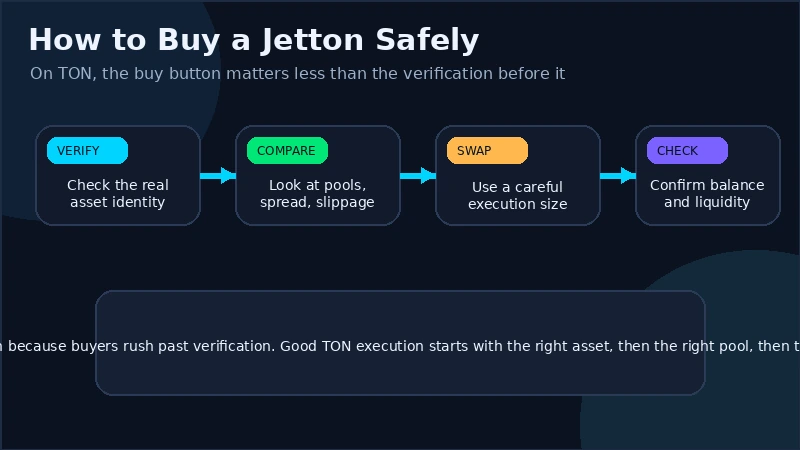
Buying a Jetton on TON can feel deceptively easy. The wallet connects fast, the network fees are low, and the swap button is close. That convenience is helpful, but it also hides the real job, which is not clicking buy. The real job is confirming that the Jetton is the correct one, the pool is healthy enough to use, and the market is not just a fake ticker wrapped in TON-native speed.
Intent check: This page is the token-purchase workflow on TON. If you still need to set up the wallet first, read How to Use Tonkeeper Wallet on TON Safely. If you first need to bring assets onto the network, read How to Bridge Assets to TON Network Safely
Quick answer: buying Jettons safely on TON means preparing the right wallet and fee balance, verifying the real token identity before you swap, checking pool liquidity and slippage on TON DEXes, and confirming after the purchase that the Jetton you received is the exact asset you intended to buy. The buy itself is the shortest part of the workflow.
- A Jetton is TON's token standard. In practice it fills a role similar to a fungible token standard on other chains.
- The ticker is not enough. The important identity check is the real Jetton contract or official token reference.
- Low fees can make bad trading feel painless. You can still overpay through slippage or buy into a fake market.
- Wallet display is not final proof. Logos, names, and icons can lag or be copied.
- DEXTools is your verification layer. Use it before and after the swap to confirm the market you are touching is actually tradeable.
What a Jetton is on TON
A Jetton is the standard way fungible tokens are represented on TON. If you come from Ethereum, the closest mental shortcut is “a TON-native token standard,” but do not stop there. What matters operationally is that Jettons can share familiar names, can appear through multiple pools, and can be discovered through wallets, DEXes, or Telegram-native tools long before a beginner really understands what they are seeing.
Trade TON with Not.Trade, the fastest terminal on TON
Not.Trade is purpose built for TON traders: real-time on-chain charts for every jetton, insider safety scoring (Top 10 wallets, snipers, dev movement, bundlers, LP lock), MCAP-trigger limit orders, multi-wallet sniping, MEV protection and one-click swaps routed across STON.fi and DeDust. It runs natively inside Telegram and as a fast web terminal, with TON Connect non-custodial wallet support.
Read the full Not.Trade guide →That is why the safer question is not “what is the ticker?” but “what is the exact Jetton I am about to touch?” On TON, users may hear about a token name in a group, see it in a Mini App, or watch it trend on a DEX. None of those is a substitute for identity verification.
This article stays practical. It is not a full DEX review and it is not a broad TON onboarding page. If you need the wider wallet entry point, use the umbrella TON tutorial. If you need the self-custody angle first, start with the Tonkeeper guide.
What you need before buying a Jetton
The clean starting stack is simple: a TON-compatible wallet, a small TON balance for network fees, a trusted source for the token identity, and the patience to verify the market before you trade.
For most self-custody users, that wallet is Tonkeeper or another TON-native wallet that can connect to a DEX. The important thing is that you control the wallet and can review transaction prompts clearly. Keep some TON available for fees even if the Jetton pair is quoted against USDT or another asset. Cheap network fees are still fees, and running out of TON in the middle of a token workflow is a very avoidable mistake.
More important than the wallet itself is the verification mindset. On TON, you do not want to buy a Jetton because a logo looks familiar. You want to buy it because the contract or official token reference matches the project you researched. The DEXTools article on verifying a token contract before trading belongs directly in this workflow.
| Before you buy | Why it matters |
|---|---|
| Wallet you control | You need to review approvals and protect the resulting token yourself. |
| Some TON for fees | Low fees still require a fee asset, and later actions may not be sponsored. |
| Official token identity | Names and logos are weak signals. Contract-level verification is stronger. |
| DEXTools market context | Liquidity, activity, and pair quality tell you whether the token is actually tradeable. |
How to find the right Jetton and avoid fake copies
This is the most important section of the whole guide, because the actual swap button is worthless if the identity check is weak. Many TON users hear about a token from Telegram first. That is fine. The mistake is treating the first token result inside a wallet or DEX search as if it were automatically the right asset.
The safest path is to start from the project's official source, then move outward. That could be the official website, a verified social profile, a trusted documentation page, or an official announcement that clearly publishes the token identity. Take the exact reference you trust and compare it against the token you see in the wallet or DEX. If the only proof of identity is “everyone in the group says this is it,” that is not enough.
TON users should also understand a useful nuance: the identity you want is the Jetton's real token reference, not a random wallet address that happened to hold or send it. Some ecosystems describe this as the Jetton master address. The name varies in how people talk about it, but the point is the same. You want the token's canonical identity, not an address that merely interacted with it.
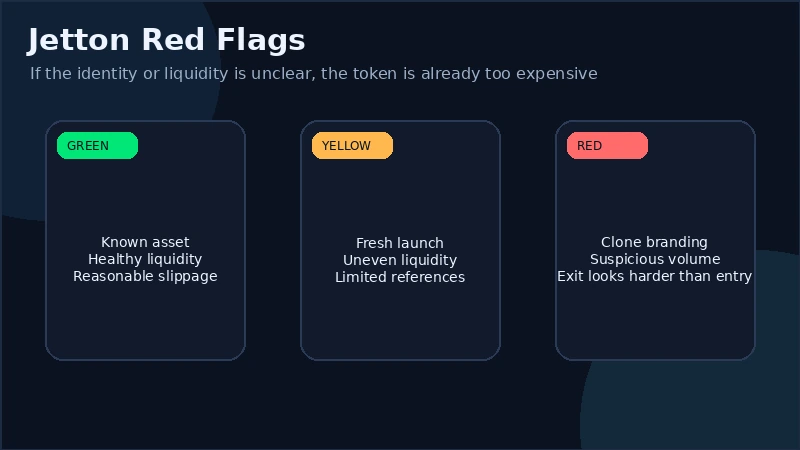
Red flags are often obvious once you look for them. Multiple tokens with near-identical names, no consistent official reference, tiny liquidity despite a loud social push, and a pool that appeared minutes ago are all reasons to slow down. So is a token that only exists in one weak venue while promoters claim it is “everywhere.”
How swaps work on TON DEXes such as STON.fi and DeDust
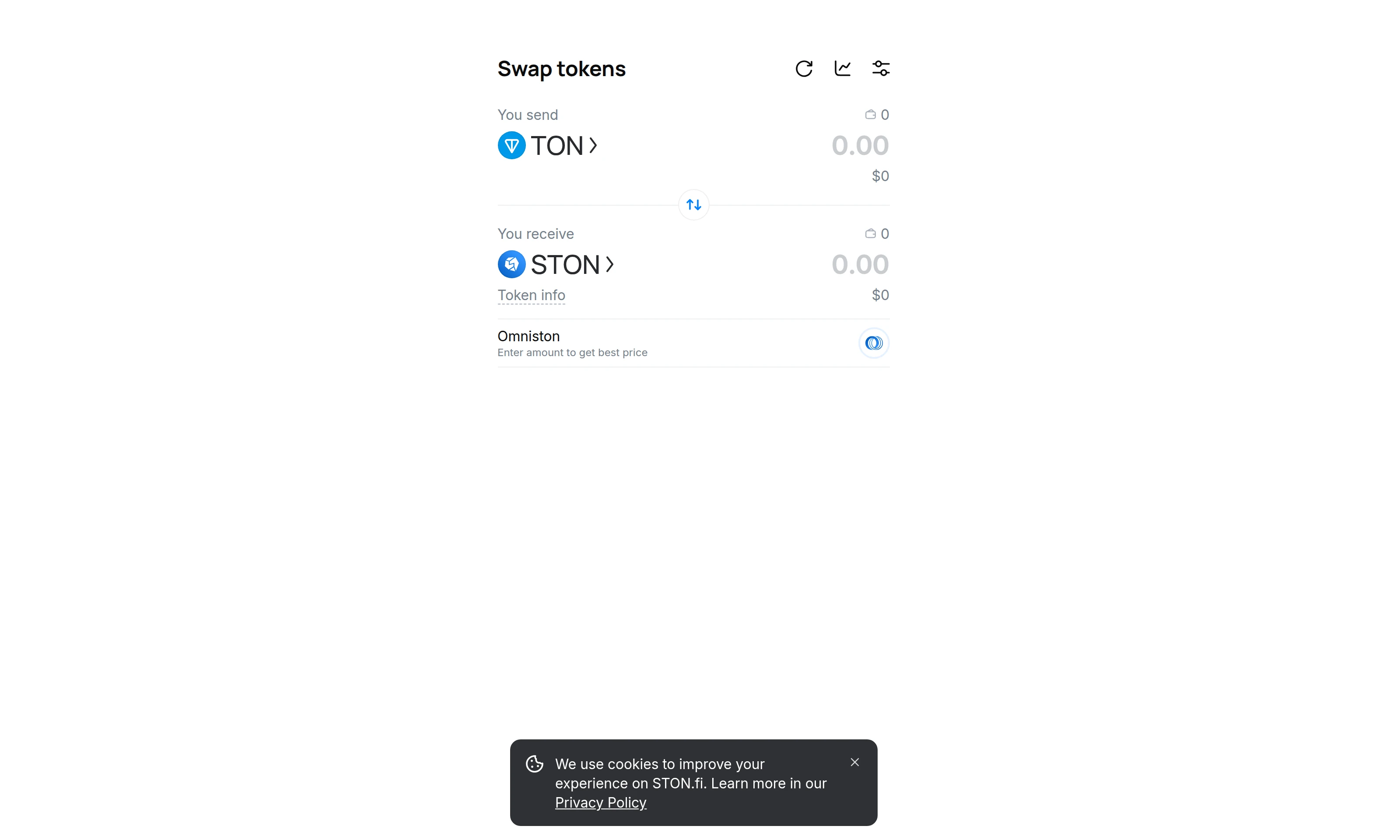
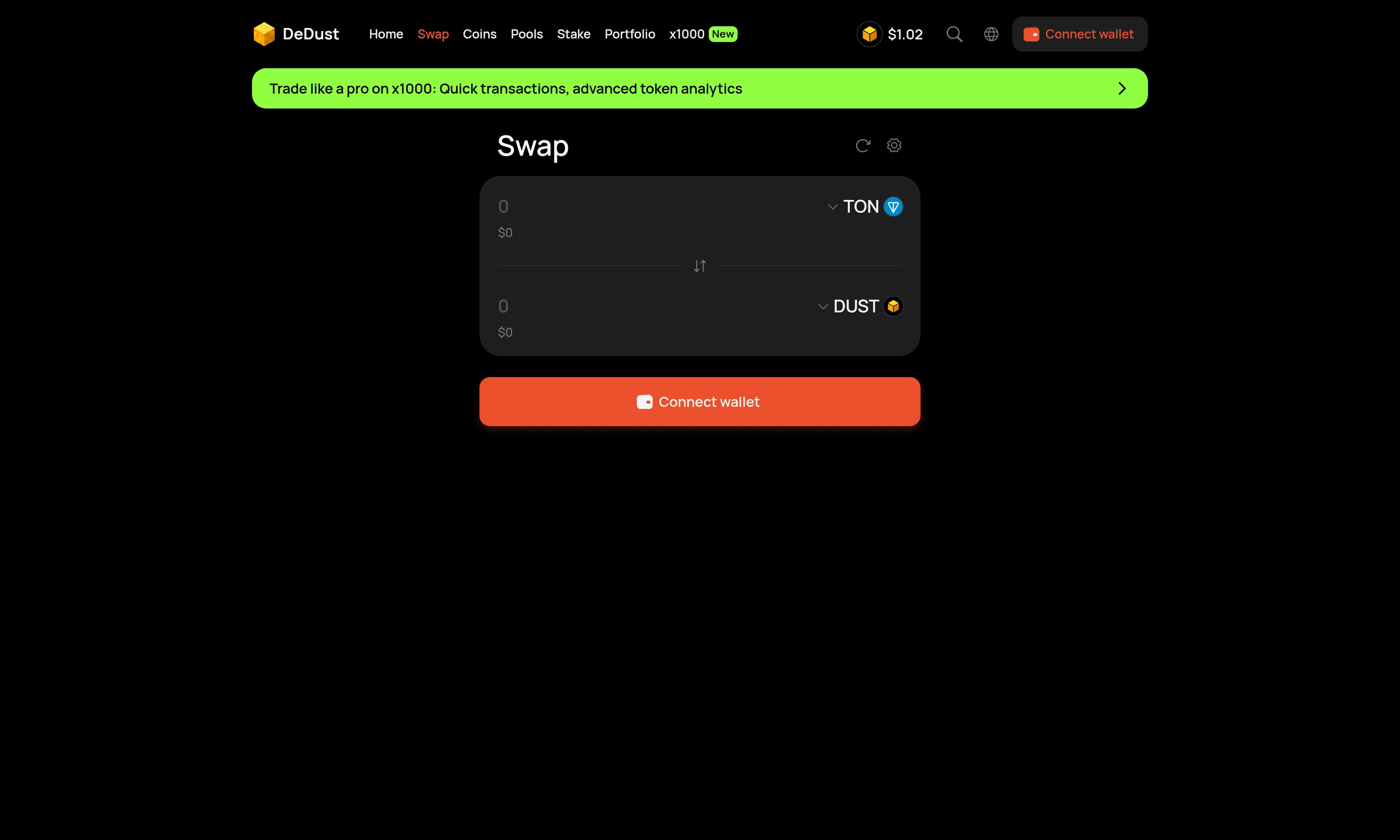
On TON DEXes, the user experience is usually simple. Connect the wallet, choose the asset pair, review the quote, approve the swap, and confirm it in the wallet. The simplicity is helpful, but it can create the illusion that all token markets are equally clean. They are not.
What matters before approval is the route quality. Which pool is actually supplying the liquidity? How much price impact does your size create? What fee or spread is embedded in the quote? Is the output Jetton the exact one you verified, or just a lookalike result surfaced by a search field?
The right beginner habit is to treat the swap preview as a review screen, not as a green light. If the output asset name, route, price impact, or minimum received amount looks off, stop and investigate before signing. Connecting the wallet is not the final risk check. The quote review is.
This is also why low-fee chains can be dangerous in a subtle way. On expensive networks, users often hesitate before clicking. On TON, cheap execution can make people click faster. That speed should be used for testing and verification, not for dropping caution.
Slippage, pool depth, and price impact on TON
Beginners often think low network fees mean a cheap trade. In reality, the hidden cost is often slippage. If the Jetton trades in a thin pool, even a modest buy can move the price against you hard enough to matter more than the fee itself.
Slippage is the gap between the expected price and the actual execution result. On TON, this can become dangerous precisely because the mechanics feel so smooth. A user sees a low fee, assumes the trade is efficient, and misses the fact that their order is chewing through weak liquidity.
Pool depth tells you whether your size belongs in that market at all. A tiny experimental buy into a small Jetton is one thing. A serious position into a shallow pool is another. If price impact is already uncomfortable before you buy, the exit may be worse later.
That is why the clean question is not only “can I buy it?” but “can I buy it and later exit it without the market collapsing under my size?” A Jetton that is easy to buy but hard to exit is still a bad market for many users.
| Signal | What it usually means |
|---|---|
| Very high price impact on a modest order | The pool is too shallow for comfort. |
| Wide minimum-received gap | The route is already warning you about unstable execution. |
| One-sided recent activity | The market may be promotional, fragile, or difficult to exit. |
| Liquidity looks small relative to social hype | The narrative may be much stronger than the actual market. |
Post-buy checks after the Jetton lands
Once the swap completes, do not assume the job is finished just because the wallet balance changed. The clean post-buy workflow is short and worth doing every time on a newer or smaller asset.
- Confirm the received token identity again. Make sure the balance corresponds to the Jetton you intended to buy.
- Check how the wallet is displaying it. Missing artwork or odd metadata does not always mean the token is fake, but it is a reason to verify again.
- Review the pool and market activity. A token can land correctly and still be trading in a weak market.
- Keep some TON for future actions. Selling, moving, or interacting later still requires operational readiness.
This is also a good point to remind yourself that buy success is not exit proof. A wallet balance is not the same as a healthy, two-way market. The safest buyers keep checking the token after the trade instead of assuming the hardest part is over.
When a Jetton is too risky to touch
Some Jettons should simply be left alone. You do not need a long thesis to reject a market that fails the basic safety checks.
- No clear official contract or token reference
- Tiny liquidity and large price impact
- A social push that is much louder than the on-chain market
- Confusing duplicates or multiple near-identical tokens
- Weak recent transaction quality or signs of artificial activity
- A token surfaced mainly through DMs, fake support, or pressure tactics
In those cases, the correct skill is not “trade smaller.” It is “do not trade it.” Selectivity is part of safe execution.
A practical DEXTools workflow for buying Jettons safely
DEXTools is where the token story meets market reality. Before a buy, use it to answer whether the Jetton is real enough, liquid enough, and orderly enough to deserve a wallet approval at all.
- Search using the verified token identity. Start from the real token reference, not from a social mention.
- Inspect pair quality. Look at liquidity, volume, age, and recent transactions together.
- Check slippage expectations before you sign. If the trade already looks bad at your intended size, reduce size or walk away.
- Review security context. If the token reached you through a fake group, copied handle, or suspicious Mini App, reinforce the decision with the DEXTools security guide.
- Use the post-buy view too. DEXTools is not only for discovery. It is for confirming that the market still makes sense after you have exposure.
For TON users who arrive through Telegram or wallet-native flows, this DEXTools check is the difference between “I saw a token” and “I verified the market.” That is a big difference.
Frequently asked questions
What is a Jetton on TON?
A Jetton is TON's standard for fungible tokens. In practice it is how many TON ecosystem tokens are represented and traded.
How do I know a Jetton is the real one?
Verify the official token identity from a trusted source, then compare it in your wallet and market tools. Do not rely only on the name, ticker, or logo.
Do I need TON to buy Jettons?
Usually yes. Even if the trade is quoted against another asset, keeping some TON for fees is still the safer operating habit.
Why does my wallet show a strange icon or incomplete metadata after I buy?
Wallet display issues can happen, especially on newer tokens. That does not automatically mean the token is fake, but it does mean you should verify the token identity again.
What is the biggest mistake when buying Jettons on TON?
The biggest mistake is buying from a ticker or a social mention without verifying the actual token identity and market quality first.
Final takeaway: the safest way to buy Jettons on TON is to treat verification as the main event and the swap as the final step. Use a wallet you control, keep TON for fees, verify the real token identity, check slippage and liquidity on DEXTools, and confirm after the trade that the Jetton you received is the one you intended to own.
Disclaimer: This draft is for educational purposes only and does not constitute investment, financial, legal, or trading advice. Smaller token markets can change quickly and carry high risk.
Related Guides
- What Are Jettons? Complete TON Token Standard Guide (2026)
- Not.Trade Safety Scoring: Detect TON Scam Jettons 2026
- How to Buy Toncoin (TON) in 2026: Exchanges, Wallet Setup and First Purchase Guide
- FDV vs Market Cap in Crypto: How to Read Unlock Risk Before You Buy (2026)
- Whale Buy or Exit Liquidity? How to Read Big Swaps Without Blindly Copying Whales
Frequently Asked Questions
What are Jettons on TON?
Jettons are the standard for fungible tokens on the TON blockchain, similar to how other chains have their own token standards. They can represent project tokens, stablecoins, or other assets issued on TON.
How do I buy Jettons on TON safely?
Verify the token's official contract address, use a reputable TON wallet and DEX, and check the pool's liquidity and slippage before trading. Starting with a small amount can help you confirm everything works as expected.
How do I avoid fake or impersonating Jettons?
Always confirm the exact contract address from an official source, since scammers can create tokens that copy a real project's name and symbol. Matching the verified address prevents buying a lookalike token.
Why do liquidity and slippage matter when buying Jettons?
Low liquidity means your trade can move the price a lot, leading to high slippage and worse fills. Checking pool depth helps you understand how much price impact your order may cause.