Robinhood vs Coinbase vs Kraken: Inside the Tokenized-Stock War, and Whose Tokens Actually Own Your Shares
— By Tony Rabbit in News

The biggest exchanges are racing to put Wall Street on-chain, each on its own blockchain, and the pace jumped again this week. But their tokenized stocks are built very differently, and the difference decides whether you own a real share or just an IOU. Here is the clear breakdown.
The biggest names in trading are in a race to do the same thing: put the stock market on a blockchain. Robinhood, Coinbase and Kraken are all pushing tokenized stocks, digital tokens that track the price of shares like Apple, Tesla or the S&P 500 and trade around the clock. The pace jumped again this week, with Robinhood's own blockchain going live and Coinbase's Base activating a new token standard. It looks like one movement, but under the hood these are very different products, and the differences decide something that matters a lot: whether you actually own a piece of the company, or just hold an IOU that tracks its price.
Why every exchange suddenly wants your stocks on-chain
The appeal is easy to see. A tokenized stock can trade 24 hours a day, seven days a week, settle in seconds instead of days, reach users in countries that never had easy access to US markets, and plug into DeFi as collateral or yield. For the exchanges, there is a sharper motive too: their crypto trading revenue is cooling. Robinhood's crypto revenue fell about 47% year on year in the first quarter of 2026, so tokenizing the entire stock market is a way to open a much bigger new business. Tokenization is the growth bet, and each exchange is building its own version of it. If the concept is new to you, our explainer on how tokenized stocks work is a good starting point.
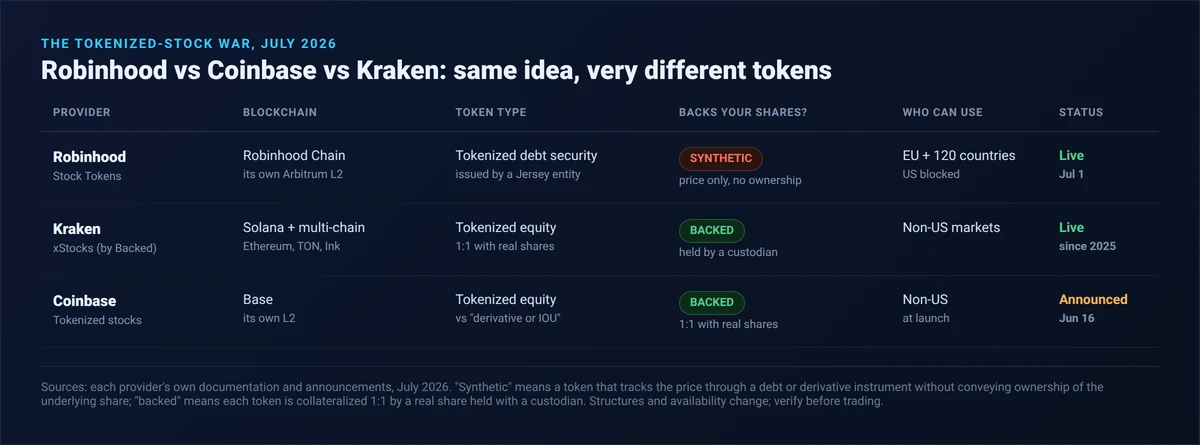
The three contenders
Robinhood made the loudest move. It launched its Stock Tokens for eligible users across the EU and more than 120 countries, and on July 1, 2026 it went live with its own blockchain, Robinhood Chain, an Ethereum Layer-2 built on the Arbitrum stack. Over 200 US stocks and ETFs are available as tokens. The catch, which we come back to below, is how those tokens are structured, and that US users are blocked from them entirely.
Kraken, through the xStocks brand issued by Backed Finance, has quietly built the most-traded product of the three. xStocks are tokenized equities that live on Solana and have expanded to other chains, and they have already seen more than $25 billion in cumulative trading volume with tens of thousands of on-chain holders. Kraken has moved to acquire Backed outright and is building its own Layer-2, Ink, as it leans further into the space.
Coinbase is the newest entrant. In June 2026 it announced tokenized US stocks for non-US users, to run on its own Layer-2, Base, and pointedly positioned them as real, backed tokens rather than a "derivative or IOU." That framing is a direct shot at the synthetic approach, and it points straight at the one distinction that matters more than any other.
The difference that decides everything: do you own the stock?
Here is the split that most coverage skips. A tokenized stock can be built in two fundamentally different ways, and they carry very different risk.
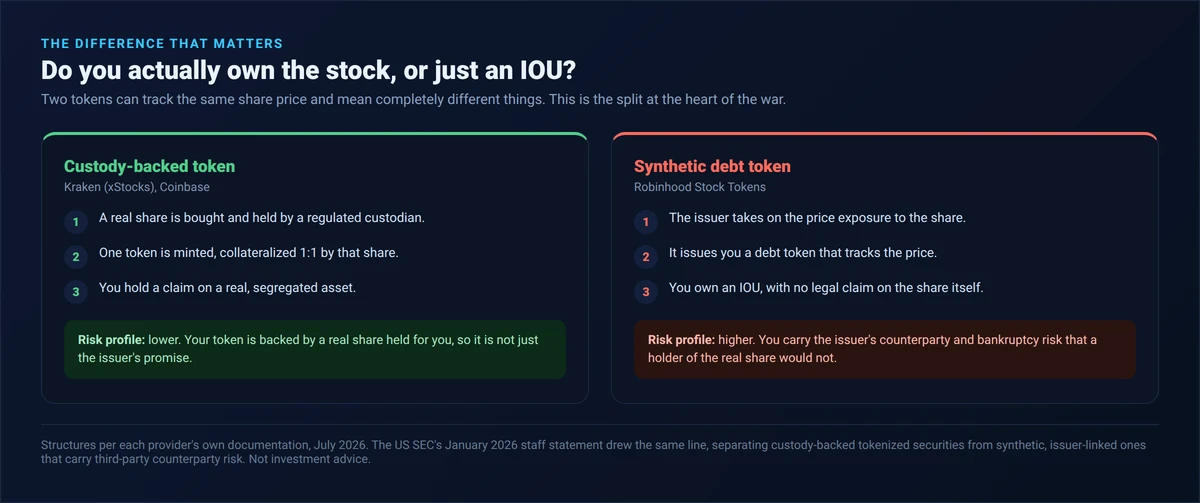
A custody-backed token, the model behind Kraken's xStocks and what Coinbase describes for its product, works like a receipt. A regulated custodian buys and holds a real share, and one token is minted against it, one to one. Your token is a claim on a real, segregated asset. A synthetic token, the model Robinhood uses, works like an IOU. Robinhood's documentation is explicit that its Stock Tokens are "tokenised debt securities" issued by a Jersey entity that grant "no legal or beneficial rights in, or against the issuer of, those underlying securities." You get the price exposure through a debt instrument, with no ownership and no shareholder rights.
Why does it matter if the price tracks the same either way? Because a synthetic, issuer-linked token carries the issuer's counterparty and bankruptcy risk that a holder of the real share, or of a fully backed token, does not. The US SEC drew the same line in a January 2026 staff statement, separating custody-backed tokenized securities from synthetic ones that carry third-party risk. It becomes even more important once these tokens are used as collateral in DeFi, where the quality of the backing is the quality of the whole position.
The chain war underneath
There is a second race happening below the tokens: each exchange wants its own blockchain. Robinhood built Robinhood Chain, Coinbase has Base, and Kraken is building Ink, while xStocks already span Solana and beyond. Owning the chain means owning the fees, the rules and the ecosystem, rather than renting space on someone else's network. But a brand-new chain also starts empty, and what fills it first is rarely the headline product. When we read Robinhood Chain one week after launch, the open on-chain activity was dominated by memecoins, not tokenized stocks. When Base switched on its new B20 token standard built for stablecoins and real-world assets, the first cohort we counted was almost entirely memecoins too. The infrastructure is real; the early on-chain reality is messier than the pitch.
What it means for you, and how not to get burned
If you are going to trade tokenized stocks, three checks matter more than which brand is loudest. First, is the token backed by a real share or synthetic? That decides your risk. Second, can you even use it? US users are largely shut out today, and availability varies country by country. Third, and this is the on-chain trap, is the token you are buying the real one? On a permissionless chain, anyone can deploy a token called AAPL or TSLA that has nothing to do with the official product, and we have already seen imposter tickers appear. Always verify the exact contract address and screen it with a tool like the Token Safety Checker before you buy.
- stocks that trade 24/7, settle in seconds and reach users worldwide
- tokenized shares that can move into DeFi as collateral or yield
- a genuine bridge between traditional markets and on-chain finance
- not all tokenized stocks are backed by a real share; some are synthetic IOUs
- US users are largely locked out, and availability varies by country
- on permissionless chains, imposter tickers can pose as the real thing
The tokenized-stock war is real, and it is probably the most important thing happening at the border between Wall Street and crypto right now. But "tokenized stock" is not one thing. It is a backed receipt from one exchange, a synthetic IOU from another, and a brand-new announcement from a third, spread across three competing blockchains. The winners will not just be whoever markets it best. They will be whoever gives people a real, safe claim on the asset, and lets them prove it on-chain. Until then, read the structure, not the slogan.
Sources and disclaimer: product structures, chains and availability are from each provider's own documentation and public announcements as of July 2026, including Robinhood's Stock Token terms ("tokenised debt securities... no legal or beneficial rights"), the Robinhood Chain mainnet launch (July 1, 2026), Kraken and Backed's xStocks (cumulative volume above $25B, live since 2025) and Coinbase's June 2026 announcement of backed tokenized stocks on Base. The US SEC staff statement referenced is from January 2026. Figures and availability change; Coinbase's product was announced rather than fully live at the time of writing. Nothing here is affiliated with, or an allegation against, any company named. This article is for information only and is not financial or investment advice. Tokenized assets carry market, counterparty and regulatory risk; verify every contract and do your own research.