What Is MyShell (SHELL)? The Decentralized AI Agent Ecosystem Explained in 2026
— By Tony Rabbit in Tutorials
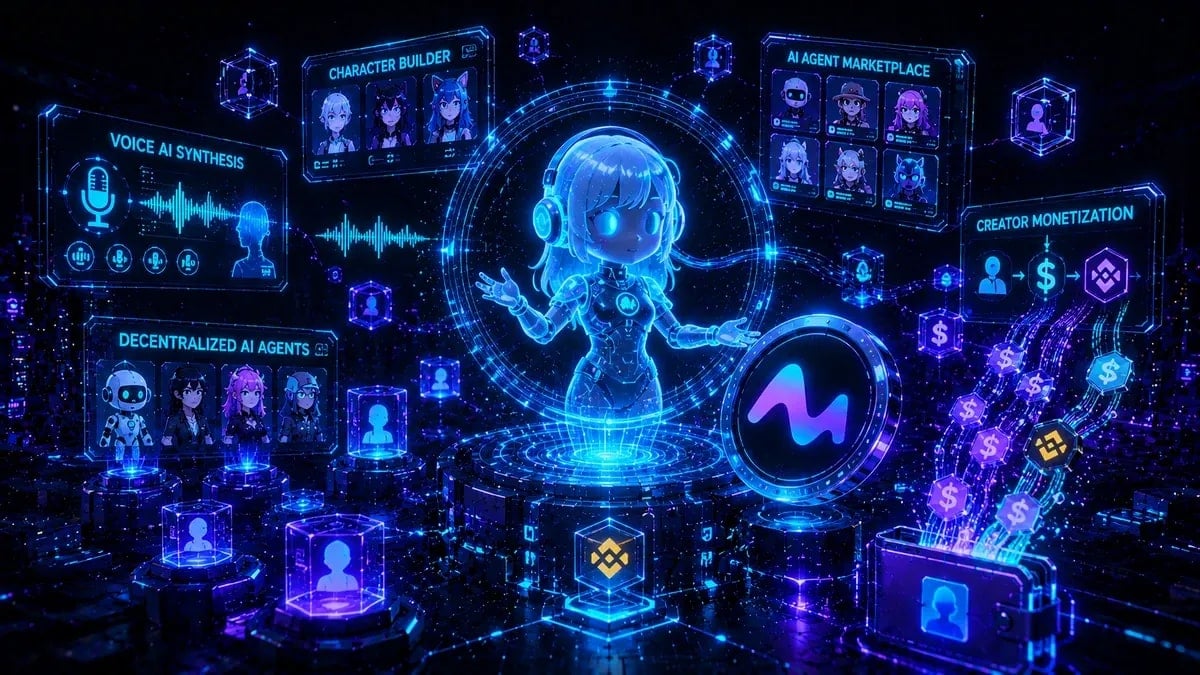
Complete 2026 guide to MyShell (SHELL): the decentralized AI consumer layer powering 200K+ agents, ShellAgent no-code framework, OpenVoice v2, SHELL tokenomics, creator economy, and comparison vs ElizaOS, Virtuals Protocol and Fetch.ai.
What Is MyShell (SHELL)? The Decentralized AI Agent Ecosystem Explained in 2026
The artificial intelligence agent category exploded between late 2024 and the first half of 2026, transforming from a research curiosity into one of the most heavily capitalized verticals across the entire cryptocurrency landscape. By the time the market matured past its first hype cycle, the question had stopped being whether on-chain AI agents would survive and started being which projects actually shipped products that millions of real users opened every day. MyShell, the team behind the SHELL token, is one of the very few platforms whose answer to that question rests on documented usage rather than promises.
Where most AI agent narratives concentrate on autonomous trading bots, smart contract automation, or backend infrastructure, MyShell positions itself somewhere fundamentally different. It calls itself the decentralized AI consumer layer for Web3, a phrase that essentially means it wants to be the place where regular people, not just developers, discover, build, and interact with AI characters, voice clones, language tutors, role-play companions, and productivity assistants. The platform combines a no-code builder, an open agent marketplace, proprietary voice technology, and a token that ties everything together.
By 2026, MyShell reports more than 200,000 deployed AI agents, around 170,000 active creators, and more than 5,000,000 users across web and mobile clients. The SHELL token, capped at one billion units with a deflationary buyback design, sits among the top five cryptocurrencies in the AI agent category and has been listed on major centralized exchanges since its 2024 token generation event. This guide breaks down the entire stack: what MyShell actually is, how ShellAgent and OpenVoice v2 work under the hood, how the token economy aligns creators with users, and how the project compares to other AI agent ecosystems such as ElizaOS, Virtuals Protocol, and Fetch.ai.
FEATURED SNIPPET
MyShell (SHELL) is a decentralized AI consumer layer that lets anyone build, share, and monetize AI agents without writing code. It combines the ShellAgent open-source framework, which exposes more than 300 ready-made AI components, with OpenVoice v2, an in-house voice cloning model. By 2026 the platform hosts 200,000+ AI agents and 170,000+ active creators serving more than 5 million users. The native SHELL token, capped at 1 billion supply with deflationary buybacks, powers creator rewards, premium model access, governance, and the agent marketplace economy.
What Is MyShell in Plain English
Imagine an app store, but instead of mobile games or productivity apps, every entry is an AI character or AI tool that a user has built and published. Some are language tutors, some are voice clones of fictional characters, some are role-play companions, some are coding assistants, and some are utility agents that read PDFs, translate documents, or summarize meetings. Each agent runs on top of large language models and audio models, but the user does not see that complexity. They just open the agent, chat with it, talk to it, or assign it tasks.
MyShell is the platform that hosts that marketplace. It also provides the builder tools to make those agents, the voice technology that gives them realistic speech, and the token-based economy that rewards creators when their agents are used. The crucial design choice is that none of those layers require advanced engineering knowledge. A teacher who wants to build a multilingual tutor for their classroom, a podcaster who wants to clone their voice for translations, or a fan community that wants to build a role-play character can all do it from a visual interface in minutes.
The decentralization angle matters because it changes who captures the value. On a traditional centralized AI platform, all revenue flows to a single corporation. On MyShell, the platform takes a smaller cut and the rest is shared with the creator who built the agent, the curators who promote it, and in some configurations, the users themselves through participation rewards. That redistribution is enforced and tracked through the SHELL token and the platform's on-chain accounting.
The Decentralized AI Consumer Layer Vision
To understand why MyShell describes itself as the decentralized AI consumer layer of Web3, it helps to picture the AI stack in three vertical bands. At the bottom sits the compute and model layer: GPUs, foundational models, and infrastructure providers. In the middle sits the agent or orchestration layer: frameworks that take models and string them into useful workflows. At the top sits the consumer layer: the actual interfaces where humans interact with AI in their daily lives.
Most crypto AI projects compete in the middle or the bottom of that stack. They build verifiable inference networks, decentralized GPU markets, or autonomous agent frameworks designed for developers. MyShell, by contrast, aims directly at the top of the stack. Its bet is that whichever platform owns the consumer relationship in AI will be in a position similar to the one Apple or Google occupies in mobile software today, and that this layer should not be locked inside a single corporation.
That vision sits naturally next to other on-chain AI consumer experiments. To understand how this fits with the broader category, our breakdown of what AI agents are in crypto explains the entire taxonomy, including why consumer-facing platforms behave differently from backend or trading-focused agents. MyShell occupies the consumer slice of that taxonomy almost by itself among well-funded projects.

Founding Team and Investors
MyShell was founded in 2023 by a team of researchers and engineers with backgrounds spanning machine learning, audio processing, and consumer product design. The company has publicly raised capital across multiple rounds from venture firms active in both Web3 and traditional AI, and disclosed funding figures by the middle of 2026 placed the total committed capital comfortably in the eight-figure range. Investor announcements have included names well known in crypto venture circles alongside AI-focused funds, a combination that mirrors the platform's hybrid identity.
The product velocity has been notable. Between the original platform launch in 2023 and the publication of OpenVoice v2 in mid 2024, the team shipped a steady cadence of model upgrades, marketplace features, and developer tools. The token generation event in late 2024 brought SHELL to major exchanges and added an explicit economic layer to a product that had already accumulated significant organic usage. By 2026, the platform was operating both a web client and a mobile experience, and the agent catalogue had grown to the hundreds of thousands.
A subtle but important detail in MyShell's investor base is the explicit mix of Web3-native funds with traditional AI funds. Many crypto AI projects are funded almost entirely by crypto venture firms, which leaves them well capitalized inside their own narrative but isolated from the broader machine learning industry. MyShell's hybrid cap table puts the team into conversations with both communities at once, which helps explain why its research releases land in mainstream AI publications and why its product surface looks more like a consumer SaaS application than a typical Web3 dApp. That dual identity is a strategic asset, especially in a market environment where bridging the AI and crypto talent pools is itself a scarce competency.
Beyond capital, the team has invested heavily in community programs: creator grants, regional ambassadors, hackathons, and partnerships with universities and content schools. These programs serve the practical purpose of seeding high-quality agents on the platform before any individual category reaches a self-sustaining flywheel, and they help explain how the platform crossed early adoption thresholds in markets such as Southeast Asia and parts of Latin America before many of its better-known Western competitors did.
MyShell Timeline: From Founding to 2026
ShellAgent: The No-Code Framework With 300+ Components
The single most important piece of MyShell's product surface is ShellAgent, the open-source framework that powers agent creation. ShellAgent is designed around the assumption that the bottleneck for AI agent adoption is not raw model capability but creator accessibility. Most people who could imagine a useful AI agent never build one because the toolchain assumes Python familiarity, prompt engineering experience, and comfort working with APIs. ShellAgent removes those barriers by reducing the entire process to dragging and connecting blocks.
Inside the framework, creators have access to more than 300 prebuilt AI components. Some are language model wrappers that handle reasoning, summarization, and conversation. Some are perception modules that read images, transcribe audio, or extract structured fields from documents. Some are action modules that send emails, call APIs, write to databases, or post to external platforms. Some are voice modules powered by OpenVoice. Stringing them together produces an agent without writing any code, although power users can drop into a scripting layer when they need bespoke logic.
The three-step creation flow that the platform exposes to first-time users is intentionally compact:
Pick a Template or Start Blank
Choose from dozens of starting templates such as tutor, role-play character, productivity helper, or voice translator, or open an empty canvas for full control.
Wire Up Components
Drag language, vision, voice, memory, and action blocks onto the canvas, connect them, and configure prompts in plain English. The framework hides the model orchestration entirely.
Publish and Monetize
Push the agent to the public marketplace with one click, set a pricing model, and start receiving SHELL-denominated rewards each time a user interacts with the agent.
ShellAgent being open source also matters strategically. Developers can self-host components, fork the framework for specialized use cases, and contribute new components back to the ecosystem. This is a meaningful contrast with closed agent platforms where every block is locked inside a vendor environment. For platform comparisons with another open-framework ecosystem, our guide to ElizaOS and the AI16Z ecosystem walks through a developer-first design philosophy that makes a useful counterpoint to MyShell's consumer-first one.
OpenVoice v2: The Voice Cloning Technology
OpenVoice is the in-house voice cloning model that MyShell publishes as open source and uses to power voice features inside the platform. The first version, released in 2024, attracted widespread attention in the research community for delivering high-quality voice cloning from very short reference audio samples. OpenVoice v2 extended that capability with improved cross-lingual transfer, allowing a cloned voice to speak languages the original speaker did not actually record, while still preserving the speaker's vocal identity.
From a creator's perspective, the practical impact is simple. A user can upload a short clip of their own voice, or a clip of a public-domain or licensed source, and within seconds generate an agent that speaks any future text in that voice across multiple languages. The control surface also includes style parameters: emotion, tone, pace, and accent can be adjusted independently of the underlying speaker identity. This is what makes language tutors, audiobook narrators, role-play companions, and dubbed video pipelines viable on the platform.
From a strategic perspective, open sourcing OpenVoice served two purposes. It validated MyShell's research credibility, important in a market full of projects that wrap third-party models, and it seeded an ecosystem of external integrations that ultimately drive users back into the MyShell environment when they want production-ready hosting, monetization, and discoverability for the agents they build with the technology.
Voice technology also raises legitimate concerns about misuse. MyShell publishes acceptable-use policies that prohibit identity impersonation without consent, and the platform's enforcement systems target deepfake misuse and policy violations. As with any voice cloning service, users should still be cautious. Treat suspicious audio messages the same way you would treat crypto address poisoning scams: assume nothing, verify identities through independent channels, and never authorize financial transactions based on a voice alone.
SHELL Tokenomics: 1 Billion Cap and Deflationary Design
The SHELL token is the economic backbone of the MyShell ecosystem. It launched in late 2024 with a fixed maximum supply of 1,000,000,000 units. There is no ongoing inflation: once the full supply schedule unlocks per the published distribution, no additional tokens can be minted by the protocol. The design is therefore disinflationary by default, and becomes outright deflationary because the project commits to using a share of platform revenue to buy back SHELL on the open market and remove it from circulation.
SHELL is implemented as a standard fungible token on the chain it launched on, following the same conventions as most other listed tokens. Readers unfamiliar with how those standards work will benefit from our explainer on the ERC-20 token standard, which covers the underlying transfer, approval, and balance functions that wallets, exchanges, and on-chain analytics rely on.
Within the MyShell ecosystem, SHELL fills several distinct roles:
- Creator rewards. When a published agent is used, a portion of the revenue is distributed in SHELL to the creator, with extra allocations for high-engagement agents and curators who promote them.
- Premium model and feature access. Users spend or stake SHELL to unlock higher-tier models, advanced voice features, expanded memory, and additional usage quotas.
- Agent launchpad and marketplace fees. New agents listed in featured slots, contests, or premium categories use SHELL as the payment layer.
- Governance. Token holders participate in votes on platform parameters, fee splits, supported models, and ecosystem grant decisions.
- Deflationary buyback. A defined percentage of platform revenue is used to buy SHELL on the open market and either burn it or route it back into ecosystem incentives, tying long-run supply pressure to product success.

Inside the AI Agent Marketplace
The marketplace is what makes the SHELL economy feel concrete. When a user opens the MyShell app, the home surface shows trending agents, featured categories, editorial picks, and personalized recommendations based on their usage. Categories range from language learning and productivity to creative writing, voice translation, role-play companions, and utility tools such as document analyzers and research assistants. Each agent has its own page with a description, a usage counter, ratings, and a launch button.
Each interaction is metered. Some agents are free for basic usage and meter only premium features. Others charge per session or per message in SHELL or in fiat-denominated credits that translate into SHELL on the backend. The platform aggregates that revenue, takes its share, and distributes the rest according to a published split: a large fraction to the creator, a smaller fraction to curators and promoters who helped surface the agent, and a portion routed into the buyback or ecosystem treasury.
For high-performing agents, the resulting earnings are non-trivial. The platform regularly highlights creators whose monthly SHELL distributions reach the equivalent of a serious side income, and the very top of the leaderboard reaches numbers that compare favorably with full-time creator economies on traditional Web2 platforms. This is the precise mechanism by which MyShell aligns creator labor with platform growth: every breakout agent simultaneously expands platform usage, increases SHELL demand, and increases the creator's own earnings.
Creator Economy: 170K Active Creators
Behind those 200,000-plus deployed agents are roughly 170,000 active creators who have built at least one published agent on MyShell. That ratio, slightly more than one agent per creator on average, suggests a healthy distribution rather than a long tail dominated by a few power users. The top of the creator distribution does include high-volume builders who maintain dozens of agents across multiple categories, but the median creator is more typical of the modern internet builder: a single individual maintaining a small portfolio.
The role model on the platform is explicit. MyShell describes its core actors as creators, users, and the agents themselves, with curators and validators layered on top. Creators build and maintain agents. Users consume them and provide the demand that drives revenue. Agents, although obviously not people, are first-class entities in the data model with their own usage stats, earnings histories, and reputations. SHELL flows between all of these roles in a way that creates feedback loops similar to those of any healthy two-sided marketplace.
For creators considering whether to invest time on the platform, this configuration is consequential. Unlike traditional creator platforms where monetization is opaque, depends on advertisers, and can be changed unilaterally, MyShell publishes its split rules and enforces them through on-chain accounting. That alignment, plus the deflationary supply design, gives creators a credible reason to expect that long-term success translates into long-term economic upside.
Pre-Trained Models and Plugin Integrations
MyShell does not lock creators into a single underlying model. Through the ShellAgent component library, agents can use a range of foundational large language models from multiple providers, multimodal models for image and audio, and specialized models for niche tasks such as code generation, math reasoning, or speech recognition. The platform handles routing, fallback, and cost optimization on behalf of the creator, who chooses models by capability rather than by vendor.
Beyond models, the plugin layer connects agents to external services. Plugins exist for search APIs, news feeds, calendar systems, file storage, translation services, and many other integrations that turn a conversational agent into something genuinely useful at work or in school. Creators with deeper technical skills can publish their own plugins to the marketplace and earn SHELL whenever other creators include those plugins in their agents.
For creators who care about data ownership and provenance, the model-agnostic and plugin-driven design also opens the door to integrations with decentralized data marketplaces. Projects such as the one covered in our explainer on Ocean Protocol and decentralized AI data show how training data and inference data can flow through verifiable on-chain markets, an emerging axis that consumer platforms like MyShell are well-positioned to plug into over time.

MyShell vs ElizaOS vs Virtuals vs Fetch.ai
The AI agent category is now crowded enough that the most common question new users ask is how MyShell differs from the other widely-known names: ElizaOS, Virtuals Protocol, and Fetch.ai. Each of these projects has a real product, real funding, and a real community, but they are not solving the same problem. Understanding the distinctions clarifies where MyShell fits and where it competes.
MyShell targets the consumer layer. It is a no-code platform, a marketplace, and a creator economy oriented toward end users who want to discover and interact with AI agents. Its product surface is comparable to a chat or content platform, not to a developer toolkit.
ElizaOS, the framework associated with the broader AI16Z ecosystem covered in our ElizaOS guide, is developer-first. It is an open-source TypeScript framework for building autonomous agents that operate across Discord, Twitter, and various Web3 surfaces. Builders write code. The output is autonomous personalities and trading agents rather than consumer-facing characters in a unified marketplace.
Virtuals Protocol, examined in detail in our Virtuals Protocol guide, sits in between. It is a launchpad and tokenization layer for AI agents on Base, where each agent often has its own associated token. The emphasis is on AI agents as on-chain financial primitives whose ownership and revenue can be fractionalized, traded, and speculated on.
Fetch.ai, covered in our Fetch.ai and ASI Alliance guide, comes from a more infrastructure-heavy lineage. It focuses on autonomous economic agents for use cases such as travel booking, energy markets, supply chains, and machine-to-machine commerce. The audience is enterprise integrations and machine-driven workflows more than consumer chat experiences.
Read in that order, the four projects describe a horizontal slice through the AI agent stack: Fetch.ai at the machine and infrastructure end, ElizaOS at the developer framework end, Virtuals at the financial tokenization end, and MyShell at the consumer experience end. They overlap at the edges, but their core users are distinct. Most serious portfolios in the AI agent category include exposure to several of them precisely for that reason.
Risks: Centralization, Model Dependence, and Market Cycles
No serious guide is complete without an honest accounting of the risks. MyShell has real ones, and pretending otherwise would do readers a disservice.
Centralization of platform operations. While SHELL is an on-chain token with on-chain accounting, the platform itself, the marketplace, the moderation policies, the discovery algorithms, and the model routing, are operated by the MyShell team. That is a normal stage for a consumer platform, but it means users and creators rely on the team's continued operation and good behavior. The ShellAgent open-source release mitigates lock-in to a degree because the framework can run independently, but the marketplace network effect remains centralized.
Dependence on third-party models. Most agents on MyShell ultimately rely on foundational models trained by external organizations. Pricing changes, capability changes, or policy changes by those providers can cascade into the MyShell experience. The model-agnostic architecture reduces this risk by enabling substitution, but it does not eliminate it.
Voice cloning misuse. Powerful voice cloning, even with strong terms of service, attracts adversarial users. Enforcement is imperfect everywhere voice technology exists, and MyShell is not exempt. Users should expect periodic news cycles around misuse and consider the platform's policies, enforcement track record, and detection systems when evaluating it.
Token volatility and category rotation. SHELL is a crypto asset and trades inside the AI agent narrative bucket. Sentiment-driven rotations in and out of that bucket can produce large price swings that have nothing to do with platform fundamentals. Anyone holding SHELL for the long term should size positions accordingly and be comfortable with multi-week or multi-month drawdowns. To put that volatility in the broader context of crypto-native risks, our complete DeFi guide covers the macro patterns that drive token cycles across categories.
Regulatory uncertainty around AI and tokens. AI regulation is evolving rapidly in major jurisdictions, and so is regulation around digital asset issuance. Combined, this represents a meaningful uncertainty layer for any platform that combines AI consumer features with a tradable token.
MyShell at a Glance: Pros and Cons
Pros
- Genuine product-market fit with 5M+ users
- 200K+ agents and 170K+ active creators
- No-code builder removes engineering barrier
- Open-source ShellAgent and OpenVoice releases
- Best-in-class voice cloning with OpenVoice v2
- Fixed 1B SHELL supply with deflationary buybacks
- Top-five AI agent category by visibility
- Multi-model architecture avoids single vendor lock-in
Cons
- Platform operations remain centralized
- Dependence on external foundational models
- Voice cloning attracts adversarial misuse
- SHELL exposed to AI category rotations
- Regulatory uncertainty around AI and tokens
- Discovery algorithms can be opaque to creators
- Competitive pressure from well-funded rivals
- Quality bar of agents is uneven across categories
Best Practices for AI Creators on MyShell
For readers thinking about actually building on MyShell rather than only investing in SHELL, a few practical principles emerge from observing the most successful creators on the platform.
Solve a real, specific problem. Generic AI assistants struggle on a platform full of generic AI assistants. The agents that consistently top the leaderboards solve a sharp, specific problem: a Mandarin tutor for a particular HSK level, a code reviewer for a specific framework, a voice translator tuned for medical vocabulary, a role-play character for a particular fandom. Specificity beats generality.
Invest in personality and voice. The platform's voice technology is one of its main differentiators. Agents that use voice intelligently, particularly with consistent personality and tone, retain users much better than text-only agents. Spending the extra time on voice configuration, persona prompts, and response style is among the highest-ROI activities a creator can undertake.
Iterate using analytics. The creator dashboard exposes session counts, retention metrics, message length distributions, and revenue. Successful creators treat these dashboards the way a serious indie game developer treats Steam analytics: they iterate on the agent design until the numbers move.
Cross-promote responsibly. Creators who build a portfolio of related agents and promote them across other channels, including social platforms, niche forums, and community Discords, often see compounding returns. Building a thoughtful funnel from those external surfaces into the agent's MyShell page is a legitimate growth lever.
Stake or hold strategically. For creators with significant SHELL earnings, the staking and holding decisions are non-trivial. Our general primer on crypto staking covers the trade-offs that apply to any token with a staking-style mechanism, and is a useful complement to MyShell's own documentation when planning a long-term position.
Track on-chain liquidity. For both creators and investors, monitoring SHELL liquidity and DEX activity is a sensible discipline, especially around token unlocks or major product events. Our DEXTools complete guide walks through the dashboards, charts, and alerts that make this kind of monitoring tractable across multiple chains.
MyShell FAQ
1. What is MyShell in one sentence?
MyShell is a decentralized AI consumer platform that lets anyone build, share, and monetize AI agents using a no-code framework called ShellAgent, with its own voice cloning technology and a token, SHELL, that ties creators, users, and governance into a single economy.
2. What is the ShellAgent framework?
ShellAgent is MyShell's open-source agent framework. It provides more than 300 prebuilt AI components, including language model wrappers, vision modules, voice modules, memory, and action blocks, that creators wire together visually to produce a working agent without writing code.
3. How does OpenVoice v2 work?
OpenVoice v2 is MyShell's in-house voice cloning model. It learns the vocal identity of a speaker from a short reference clip and can then synthesize new speech in that voice across multiple languages, with separate controls for tone, emotion, and accent. The model is published as open source.
4. Do I need coding to build an AI agent on MyShell?
No. The standard path is fully no-code: pick a template, drag and connect components, write plain-English prompts, and publish. Developers who want bespoke behavior can drop into a scripting layer or extend ShellAgent directly, but coding is optional, not required.
5. What is the SHELL token used for?
SHELL pays creator rewards, unlocks premium models and features, powers marketplace and launchpad fees, drives governance votes, and is bought back from the open market using a share of platform revenue as part of the deflationary design.
6. How is MyShell different from ElizaOS or Virtuals Protocol?
MyShell focuses on the consumer experience layer with a marketplace and no-code builder for end users. ElizaOS is a developer-first framework for autonomous agents. Virtuals Protocol is an agent tokenization launchpad on Base. They overlap at the edges but serve distinct primary audiences.
7. How many AI agents are deployed on MyShell?
As of 2026, MyShell reports more than 200,000 deployed agents built by around 170,000 active creators, serving a user base of more than 5,000,000 across web and mobile clients.
8. Who can earn SHELL rewards?
Creators earn SHELL when their agents are used. Curators and promoters earn SHELL for surfacing high-quality agents to new users. Participants in incentive programs, contests, and ecosystem campaigns can earn SHELL, and token holders can also earn through governance and staking-style mechanisms when those programs are active.
9. What is decentralized AI (DeAI)?
Decentralized AI describes AI systems whose models, data, compute, or economics are distributed across many participants rather than controlled by a single corporation. MyShell focuses on the consumer and economic decentralization side: creators own their agents and capture most of the value those agents generate, with on-chain accounting through SHELL.
10. Where can I buy SHELL?
SHELL is listed on major centralized exchanges and on decentralized exchanges on the chain it deployed to. As with any digital asset, verify the official contract address through MyShell's own documentation before interacting with any pool, and confirm liquidity on tools like DEXTools before sizing a position.
11. What are the main risks of using or holding SHELL?
The main risks include platform centralization, dependence on third-party foundational models, voice cloning misuse, token volatility tied to AI category rotation, and evolving regulation around both AI and digital assets. None of these are unique to MyShell, but all should be sized into any allocation or creator commitment.
12. What is MyShell's roadmap?
Publicly stated priorities include deeper agent autonomy, richer mobile experiences, expanded creator monetization tooling, additional model and plugin integrations, and continued international rollout. Specific features and timelines should always be confirmed against MyShell's own announcements before being treated as commitments.
Closing Thoughts: MyShell in the 2026 AI Stack
Among the projects competing inside the AI agent category, MyShell stands out because it does not look like the others. While most peers fight over developer mindshare, infrastructure stack position, or financial primitives, MyShell has methodically built a consumer product with millions of real users, an open-source research footprint with OpenVoice, a no-code creator economy with ShellAgent, and a token whose economic design ties success to product usage rather than narrative cycles alone. That combination is rare anywhere in crypto, and unusually rare in AI-adjacent crypto specifically.
For users, MyShell is the easiest place to discover and use AI agents built by other people, including agents that would simply not exist on a centralized platform with a single editorial gate. For creators, it is one of the most credible attempts to date at a Web3-aligned AI creator economy, where the rules of monetization are explicit, the upside is real, and the platform's token economy compounds with the creator's own work. For investors and observers, SHELL is one of a small handful of AI agent tokens whose value proposition is anchored in measurable product metrics rather than purely in attention.
None of this guarantees success. Consumer platforms are difficult, AI is volatile, and the next wave of foundational model releases will continue to reshape the economics of every project in the category. But anyone seriously studying the intersection of AI and crypto in 2026 has to include MyShell in the conversation, and ideally evaluate it side by side with ElizaOS, Virtuals Protocol, Fetch.ai, and the broader decentralized data and inference stack that surrounds them. Build something on it, hold a position, or simply watch the metrics, the project rewards careful attention either way.
This article is educational content, not financial advice. Always do your own research, verify contract addresses through official sources, and size any position to your personal risk tolerance. Cryptocurrency assets and AI platforms are both subject to rapid change and meaningful downside risk.
Related Guides
- What Is Spectral Network (SPEC)? The Onchain AI Agent Marketplace Explained in 2026
- How to Create an AI Trading Agent on PERPTools: Complete AI Arena Guide 2026
- AI Agents on Crypto: Virtuals, ai16z and Agent Economy
- AI Crypto Agents 2026: Complete Ecosystem Guide
- How AI Agents Are Revolutionizing DeFi and Finance
- What Is Cookie DAO (COOKIE)? The Data Engine for AI Agents (