What Is Ocean Protocol (OCEAN)? The Decentralized Data Marketplace Powering AI in 2026
— By Tony Rabbit in Tutorials
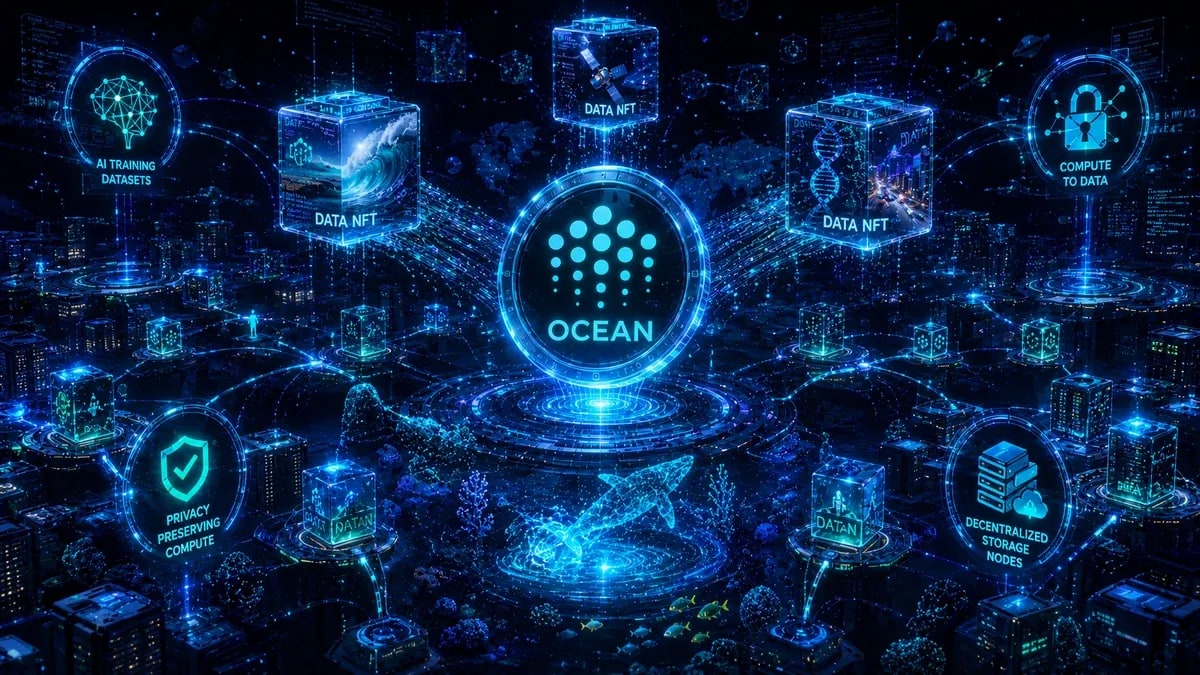
Complete 2026 guide to Ocean Protocol: datatokens, Data NFTs, Compute-to-Data privacy, OCEAN tokenomics, the ASI Alliance merger with Fetch.ai and SingularityNET, real use cases in healthcare and finance, and a side by side comparison with Filecoin, The Graph, and rival data networks.
What Is Ocean Protocol (OCEAN)? The Decentralized Data Marketplace Powering AI in 2026
Every modern artificial intelligence system has the same hidden dependency, and that dependency is data. Not algorithms, not GPUs, not even capital. Data. The companies that train the most accurate models are the companies that have managed to corner the largest, cleanest, and most diverse datasets, and the result is a market structure where a handful of platforms own most of the world's training corpus while billions of contributors who actually produced that information receive nothing in return.
Ocean Protocol was conceived as the architectural answer to that imbalance. Built on Ethereum and later expanded to multiple Layer 2 networks, Ocean turns datasets into tradable tokens, allows raw information to remain private through a method called Compute-to-Data, and lets researchers, hospitals, banks, and AI labs publish, discover, and monetise data without ever handing the original files to a centralised intermediary. In March 2024 the project announced the ASI Alliance merger with Fetch.ai and SingularityNET, a strategic combination that turned three independent crypto AI ecosystems into a single coordinated stack covering agents, models, and data.
This guide explains, in plain language and at a level useful to both newcomers and serious researchers, exactly what Ocean Protocol is, how its technology works, how the OCEAN token captures value, who founded the project, how it compares with Fetch.ai, SingularityNET, The Graph, and Filecoin, and where the practical risks live. You will leave with a clear picture of why decentralised data infrastructure matters for the AI economy of 2026 and how Ocean Protocol fits into the larger picture covered in our analysis of AI agents in crypto and the wider DeFi landscape.
Featured Snippet
Ocean Protocol is an open-source blockchain platform that turns datasets into ERC-20 tokens called datatokens, represents dataset ownership as Data NFTs, and uses a privacy technique called Compute-to-Data to let algorithms train on private information without ever exposing the raw files. The OCEAN token is used for governance, staking, and payment inside the Ocean ecosystem, which in 2024 merged with Fetch.ai and SingularityNET to form the ASI Alliance, a unified decentralised stack for AI agents, models, and data.
What Is Ocean Protocol in Plain English
Imagine a library where every book is locked inside its own glass case. You cannot take the book home. You cannot photocopy a single page. But you can rent a tiny robot that walks into the case, reads the book on your behalf, and walks back out carrying only the answers to the questions you asked. The book itself never leaves the case, the author still owns it, and you only pay for the answers you actually consumed.
That metaphor maps almost one to one onto Ocean Protocol. The book is a dataset. The glass case is the publisher's private storage. The robot is a containerised algorithm. The library catalogue is Ocean Market, a decentralised front end that lists every published dataset alongside its price, license, and access conditions. The payment rails and proof of access are handled by Ethereum compatible smart contracts.
Ocean does not try to replace cloud storage, model training frameworks, or scientific data formats. Instead it sits as a coordination layer between data producers, data consumers, and the compute environments where the data is actually used. Producers tokenise their datasets and set access conditions. Consumers buy access through datatokens. Algorithms either download the dataset, when the producer allows that, or run inside a sandbox next to the data, when the producer requires privacy.
The result is a peer-to-peer market that resembles a stock exchange more than a corporate marketplace. There is no Ocean Inc that warehouses your data. There is a protocol, a set of contracts, a registry of datasets, and a community of publishers and consumers transacting under transparent on-chain rules.
The Data Monopoly Problem Ocean Is Trying to Fix
To understand why a project like Ocean exists at all, you have to look at how the modern data economy is structured. A small group of platforms, mainly large search engines, social networks, advertising networks, and mobility apps, harvest behaviour and content from billions of users and store it in private silos. That information is then used internally to train recommendation engines, language models, image generators, and pricing systems that produce trillions of dollars of market value.
For an independent AI lab, a university, or a startup, getting access to comparable data is often impossible. Public datasets are useful but limited. Commercial data feeds are expensive and rarely include the long tail of niche information that produces genuinely novel models. Sensitive domains such as electronic health records, banking transactions, and proprietary scientific measurements are almost entirely locked behind compliance regimes that forbid transfer to third parties.
Ocean Protocol attacks this from three angles. First, by making datasets directly tokenisable and saleable on chain, it lowers the friction for any researcher or institution to monetise what they already collect. Second, by introducing Compute-to-Data, it makes it legally and technically feasible to sell access to data that can never legally leave a hospital, a bank, or a national jurisdiction. Third, by tying everything to a public blockchain, it creates a global, neutral substrate that any party can plug into without negotiating bilateral contracts.
The ambition is similar in spirit to what DePIN projects do for physical infrastructure, an idea we explore in our deep dive on Grass and decentralised bandwidth for AI training. Ocean is the data version of that thesis, owned by users, paid in tokens, and transparent on chain.

The Founding Story: Bruce Pon, Trent McConaghy, and BigchainDB
Ocean Protocol did not appear out of nowhere. It is the second major project from a team that had already built one of the earliest blockchain databases. Bruce Pon, an entrepreneur with a background in renewable energy and emerging market banking, and Trent McConaghy, a computer scientist who had spent two decades applying machine learning to electronic design automation, co-founded BigchainDB in Berlin in 2013. BigchainDB pioneered the idea that blockchain properties could be added to a traditional database engine rather than the other way around.
The two founders kept running into the same question while talking to enterprises. Customers wanted to share data with partners, regulators, and research collaborators, but they were terrified of losing control. A pure database, even a decentralised one, did not solve the deeper economic question of how data should be priced, who should be allowed to use it, and how usage should be audited. That gap eventually became Ocean Protocol, launched out of the BigchainDB team as a dedicated foundation in 2017.
Bruce Pon has remained the public face of the project as co-founder and a senior figure inside the Ocean Protocol Foundation, while Trent McConaghy serves as the technical leader, often described in early documentation as the project's chief technology officer and continues to drive research into tokenomics and AI integrations. Their combined background, deep machine learning research on one side and structured commercial deployment on the other, shaped a protocol that is unusually pragmatic about real industry use cases compared with many crypto AI peers.
Ocean Protocol Timeline: From 2017 to the ASI Alliance Era
Ocean Protocol Foundation established in Singapore. The whitepaper introduces the core idea of a tokenised, decentralised data exchange with a native utility token called OCEAN.
First proof of concept marketplaces deployed with enterprise partners in mobility, automotive, and financial services. Initial network token sale completed and the OCEAN token enters distribution.
Mainnet V3 introduces datatokens, the ERC-20 representation of dataset access. Ocean Market goes live as a public reference marketplace built directly on top of the protocol contracts.
Compute-to-Data framework matures into a production feature, allowing publishers to expose private datasets for algorithmic analysis without releasing the raw files. OceanDAO funding rounds bring early community grants.
Ocean V4 launches with Data NFTs, separating ownership from access. A dataset is now represented by an ERC-721 base asset that can mint multiple ERC-20 datatokens with different pricing and license terms.
Predictoor service launched as an on-chain prediction feed market, becoming one of the first large scale consumer products built directly on Ocean datatokens and bringing recurring transactional demand to the protocol.
ASI Alliance merger announced in March 2024. Ocean Protocol joins Fetch.ai and SingularityNET under a unified token roadmap, with OCEAN, AGIX, and FET designed to converge into the new ASI token framework.
Ocean operates as the data layer of the ASI Alliance, plugging into agent marketplaces and decentralised AI services while continuing to expand enterprise data partnerships in healthcare, finance, and scientific research.
Datatokens and Data NFTs: The Architecture Layer
The first architectural concept that anyone studying Ocean has to internalise is the split between Data NFTs and datatokens. Both are standard Ethereum tokens, but they play very different roles. Data NFTs are based on the ERC-721 non-fungible token standard and represent ownership of an underlying dataset. Datatokens are based on the ERC-20 fungible token standard and represent the right to access that dataset under specific conditions.
When a publisher tokenises a dataset on Ocean they first mint a Data NFT. That NFT acts as the on-chain identity card for the dataset and stores metadata such as a content identifier, license type, and pointer to the storage location. The NFT can be held in any wallet, transferred to a new owner, or used as collateral in a future iteration of decentralised finance. Ownership of the NFT means ownership of the asset, not access to it.
From that single Data NFT the publisher can spawn many datatokens, each with its own access policy. One datatoken might unlock a one-time download for a fixed fee. Another might grant a researcher the right to run a single compute job. A third might be paired into a liquidity pool so that the market discovers a fair price through automated trading. The publisher acts like a record label that owns the master tape and licenses different distribution rights to different buyers.
Under the hood, when a consumer wants to access a dataset they purchase or receive one datatoken, hand it to the Ocean Provider service, and in return get a signed URL or a job submission slot. The datatoken is burned or otherwise marked as consumed in the process. The whole exchange is recorded on chain, which means publishers can audit who consumed what and when, while consumers retain a verifiable proof of purchase.
Compute-to-Data: How Ocean Solves the Privacy Problem
Compute-to-Data is the feature that turns Ocean from a niche marketplace into a serious enterprise tool. The basic principle is brutally simple: instead of moving the data to the algorithm, the algorithm is moved to the data. The dataset never leaves the publisher's controlled environment, but a consumer can still extract aggregated insights, train a model, or compute statistics by submitting their algorithm to run there.
Publish
Data owner uploads dataset to private storage, mints a Data NFT, configures Compute-to-Data access, and lists the asset on Ocean Market with a price and an approved algorithm policy.
Submit Algorithm
Buyer purchases a datatoken, then submits a containerised algorithm to the Ocean Compute Provider. The algorithm spec is also tokenised so the publisher knows exactly what code is about to run.
Compute and Return
The algorithm runs in an isolated environment next to the private data. Only the aggregated output, such as a model file or a statistics report, is returned to the buyer. The raw data never leaves the secure boundary.
This pattern is genuinely powerful in regulated industries. A hospital network can sell access to anonymised electronic health records without ever shipping patient data outside the firewall. A bank can let a quantitative research firm train risk models against transaction histories without revealing individual customer information. A satellite operator can monetise raw imagery without giving competitors a chance to mirror the archive.
Compute-to-Data also pairs naturally with privacy techniques that exist outside Ocean. Publishers can layer differential privacy on the output, apply federated learning patterns across multiple data sources, or restrict approved algorithms to those that have been vetted by a regulator. Ocean does not invent these techniques on its own. It provides the marketplace, payment, and access control plumbing that turns them into a commercial product.
OCEAN Tokenomics and Governance in 2026
OCEAN is the native utility and governance token of the protocol. The total supply was set at 1.41 billion tokens with a long emission schedule designed to align rewards with network usage rather than rapid initial inflation. A significant share of supply is held by the Ocean Protocol Foundation to fund research, grants, and ecosystem development, while the remainder circulates among investors, contributors, market participants, and community members.
The token has several concrete functions inside the ecosystem. It is the default unit of payment for many datasets listed on Ocean Market, although publishers can also denominate prices in other assets. It is used in automated market makers that provide liquidity for datatokens. It is the resource that data curators stake to signal which datasets they believe are valuable, a process inspired by curated registries in earlier crypto governance experiments. It is also the voting unit for governance proposals submitted under the OceanDAO framework and its successor structures inside the ASI Alliance.
A separate vehicle called veOCEAN, short for vote escrowed OCEAN, allows token holders to lock their OCEAN for periods of time in exchange for voting weight and a share of network rewards. Anyone familiar with vote escrowed designs from other crypto staking systems will recognise the pattern, which discourages short term speculation by rewarding long term commitment. Lockers can direct rewards toward specific datasets they believe will drive volume, creating an incentive to surface high quality data.
Since the announcement of the ASI Alliance, the long term plan has been to migrate OCEAN holders into the new ASI token at a defined exchange ratio, alongside FET from Fetch.ai and AGIX from SingularityNET. The exact technical mechanics have evolved over time as the alliance has refined its roadmap, but the underlying intent is to consolidate the three communities into a single unified asset while keeping the individual ecosystems operationally distinct.

The ASI Alliance: Where Ocean Fits in the New AI Stack
The Artificial Superintelligence Alliance, almost universally referred to as the ASI Alliance, was announced in March 2024 as a merger of three of the largest crypto AI ecosystems: Fetch.ai, SingularityNET, and Ocean Protocol. The thesis behind the alliance is that no single decentralised AI project can credibly compete with the resources of large incumbent platforms, but a coordinated stack covering agents, models, and data can.
Within that stack each member specialises in a clearly defined layer. Fetch.ai, covered in detail in our Fetch.ai and ASI Alliance guide, contributes its autonomous agent framework, its Almanac registry, and its core infrastructure for agent to agent communication and economic interaction. SingularityNET contributes a marketplace for AI services and a long history of research into general intelligence. Ocean contributes the data layer, the datatoken standard, and the Compute-to-Data privacy framework.
In practical terms, this means an autonomous agent built on Fetch can call into an AI model hosted on SingularityNET and feed that model with data published on Ocean, all denominated in a single unified token and governed by a single alliance level governance process. The user does not have to manage three separate wallets, three separate token allocations, and three separate sets of governance proposals to participate in the stack.
For Ocean specifically, the alliance brings two large benefits. The first is distribution. The dataset catalogue is now visible to anyone interacting with the broader ASI ecosystem, which significantly expands the addressable consumer base beyond the original Ocean Market audience. The second is integration. By embedding datatokens directly into agent and model workflows, Ocean stops being a standalone marketplace and becomes a fundamental primitive in every AI transaction that flows through the alliance.
Industry Use Cases: Healthcare, Finance, AI Research
Ocean's enterprise traction tends to cluster around industries where data is simultaneously extremely valuable and extremely sensitive. Three sectors stand out: healthcare, financial services, and AI research itself.
In healthcare, hospital networks and clinical research organisations have for years experimented with Ocean as a way to expose anonymised cohorts to outside researchers without violating data protection regulations. A typical pattern looks like this: a hospital publishes a Data NFT representing a cohort of, for example, diabetic patients, attaches Compute-to-Data with a strict list of approved algorithms, and sets a price. A pharmaceutical company can then run an approved statistical model against that cohort to evaluate the efficacy of a treatment without ever obtaining the underlying medical records. The hospital earns revenue. The researcher gets insights. The patient data never moves.
In financial services, the most active use cases involve alternative data and quantitative research. Banks, exchanges, and payment processors hold enormous proprietary datasets covering transactions, order books, and credit histories. Selling that data directly is usually impossible for regulatory reasons, but exposing it through Compute-to-Data allows quantitative funds and risk management firms to extract calibrated models without ever taking custody of customer records. The Predictoor service, built directly on Ocean datatokens, is an example of a financial product native to the protocol where individual data feeds and prediction streams trade with on-chain settlement.
In AI research, Ocean has been adopted as a way for universities and independent labs to publish datasets and earn ongoing revenue every time someone uses them. This is closer to a royalty model than a traditional academic data release. Authors keep ownership of the Data NFT, set a fair price, and receive payment automatically every time a researcher purchases a datatoken or runs a Compute-to-Data job. The combination is particularly appealing for niche scientific datasets that would otherwise sit unused on a forgotten server.
Ocean Market Walkthrough: From Browsing to Buying
Ocean Market is the most visible front end for the protocol. It is a fully decentralised marketplace operated as a reference implementation, meaning anyone can fork the front end and run their own branded marketplace on top of the same underlying contracts. Universities, enterprises, and verticals such as automotive data have all deployed branded marketplaces built on the Ocean stack.
A first time visitor sees a catalogue of datasets with title, description, file size or job specification, price denominated in OCEAN or another supported asset, and tags that identify the data category. Filtering is available by network, by access type, by category, and by publisher. The interface looks intentionally similar to a generic ecommerce store, with the differences hidden one layer below the surface.
To consume a dataset, a buyer first connects a wallet such as the ones described in our DexTools guide, which doubles as a useful primer on safely interacting with decentralised front ends. Once the wallet is connected, the buyer approves the spending of OCEAN, signs a transaction that purchases a datatoken, and either downloads the dataset directly or submits an algorithm into a Compute-to-Data job depending on the publisher's access type. Behind the scenes the Ocean Provider service mediates between the on-chain contracts and the off-chain storage.
Publishers go through a similar but mirrored flow. They connect their wallet, mint a Data NFT representing the asset, upload or link the underlying file or compute environment, and configure the datatoken parameters including price, supply, and access type. Once published, the dataset becomes globally visible and any wallet on the supported networks can transact with it. Throughout the lifecycle, smart contracts handle settlement, royalties, and metadata updates without requiring trust in a central operator.

Ocean vs Fetch.ai vs SingularityNET vs The Graph vs Filecoin
Ocean is often grouped with other crypto AI and data projects, but the closer you look the clearer the boundaries become. Each of these networks addresses a different part of the data and AI value chain, and understanding the difference is essential before drawing conclusions about competition or investment positioning.
Filecoin in particular is often confused with Ocean because both deal with data. The distinction is straightforward. Filecoin sells storage. You pay miners to keep your file alive and retrieve it on demand. Ocean sells access and usage rights to datasets that may or may not actually live on Filecoin. The two can be combined naturally, with a Filecoin content identifier referenced inside an Ocean Data NFT, but they solve completely different problems.
The Graph is a different beast. It indexes data that already lives on chain so that applications can query it efficiently. Ocean is concerned with off-chain data and how it gets monetised. A DeFi front end might use The Graph to query lending positions and Ocean to access an external pricing dataset, and the two never overlap. The frequent grouping of all four projects under a single banner of crypto data is convenient for journalism but technically misleading.
Risks: What Can Go Wrong With Ocean Protocol
No honest guide to a protocol is complete without an unfiltered review of its risks. Ocean carries several, some unique to its design and some common to every crypto AI project.
The first risk is data quality. A marketplace is only as good as what is listed on it. Bad data, fraudulent datasets, mislabelled assets, or recycled scrapings can pollute the catalogue and erode trust. Ocean addresses this with curation, staking, and reputation, but those mechanisms only partially substitute for the editorial control that centralised platforms exercise on their content.
The second risk is technical complexity. Compute-to-Data is conceptually elegant but operationally demanding. Publishers have to maintain a compute environment capable of running buyer submitted algorithms safely. Buyers have to learn how to package their algorithms in compatible formats. The combination produces friction that prevents casual users from interacting with the protocol the way they might with a familiar consumer SaaS product.
The third risk is regulatory. Data protection laws differ across jurisdictions and continue to evolve. A publishing strategy that is fully compliant in one country can be problematic in another. Although Compute-to-Data significantly reduces the compliance burden compared with raw data transfer, it does not eliminate it. Publishers remain responsible for the legal basis of any data they expose.
The fourth risk is competitive. Large incumbent cloud providers can plausibly build similar marketplaces inside their own walled gardens, capturing the convenience advantage while sacrificing the openness that defines Ocean. The ASI Alliance is a strategic response to that risk, but the long term outcome depends on whether decentralised stacks can grow distribution faster than centralised platforms can copy their features.
The fifth risk is market and execution risk on the OCEAN token itself. Token prices in crypto are notoriously volatile, the ASI token migration introduces additional uncertainty around exact conversion mechanics, and any disappointment in alliance level execution can pressure all three component tokens at once. Anyone evaluating OCEAN as an investment should also study the broader thesis on Ethereum and Layer 2 economics because Ocean's fate is heavily dependent on the host networks it runs on.
The sixth risk is security. Wallets that hold OCEAN are targets for the same phishing, address poisoning, and social engineering attacks that affect every crypto user. Our guide on how to avoid address poisoning scams is recommended reading for anyone moving meaningful balances of OCEAN or interacting with Ocean Market on a regular basis.
Pros and Cons of Ocean Protocol
Pros
- Unique Compute-to-Data primitive that no major centralised competitor offers in the same neutral form
- Open ERC-20 and ERC-721 standards mean datasets are programmable inside DeFi and AI workflows
- Founding team with deep machine learning credentials and almost a decade of dedicated execution
- ASI Alliance brings cross ecosystem distribution into Fetch.ai and SingularityNET communities
- Real industry deployments in healthcare, finance, automotive, and scientific research
- Predictoor and similar native products generate recurring on-chain demand for datatokens
- Fully decentralised front end can be forked into branded marketplaces by any operator
- OCEAN token has clear utility through governance, staking, payments, and curation
Cons
- Operational complexity around Compute-to-Data is high for casual publishers
- Dataset quality varies and curation mechanisms are still maturing
- Regulatory environment around data monetisation is uncertain and jurisdiction dependent
- ASI token migration introduces structural uncertainty around the future of OCEAN as a standalone asset
- Large incumbent cloud providers can credibly replicate parts of the feature set inside walled gardens
- Network effects are still small relative to centralised data marketplaces
- Liquidity for many individual datatokens remains thin
- Crypto market volatility and security risks apply to the OCEAN token like any other digital asset
Best Practices for Data Buyers and Sellers
Both sides of an Ocean transaction benefit from a few hard learned habits. The lessons below are not exhaustive, but they cover the most common failure modes that show up in practice.
If you are a publisher, invest serious effort in metadata. The single biggest determinant of whether a dataset gets discovered and purchased is the quality of its description, sample preview, and license documentation. Buyers cannot inspect the raw file before purchase. They are evaluating you and your description, not the bytes themselves. A clear schema definition, a representative sample, and a transparent license dramatically improve conversion.
Price tiering matters. The same dataset can be offered in multiple variants with different price points and access policies. A free or low cost preview slice creates trust. A premium full access tier captures revenue. A Compute-to-Data tier monetises buyers who cannot legally download the data anyway. Treating Ocean publication as a product design exercise rather than a single upload pays off.
If you are a buyer, read the access type carefully before purchasing. Some datasets are download only. Others are Compute-to-Data only. Others combine both. The price displayed on the marketplace is for one specific access mode, and accidentally buying a download token for a dataset you needed to query through compute is a frustrating but reversible mistake.
Use staging wallets for testing. Before connecting your main wallet, use a low balance staging address to interact with a new marketplace. This is good hygiene for every DeFi or Web3 interaction and reduces the surface area for accidental approvals or contract bugs.
For everyone, follow alliance level governance proposals. The economic environment around Ocean has shifted significantly since the ASI Alliance announcement, and the most important parameter changes increasingly come from alliance level votes rather than Ocean only governance. Subscribing to official communication channels and participating in vote escrow programs keeps you aligned with the direction of the protocol you depend on.
Frequently Asked Questions
1. What is Ocean Protocol in one sentence?
Ocean Protocol is an open-source blockchain platform that lets anyone publish, discover, and monetise datasets through tokens called datatokens, with optional privacy preserving access through a technique called Compute-to-Data.
2. What are datatokens?
Datatokens are ERC-20 tokens that act as access keys to a specific dataset. Holding and consuming one datatoken grants the right to download a file or run a Compute-to-Data job according to the publisher's terms.
3. What are Data NFTs?
Data NFTs are ERC-721 tokens that represent ownership of a dataset on Ocean. The owner of the NFT controls metadata updates and can mint multiple datatokens off the same underlying asset.
4. How does Compute-to-Data preserve privacy?
The algorithm runs inside a sandbox next to the private data, instead of the data being shipped to the algorithm. Only aggregated outputs leave the secure environment, so the raw dataset never moves.
5. What is the ASI Alliance and how does Ocean fit in?
The Artificial Superintelligence Alliance is the 2024 merger of Fetch.ai, SingularityNET, and Ocean. Ocean contributes the data layer of a coordinated decentralised AI stack that also covers agents and AI services.
6. Who founded Ocean Protocol?
Ocean Protocol was co-founded by Bruce Pon and Trent McConaghy, who previously built BigchainDB. Trent McConaghy has long led the technical direction as the project's chief technology figure.
7. What is the OCEAN token used for?
OCEAN is used to pay for datasets, provide liquidity in datatoken markets, stake on curated registries, and vote in governance. veOCEAN holders lock tokens for additional voting weight and rewards.
8. How is Ocean different from Fetch.ai or Filecoin?
Fetch.ai focuses on autonomous AI agents, Filecoin focuses on decentralised file storage, and Ocean focuses on the marketplace and access control layer for datasets. The three are complementary rather than direct competitors.
9. What industries use Ocean Protocol?
Healthcare, financial services, automotive, scientific research, and AI labs are the main industry clusters. The common pattern is sensitive proprietary data combined with strong demand for outside analysis.
10. Where can I buy OCEAN?
OCEAN trades on major centralised exchanges and on decentralised exchanges across Ethereum and supported Layer 2 networks. Always verify the official contract address from Ocean's documentation before swapping.
11. What are the main risks?
Data quality, operational complexity, regulatory uncertainty, competition from centralised cloud providers, ASI token migration mechanics, and general crypto market volatility are the main risks to understand.
12. Is Ocean Protocol a good investment in 2026?
This guide does not give financial advice. Ocean is a technically credible project with real industry traction and a strong alliance, but token performance depends on broader market dynamics and ASI level execution. Always do your own research.
Final Thoughts
The story of AI in the second half of this decade is going to be written largely in datasets. The labs that figure out how to access richer, more diverse, and more sensitive data without violating the trust of the people who generated it will produce the most useful models. Ocean Protocol has spent almost a decade quietly building the rails for that future, and through the ASI Alliance it now finds itself inside a coordinated effort that covers agents, models, and data under a single roof.
Whether you are a researcher looking to monetise a niche dataset, an enterprise compliance officer hunting for a privacy preserving way to share information, an AI developer searching for training corpora that nobody else has, or simply a curious observer trying to understand where the crypto AI sector is heading, Ocean is worth studying in depth. The combination of datatokens, Data NFTs, Compute-to-Data, and alliance level distribution is one of the more credible answers the decentralised world has produced to the question of who should own the data that powers the next generation of intelligence.
As always with crypto, the right posture is informed curiosity rather than blind enthusiasm. Read the documentation, monitor governance, follow the migration into the ASI token, watch industry adoption metrics, and treat any token exposure as a position that requires active risk management. Ocean is not a guaranteed winner, but it is a serious project with a serious technical answer to one of the most important questions in the modern data economy.
Related Guides
- What Is io.net? The Decentralized GPU Network Powering AI on Solana in 2026
- What Is Aethir (ATH)? The Decentralized GPU Cloud Powering AI and Gaming in 2026
- What Is Pocket Network: Public RPC, Gateways and Decentralized Data Access (2026)
- What Is Filecoin: Decentralized Storage Markets, Incentives and Web3 Data (2026)
- What Is Vana Protocol Data Sovereignty Dao Token Guide 2026